
Perceptions And Concerns About Trump’s War Against Iran

Poll: Iran

This Navigator Research report covers the latest views of Trump’s military operation against Iran, the impacts on costs at home, and concerns over being bogged down in another lengthy, costly foreign war.

Awareness and Support

The conflict with Iran is dominating news coverage. Eight-in-10 Americans say they are hearing about the conflict in the Middle East and the U.S. striking Iran (80%), including 55% who say they are hearing “a lot.” Even among passive news consumers, or those who say news comes to them rather than seeking it out, two-in-three have heard of the U.S. striking Iran (67%).
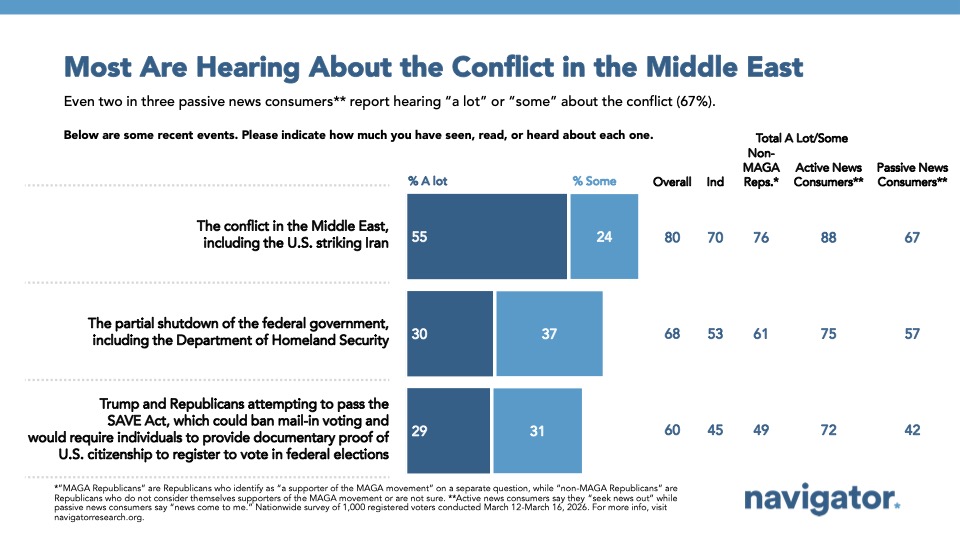
Bar graph from Navigator Research titled Most Are Hearing About the Conflict in the Middle East

By nine points, Americans oppose the military operation against Iran (40% support – 49% oppose). Majorities of Democrats and independents oppose the military operation against Iran (74% and 52% oppose, respectively), while Republicans are more supportive of the operation (70% support). MAGA Republicans are significantly more likely to support the operation (net +73; 84% support – 11% oppose) compared to non-MAGA Republicans (net +8; 48% support – 40% oppose).
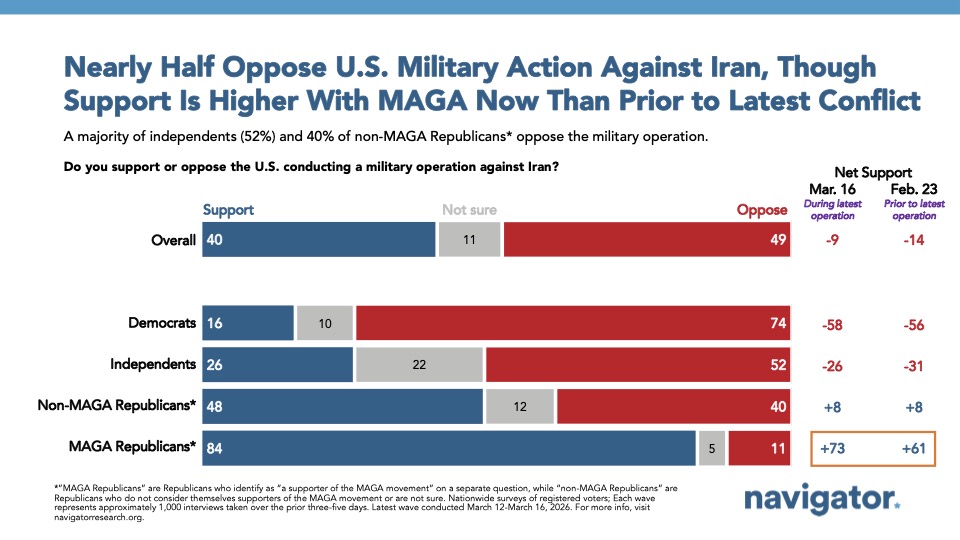
Bar graph from Navigator Research titled, Nearly Half Oppose U.S. Military Action Against Iran, Though Support Is Higher With MAGA Now Than Prior to Latest Conflict

Why Trump Launched the War 

When picking the top three reasons President Trump launched the military operation against Iran, Americans are most likely to say he wants to get access to oil and other resources in the region (40%) and he wants to use conflict to distract from other issues like the Epstein files (40%). Slightly less believe he actually felt Iran’s nuclear and missile programs posed an imminent threat (38%), and less than one-in-three believe he wants to liberate the Iranian people from an oppressive regime (31%). As Trump’s reasons for the war are questioned, by 18 points, Americans think the military operation against Iran has made the world less safe (28% safer – 46% less safe).

One-in-five Americans who voted for Trump in 2024 continue to say they regret their vote (19%). When citing why they regret their vote, phrases like “war,” “promises,” and “prices” dominate their reasons. The share of Trump voters that regret their decision matches Navigator’s late February survey (20%), and is an increase from the share in late 2025 (14%).
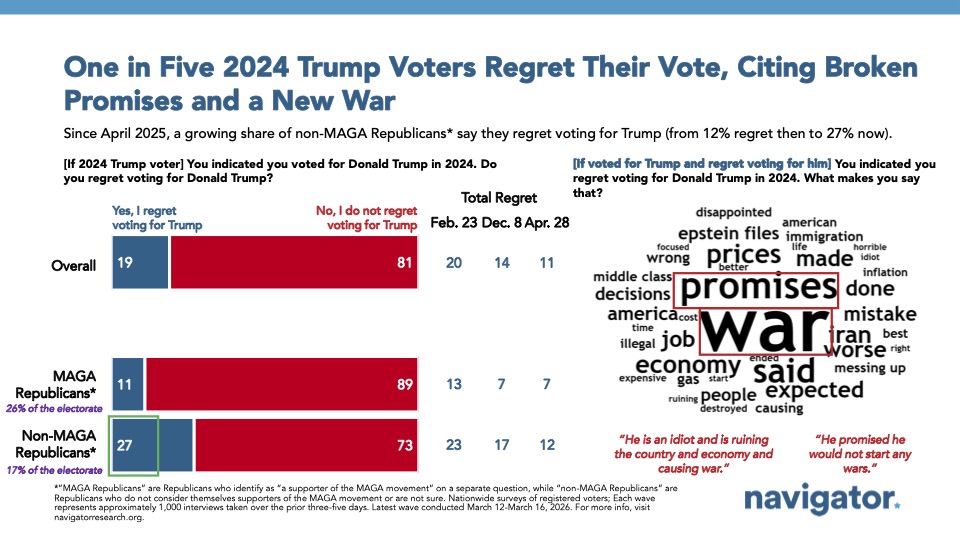
Slide from Navigator titled One in Five 2024 Trump Voters Regret Their Vote, Citing Broken Promises and a New War

Lack of Clear Timeline and Goals for the War 

Despite what President Trump claims about the military operation, a majority of Americans believe the U.S. conflict with Iran will last months or longer (53%), and 30% believe it will last a year or longer. Given the lengthy timeline, two-in-three are concerned that the U.S. will become bogged down in a prolonged conflict with Iran (67%), including 84% of Democrats, 74% of independents, and 47% of Republicans. When it comes to Trump’s timeline for the military operation, a majority believe he does not have a clear timeline and goals for the operation (53%).
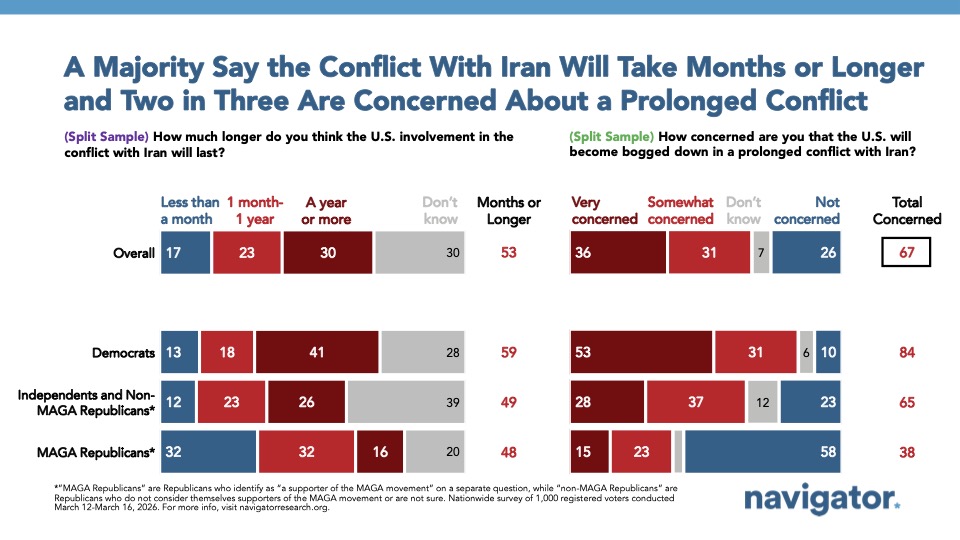
Bar graph from Navigator Research titled A Majority Say the Conflict With Iran Will Take Months or Longer and Two in Three Are Concerned About a Prolonged Conflict

Concerns Over the Cost of War

By 20 points, Americans oppose Congress providing an additional $50 billion in funding for the U.S. military operation against Iran (34% support – 54% oppose). Support for the additional funding is driven by Republicans (58% support – 29% oppose), though non-MAGA Republicans are split (43% support – 42% oppose). Independents oppose the additional funding by 42 points (60% oppose – 18% support). 

As debate for additional funding continues, Americans’ concerns are focused on their costs being impacted. Top concerns about the U.S. military action against Iran include:

  • It will raise oil and gas prices (34%) 
  • It is another conflict that will lead to billions being spent abroad instead of helping Americans at home (29%)
  • It has resulted in the deaths of innocent civilians, including children (27%)
  • It puts U.S. troops unnecessarily in harm’s way, with 13 troops already killed (27%)

As 85% already believe the cost of gas is rising, Americans continue to want Trump and Congress to prioritize inflation and the cost of living (58%), but believe Trump and Republicans in Congress are most focused on immigration and foreign conflicts (64% and 54%, respectively).
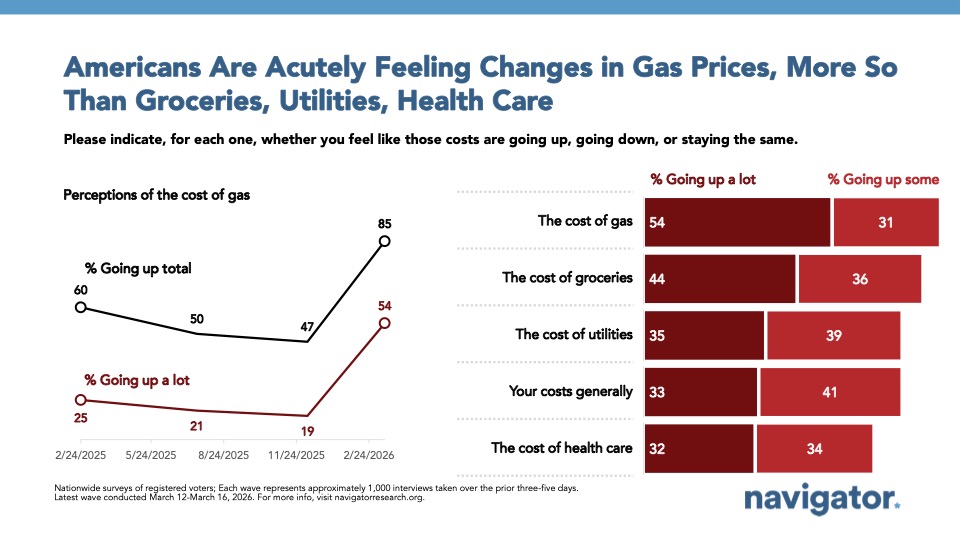
Slide with a line graph and bar chart from Navigator Research titled Americans Are Acutely Feeling Changes in Gas Prices, More So Than Groceries, Utilities, Health Care

Messaging on Trump’s Actions in Iran

Many Americans are most worried about how President Trump’s military actions in Iran will affect the cost of living and everyday prices at home. The war was started as many are already struggling with an affordability crisis that Trump and Republicans in Congress made worse through sweeping cuts to programs many Americans rely on.

Most concerning messages about the conflict with Iran:

  • “Trump cut programs people depend on, like Medicaid and SNAP, and is using that money to fund this multi-billion dollar war with Iran. He says we don’t have the money to help Americans afford health care or keep food on the table, but we’re spending billions on bombs and wars” (61% concerning, including 47% “extremely” concerning).
  • “We can’t afford Trump’s war with Iran. In the first two days of the conflict alone, the U.S. spent nearly $6 billion on the war. With no end in sight, the conflict could cost the U.S. tens of billions of dollars. We’re spending time and money on the wrong things, with billions spent on bombs and war when we have a cost of living crisis at home.” (62% concerning, including 45% “extremely” concerning).

Read More

May 22, 2026

Americans Want Major Change, But Aren’t Sure if Leaders Can Deliver

This Navigator Research report covers how Americans feel about democracy, institutions, and systems and whether anyone can fix them.

Julie Alderman Boudreau
May 21, 2026

Following Callais: Views on Supreme Court Remain Mixed But Reforms Are Popular

This Navigator Research report covers views of the Supreme Court and what type of reforms Americans support.

Tina Tang
May 20, 2026

Low Awareness, High Stakes: Views on the Recent Supreme Court Ruling on the Voting Rights Act

This Navigator Research report covers how Americans are reacting to the recent Supreme Court decision, Louisiana v. Callais, which gutted protections under the Voting Rights Act.

Tina Tang
May 14, 2026

SPECIAL REPORT: Asian Americans on the Economy and President Trump

This Navigator Research Report focuses on economic sentiment among Asian Americans and how they view President Trump’s job performance across a range of important issues.

Tina Tang & Aidan Harty

Battleground Views On Utility Costs and Data Centers

Poll: AI and Data Centers

This Navigator Research report covers the latest perceptions of utility and energy costs, artificial intelligence, and data centers from Americans in the battleground.

Battleground Constituents Don’t Like Utility and Energy Companies

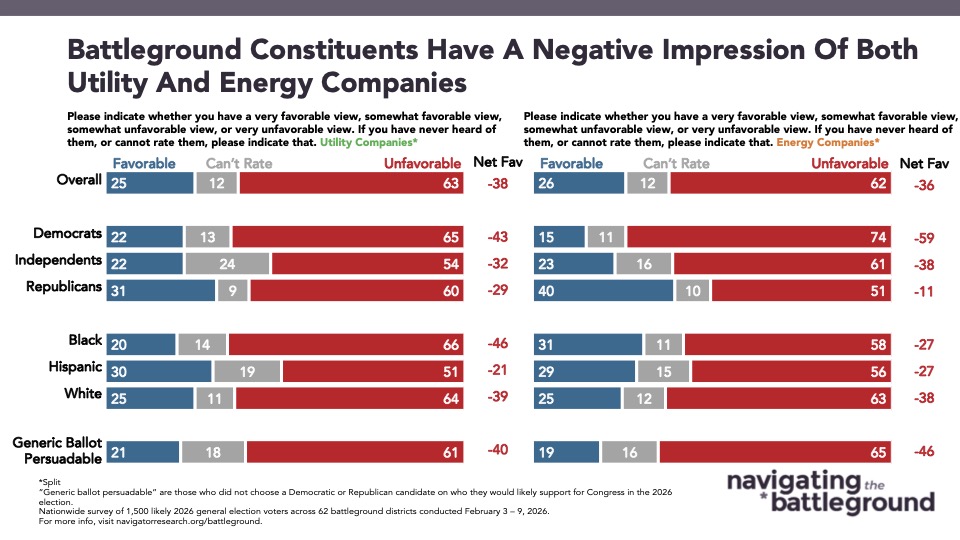
Americans in the battleground are unfavorable towards utility and energy companies. Utility companies have a net favorability of -38 (25% favorable – 63% unfavorable) and energy companies have a net favorability of -36 (26% favorable – 62% unfavorable). Utility and energy companies also have a net negative favorability among Democrats (-45 and -59, respectively), Republicans (-25 and -14, respectively), and independents (-37 and -32, respectively).

Bar graph from Navigator Research titled, Battleground Constituents Have A Negative Impression Of Both Utility And Energy Companies

Battleground constituents are slightly more favorable towards technology companies, which have a net favorability of -23 (34% favorable – 57% unfavorable). However, there is a big difference based on party. Technology companies have a net -56 favorability among Democrats and net -26 among independents. Among Republicans, technology companies have a +18 net favorability.

Battleground constituents who live close to a data center are more likely to view technology companies unfavorably. Among battleground Americans living close to data centers, their net favorability of technology companies is -37 (26% favorable – 63% unfavorable).

Battleground Americans Say Utility Costs Have Gone Up More Than Any Other Cost

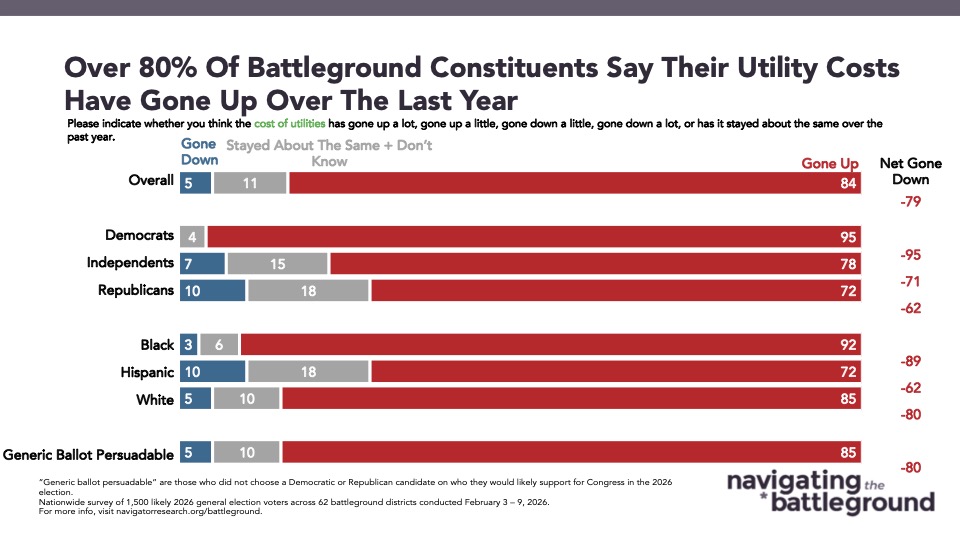
84% of battleground constituents said their utility costs have gone up over the past year, more than said the same for any of the other costs tested. Nearly half (48%) of battleground Americans say their utility costs have “gone up a lot” over the past year.

Bar graph from Navigator Research titled, Over 80% Of Battleground Constituents Say Their Utility Costs Have Gone Up Over The Last Year
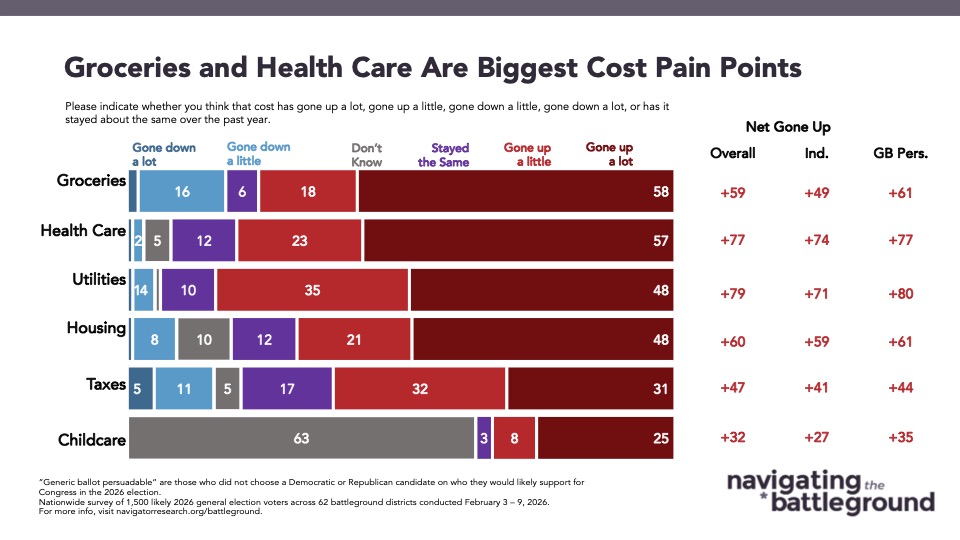
Bar graph from Navigator Research titled, Groceries and Health Care Are Biggest Cost Pain Points

85% of Americans in the battleground think that Congress can do something to lower the cost of their utilities, including 49% who say Congress can do “a great deal” to lower those costs. The only cost that battleground constituents were more confident that Congress could do more to lower were health care costs (91%).

Americans In The Battleground Blame Utility Companies, AI, Data Centers, And Crypto For Increased Energy Costs

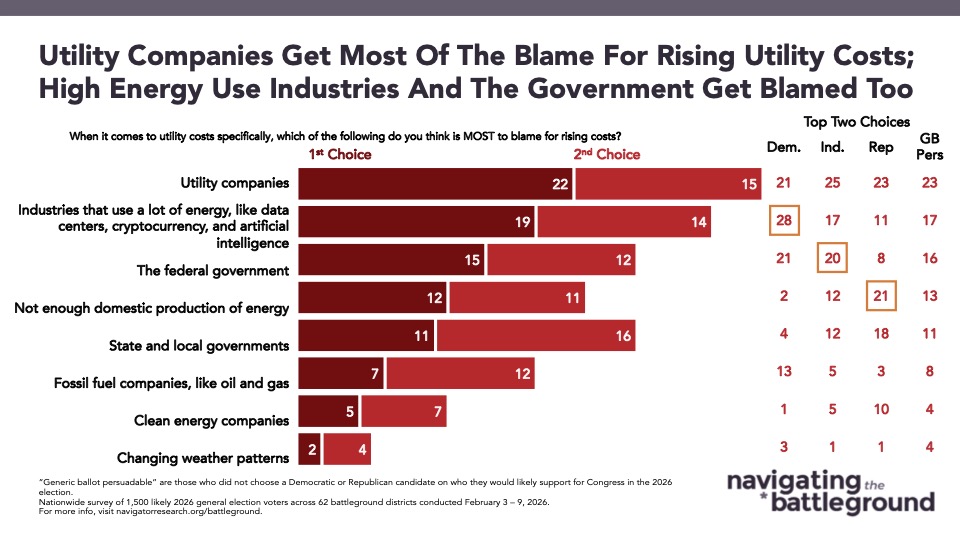
When asked who they blame for rising utility costs, the most popular answer among battleground constituents was utility companies (37% blame) followed by industries that use a lot of energy, like data centers, cryptocurrency, and artificial intelligence (33%).

Bar graph from Navigator Research titled, Utility Companies Get Most Of The Blame For Rising Utility Costs; High Energy Use Industries And The Government Get Blamed Too

Among those battleground Americans who live close to a data center, a plurality (44%) say they blame industries that use a lot of energy, including data centers, crypto currency, and artificial intelligence. 39% of these Americans living close to a data center blame utility companies.

While overall, Americans in the battleground are evenly split on blaming state and federal government for rising utility costs (27% blame each), battleground constituents who live close to data centers are more likely to blame state government (33% blame) than federal government (25% blame) for their high energy costs.

Awareness Of Where Data Centers Are Located, And Data Centers Overall, Is Low

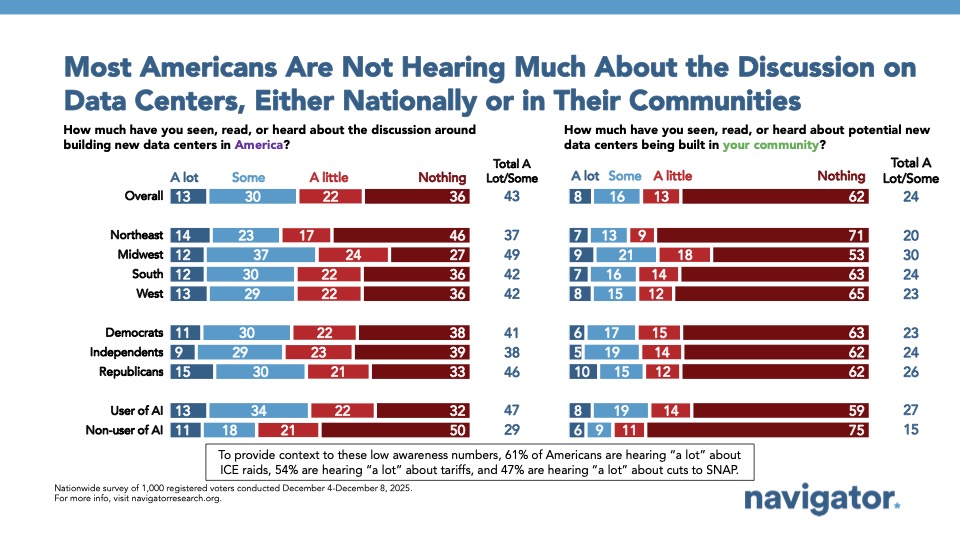
Awareness of data centers in battleground Americans’ area is low. 8% say they live close to a data center and 5% say they don’t live close to one but see them regularly. 47% say they don’t know where data centers are located in their areas.

In Navigator’s December national survey, overall understanding of data centers was low, with only 43% of Americans saying they’ve heard at least something about them.

Bar graph from Navigator Research titled, Most Americans Are Not Hearing Much About the Discussion on Data Centers, Either Nationally or in Their Communities

Americans are fed up with cruel immigration policies

Poll: Immigration

This Navigator Research report covers the latest on President Trump’s handling of immigration, ICE, and the partial federal government shutdown.

Americans Still Think Trump And Republicans In Congress Are More Focused On Immigration Than The Cost Of Living

Americans overwhelmingly list economic issues, including inflation and the cost of living (56%) and jobs and the economy (46%) as their top priorities – though only 21% and 22% say President Trump and Republicans in Congress are focused on those issues, respectively. 71% say that President Trump and Republicans in Congress are focused on immigration, a priority only 31% of Americans list in their top five.

Dot plot from Navigator Research titled, Trump/GOP Continue to Be Seen As Too Focused on Immigration, Not Enough on the Economy

Net approval of Trump’s handling of immigration has continued to fall from -3 in June 2025 to -17 today (40% approve – 57% disapprove). Similarly, net support of Trump’s mass deportation plan has fallen from +10 in January 2025 to -14 today (40% support – 54% oppose).

Americans View ICE Unfavorably, See Enforcement As Too Aggressive

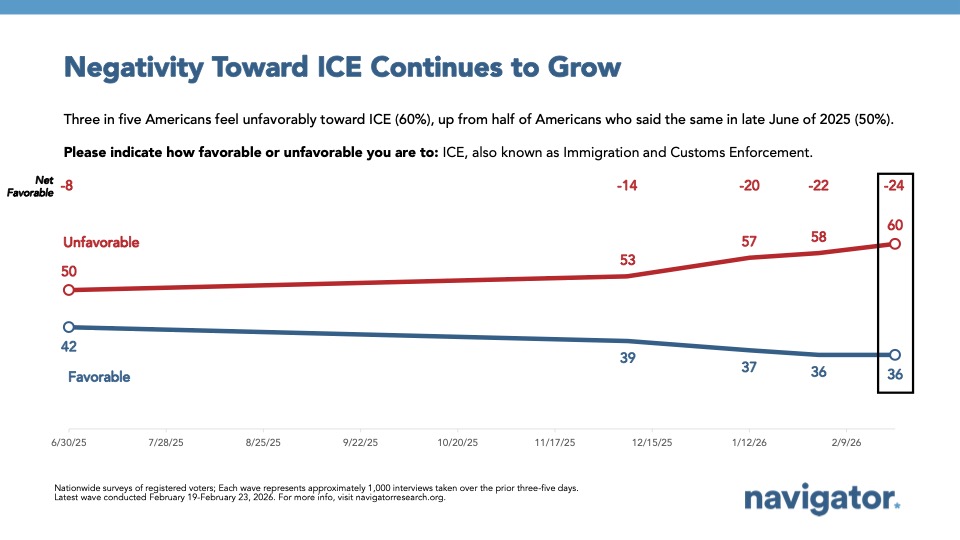
Three-in-five (60%) Americans are now unfavorable towards ICE, reaching its highest unfavorability since Trump took office this term.

Line graph from Navigator Research titled, Negativity Toward ICE Continues to Grow

Similarly, 62% of Americans say ICE has been too aggressive in its approach, compared to just 22% who say it has struck the right balance and 11% who say ICE has not been aggressive enough.

Bar graph from Navigator Research titled, Three in Five Continue to Say ICE Has Been Too Aggressive

Awareness Of DHS Shutdown Lower Than Last Fall’s Government Shutdown, But Americans Blame Trump and Republicans In Congress

61% of Americans have heard, read, or seen information about the current partial government shutdown of the Department of Homeland Security (DHS). Awareness is notably low among independents (52% have seen some or a lot about the shutdown) and passive news consumers (47% have seen some or a lot about the shutdown).

By a 19-point margin, Americans blame Trump and Republicans in Congress (48% blame) for the current shutdown over Democrats in Congress. However, 24% say they blame both groups equally.

Bar graph from Navigator Research titled, Trump and Republicans Are More Blamed for the Current Partial Federal Government Shutdown Than Democrats

But, Americans support the shutdown in service of getting the changes they want to see to ICE: 58% of Americans – including 65% of independents – think that Congress should withhold funding from ICE until it changes its approach, even if that means shutting down DHS. Just 34% support reopening DHS by continuing to fund ICE as it currently operates.

Bar graph from Navigator Research titled, Americans Want a Withholding of Funding from ICE Until They See Changes, Even If It Means a DHS Shutdown

Similarly, a majority (58%) say they would not support an elected official who voted to continue funding ICE after the deadly shootings in Minneapolis by federal immigration agents, compared to just 32% who would support the elected official. The gap was even more pronounced among independents (23% support – 61% not support).

Americans Aware Of ICE In Minneapolis, But Aren’t As Aware Of Other Troubling Immigration-Related News

An overwhelming majority of Americans have heard about the deployment of ICE to Minneapolis and elsewhere (80% heard at least some) and the subsequent shootings of Renee Good and Alex Pretti by federal immigration agents (78% heard at least some).

Many fewer Americans have heard about other immigration-related news, including the detention of five-year-old Liam Ramos (54% heard at least some), dire conditions in migrant detention centers (47% heard at least some), and the federal government spending billions to convert warehouses to ICE detention centers (49% heard at least some). Awareness of these news stories was much lower among passive news consumers, with none of these stories garnering more than 38% awareness among them.

News About Immigration Continues To Concern Most Americans

Despite this familiarity gap, Americans are deeply concerned about these stories when they hear about them. At least six-in-10 Americans are concerned about all of the stories mentioned. The story eliciting the most concern was the one Americans knew the least about: Dire conditions at migrant detention centers, including contaminated food, measles outbreaks, and even deaths (47% aware – 68% concerned).

An Immigration Positive Moves More Than Just The Negative

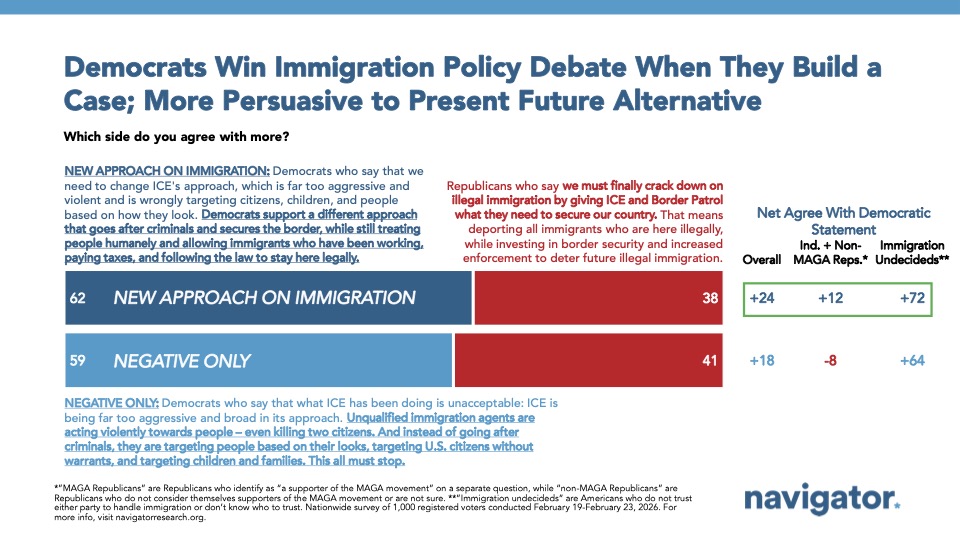
A message explaining Democrats in Congress’ own agenda worked marginally better than one only hitting Republicans in Congress’ agenda (62% agree – 59% agree).

Both the agenda message and the negative-only message moved Americans to trust Democrats in Congress’ immigration agenda more than President Trump and Republicans in Congress’ immigration agenda.. The message with Democrats’ vision moved trust on immigration 9 points while the negative-only message moved people 7 points towards Democrats’ agenda.

Bar graph from Navigator Research titled, Democrats Win Immigration Policy Debate When They Build a Case; More Persuasive to Present Future Alternative

Read More

May 22, 2026

Americans Want Major Change, But Aren’t Sure if Leaders Can Deliver

This Navigator Research report covers how Americans feel about democracy, institutions, and systems and whether anyone can fix them.

Julie Alderman Boudreau
May 21, 2026

Following Callais: Views on Supreme Court Remain Mixed But Reforms Are Popular

This Navigator Research report covers views of the Supreme Court and what type of reforms Americans support.

Tina Tang
May 20, 2026

Low Awareness, High Stakes: Views on the Recent Supreme Court Ruling on the Voting Rights Act

This Navigator Research report covers how Americans are reacting to the recent Supreme Court decision, Louisiana v. Callais, which gutted protections under the Voting Rights Act.

Tina Tang
May 14, 2026

SPECIAL REPORT: Asian Americans on the Economy and President Trump

This Navigator Research Report focuses on economic sentiment among Asian Americans and how they view President Trump’s job performance across a range of important issues.

Tina Tang & Aidan Harty

SPECIAL REPORT: Views on Health Care in the Battleground and Beyond

Poll: Health Care

This Navigator Research report covers the latest views on health care for Americans in the battleground and beyond, including on rising costs, who they trust to handle those costs, and how much they think Congress can do about it.

Vast Majority Of Americans in the Battleground Are Experiencing Increased Health Care Costs

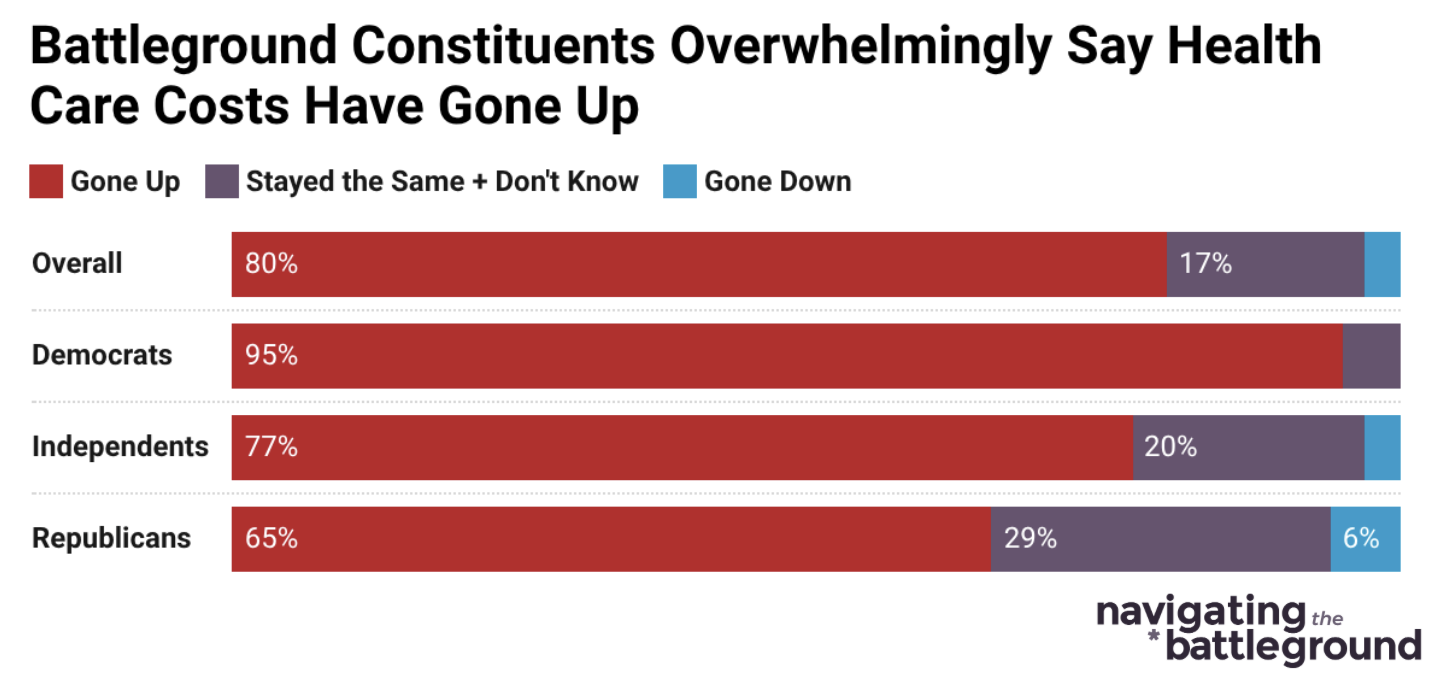
Health care costs are a near-universal concern in battleground districts. Eight-in-10 Americans in battleground districts say their health care costs have gone up (80%) – and most say their costs have gone up “a lot” (57%). Few say their health care costs have stayed the same (12%), and almost no battleground Americans think their health care costs have gone down (3%). 

There’s consensus across partisanship that health care costs are going up, including two thirds of battleground Republicans (65%), over nine-in-10 battleground Democrats (95%), and three quarters of battleground independents (77%).

Bar graph from Navigator Research, titled: Battleground Constituents Overwhelmingly Say Health Care Costs Have Gone Up

Americans in Battleground Say Republican Health Care Policies Have Raised Costs

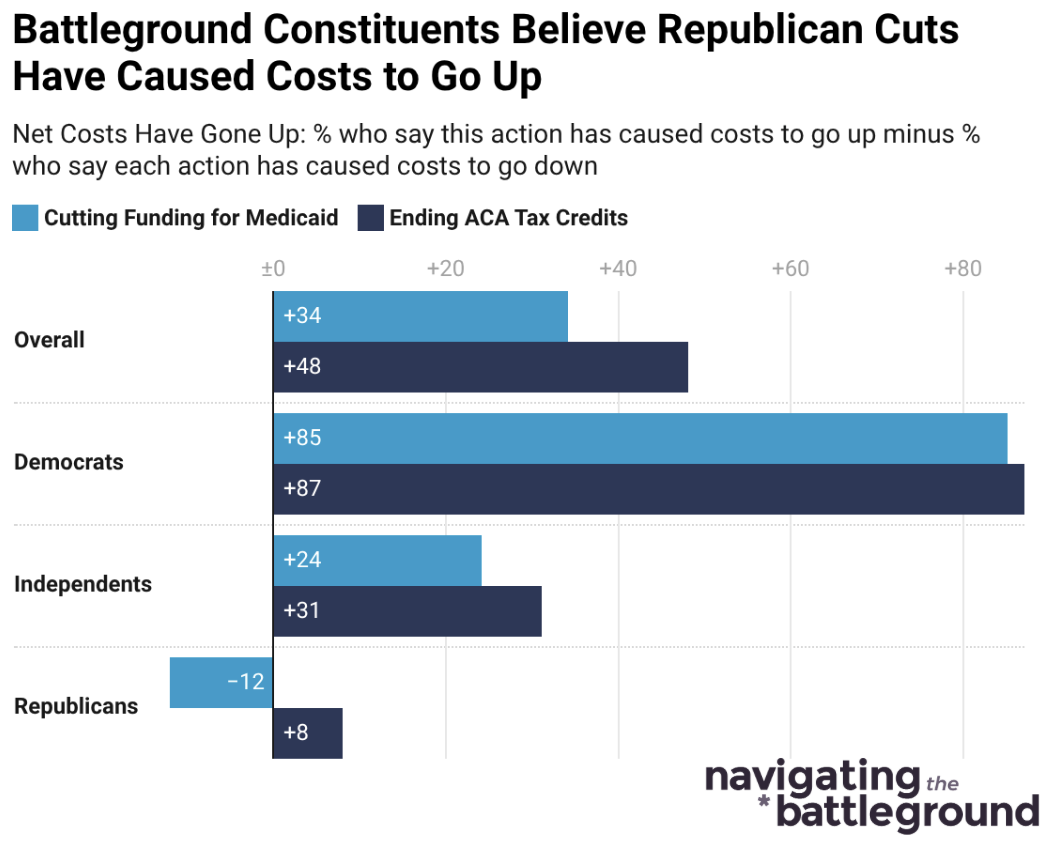
Battleground Americans blame Republican health care policies for increased costs. 53% of battleground Americans say Medicaid cuts have caused costs to go up, including four-in-10 who say the cuts have caused costs to go up “a lot” (42%). Likewise, six-in-10 say the end to ACA tax credits has caused costs to go up (60%).

Battleground independents are 24 points more likely to say Medicaid cuts have caused costs to go up than down (46% say this caused costs to go up – 22% say this caused costs to go down), and 31 points more likely to say the same about the ending of ACA tax credits (51% say this caused costs to go up – 20% say this caused costs to go down).

Bar graph from Navigator Research, titled: Battleground Constituents Believe Republican Cuts Have Caused Costs to Go Up

Battleground Americans Believe Congress Can Take Action To Lower Their Health Care Costs

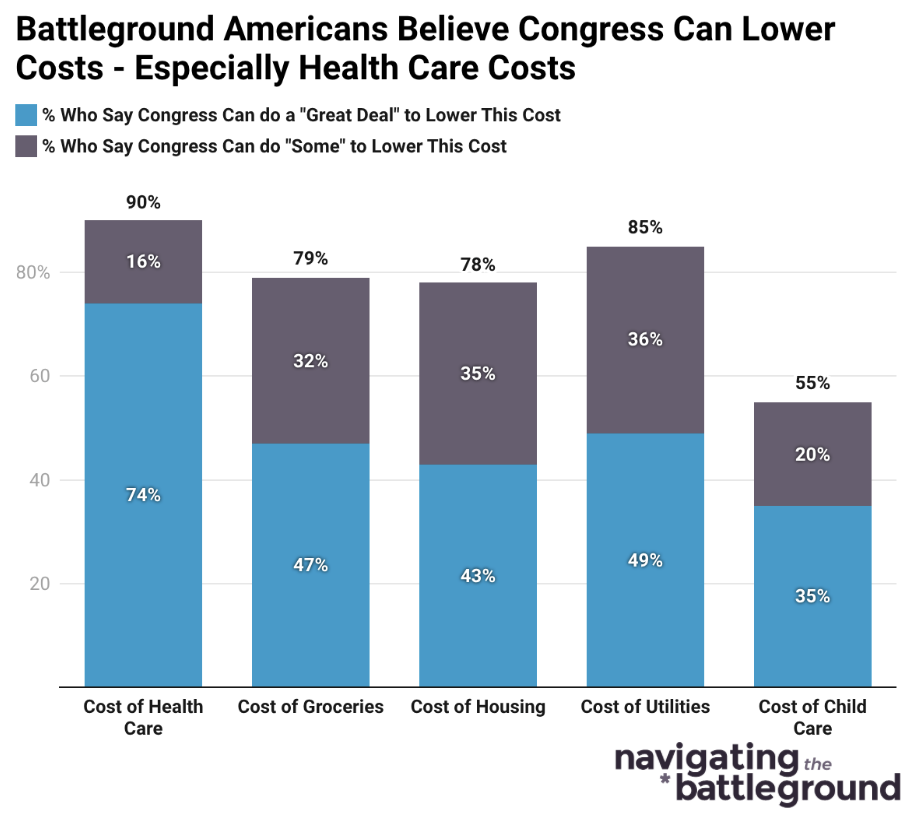
Americans in the battleground overwhelmingly believe that Congress has the power to lower health care costs. Nine-in-10 battleground Americans say Congress can lower health care costs (91%), including nearly three-quarters who say Congress can do a “great deal” to lower these costs (74%). Battleground Americans across partisanships agree that Congress can lower the cost of health care, including 97% of battleground Democrats, 85% of battleground Republicans, and 88% of battleground independents. Of the various cost increases tested, the largest share identify health care as one that Congress can do a “great deal” to lower.

  • In addition, a quarter of Americans living in battleground districts say health care is the most important cost for Congress to focus on lowering (23%), while four-in-10 rank it in their top two.
Bar graph from Navigator Research, titled: Battleground Americans Believe Congress Can Lower Costs - Especially Health Care Costs

Battleground Americans Trust Congressional Democrats More on Lowering Health Care Costs

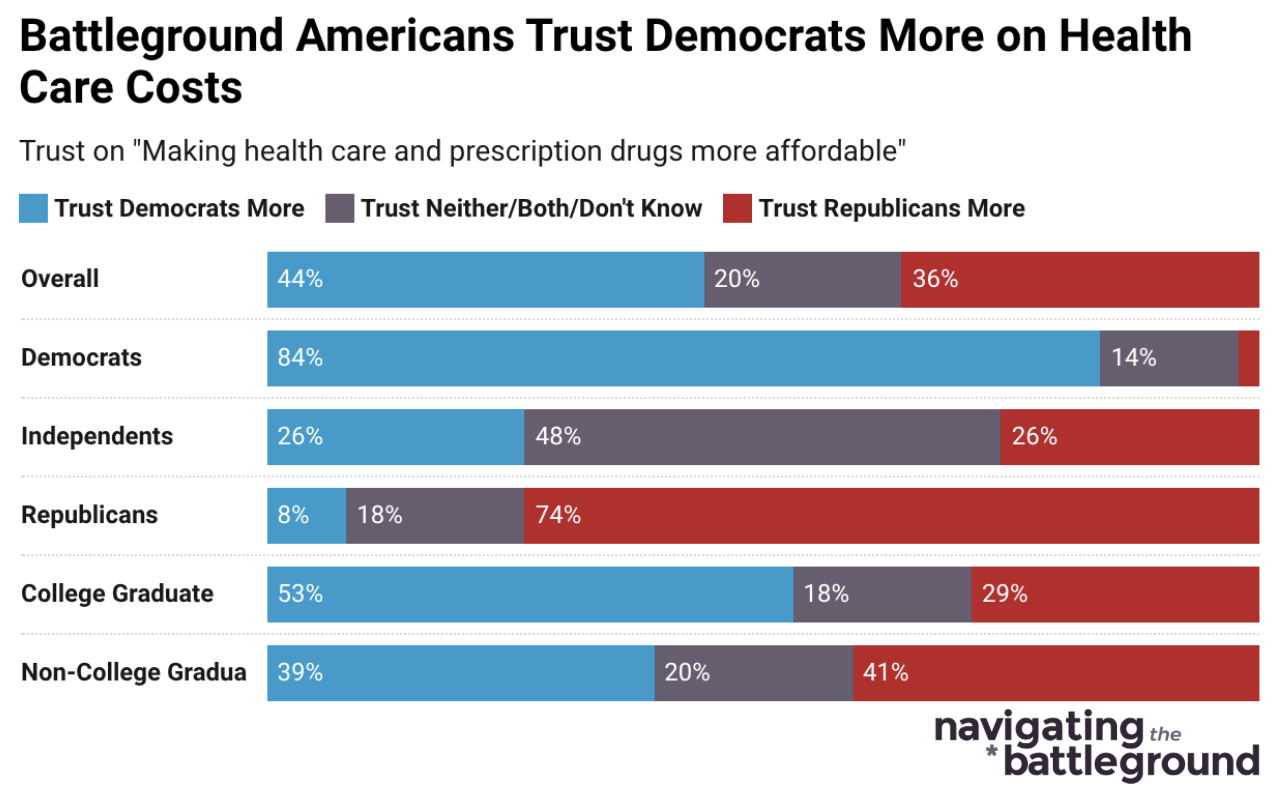
People in the battleground are eight points more trusting of Democrats in Congress than Republicans to make health care and prescription drugs more affordable (44% and 36%, respectively). Unsurprisingly, this belief corresponds with partisanship: 84% of battleground Democrats trust Democrats more, while three quarters of battleground Republicans trust Republicans more (74%). Battleground independents are split and pessimistic – while a quarter either trust Democrats or Republicans more (26% each), a plurality say they trust neither party to lower health care costs (41%).

Education level also plays an important role in how battleground Americans view each party on health care. Battleground Americans without a college degree are slightly more trusting of Congressional Republicans than Democrats to lower health care costs (39% trust Democrats more – 41% trust Republicans more), while college-educated Americans in the battleground are 24 points more trusting of Democrats (53% trust Democrats more – 29% trust Republicans more).

Bar graph from Navigator Research, titled: Battleground Americans Trust Democrats More on Health Care Costs

Americans Nationally Say They Could Not Support Elected Official Who Makes Cuts to Medicaid and SNAP In Order To Give Tax Breaks To The Wealthy And Corporations 

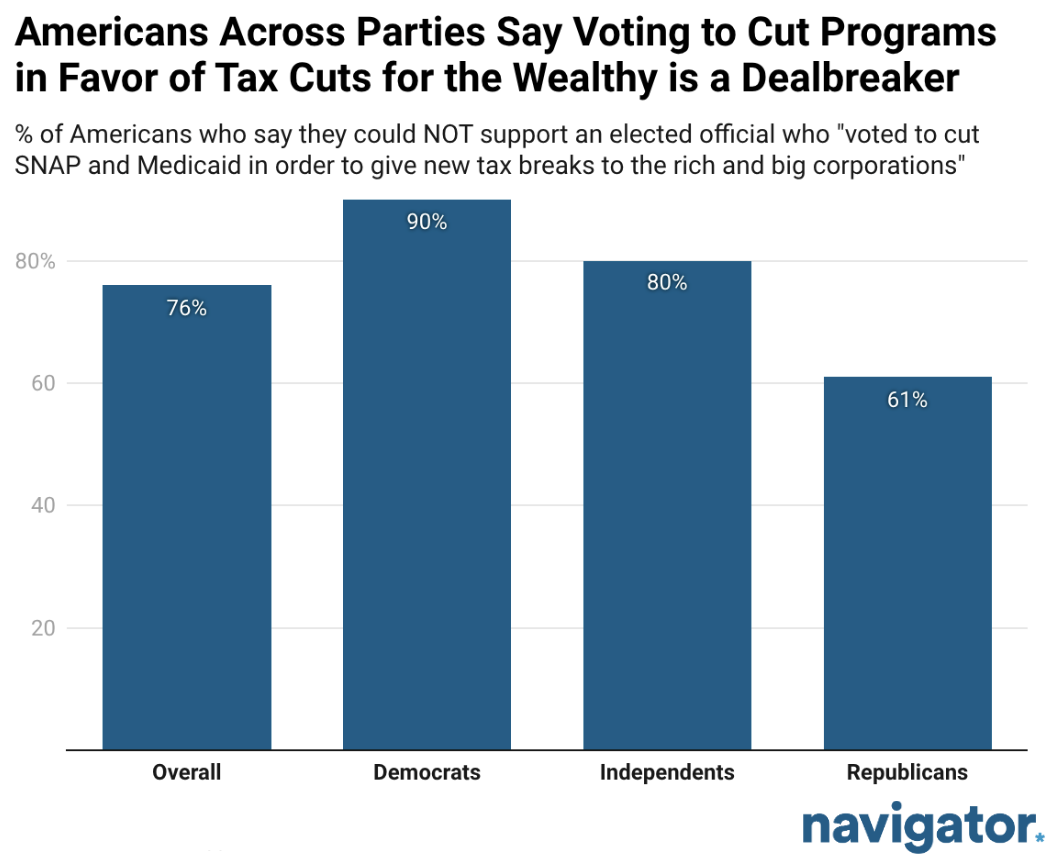
Three-quarters of Americans nationally say they could not support an elected official who voted to cut SNAP and Medicaid to give tax breaks to the rich and big corporations (76%), including 60% who say they could “definitely” not support such an elected official. This belief persists across partisanship, as nine-in-10 Democrats (90%), eight-in-10 independents (80%), and six-in-10 Republicans (61%) all say voting to cut benefits in favor of tax breaks for the wealthy is a dealbreaker.

Bar graph from Navigator Research, titled: Americans Across Parties Say Voting To Cut Programs in Favor of Tax Cuts for the Wealthy Is A Dealbreaker

Likewise, seven-in-10 Americans nationally say they are concerned that “Trump cut programs people depend on, like Medicaid and SNAP, to pay for tax cuts for billionaires and big corporations.” More than half of Americans say they find this “extremely” concerning (56%). Although Republicans are more likely to either say this is not concerning (14%) or that they “don’t believe” this is happening (32%), a plurality four-in-10 Republicans still say they find this concerning (43%). Nine-in-10 Democrats (92%) and eight-in-10 independents (81%) say they are concerned about Trump paying for tax cuts for the wealthy by cutting essential programs. 

This contrast message connecting Medicaid and SNAP cuts to tax breaks for billionaires and big corporations was more effective than only highlighting the program cuts (67% said they could not support someone who voted for the largest Medicaid cut in history; 73% said they could not support someone who voted to cut SNAP and Medicaid in order to give new tax breaks to the rich and big corporations).

Read More

May 22, 2026

Americans Want Major Change, But Aren’t Sure if Leaders Can Deliver

This Navigator Research report covers how Americans feel about democracy, institutions, and systems and whether anyone can fix them.

Julie Alderman Boudreau
May 21, 2026

Following Callais: Views on Supreme Court Remain Mixed But Reforms Are Popular

This Navigator Research report covers views of the Supreme Court and what type of reforms Americans support.

Tina Tang
May 20, 2026

Low Awareness, High Stakes: Views on the Recent Supreme Court Ruling on the Voting Rights Act

This Navigator Research report covers how Americans are reacting to the recent Supreme Court decision, Louisiana v. Callais, which gutted protections under the Voting Rights Act.

Tina Tang
May 14, 2026

SPECIAL REPORT: Asian Americans on the Economy and President Trump

This Navigator Research Report focuses on economic sentiment among Asian Americans and how they view President Trump’s job performance across a range of important issues.

Tina Tang & Aidan Harty

Tariffs, Tax Cuts & Trouble for Republicans

Battleground Poll: Costs

This Navigator Research report covers the latest perceptions of government leaders and their handling of the economy, including the costs battleground constituents see as increasing the most, and the power they believe Congress has to act to lower these costs.

Approval of Congress’s Handling of the Economy

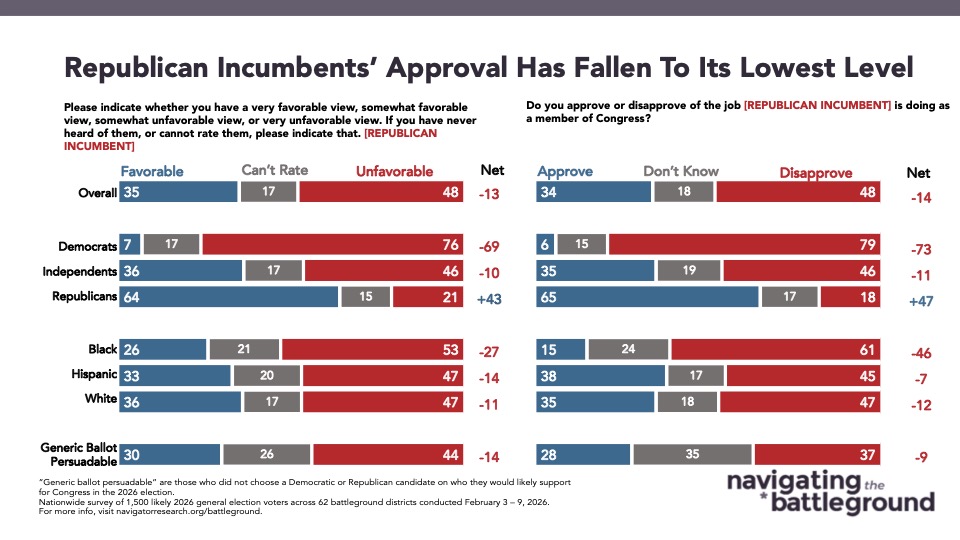
Americans in the battleground disapprove of their Republican incumbents’ handling of the economy by 16 points (31% approve – 47% disapprove), a steep decline from last February where Congressional Republican incumbents had an economic approval of net zero (36% approve – 36% disapprove). Named Congressional Democratic incumbents are 4 points underwater on their handling of the economy (35% approve – 39% disapprove) – consistent with their approval from last February (net -2; 34% approve – 36% disapprove).

Bar graphs from Navigator Research titled: Republican Incumbents' Approval Has Fallen To Its Lowest Level

Costs

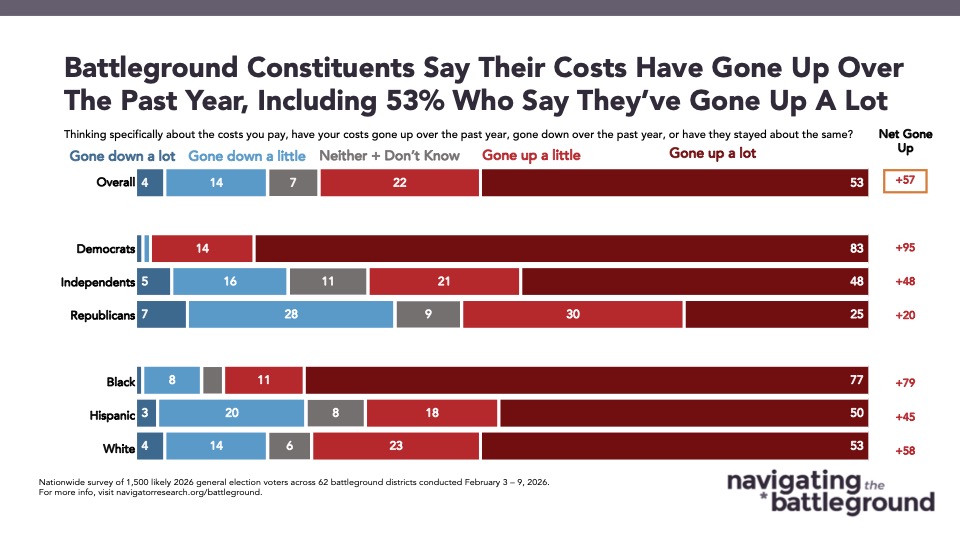
Three-in-four battleground constituents say their costs have gone up over the past year (75%), including 53% who say they have gone up “a lot.” Across parties costs are seen as going up, including among 98% of Democrats, 71% of independents, and 52% of Republicans.

Bar graph from Navigator Research titled: Battleground Constituents Say Their Costs Have Gone Up Over The Past Year, Including 53% Who Say They’ve Gone Up A Lot

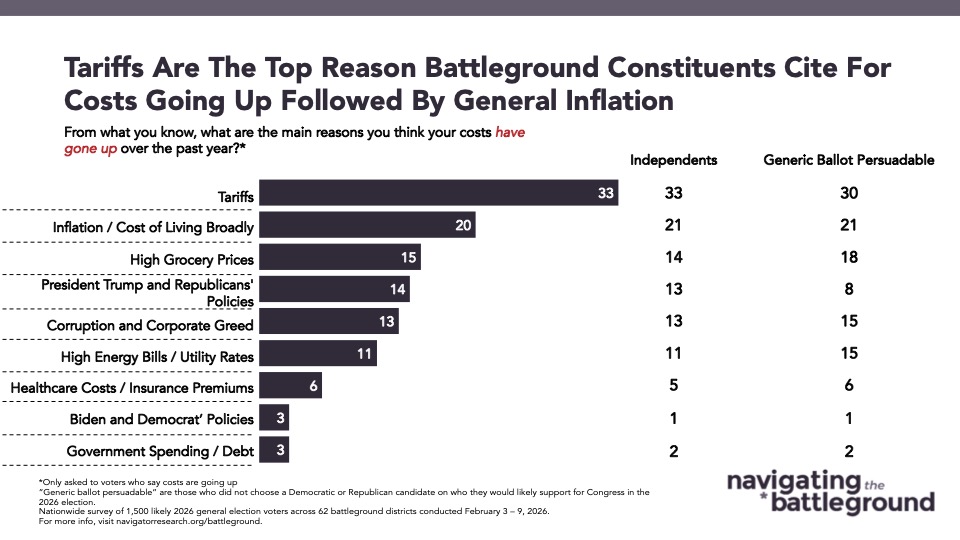
When citing the main reasons for costs increasing over the past year, 33% cite “tariffs” in an open-end response, with the second most popular answer being inflation (20%). Independents in the battleground are most likely to cite tariffs as the top reason costs are going up (27%).

Bar graph from Navigator Research titled: Tariffs Are The Top Reason Battleground Constituents Cite For Costs Going Up Followed By General Inflation

Specific Costs: Groceries, Housing, Utilities, and Health Care

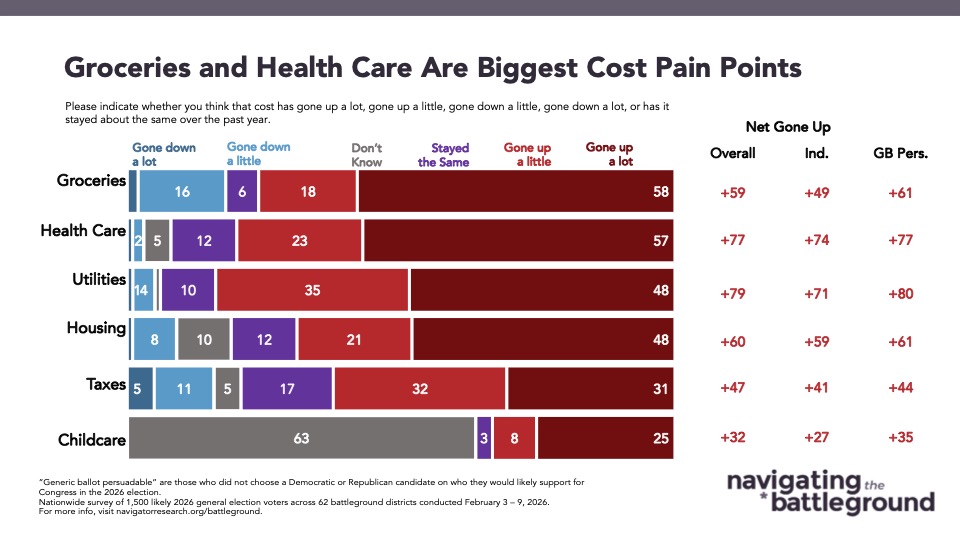
Overwhelming majorities say the cost of utilities (84%), health care (80%), groceries (77%), and housing (69%) have gone up. Though a cost that fewer experience, one-third say the cost of child care has increased (33%), including 25% who say it has increased “a lot.”

Bar graph from Navigator Research titled: Groceries and Health Care Are Biggest Cost Pain Points

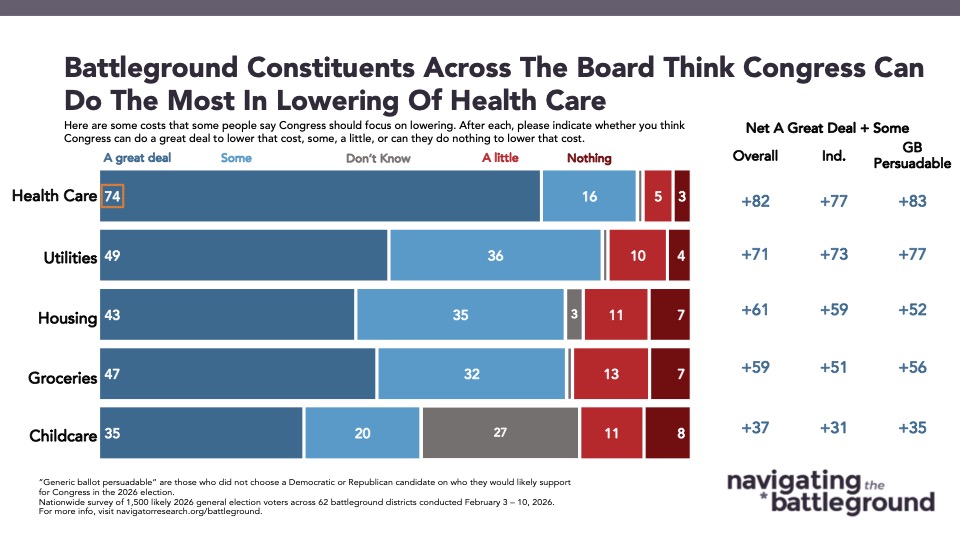
When it comes to the power Congress has to lower these costs, 91% believe Congress has the power to lower health care costs, including 74% who say they have the power to lower the cost of health care “a great deal.” Overwhelming majorities also believe Congress has the power to lower costs related to utilities (85%), housing (79%), and groceries (79%).

Bar graph from Navigator Research titled: Battleground Constituents Across The Board Think Congress Can Do The Most In Lowering Of Health Care

Congressional Republican Actions Leading to Costs Increasing

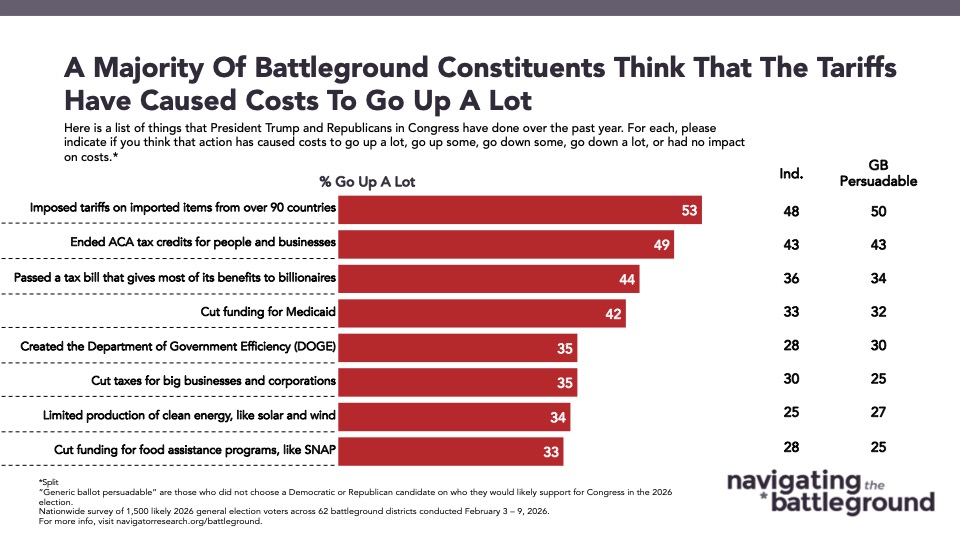
While battleground constituents believe Congress has the power to lower a range of costs – they see President Trump and Congressional Republicans as raising costs through a number of their policies. Nearly three-in-four Americans in the battleground believe Trump and Republicans in Congress imposing tariffs on imported items has led to costs going up (72%), including 53% who say tariffs have led to costs increasing “a lot.” Other Trump and Congressional Republican policies are also linked to higher costs, including ending tax credits for people and businesses who get their health insurance through the ACA marketplace (60%), passing a tax bill that benefits the ultra wealthy (54%), cutting funding for Medicaid (53%), and limiting the production of clean energy (51%).

Bar graph from Navigator Research titled: A Majority Of Battleground Constituents Think That The Tariffs Have Caused Costs To Go Up A Lot

Stay tuned for more Navigating the Battleground reports focusing specifically on health care and utility costs.

Americans Are Angry About Epstein – and They Want Accountability

Poll: Epstein Files

This Navigator Research report covers Americans’ views of the Epstein files, including on the share who disapprove of President Trump’s handling of it, Americans’ desire for increased accountability, and their belief the government is engaged in a cover-up.

Epstein Files and Tariff News Dominate Trump’s Negatives 

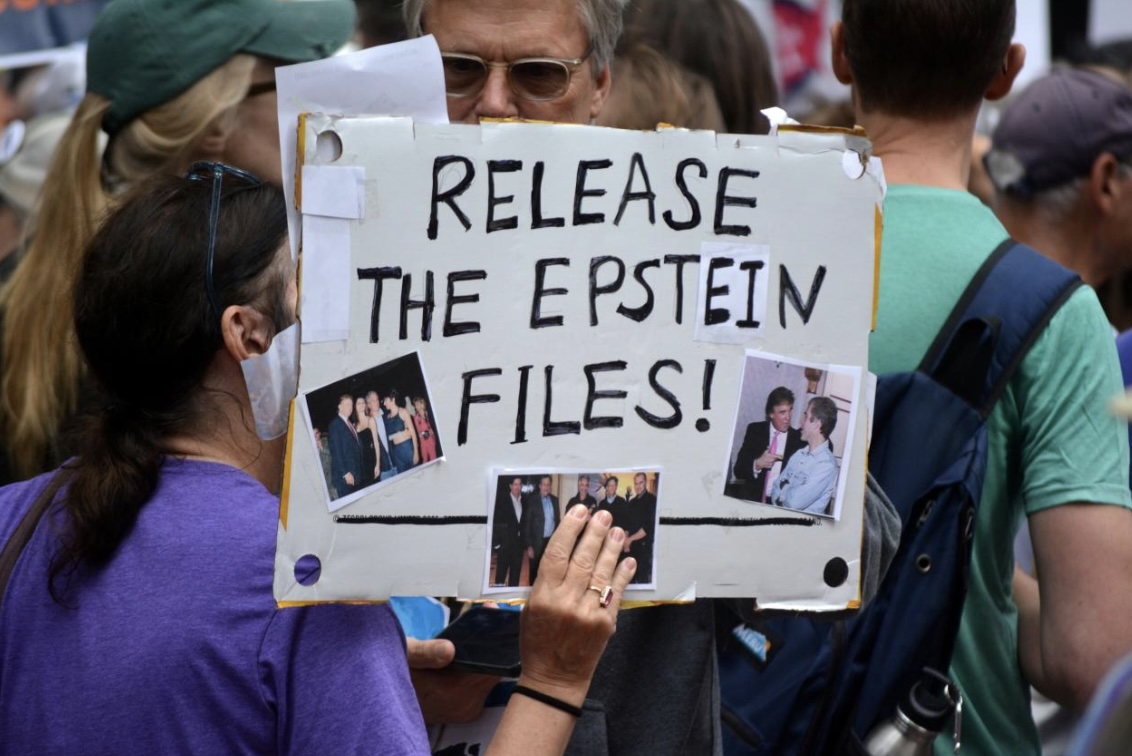
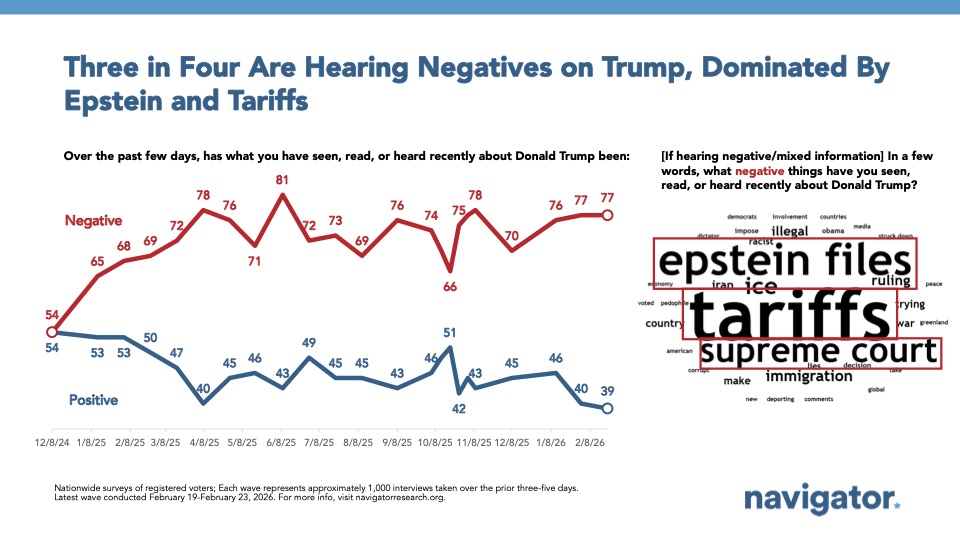
Americans are still hearing about the Epstein files – and their reaction is overwhelmingly negative. Among the 77% of Americans who report either hearing mostly negative or mixed things about President Trump in the last few days, the Epstein files, along with tariff-related news, stand out.

Line graph from Navigator Research with a word cloud on negative news on Trump

Few See Trump Handling Epstein Files Well

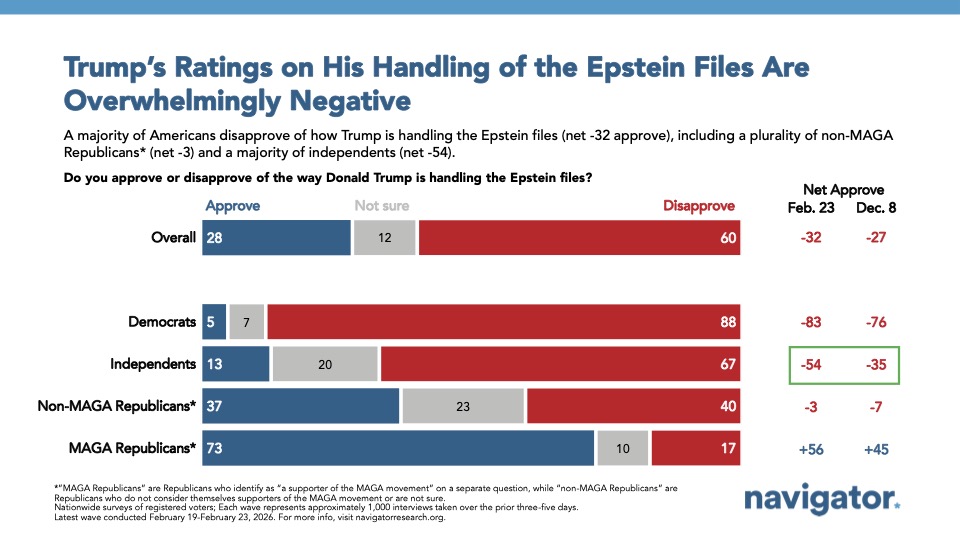
Less than three-in-10 Americans approve of how Trump is handling the Epstein files (28% approve – 60% disapprove). Among independents, two-thirds (67%) disapprove while just 13% approve – a 54-point gap. Since Navigator last asked Americans this question in early December, disapproval among independents has moved up 13 points (54% of independents disapproved in December)

More than a quarter of Republicans disapprove of how Trump is handling the Epstein files (28% disapprove). While 73% of MAGA Republicans approve, just 37% of non-MAGA Republicans approve, a 36-point difference.

bar graph from Navigator Research showing Trump’s ratings on his handling of the Epstein files

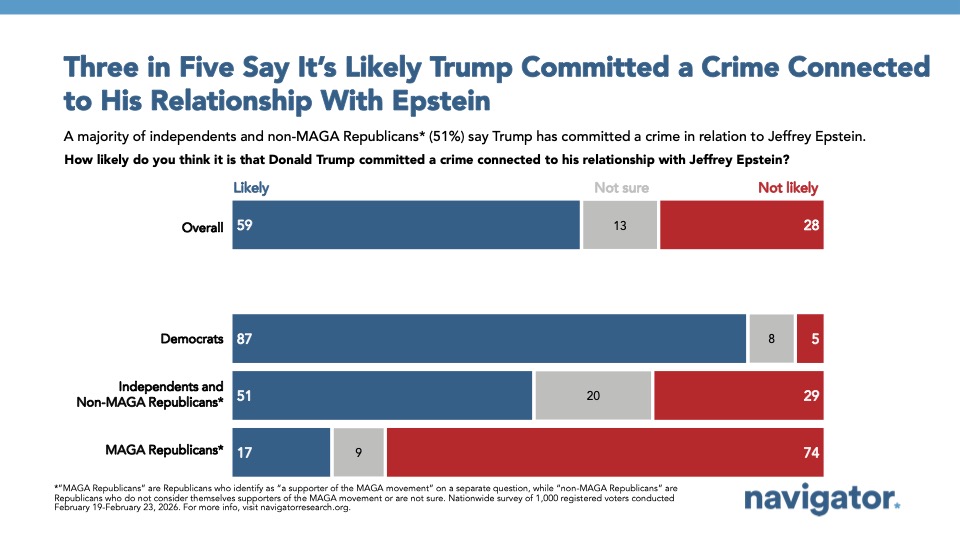
Nearly six-in-10 Americans say it is likely President Trump committed crimes connected to his relationship with Jeffrey Epstein (59%). Only around a quarter say this is “not likely” (28%). While just 17% of MAGA Republicans say Trump likely committed a crime connected to his relationship with Epstein, 50% of non-MAGA Republicans say it is likely Trump committed an Epstein-related crime – and only three-in-10 non-MAGA Republicans say this is not likely (32%). Among Republicans overall, a full third say Trump likely committed a crime connected to his relationship with Epstein (33%).

Bar graph from Navigator Research showing how many people say it’s likely Trump committed a crime related to Epstein

The Trump Administration is Not Trusted on the Epstein Files 

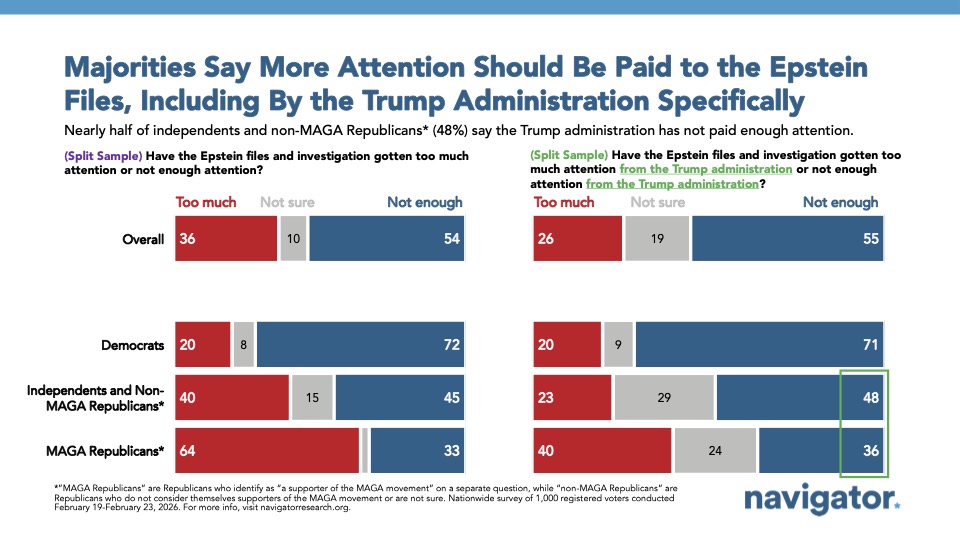
Americans want more attention on the Epstein files. Over half say the Epstein files have received “not enough attention” (54%), while just one-third say they have gotten “too much attention” (36%). When asked if they believe the Epstein files have received too much attention from the Trump administration specifically, Americans are 10 points less likely to say the Epstein files have received too much attention (36% say too much attention – 26% say too much attention from the Trump administration). 

  • Among independent voters, this goes from a 17-point split in favor of more attention on the Epstein files generally (31% say too much attention – 48% say not enough attention), to a 48-point split in favor of more attention from the Trump administration (12% say too much attention from the Trump administration – 60% say not enough attention from the Trump administration).
two bar graphs from Navigator Research showing that people want more attention given to the Epstein files

Accountability, Cover-Up, and Conspiracy

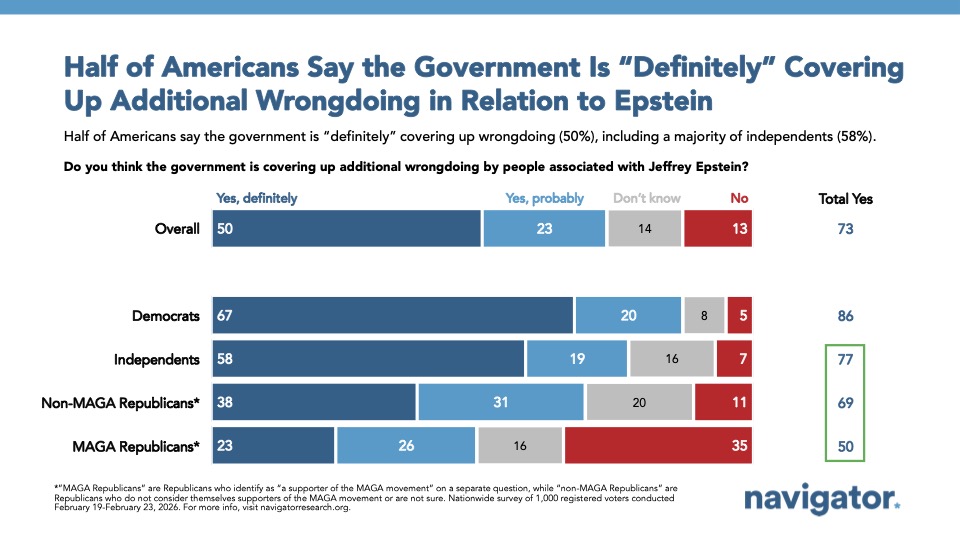
A strong majority of Americans believe the government is covering up additional Epstein-related wrongdoing. 73% percent of Americans say the government is covering up additional wrongdoing, including 50% who say this is “definitely” the case. 

bar graph from Navigator Research showing how many Americans think the government is involved in a cover-up related to Epstein

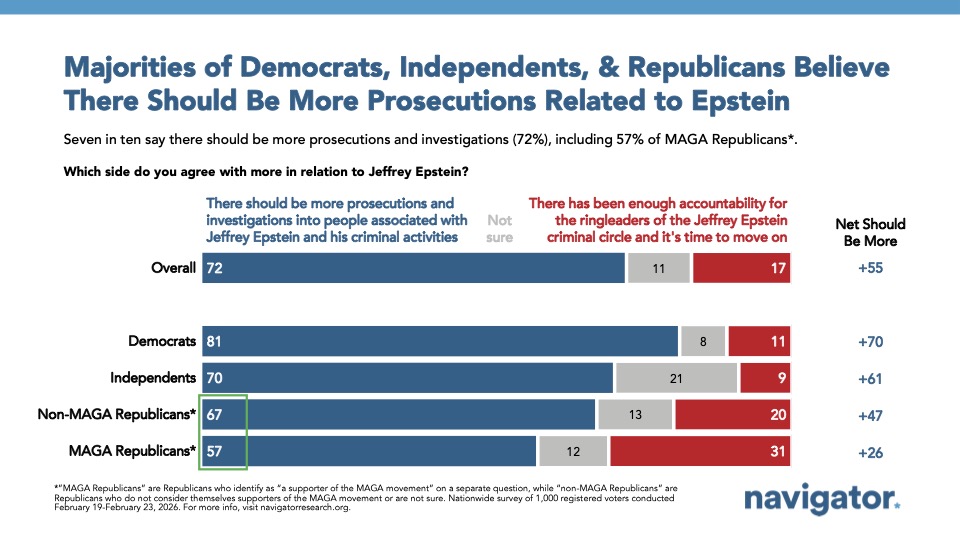
Likewise, Americans overwhelmingly want more accountability for the Epstein files. Nearly three-in-four say there should be more prosecutions and investigations into people associated with Epstein (72%), compared to just 17% who say there has been enough accountability and that it is time to move on – a 55-point gap. This feeling extends across partisanship, as solid majorities of Democrats (83%), Republicans (62%), and independents (70%) all say there should be more prosecutions and investigations.

Bar graph from Navigator Research showing Americans want to see prosecutions related to Epstein

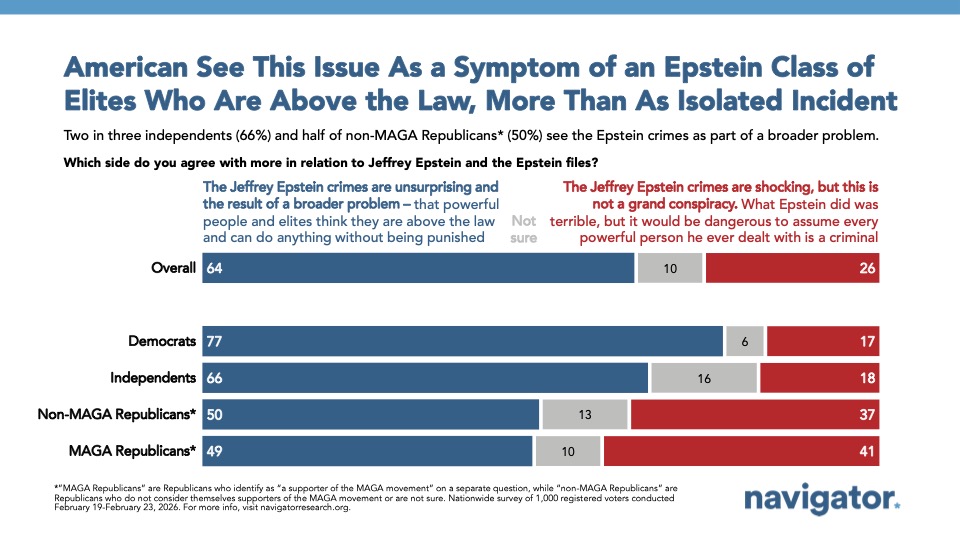
Americans view the Epstein files as part of a broader problem with elites. About two-thirds of Americans say Epstein’s crimes are unsurprising and the result of powerful people and elites thinking they are above the law and immune to punishment (64%), compared to a quarter who say Epstein’s crimes are not a grand conspiracy and that it would be dangerous to assume every powerful person he dealt with is a criminal (26%). This feeling sticks across partisanship:

  • Democrats: 77% say Epstein’s crimes are the unsurprising result of broader problem (net +60)
  • Independents: 66% say Epstein’s crimes are the unsurprising result of broader problem (net +48)
  • Republicans: 49% say Epstein’s crimes are the unsurprising result of broader problem (net +10)
Bar graph from Navigator Research showing Americans view the Epstein files as an issue of elites getting away with things

Americans Want Trump Officials Connected to Epstein to Resign, Especially When Informed About Accountability Abroad

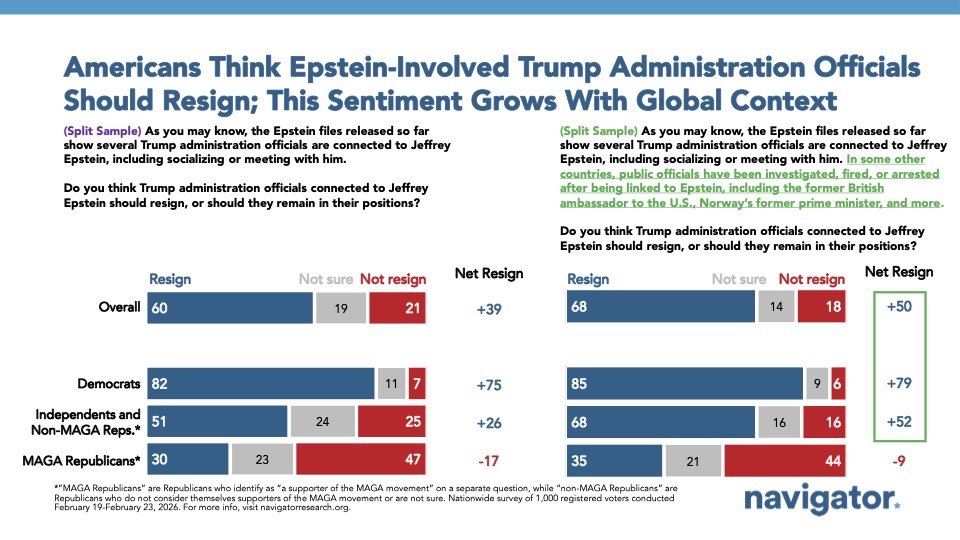
Overall, six-in-10 Americans say Trump administration officials connected to Jeffrey Epstein should resign. When including the context that in “some other countries, public officials have been investigated, fired, or arrested after being linked to Epstein, including the former British ambassador to the U.S., Norway’s former prime minister, and more,” closer to seven-in-10 Americans are supportive of resignations. This shift is particularly strong among Republicans. Without international context, Republicans are divided on whether Trump officials connected to Epstein should resign (37% resign – 38% not resign). With this context, Republicans are 16 points more likely to say these officials should resign (49% resign – 33% not resign).

Bar graphs from Navigator Research showing how Americans think officials who engaged with Epstein should resign

Read More

May 22, 2026

Americans Want Major Change, But Aren’t Sure if Leaders Can Deliver

This Navigator Research report covers how Americans feel about democracy, institutions, and systems and whether anyone can fix them.

Julie Alderman Boudreau
May 21, 2026

Following Callais: Views on Supreme Court Remain Mixed But Reforms Are Popular

This Navigator Research report covers views of the Supreme Court and what type of reforms Americans support.

Tina Tang
May 20, 2026

Low Awareness, High Stakes: Views on the Recent Supreme Court Ruling on the Voting Rights Act

This Navigator Research report covers how Americans are reacting to the recent Supreme Court decision, Louisiana v. Callais, which gutted protections under the Voting Rights Act.

Tina Tang
May 14, 2026

SPECIAL REPORT: Asian Americans on the Economy and President Trump

This Navigator Research Report focuses on economic sentiment among Asian Americans and how they view President Trump’s job performance across a range of important issues.

Tina Tang & Aidan Harty