
Overview:
As the final quarter of 2026 begins, Navigator is taking stock of trends we’ve seen in our data during President Trump’s second term. Across dozens of surveys and extensive qualitative research in battleground states, five clear themes have emerged. Below, we highlight the trends we’re seeing that have defined and shaped the current moment.
1) Trump Has Become More Toxic as One-in-Four Regret Their Vote
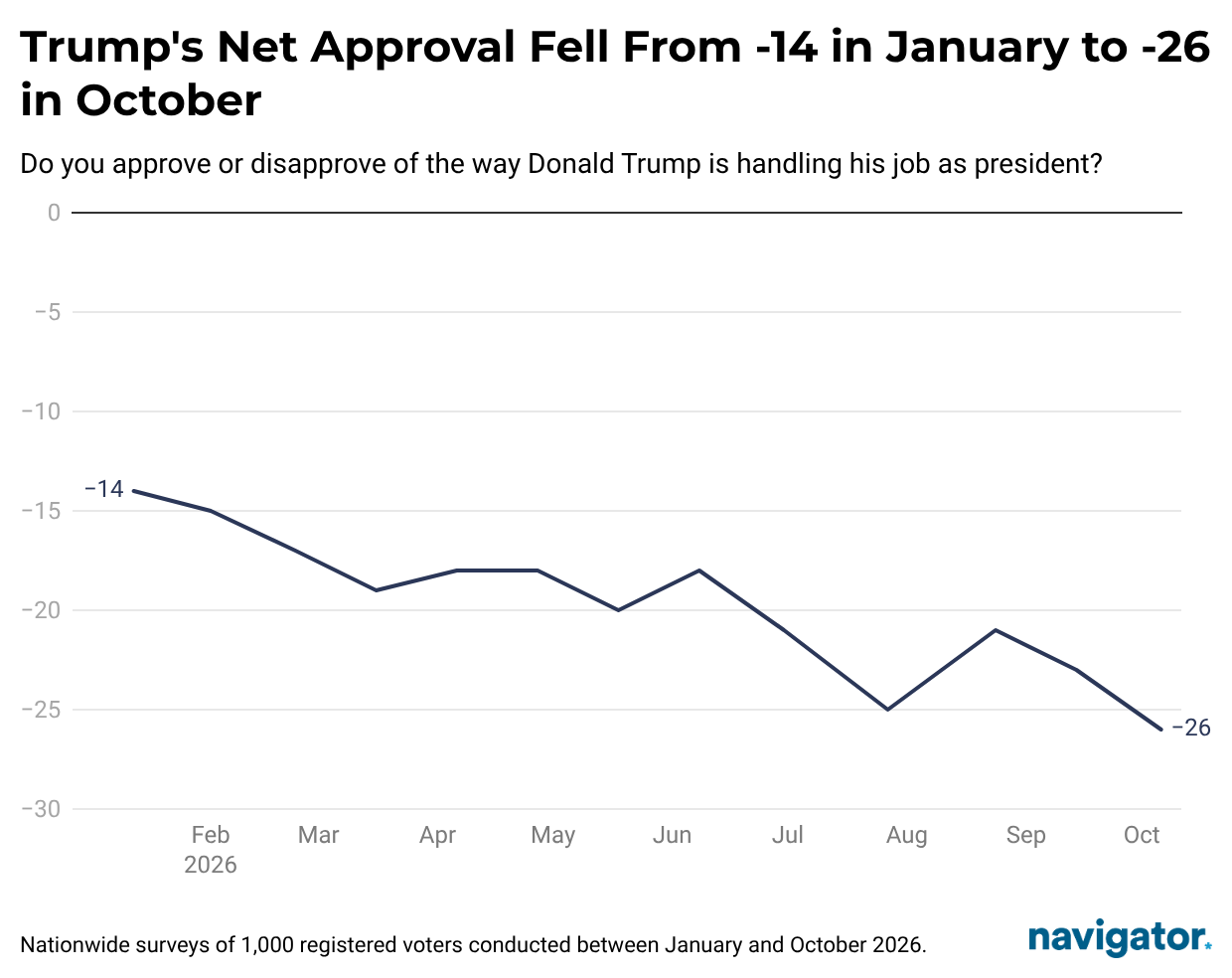
President Trump’s net job approval has dropped throughout the year, hitting its lowest point in Navigator tracking this month (-26 net approval, 36% approve – 62% disapprove). This is a net 19-point drop from the start of the year when his job approval was underwater by 14 points (42% approve – 56% disapprove in January).
Views of Trump’s handling of the economy are nearly equally negative, with 65% disapproving (including 50% strongly) and 32% approving in our latest polling.
Additionally, we’ve seen that one-in-four who voted for Trump in 2024 now regret their vote. Several key groups who made up Trump’s winning coalition in 2024 now say they regret their vote at a rate even higher than Americans overall.
- 30% of Trump voters 18-34 now regret their vote. This is nearly triple the rate of Trump voters over 55 (12%) and well above the rate for Trump voters 35-54 (18%).
- 34% of Black and 32% of Latino Americans who voted for President Trump now regret their vote, double the rate of white Trump voters (16%) who now regret their vote.
- 22% of moms who voted for President Trump now regret their vote compared to just 13% of dads.
Some of the most oft-cited reasons for Trump regret include his handling of the war in Iran, the economy and his broken promises.
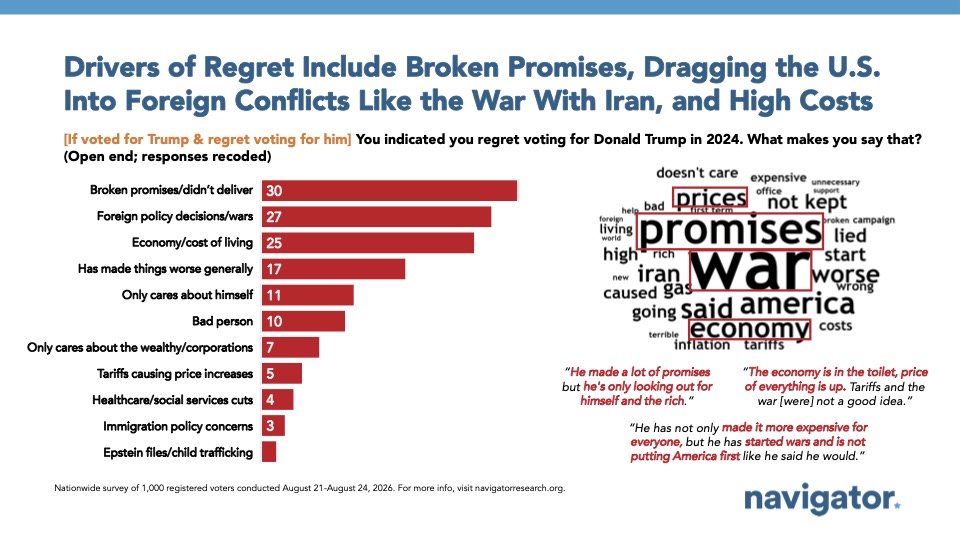
In focus groups, Trump regretters lament higher costs when promised lower prices, rising health care premiums, and yet another foreign war.



2) A Persistent Gap in Focus
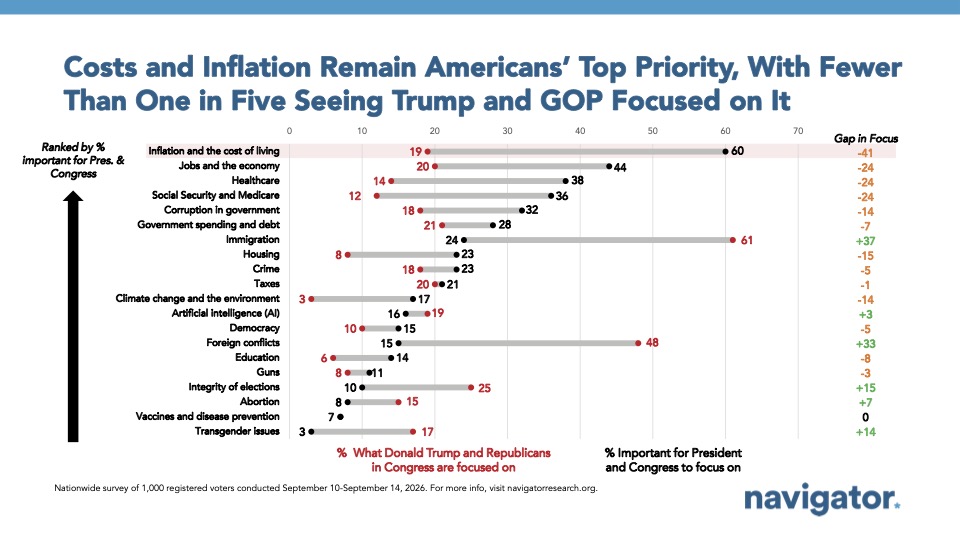
Americans want their leaders to focus on lowering costs. Consistently in Navigator’s polling, about three-in-five say the President and Congress should prioritize inflation and the cost of living, but only about one-in-five think President Trump and congressional Republicans are doing so. That double digit (approximately 40-point) gap echoes what we consistently hear in focus groups: Americans feel Trump and Republicans are focused on the wrong things.
3) Americans Sour on Republican Policies
Many of the policies enacted by Trump and Republicans in Congress remain unpopular, and their unpopularity has only grown over time. Issues they’ve either championed, like data center expansion, or blocked, like release of the Epstein files, are even more unpopular.
- Between January and June, the favorability of the GOP tax law (otherwise known as the One Big Beautiful Bill Act) dropped by 6 points from -14 (35% favorable – 49% unfavorable) to -20 (33% favorable – 53% unfavorable) even after the Trump administration sent cabinet officials across the country to tout their marquee legislative achievement. Even more unpopular than the bill itself are many of its components, including tax cuts for the rich and cuts to Medicaid and SNAP.
- On the war with Iran, six-in-10 Americans say they do not think the conflict has been worth it, including 37% who feel this way strongly. A growing share (62%, up from 56% in April when the war began) say Trump does not have a clear timeline and goals for the military operation. As gas prices have increased due to the war, 76% disapprove of Trump’s handling of them, including 60% who strongly disapprove. Only 20% approve.
- Views of tariffs reached a new low in Navigator tracking with 63% reporting an unfavorable view of tariffs in our September survey, up from only 35% who held an unfavorable view in August 2024. Two-thirds see tariffs as price-raising, including 64% of independents and 61% of non-MAGA Republicans.
- Opposition to data centers is growing rapidly, as three-in-five (58%) view data centers unfavorably and say they would not support the building of a data center in their local community (58%). Opposition to building a data center locally has grown from 32% in December 2025 to 58% in September 2026, a 26-point swing in only nine months.
- Less than three-in-10 Americans approve of how Trump has handled the Epstein files (28% approve – 60% disapprove). It’s an issue causing fractures within the Republican Party as more than a quarter of Republicans disapprove of how Trump has handled the Epstein files (28% disapprove). And 73% of Americans overall believe the government is covering up additional Epstein-related wrongdoing.
- A majority (55%) disapprove of the way Trump has handled immigration, which was previously a strength for him, compared to just 41% who approve. Similarly, ICE has remained unpopular throughout 2026. In January, the agency had a net approval of -20 (37% favorable – 57% unfavorable). In October, that net approval dropped to -27 (33% approve – 60% disapprove).
4) Trust in Republicans to Handle Key Issues Has Deteriorated
As Trump and Republicans in Congress continue to focus on unpopular policies, we’ve seen noteworthy shifts in which party Americans trust on several keys issues:
- On jobs and the economy, a tie has become a Democratic lead. Party trust was even in January (38% Democrats – 38% Republicans), but by October, Democrats held a 10-point edge (42% Democrats – 32% Republicans).
- On inflation and the cost of living, again, a tie has become a 17-point Democratic advantage on the issue. Trust was even in January (37% Democrats – 37% Republicans), but by October, Democrats led 43% to 26%.
- Democrats have also moved from parity to an advantage on tariffs. In February, Americans were evenly split on which party they trust more to handle tariffs (37% Democrats – 37% Republicans). By September, Democrats led on the issue by 9 points (40% Democrats – 31% Republicans).
- On national security and foreign policy, Republicans had a 12-point advantage on the issue (33% Democrats – 45% Republicans) in January. As of early October, Democrats have an 8-point advantage on handling foreign policy (40% Democrats – 32% Republicans).
The shifts in trust owe more to Republican declines than Democratic growth. Democrats have made gains on key issues (+4 on jobs and the economy, +6 on inflation and the cost of living, +3 on tariffs) but the movement away from trust in Republicans hasn’t solely translated to an equal increase in trusting Democrats: a growing number of Americans now say they trust neither party to handle the issue (20% jobs and the economy, 26% inflation and the cost of living, 22% tariffs trust neither party), demonstrating the pessimism and frustration we frequently hear in focus groups.
5) Americans are Connecting Government Corruption to Personal Costs
Corruption isn’t just an abstract political issue for Americans, it’s a pocketbook one. Huge majorities across party lines say corruption in government is raising their costs personally (81%), with nearly half feeling this way strongly (48%). They’re blaming elected officials who allow waste, fraud, and abuse of taxpayer dollars (82% raises costs), the protecting of monopolies and large corporations that price gouge consumers (82% raises cost), and allowing lobbyists and special interests to have more influence than ordinary people (77%).
Americans are also opposed to and resentful of Trump’s expensive White House renovations, reflecting pool makeover, and self-aggrandizing projects.
- Two-in-three (66%) oppose Trump tearing down the East Wing of the White House and requesting $1 billion in taxpayer dollars for a new White House ballroom.
- Even among Republicans, the ballroom is divisive, with 42% supportive of Trump’s actions and 42% opposed – though non-MAGA Republicans oppose it by 29 points (28% support – 57% oppose).
- Nearly six-in-ten (58%) report concerns awarding a no-competition contract to a favored company to repaint the Reflecting Pool in Washington.
- Seven-in-10 say Trump’s face being included on special edition passports and the new $250 bill shows he’s focused on the wrong things.
The throughline in our data this year is broken promises and a disconnect with Americans’ priorities. Americans want action to lower their costs, and they see a president and party in power focused on the wrong things: unpopular price-raising policies, a costly war, and projects that feel self-serving as Medicaid and SNAP are cut. The result is a president at his lowest net approval this year, a Republican trust advantage on key issues that has largely eroded, and Americans increasingly trusting neither party to deliver for them. Until the gap between what Americans want and what leaders are focused on closes, it’s likely these trends persist.