

Majorities Oppose Republicans in Congress’ Proposed Budget Plan

June 17, 2025
Maryann Cousens

Polling report on the latest perceptions of House Republicans’ proposed budget plan.

Poll: House Republicans’ Proposed Budget Plan

This Navigator Research report covers the latest perceptions of House Republicans’ proposed budget plan.

A majority of Americans (51 percent) now oppose the Republican budget plan following its passage in the House. Opposition outweighs support by 15 points, with just 36 percent supporting the GOP budget bill. Opposition to the bill has increased six points since May and has grown the most among independents. In May, support among independents was at net -14. It now stands at net -38. Notably, 30 percent of independents say they are “not sure” if they support or oppose the tax bill.
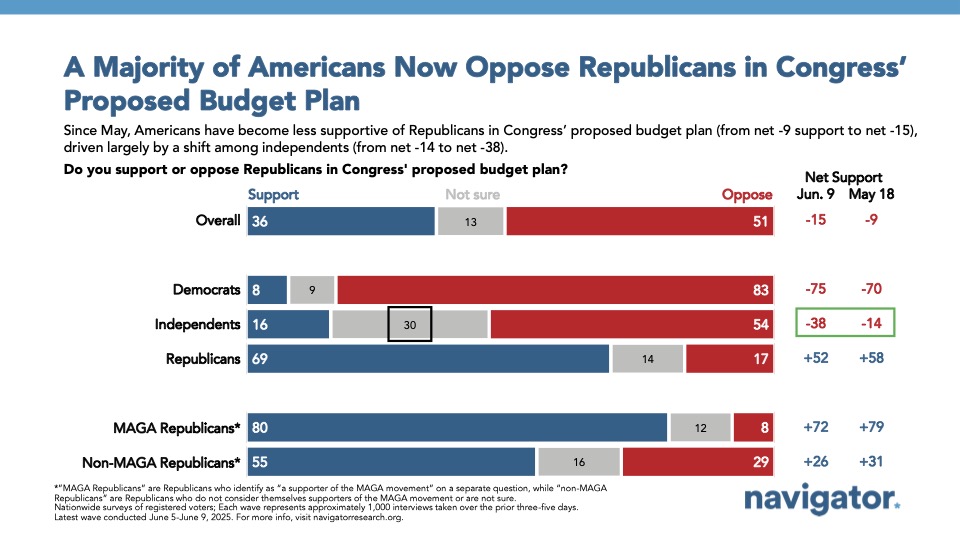
Bar chart from Navigator Research titled: A Majority of Americans Now Oppose Republicans in Congress’ Proposed Budget Plan

In the Battleground: Half of battleground constituents believe the Republican budget plan would be bad for people like them, compared to just 41 who believe it would be beneficial, including 56 percent of women and 84 percent of Black battleground constituents.
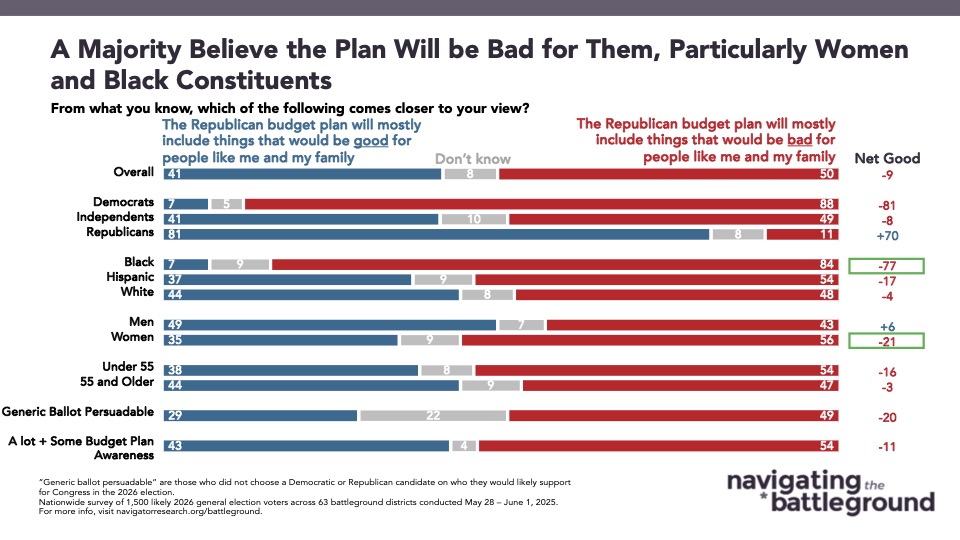
Bar chart from Navigator Research titled: A Majority Believe the Plan Will be Bad for Them, Particularly Women and Black Constituents

Americans have mixed views on tax cuts in the Republican tax bill — but support plummets when they hear that these additional tax cuts would mostly benefit those who are already rich.

Learning that additional tax cuts would benefit those who are already rich leads 55 percent of independents and a 43 percent plurality of non-MAGA Republicans to oppose the budget plan.
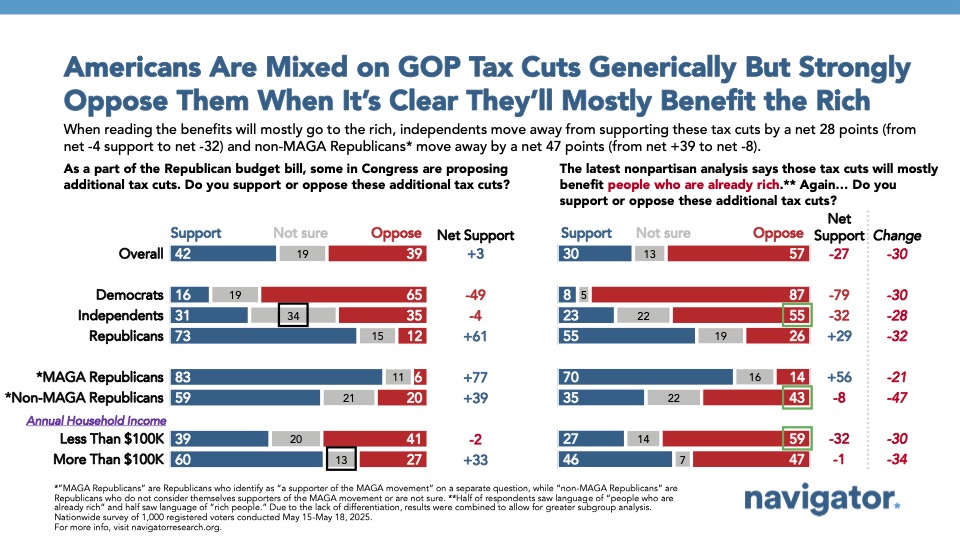
Bar chart from Navigator Research titled: Americans Are Mixed on GOP Tax Cuts Generically But Strongly Oppose Them When It’s Clear They’ll Mostly Benefit the Rich

Giving new tax breaks to the rich and big corporations is a dealbreaker for Americans across partisanship: 87 percent of Democrats, 73 percent of independents, and 51 percent of Republicans say they could not support an elected official who voted to give new tax breaks to the wealthy.
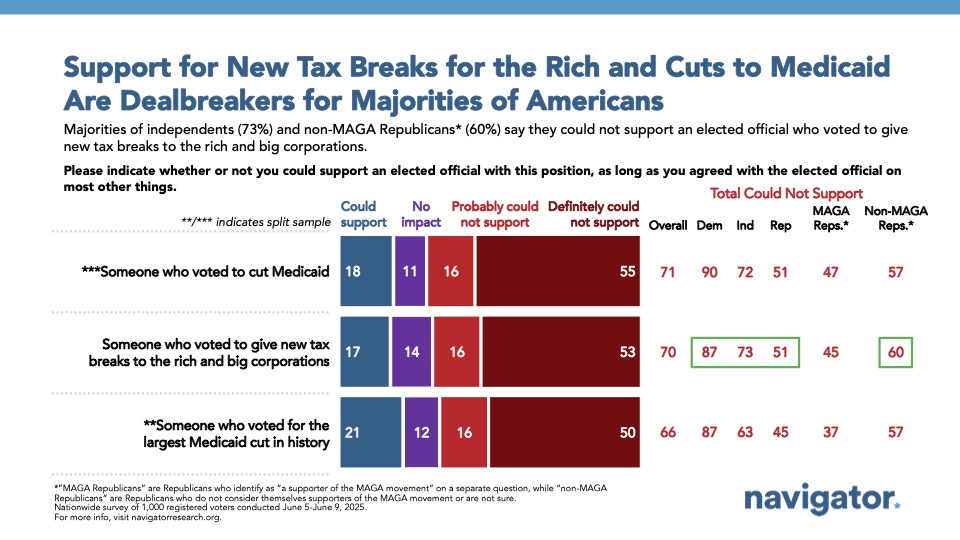
Bar chart from Navigator Research titled: Support for New Tax Breaks for the Rich and Cuts to Medicaid Are Dealbreakers for Majorities of Americans

Recommendations:

  1. Focus on the impact when messaging about Congressional Republicans’ proposed budget plan: Costs will go up and benefits will be cut, while the wealthy and big corporations receive additional tax breaks.
  2. Acknowledge the tax system is broken and rigged to benefit the wealthiest individuals instead of people who work for a living.
  3. Highlight the “why” — Republicans in Congress want to cut Medicaid and increase costs for everyday Americans so they can give additional tax breaks to already wealthy individuals and corporations.

Read More

February 9, 2026

Do’s and Don’ts about Discussing ICE and Immigration

Do’s and Don’ts about Discussing ICE and Immigration

Navigator Research
February 5, 2026

All eyes are on ICE

This Navigator Research report covers Trump’s handling of immigration and mass deportations as well as messaging guidance on ICE.

Maryann Cousens
February 4, 2026

Americans Continue To Sour On ICE

Polling report on the most recent perceptions of ICE following the killings of both Renee Good and Alex Pretti, including tracking of ICE’s favorability, the share who believe Secretary Noem should be impeached and Stephen Miller should be fired, and the reforms to ICE that Americans most support.

Julie Alderman Boudreau & Maryann Cousens
January 29, 2026

Meet The Pocketbook Pessimists

This Navigator Research report covers Americans who rate the economy negatively or are unsure but don’t yet blame Trump and Republicans in Congress.

Julie Alderman Boudreau
Download
Toplines
Share

About The Study

Global Strategy Group conducted a public opinion survey among a sample of 1,000 registered voters from June 5-June 9, 2025. 100 additional interviews were conducted among Hispanic voters. 71 additional interviews were conducted among Asian American and Pacific Islander voters. 100 additional interviews were conducted among African American voters. 100 additional interviews were conducted among independent voters. The survey was conducted online, recruiting respondents from an opt-in online panel vendor. Respondents were verified against a voter file and special care was taken to ensure the demographic composition of our sample matched that of the national registered voter population across a variety of demographic variables. The margin of error for the
full sample at the 95 percent level of confidence is +/- 3.1 percentage points. The margin of error for subgroups varies and is higher.