Opposition to Trump’s Tariff Plan Has Steadily Increased

May 6, 2025
Camille Keene

Polling report on President Trump’s tariff plan, as well as how Americans see it affecting the economy and jobs.

Poll: Trump’s Tariff Policy

This Navigator Research report covers perceptions of President Trump’s tariff plan, as well as how Americans see it affecting the economy and jobs.

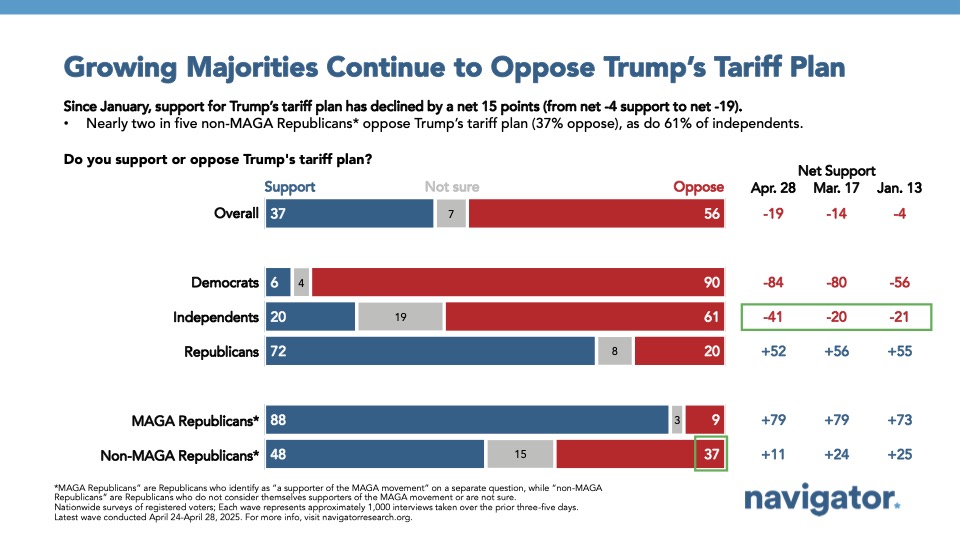
A majority of Americans oppose President Trump’s tariff plan (56 percent), an increase of 15 points since just prior to inauguration.

The most concerning aspect of the tariff plan is that costs will go up (62 percent), followed by the fact that these policies favor the rich over the middle class (59 percent). In Navigator’s recent focus groups among women without a college degree in Pennsylvania, concern about rising costs was prevalent, with one woman saying: “He needs to focus on the cost of living because the poor are just getting poorer and [there are] more and more homeless.”  

Two-thirds say that Trump’s policies have already caused costs to go up (67 percent), including three in five independents (62 percent). A substantial share say that costs have gone up “a lot” (40 percent). 
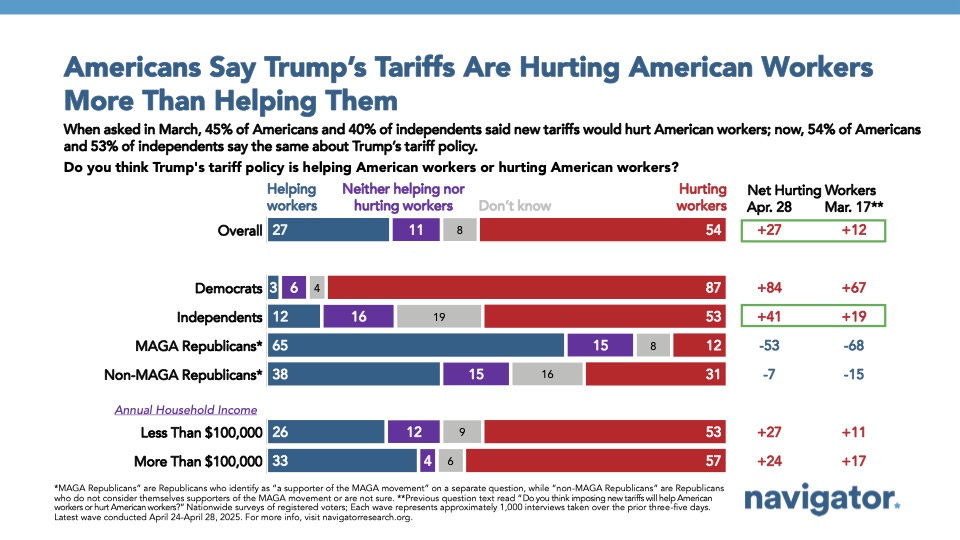
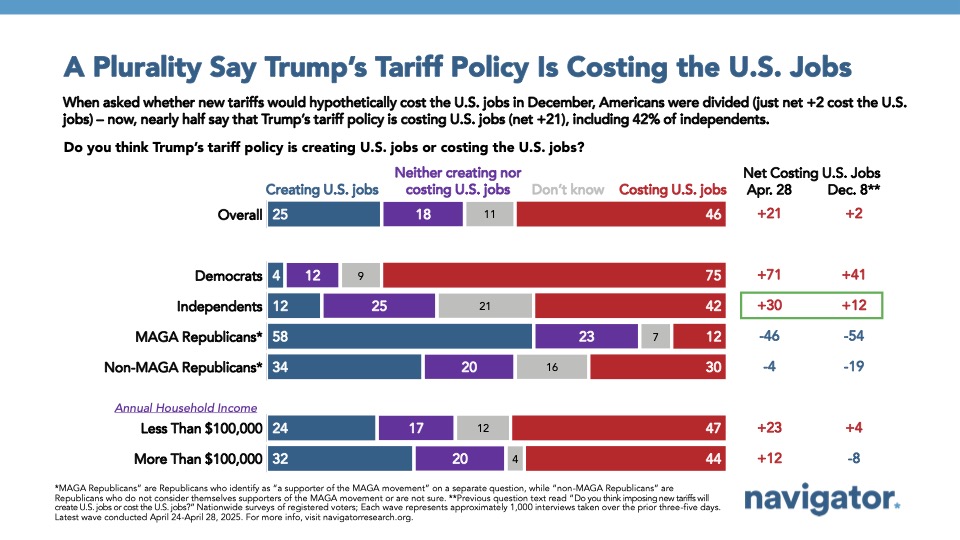
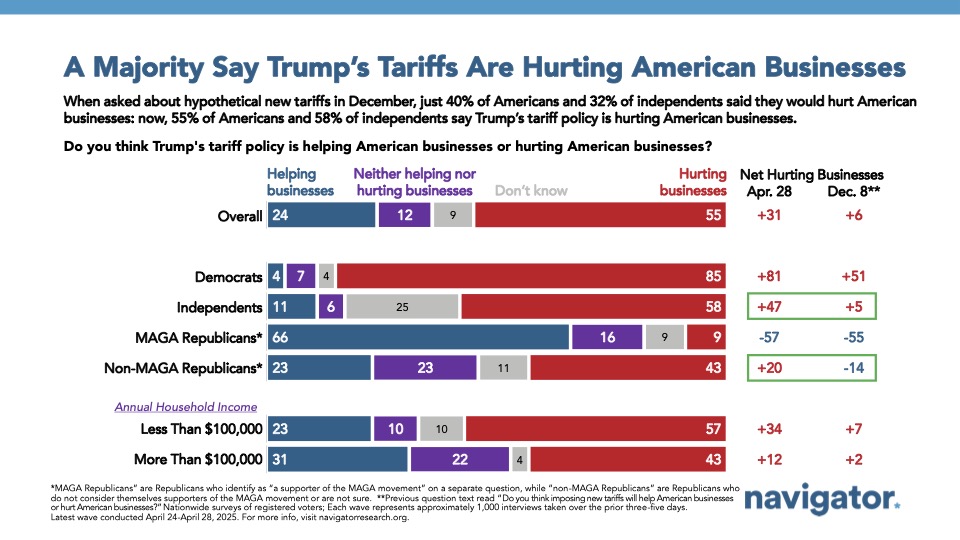
By a 21-point margin, a plurality of Americans say that Trump’s tariff policies are costing more U.S. jobs rather than creating them (46 percent). And by the same margin, a majority say that the policies are hurting American businesses more than they’re helping. Over half say Trump’s tariffs are hurting American workers more than helping them (54 percent), including a near identical share of independents (53 percent) and a fifth of Republicans (19 percent). 

As one Trump voter in Pennsylvania put it: “...our economy has just gone to shit.
An increasing majority of Americans say that Trump’s policies on tariffs and trade have been “mostly bad” for various groups and industries, including American consumers (58 percent), the automobile industry (52 percent), and American workers in general (52 percent). Americans also believe Trump’s tariffs have so far been mostly bad for small businesses (55 percent), the global economy (55 percent), and seniors with retirement accounts, like an IRA or 401(k) (52 percent). 
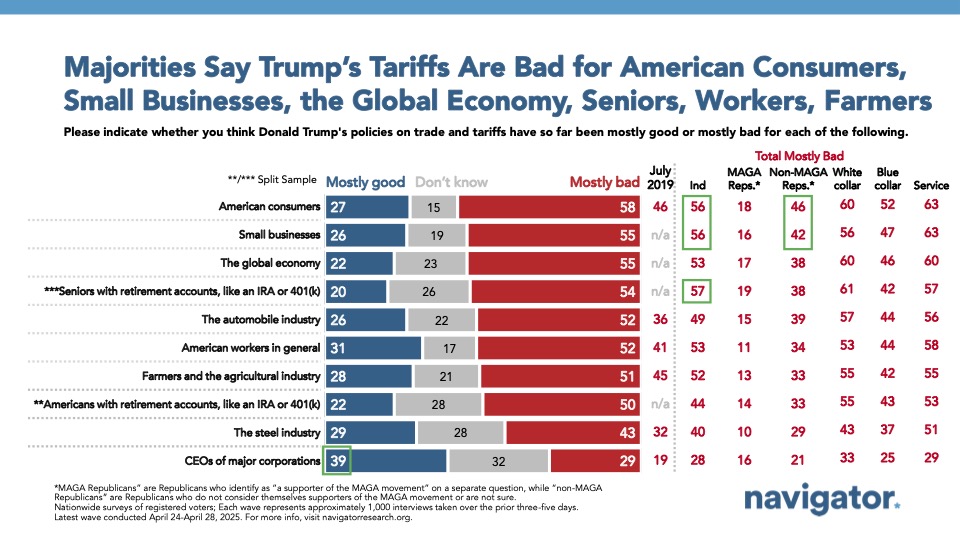
Nearly 60 percent of Americans say that American consumers, rather than foreign countries, are facing the brunt of negative effects from Trump’s tariffs.

This includes a majority of independents (55 percent) and a third of Republicans (33 percent). Each of these impacts is notably worse than when asked 5 years ago – during Trump’s first term

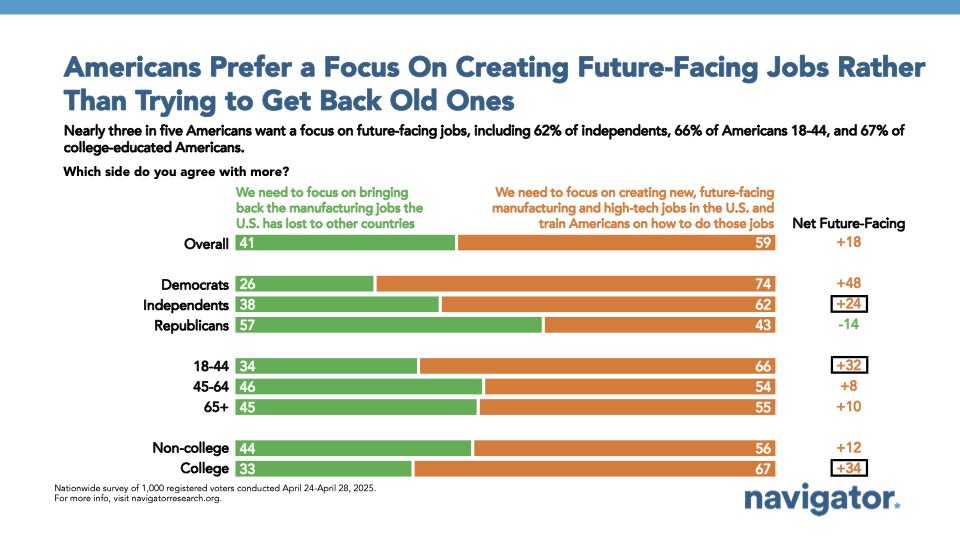
A majority prefer a focus on creating future-facing manufacturing jobs rather than trying to get back old ones (59 percent).

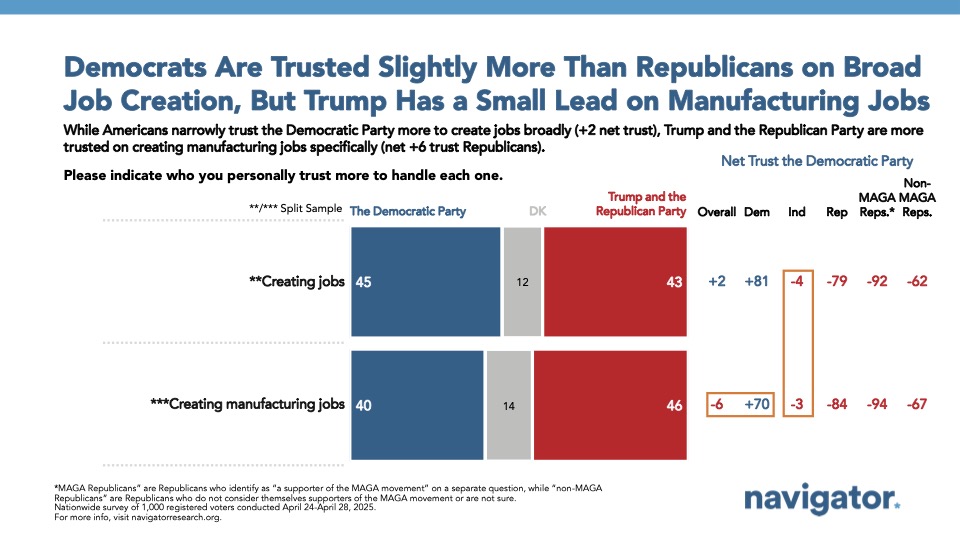
Despite this, Republican officials are more trusted when it comes to creating manufacturing jobs (40 percent Democrats – 46 percent Trump/Republicans), driven largely by Republicans, as they see tariffs as a tool, although painful, that can be used to bring back jobs. As one North Carolina Trump voter put it: “I think [the tariffs are] kind of like lifting weights and exercising. It hurts for a little while, but then you see the long-term benefits.”
Read More

June 4, 2026

Americans Are Split on How Safe our Food Is

This Navigator Research report covers perceptions of food safety and the health and wellness concerns that are top of mind for Americans.

Maryann Cousens
June 3, 2026

The Overreach Backfires: Battleground Americans Reject Abuse of Government Power

This Navigator Research report covers government weaponization, including which actions concern battleground constituents the most and how to message about them.

Julie Alderman Boudreau
June 2, 2026

SPECIAL REPORT: LGBTQ+ Americans on President Trump and the Country

This Navigator Research report covers economic sentiment among LGBTQ+ Americans and how they view President Trump’s job performance across a range of issues.

Maryann Cousens & Tina Tang
May 28, 2026

Focus Group Report: Black Americans on Leadership and Voting

This Navigator Research report covers focus groups that explored how Black Americans view the state of the country, elected leaders in Washington, and voting in the wake of the Supreme Court’s Callais decision.

Maryann Cousens
Download
Toplines
Share

About The Study

Global Strategy Group conducted a public opinion survey among a sample of 1,000 registered voters from April 24-April 28, 2025. 100 additional interviews were conducted among Hispanic voters. 68 additional interviews were conducted among Asian American and Pacific Islander voters. 100 additional interviews were conducted among African American voters. 100 additional interviews were conducted among independent voters. The survey was conducted online, recruiting respondents from an opt-in online panel vendor. Respondents were verified against a voter file and special care was taken to ensure the demographic composition of our sample matched that of the national registered voter population across a variety of demographic variables. The margin of error for the full sample at the 95 percent level of confidence is +/- 3.1 percentage points. The margin of error for subgroups varies and is higher.

Related Posts

READ MORE
June 04, 2026

Americans Are Split on How Safe our Food Is

This Navigator Research report covers perceptions of food safety and the health and wellness concerns that are top of mind for Americans.

Maryann Cousens
June 03, 2026

The Overreach Backfires: Battleground Americans Reject Abuse of Government Power

This Navigator Research report covers government weaponization, including which actions concern battleground constituents the most and how to message about them.

Julie Alderman Boudreau
June 02, 2026

SPECIAL REPORT: LGBTQ+ Americans on President Trump and the Country

This Navigator Research report covers economic sentiment among LGBTQ+ Americans and how they view President Trump’s job performance across a range of issues.

Maryann Cousens & Tina Tang
May 28, 2026

Focus Group Report: Black Americans on Leadership and Voting

This Navigator Research report covers focus groups that explored how Black Americans view the state of the country, elected leaders in Washington, and voting in the wake of the Supreme Court’s Callais decision.

Maryann Cousens