Poll: Medication Abortion
This Navigator Research report contains polling data on perceptions of the latest attacks on abortion medication, including the most concerning aspects of restricting access to FDA-approved abortion medication.
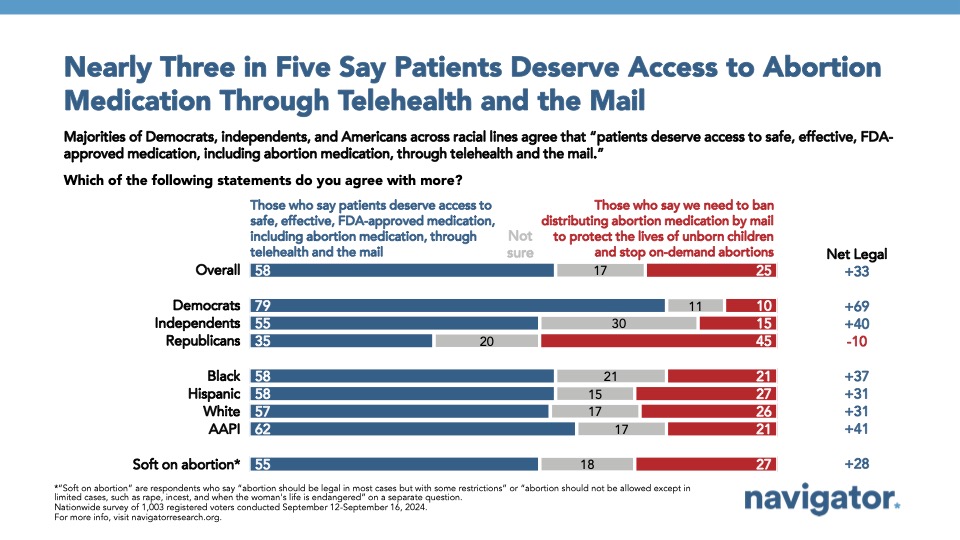
Three in five Americans agree that patients deserve access to abortion medication through telehealth and the mail.
By a 33-point margin, Americans overwhelmingly agree more with those who say “patients deserve access to safe, effective, FDA-approved medication, including abortion medication, through telehealth and the mail” (58 percent) over those who say “we need to ban distributing abortion medication by mail to protect the lives of unborn children and stop on-demand abortions” (25 percent). Four in five Democrats (79 percent), a majority of independents (55 percent), and over a third of Republicans (35 percent) agree patients deserve access to abortion medication. 17 percent say they are not sure which they agree with most, including 30 percent of independents and 20 percent of Republicans.
A majority of Americans who believe abortion should only be legal sometimes (either legal with some restrictions or illegal with some exceptions) also agree that Americans deserve access to abortion medication (net +28; 55 percent deserve access – 27 percent ban abortion).
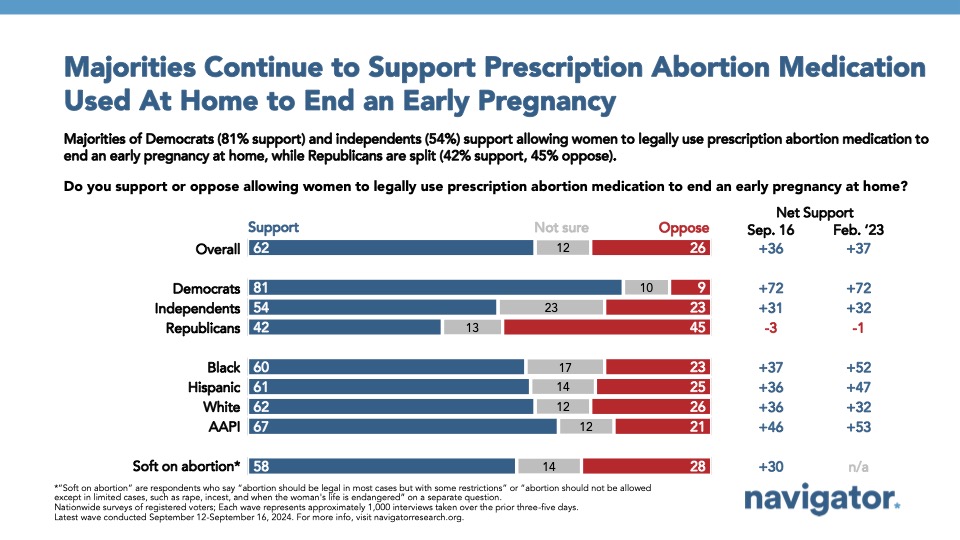
62 percent of Americans support allowing women to legally use prescription abortion medication to end an early pregnancy at home, including 81 percent of Democrats and 54 percent of independents. Republicans are narrowly divided by a 3-point margin (42 percent support – 45 percent oppose).
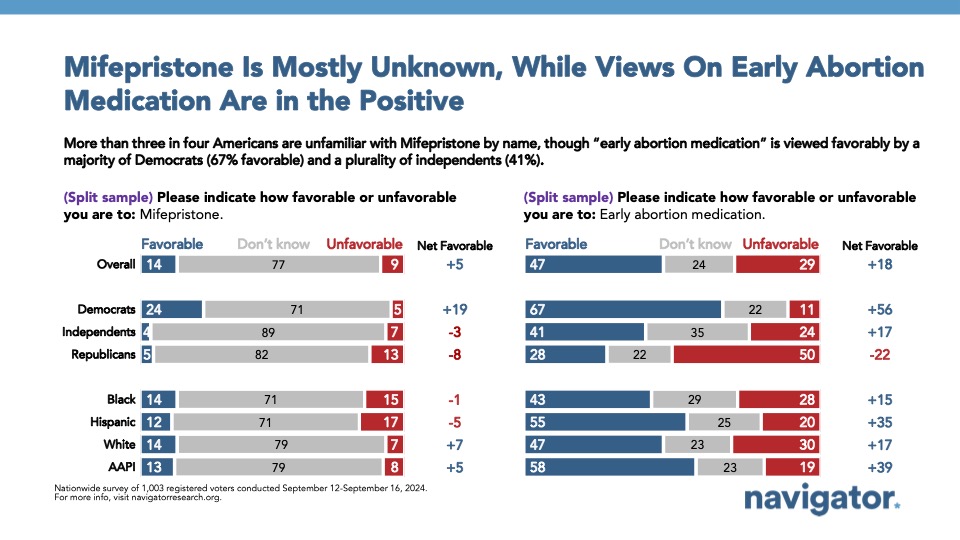
By an 18-point margin, Americans view early abortion medication favorably (47 percent favorable – 29 percent unfavorable), including two in three Democrats (67 percent) and a plurality of independents (41 percent). Just 22 percent are familiar with Mifepristone (14 percent favorable – 9 percent unfavorable), with Democrats most familiar (29 percent), compared to just 12 percent of independents and 18 percent of Republicans.
Two in three Americans are concerned that restrictions on abortion medication would insert politicians and courts into decisions that should be made by women and doctors.
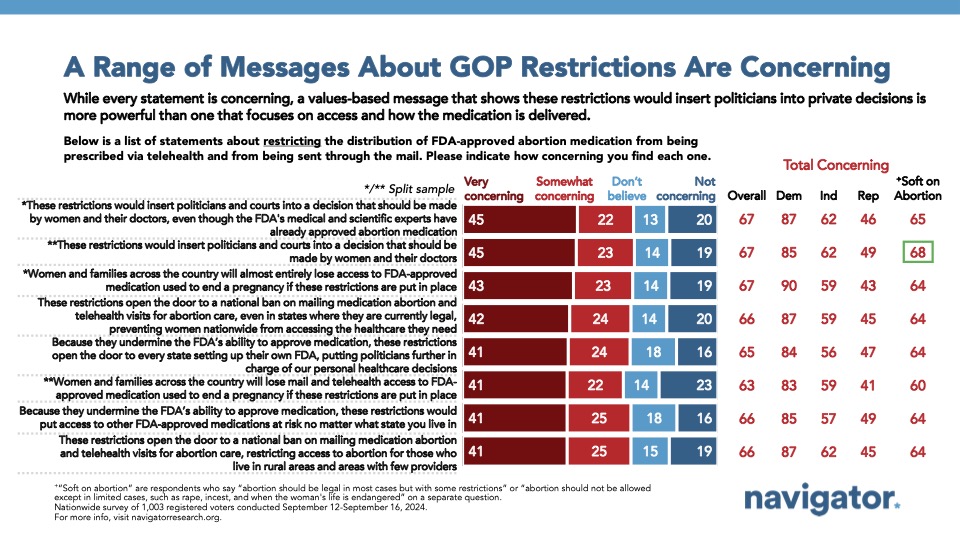
Two in three Americans are concerned that restrictions on abortion medication would insert politicians and courts into decisions that should be made by women and doctors. Among a list of statements about restricting the distribution of FDA-approved abortion medication, at least two in three Americans were concerned by the following:
These restrictions would insert politicians and courts into a decision that should be made by women and their doctors (67 percent find this concerning, including 68 percent of those who believe abortion should only be legal sometimes);
Women and families across the country will almost entirely lose access to FDA-approved medication used to end a pregnancy if these restrictions are put in place (67 percent find this concerning, including 64 percent of those who believe abortion should only be legal sometimes);
Because they undermine the FDA’s ability to approve medication, these restrictions open the door to every state setting up their own FDA, putting politicians further in charge of our personal healthcare decisions (66 percent find this concerning, including 64 percent of those who believe abortion should only be legal sometimes); and,
Because they undermine the FDA’s ability to approve medication, these restrictions would put access to other FDA-approved medications at risk no matter what state you live in (66 percent find this concerning, including 64 percent of those who believe abortion should only be legal sometimes).