The Vast Majority of Americans Think Democracy is Broken
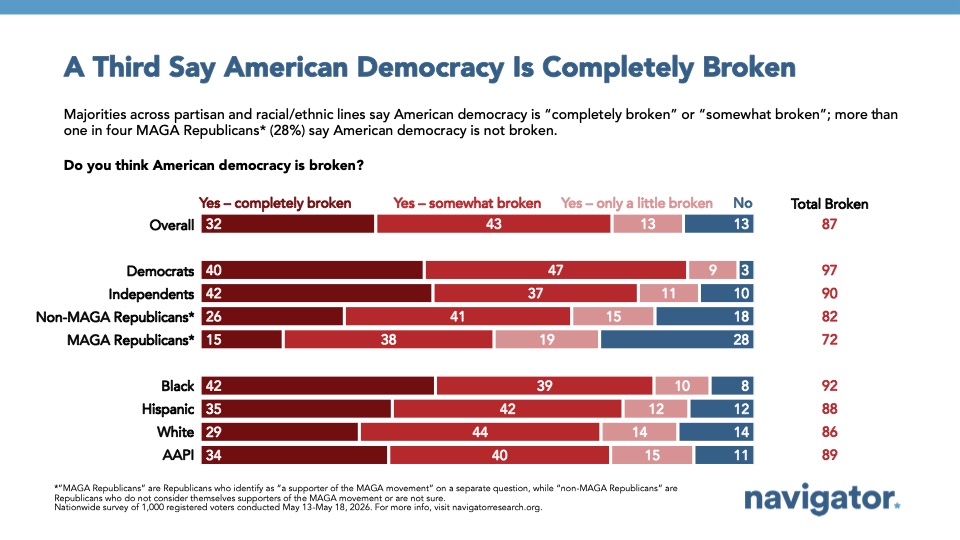
Nearly nine-in-10 (87%) say our democracy is broken. This includes 90% of independents and 72% of MAGA Republicans who say American democracy is at least a little broken. The plurality (43%) say U.S. democracy is only somewhat broken while nearly a third (32%) say it is completely broken. Just 13% of respondents say our democracy is not broken.
At least 65% of people across every demographic – age, gender, political party, education level, and income, among others – say American democracy is at least somewhat broken.
Most Think Political and Economic Systems Need Major Changes
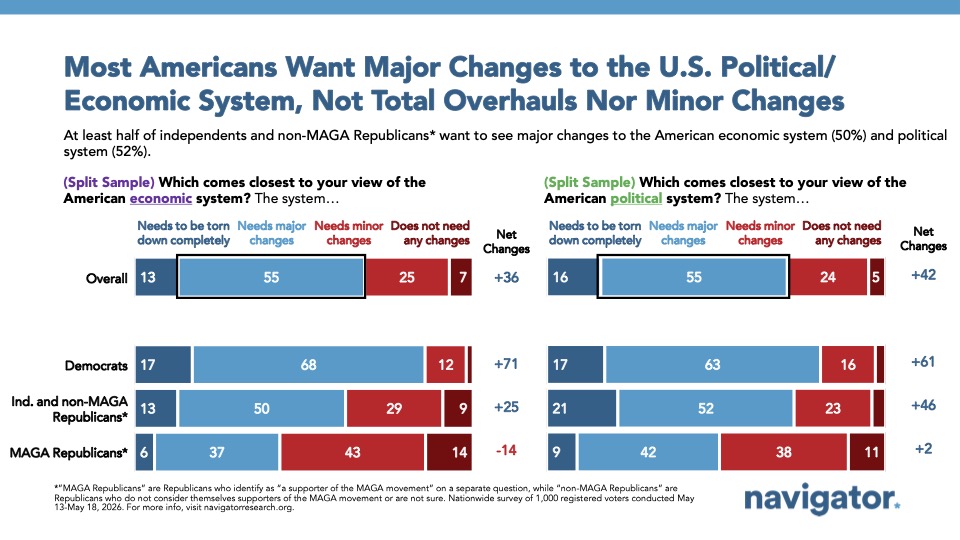
A majority think the American economic system needs major changes (55% major changes) while 13% say the system needs to be torn down completely. A quarter (25%) say the economic system only needs minor changes while just 7% say it needs no changes at all.
55% of Americans say the political system needs major changes while 16% want it torn down completely. Just 29% say only minor changes or no changes are needed (24% minor changes – 5% no changes). These results are relatively unchanged from when Navigator asked this in April 2025 (13% torn down completely – 59% major changes – 29% minor or no changes), demonstrating the desire for institutional change remains high.
Republicans are nine points more likely to say the political system needs at least major changes than they are to say the same about the economic system (48% at least major changes to the economic system – 57% at least major changes to the political system).
Americans See Both Parties Focused On Change, but Are Split On Whether That Change is Good or Bad
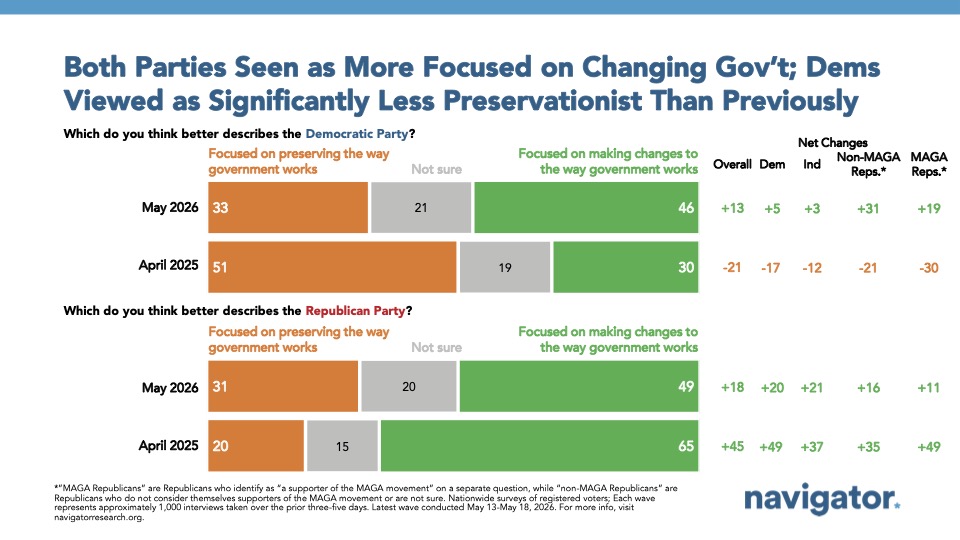
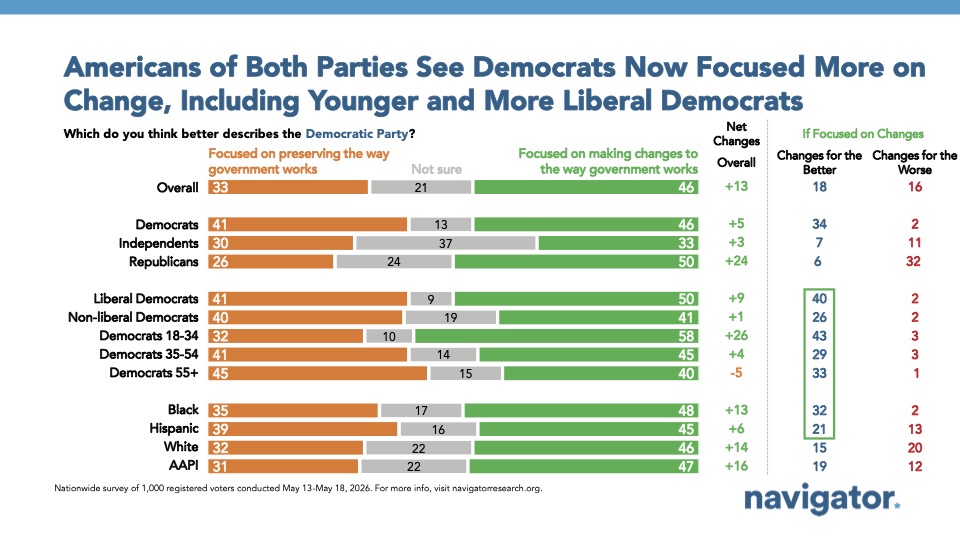
A plurality of Americans see both Democrats and Republicans focused on making changes to the way government works, rather than preserving the way it works (Democrats: 33% preserving – 46% changing, Republicans: 31% preserving – 49% changing). Both parties have seen major shifts from when Navigator last asked this question in April 2025.
In April 2025, a slight majority of Americans (51%) said Democrats were focused on preserving the way that government works, compared to just 33% today, a swing of 18 points towards being focused on change.
Since April 2025, the portion of Americans who say Republicans are focused on preserving the way that government works has increased by 11 points (April 2025: 20% preserving – May 2026: 31% preserving), while fewer see Republicans as trying to change the way the government works.
Americans are split on whether the changes each party is pursuing are for better or worse. Among those who see Democrats as focused on changing how government works, slightly more say those changes are positive (18%) than negative (16%), with 11% saying it’s a mix of both. Republicans face a more skeptical read: among those who see the GOP driving change, more say it’s for the worse (22%) than for the better (17%).
Notably, more independents think both Democrats and Republicans are changing things for the worse, however they feel more negatively about Republicans (Democrats: 11% change for the worse – Republicans: 21% change for the worse).
Americans Name the Political and Immigration Systems and Congress as the Most Broken
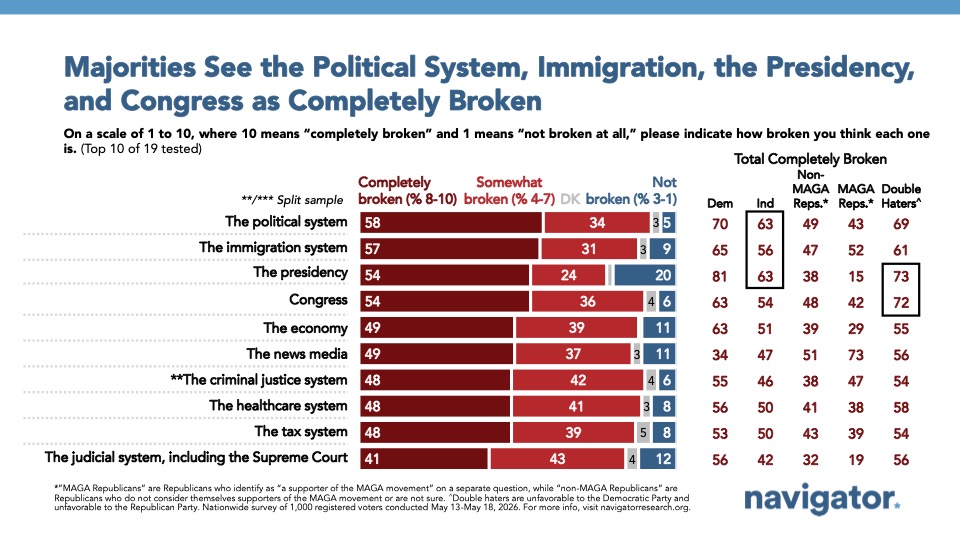
When given a list of institutions and systems in American life, people rated the political system, the immigration system, the presidency, and Congress as the most broken (political system: 58% broken – immigration system: 57% broken – presidency: 54% broken – Congress: 54% broken).
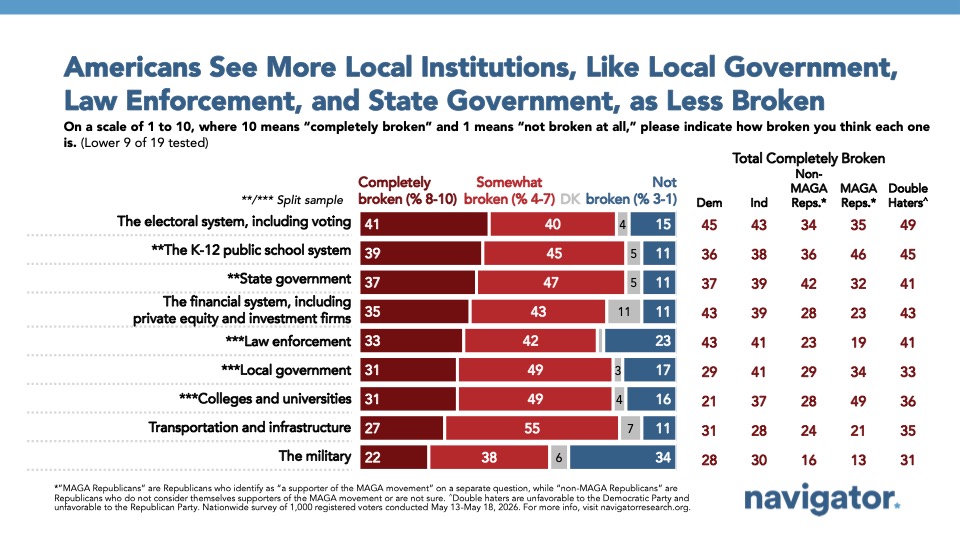
Americans are less likely to say localized institutions are broken. While 54% say Congress and the presidency are broken, less than two-in-five said the same about state and local government (State government: 37% broken – local government: 31% broken). Similarly, as 48% say the criminal justice system is broken, only 33% say the same about law enforcement.
Among the items Navigator tested, the military was the only institution to have more people say it was not broken than broken (34% not broken – 22% broken), although a plurality (38%) said it was somewhat broken.
Many Americans Don’t Trust Either Party To Fix Broken Systems
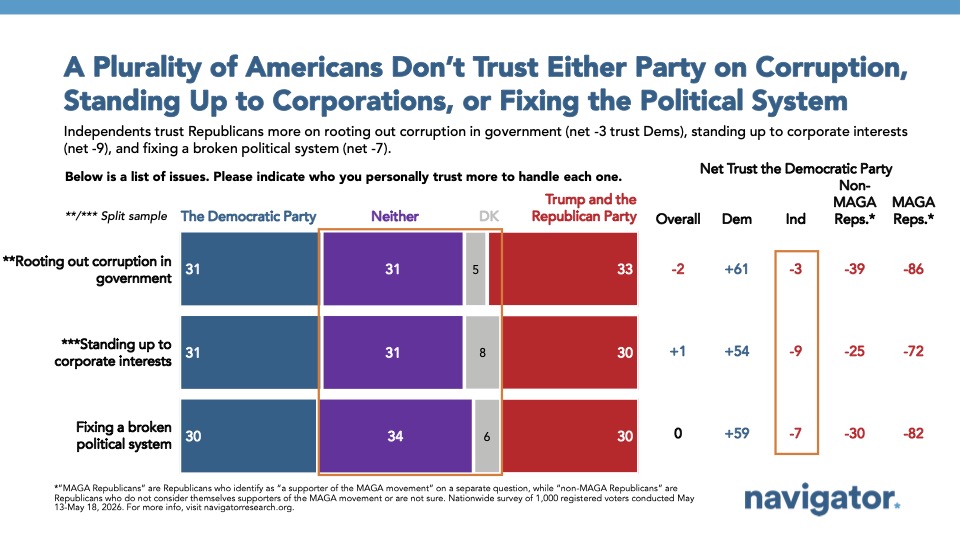
While Americans are evenly split on whether Democrats or Republicans can be trusted to fix a broken political system (30% Democrats – 30% Republicans), a plurality (34%) think neither party can be trusted to fix it, and 6% don’t know.
Three-in-five independents (61%) say they trust neither party to fix a broken system, however those who did choose a party gave Republicans a seven-point advantage (9% Democrats – 16% Republicans).
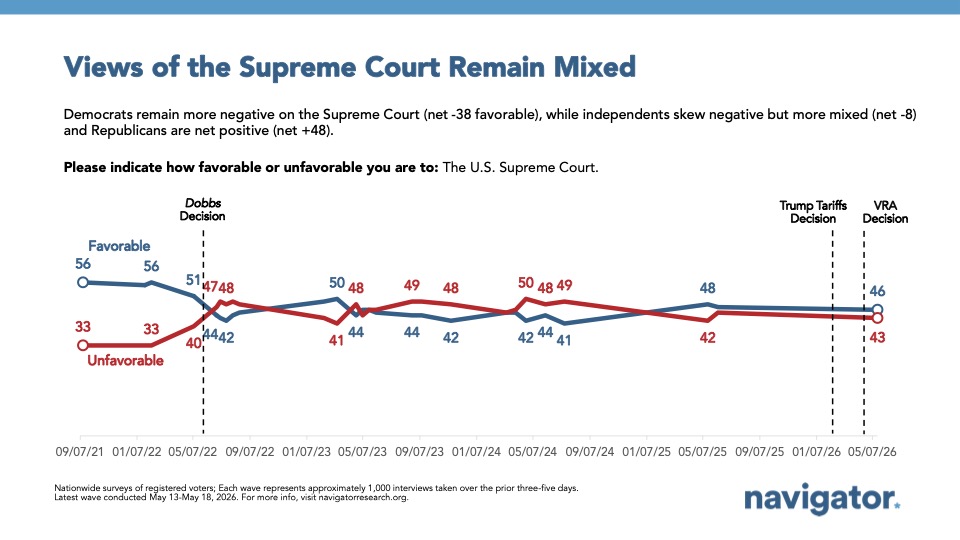
Despite major rulings from the court this year on tariffs and most recently the Voting Rights Act, Americans have remained mixed on their views of the Supreme Court. Notably, views on the court have remained largely stagnant in Navigator tracking since May 2022, when the case to overturn abortion rights was decided in Dobbs v. Jackson Women’s Health Organization. Prior to Dobbs, a majority of Americans (56%) viewed the court favorably, since Dobbs, favorability of the Supreme Court has not moved past 50%.
Americans Narrowly Trust The Supreme Court To Make The Right Decisions
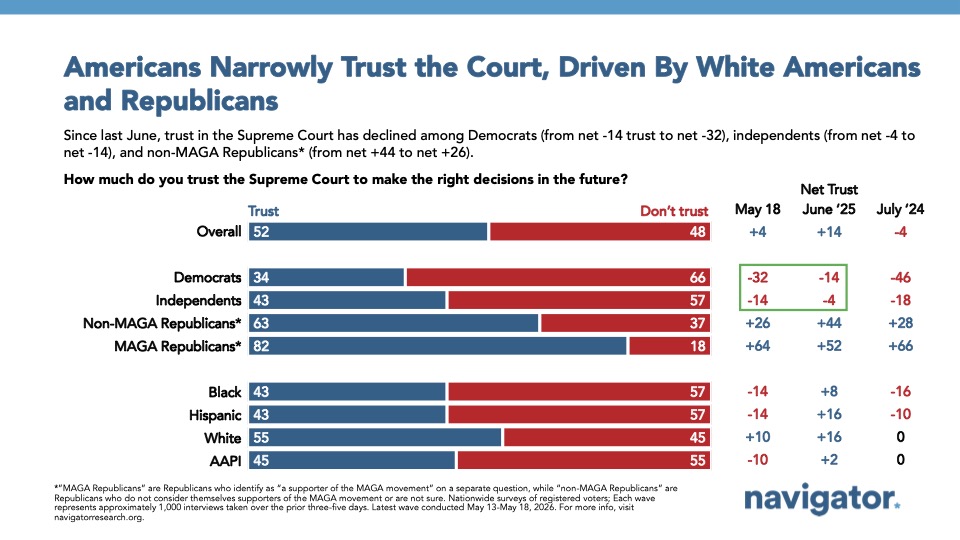
A narrow majority (52%) of Americans say they trust the Supreme Court to make the right decisions, while 48% do not trust the court, including a majority of independents (57%) and majorities of non-white Americans.
Americans generally believe that the Supreme Court is middle of the road (37%), though a third (34%) believe it is too conservative. Just 15% believe it is too liberal.
Democrats Have A Trust Advantage On SCOTUS Reform, Though Many Have Yet To Make Up Their Minds
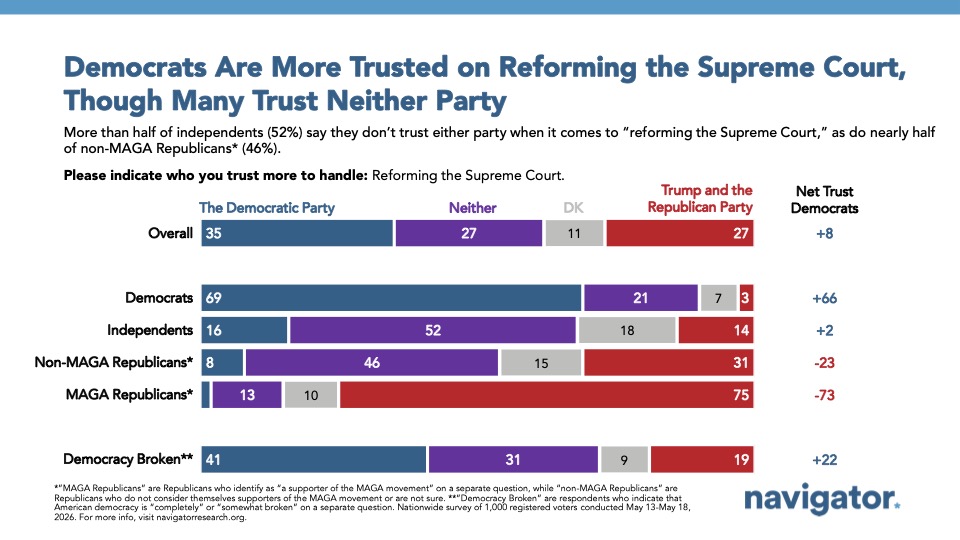
Americans generally trust the Democratic Party (35%) to reform the Supreme Court, however, just over a quarter (27%) do not trust either party and double digits (11%) do not know. However, among those who say our democracy is broken, 41% trust Democrats more to reform the Supreme Court, while 31% do not trust either.
Supreme Court Reforms Are Broadly Popular
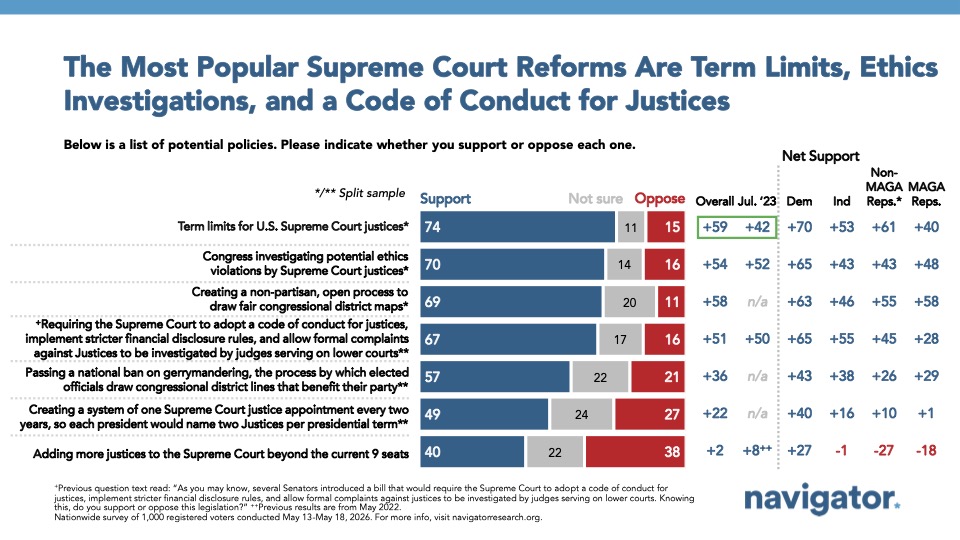
Americans broadly support a variety of Supreme Court reforms. The most popular reforms include term limits for justices (74% support, net +59 overall, up from +42 in July 2023) and Congress investigating SCOTUS ethics violations (70% support, net +54 overall). Expanding the court is only supported by a plurality of Americans (40%), driven mostly by Democratic support (+27 support), while remaining unpopular with independents (-1 support) and non-MAGA Republicans (-27 support).
Navigator recently published data on Americans’ views of Louisiana v. Callais, you can read that report here.
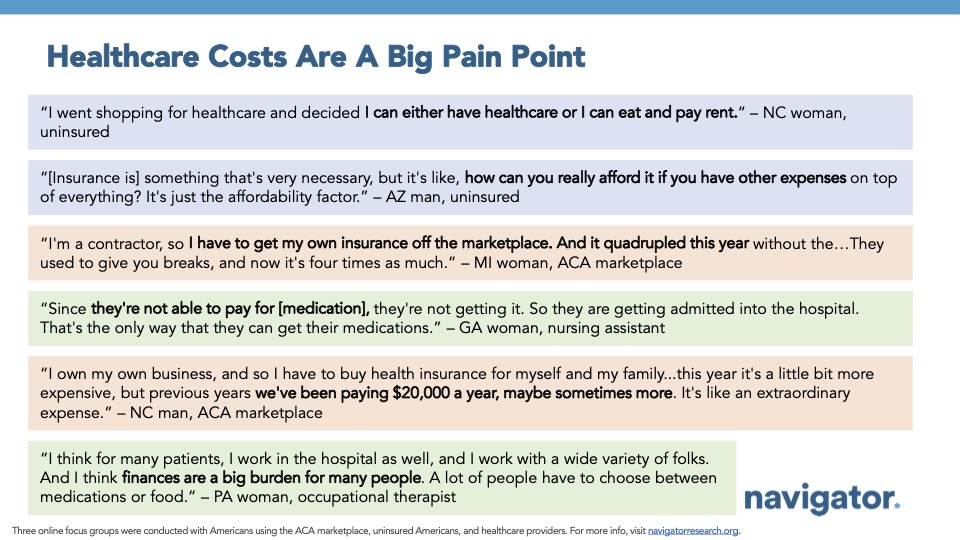
Participants cited healthcare costs as a major financial stressor in their lives, with many saying costs have increased to such an extent they have to choose between healthcare and other necessities.
“I went shopping for healthcare and decided I can either have healthcare or I can eat and pay rent.” – NC woman, uninsured
“I’m a contractor, so I have to get my own insurance off the marketplace. And it quadrupled this year…They used to give you breaks, and now it’s four times as much.” – MI woman, ACA marketplace
Many Attribute Increase in Costs to Republican Budget Bill
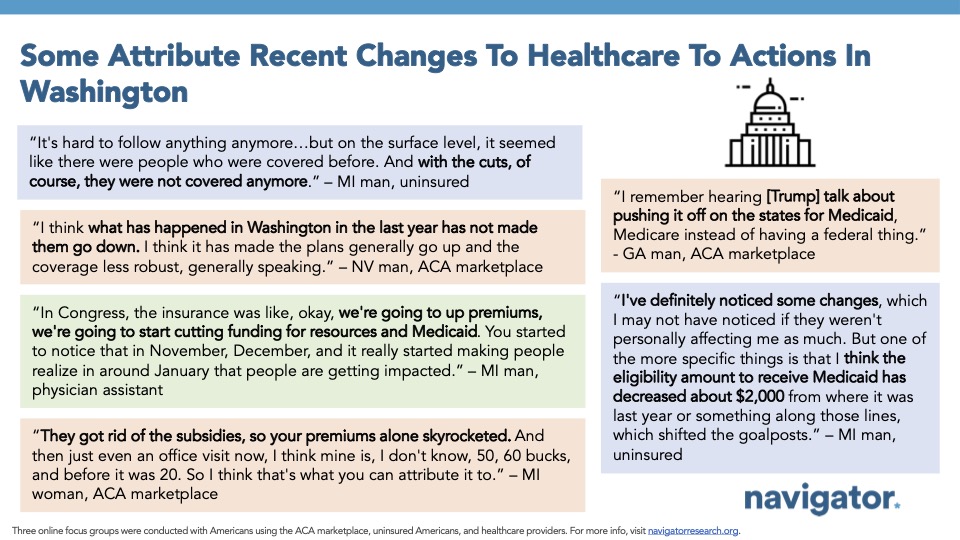
Without priming, some participants organically brought up the Republican tax law, also known as the One Big Beautiful Bill Act, as a culprit for their most recent rise in healthcare costs.
“They got rid of the subsidies, so your premiums alone skyrocketed. And then just even an office visit now, I think mine is, I don’t know, 50, 60 bucks, and before it was 20. So I think that’s what you can attribute it to.” – MI woman, ACA marketplace
“I think what has happened in Washington in the last year has not made them go down. I think it has made the plans generally go up and the coverage less robust, generally speaking.” – NV man, ACA marketplace
Most Say they Avoid Going to the Doctor
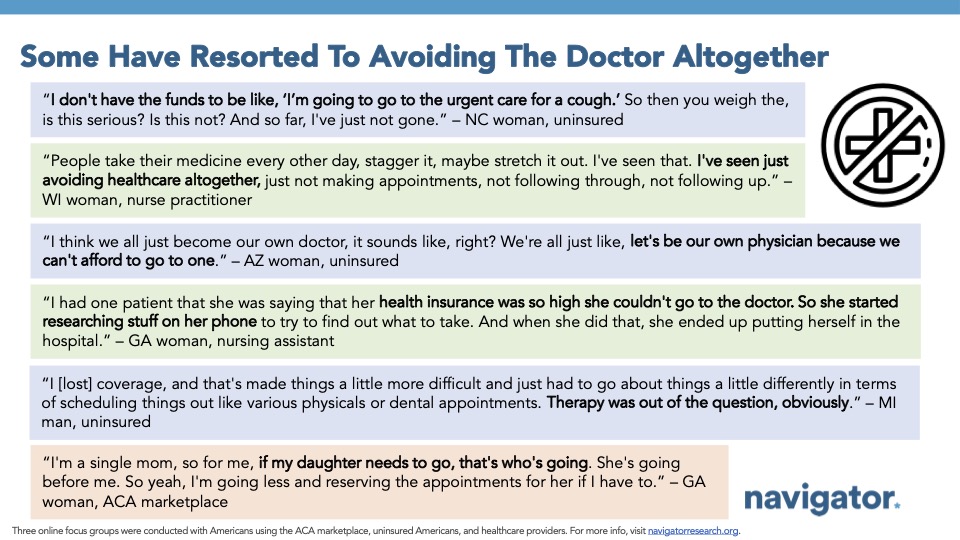
Avoiding doctor visits is a primary strategy for saving on healthcare costs, with many saying something catastrophic would have to occur for them to seek medical care.
“I’m a single mom, so for me, if my daughter needs to go, that’s who’s going. She’s going before me. So yeah, I’m going less and reserving the appointments for her if I have to.” – GA woman, ACA subsidies
“I don’t have the funds to be like, ‘I’m going to go to the urgent care for a cough.’ So then you weigh the, is this serious? Is this not? And so far, I’ve just not gone.” – NC woman, uninsured
Participants Cite Range of Strategies for Avoiding Health Care System Altogether
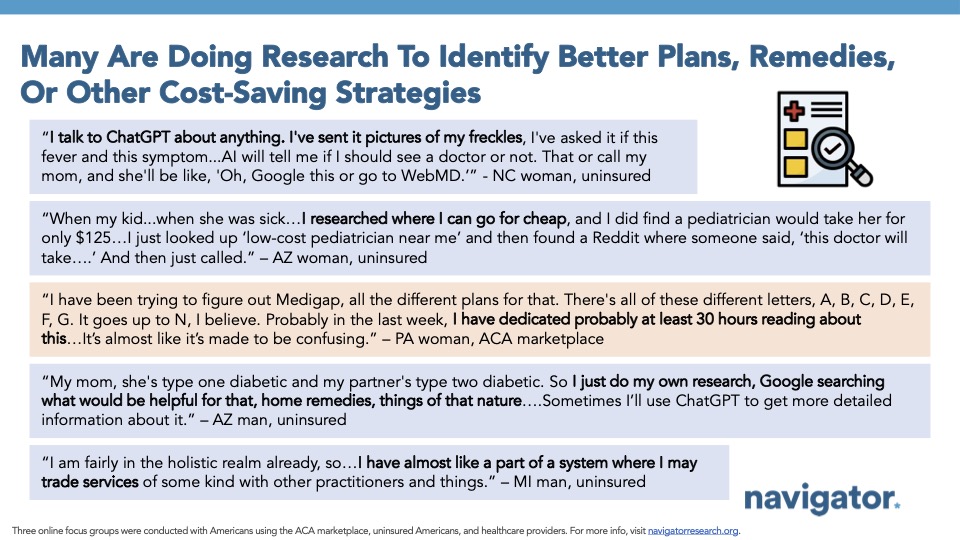
From AI to holistic remedies to spending hours on research, participants have found ways to cope with their lack of access to affordable healthcare options.
“I talk to ChatGPT about anything. I’ve sent it pictures of my freckles, I’ve asked it if this fever and this symptom…AI will tell me if I should see a doctor or not. That or call my mom, and she’ll be like, ‘Oh, Google this or go to WebMD.'” – NC woman, uninsured
“I have been trying to figure out Medigap, all the different plans for that. There’s all of these different letters, A, B, C, D, E, F, G. It goes up to N, I believe. Probably in the last week, I have dedicated probably at least 30 hours reading about this…It’s almost like it’s made to be confusing.” – PA woman, ACA marketplace
Insurance Companies Seen as Obvious Villain
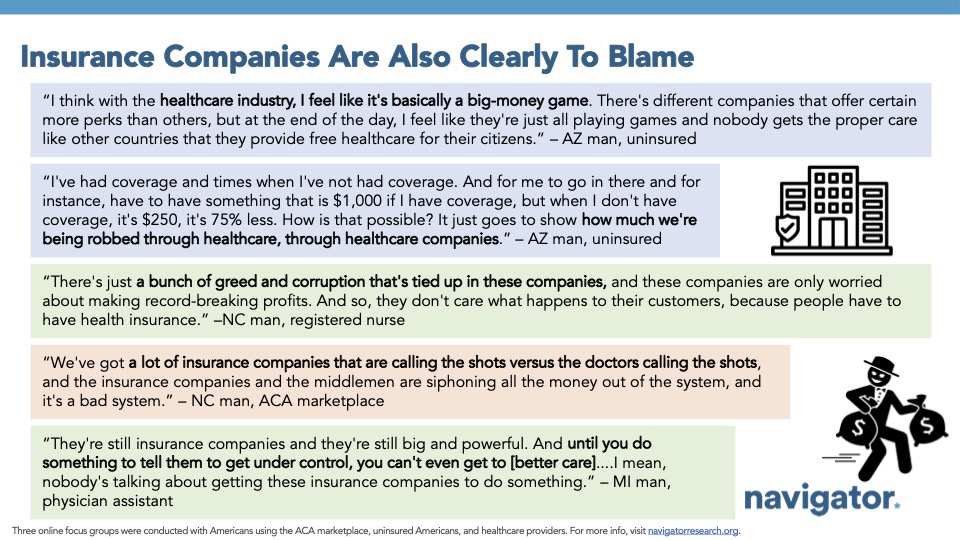
Though the Republican tax law is seen as responsible for recent hikes in healthcare costs, insurance companies are seen as the real villains of a broken healthcare system.
“I’ve had coverage and times when I’ve not had coverage. And for me to go in there and for instance, have to have something that is $1,000 if I have coverage, but when I don’t have coverage, it’s $250, it’s 75% less. How is that possible? It just goes to show how much we’re being robbed through healthcare, through healthcare companies.” – AZ man, uninsured
“We’ve got a lot of insurance companies that are calling the shots versus the doctors calling the shots, and the insurance companies and the middlemen are siphoning all the money out of the system, and it’s a bad system.” – NC man, ACA marketplace
Neither Party Seen as Fighting to Fix Healthcare
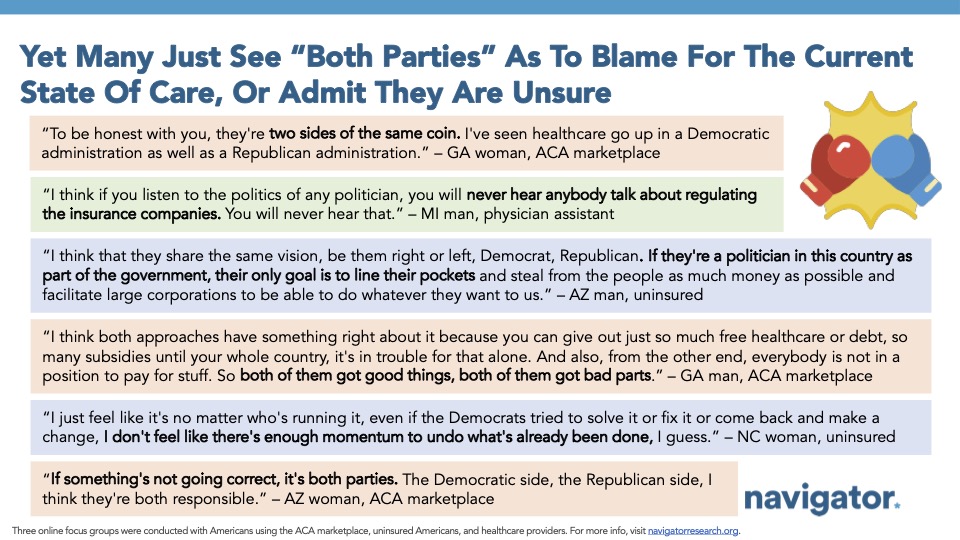
Participants expressed feeling like nobody in Washington is fighting for them – no matter the political party. Many felt hopeless that either party could solve the deep-rooted issues within the U.S. healthcare system because many politicians are perceived as beholden to corporate or donor interests instead of helping everyday people.
“I just feel like it’s no matter who’s running it, even if the Democrats tried to solve it or fix it or come back and make a change, I don’t feel like there’s enough momentum to undo what’s already been done, I guess.” – NC woman, uninsured
“I think that they share the same vision, be them right or left, Democrat, Republican. If they’re a politician in this country as part of the government, their only goal is to line their pockets and steal from the people as much money as possible and facilitate large corporations to be able to do whatever they want to us.” – AZ man, uninsured
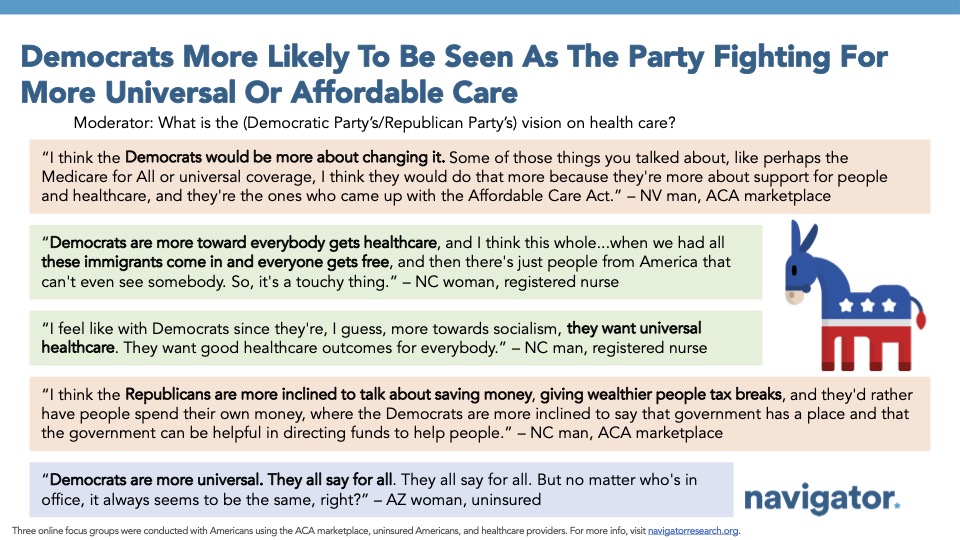
Democrats Seen as More Likely to Fix the Healthcare System
Participants associated affordable and universal healthcare plans with Democrats, saying it’s more aligned with their platform. Skepticism remained on Democrats’ ability to execute healthcare plans.
“I think the Democrats would be more about changing it. Some of those things you talked about, like perhaps the Medicare for All or universal coverage, I think they would do that more because they’re more about support for people and healthcare, and they’re the ones who came up with the Affordable Care Act.” – NV man, ACA marketplace
“Democrats are more universal. They all say for all.They all say for all. But no matter who’s in office, it always seems to be the same, right?” – AZ woman, uninsured
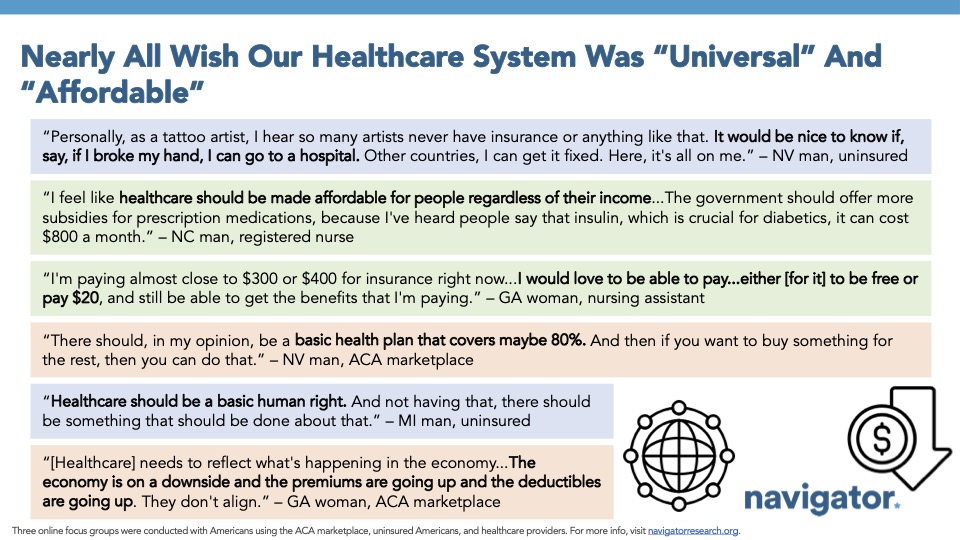
Participants Say Change is Needed, Universal Healthcare Seen as Obvious Solution
Nearly every participant said they wished healthcare was universal – which carried a range of definitions across participants – but boiled down to a basic healthcare plan that all Americans could afford no matter their job or income level.
“There should, in my opinion, be a basic health plan that covers maybe 80%. And then if you want to buy something for the rest, then you can do that.” – NV man, ACA marketplace
“Healthcare should be a basic human right. And not having that, there should be something that should be done about that.” – MI man, uninsured
“Personally, as a tattoo artist, I hear so many artists never have insurance or anything like that. It would be nice to know if, say, if I broke my hand, I can go to a hospital. Other countries, I can get it fixed. Here, it’s all on me.” – NV man, uninsured
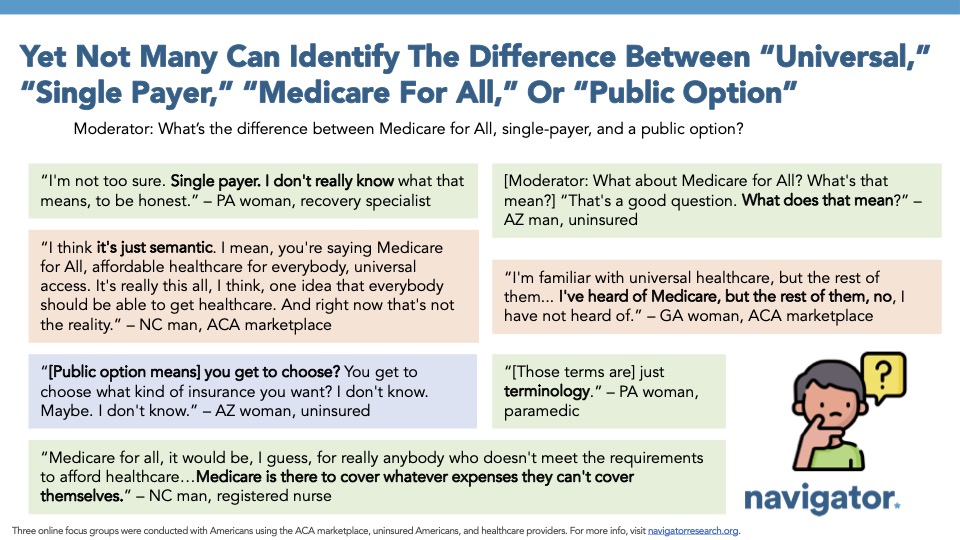
Participants Don’t Know the Difference Between “Universal,” “Single Payer,” “Medicare for All” or “Public Option”
Though some form of universal healthcare was seen as a solution to fixing the healthcare system, few could define “universal,” “single payer,” “Medicare for all,” and “public option.” Communicators need to keep this in mind, while Washington may be debating what is the best branding for this fight, Americans are concerned about access and cost of healthcare.
“I’m familiar with universal healthcare, but the rest of them…I’ve heard of Medicare, but the rest of them, no, I have not heard of.” – GA woman, ACA marketplace
[Moderator: What about Medicare for All? What’s that mean?] “That’s a good question. What does that mean?” – AZ man, uninsured
Part 1 of this report covers the first two groups: those insured through the ACA marketplace and those who are uninsured. Part 2 will summarize the findings from our patient-facing healthcare provider group.
This Navigator Research report covers shifting public sentiment on immigration, Trump’s handling of immigration and deportations, and the deployment of ICE following the shooting of Renee Good in Minnesota.
Favorability and Awareness of ICE
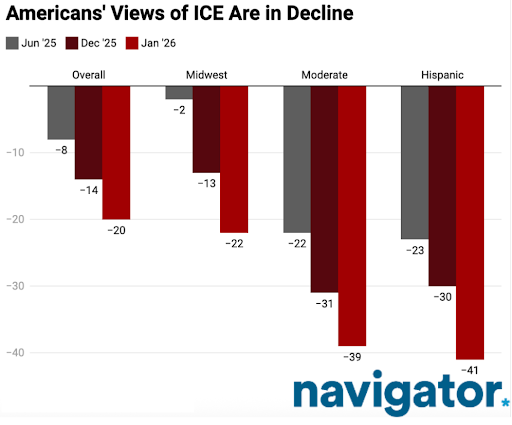
Americans’ perception of Immigration and Customs Enforcement, or ICE, has deteriorated over the past month – going from a favorability rating of net -8 in June to net -14 in December to net -20 in January, following the shooting of Renee Good. The story of Renee Good’s shooting broke through to overwhelming majorities (78% heard a lot/some), even among passive news consumers, or those who say news comes to them (65% heard a lot/some).
Favorability of ICE has taken an even sharper turn among those who have heard the news of the shooting of Renee Good compared to those who have heard less about the news (have heard the news: 58% unfavorable, have not heard the news: 49% unfavorable). Other groups who have seen stark drop offs in ICE’s favorability are Hispanic Americans (from net -23 in June, to net -30 in December, to now net -41), those living in the Midwest (from net -2 in June, to net -13 in December, to now net -22), and moderates (from net -22 in June, to net -31 in December, to now net -39).
ICE’s Aggression and Fractures within Republican Party
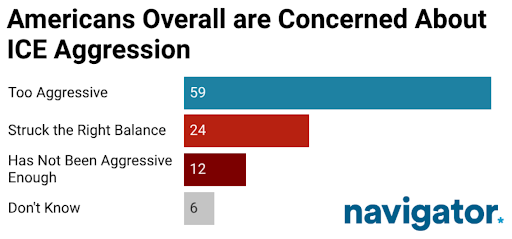
Majorities believe ICE has been too aggressive in their actions (59% too aggressive – 24% balanced – 12% not aggressive enough). In June 2025, amid ongoing protests against ICE in Los Angeles, Navigator found that 52% believed Trump’s deportation efforts had gone too far and 31% thought they struck the right balance.
Republicans have begun to fracture on the issue of ICE, with more Republican women now saying ICE has been too aggressive (35% too aggressive – 33% struck the right balance – 20% not aggressive enough). Similarly, a majority of Catholic Americans, a slightly Republican-leaning group (46% lean Republican – 44% lean Democrat), believe ICE has been too aggressive in their actions (59% too aggressive – 27% struck the right balance – 13% not aggressive enough).
From Focus Groups
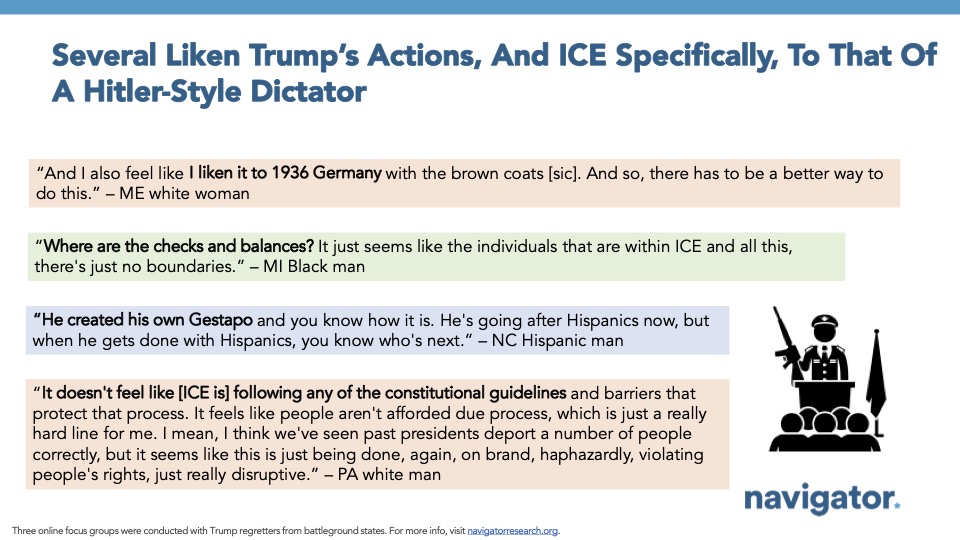
Navigator held focus groups days after an ICE officer shot and killed Renee Good in Minneapolis. ICE enforcement and the shooting are top of mind for many, especially for Latino Americans. Others say raids and deportations are hitting close to home.
“It’s just been kind of disgusting what happens because of the domino effect of ICE getting $4 billion jumping up there, how much they have now to spend and use.” – AZ Hispanic man
“He created his own Gestapo and you know how it is. He’s going after Hispanics now, but when he gets done with Hispanics, you know who’s next.” – NC Hispanic man
“Where are the checks and balances? It just seems like the individuals that are within ICE and all this, there’s just no boundaries.” – MI Black man
This Navigator Report contains new research from our latest survey conducted August 21 - 24 concerning Americans’ views on corruption, who and what they see as most corrupt, and which systems are broken and need change.
This Navigator Research report covers the latest views of President Trump’s first year in office, including how Americans think his policies have impacted the country, and how they would rate his performance as President.
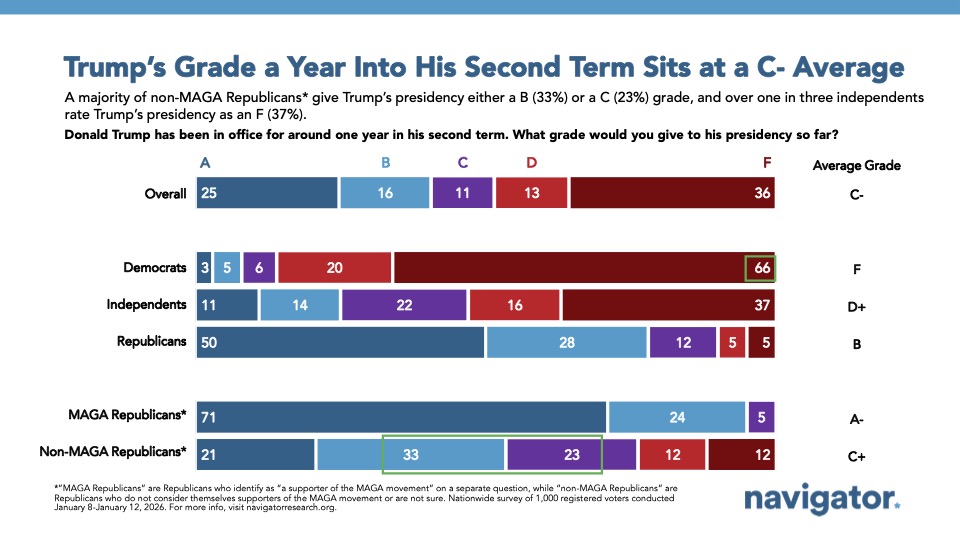
Americans Give Trump a C- Average
Trump gave his economy an “A+++++,” but Americans do not agree. They give Trump a C- average a year into his second term and give his economy the same grade. When rating Trump’s first year in office, over one-third of people give Trump an “F” (36%), including 37% of independents. Averaging out his grades, Trump scores a 1.78 GPA overall with Americans. Trump’s economy gets a 1.88 GPA, or C- average.
Majorities continue to disapprove of how President Trump handles the economy, inflation, and the presidency overall. 56% disapprove of both his handling of the economy and the presidency overall, while 58% disapprove of his handling of inflation and the cost of living. Among those disapproving of his handling of inflation are 44% of non-MAGA Republicans and 66% of independents.
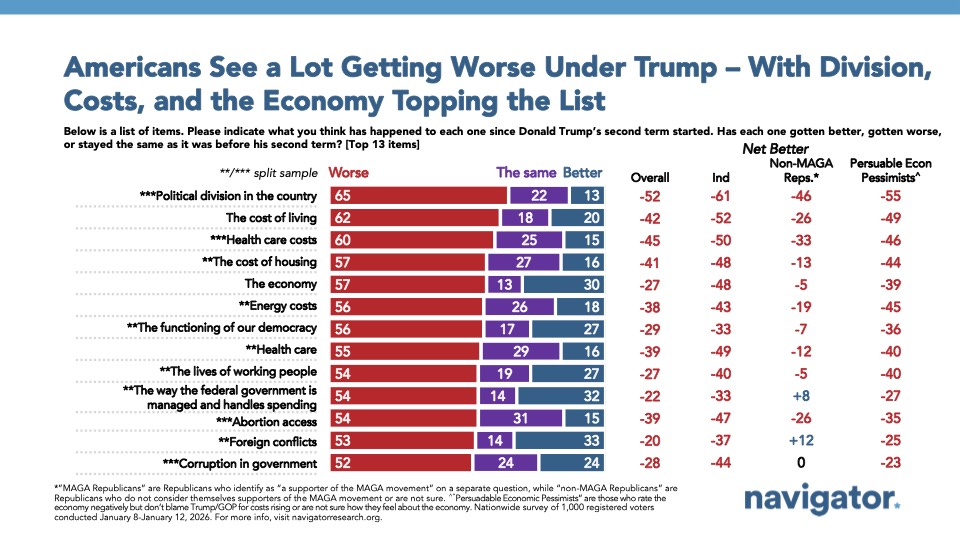
Political Division and Costs Worse Under Trump
Nearly two-thirds believe political division has gotten worse during the first year of President Trump’s second term (65%), including 47% who say it has gotten “a lot” worse. Majorities also say the cost of living and health care costs have gotten worse under Trump (62% and 60%, respectively). When it comes to non-cost related metrics, 56% believe the functioning of our democracy has deteriorated and 54% say the lives of working people have gotten worse, including 50% of middle class Americans.
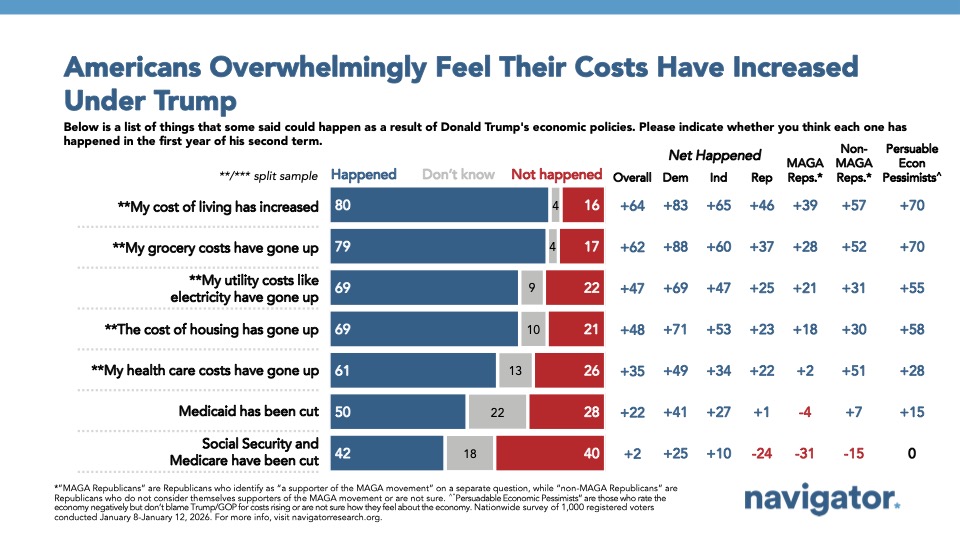
Majorities Link Cost Increases to Trump Policies
Eight in ten say both their cost of living generally and their grocery costs have increased as a result of Trump’s second term policies (80% and 79%, respectively). Americans are more likely to say their specific costs and costs generally have increased as a result of Trump’s policies rather than seeing cuts to programs as a result of his economic policies. Half believe Medicaid has been cut as a result of Trump’s actions (50%), and 42% believe Social Security and Medicare have been cut.
Utility costs (69%), housing costs (69%), and health care costs (61%), are all seen as increasing as a result of Trump’s policies.
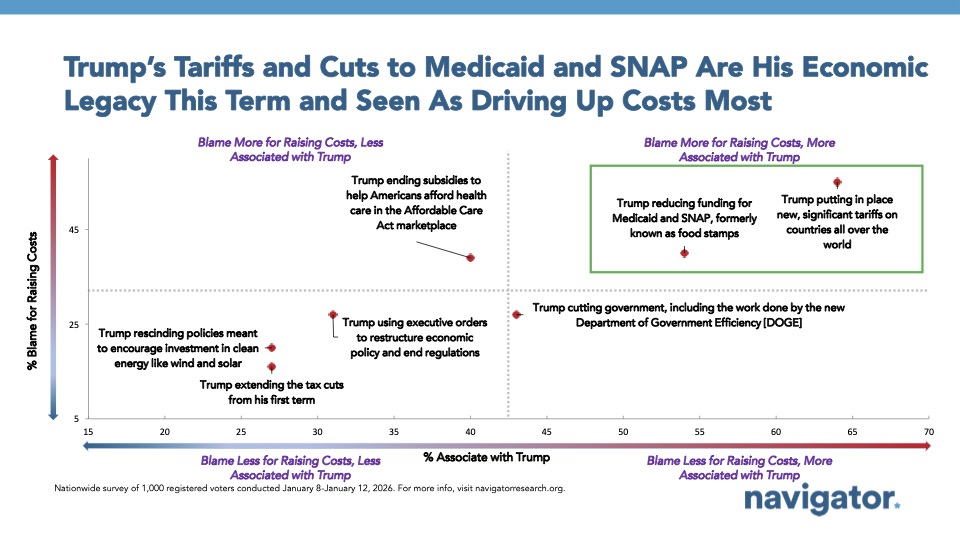
Trump’s Tariffs to Blame for Costs
Nearly half say Trump’s tariffs are one of the top two policies they associate most with his second term (48%). Two thirds place it in their top three (64%). After tariffs, the policies most associated with Trump’s second term are: cuts to SNAP and Medicaid (38% top two, 54% top three) and cuts to the federal government via DOGE (29% top two, 43% top three).
One-third rank Trump’s tariffs first in terms of policies that have increased costs (33%), and a majority ranked it in their top three (55%). Cuts to Medicaid and SNAP as well as Trump’s ending of ACA subsidies were also ranked as cost increasing culprits –though not as highly as tariffs (Medicaid/SNAP; 40% top three, ACA; 39% top three).
This Navigator Report contains new research from our latest survey conducted August 21 - 24 concerning Americans’ views on corruption, who and what they see as most corrupt, and which systems are broken and need change.
This Navigator Research report covers focus groups conducted among working class Americans in Senate battleground states on their personal financial situations, their greatest economic concerns, and perceptions of elected officials tackling affordability.
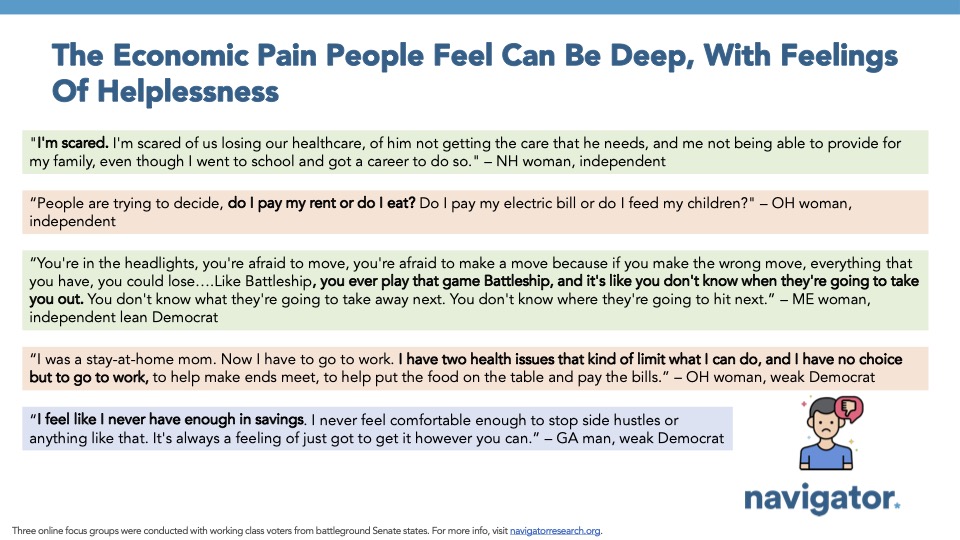
Participants cite feelings of deep economic pain and feelings of helplessness when it comes to their finances, with most seeing the situation as worsening not improving.
“I’m scared. I’m scared. I’m scared of us losing our healthcare, of him not getting the care that he needs, and me not being able to provide for my family, even though I went to school and got a career to do so.” – NH woman, independent
“I think the economy’s going to tank because when we all lose healthcare starting in January, or most of us like me, I’m going to lose it in January, what is that going to do to the economy? People can’t afford to buy anything now. It’s going to just kill it.” – NH woman, weak Democrat
“I find everything is higher priced around here. I find work, but I’m looking for higher paying job and that’s been very discouraging. Unemployment’s up higher than it’s been in four years and I don’t see it getting better.” – MI woman, weak Democrat
The cost of utilities and electricity is widely cited as an economic pain point, though the job market and changes in SNAP also come up as specific economic challenges.
“Right now my biggest stress is getting through this winter with heating and I have a wood fireplace, so I’m up three times a night. So I’m not sleeping. I’m not sleeping. I’m just trying to get through a night or day.” – ME woman, weak Republican
“The price of natural gas is outrageous…Every bill I got, it ate, probably, about maybe 40% of my paycheck and it was crazy. I had to switch [to electric].” – NC man, independent lean Democrat
“I get $64 a month in food stamps. At the beginning of this year, January 25, I had $257 in food stamps every month and every month since consistently, they kept cutting it down, cutting it down, cutting it down to the point where I now get $64 a month in food stamps, which does not buy very much at all.” – NH woman, independent lean Democrat
Many participants say they have developed new strategies to get by, including buy now pay later services like Klarna.
“I buy my groceries with my cash app card so that I can use after pay and break the payments down to three or four payments so that I can actually afford the groceries.” – NH woman, independent lean Democrat
“In order to get dog food recently I had to do a split and four payment type plan and I’ve never had to do that before.” – ME woman, weak Republican
“We have cut our grocery bill in half….You just don’t buy as much and just make do with what you have. There’s more chicken and rice and things that are lower costing than the things that you really want.” – OH woman, weak Democrat
Participants across groups express perceptions of inequity and an economic system that is rigged for the wealthy.
“Honestly, about the last couple of years, it just seems like the rich are richer, the poor or poorer. There’s not a whole lot of middle class around me. Either you can afford things or you can’t….I’m not saying that rich people need to give to less fortunate people, but there has to be some way to even it out. I don’t know the answer, but I don’t think it’s fair.” – MI woman, weak Democrat
“People like Bezos, Elon Musk, Zuckerberg, these people who are billionaires who could solve problems like homelessness and hunger and stuff, they should be taxed more, period.. They should pay their share. It’s not fair.” – NH woman, independent
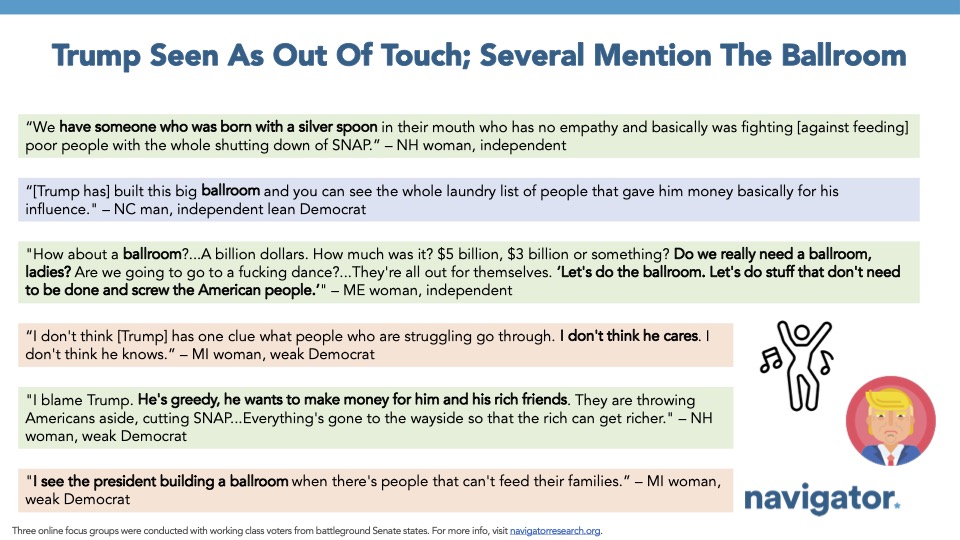
Trump is seen as out of touch with working class people, with several citing his ballroom project as a proofpoint.
“I blame Trump. He’s greedy, he wants to make money for him and his rich friends. They are throwing Americans aside, cutting, SNAP….Everything’s gone to the wayside so that the rich can get richer.” – NH woman, weak Democrat
“How about a ballroom?….A billion dollars. How much was it? $5 billion, $3 billion or something? Do we really need a ballroom, ladies? Are we going to go to a fucking dance?…They’re all out for themselves. ‘Let’s do the ballroom. Let’s do stuff that don’t need to be done and screw the American people.’” – ME woman, independent
“I see the president building a ballroom when there’s people that can’t feed their families.” – MI woman, weak Democrat
Republican lawmakers as a whole are seen as more focused on the wealthy.
“[Republicans are] definitely not fighting for people like me at all. It’s mostly they’re rich and ultra wealthy. That’s all in their mind. Just look at the huge tax breaks they gave the wealthy, I mean, come on.” – OH man, weak Democrat
“[Republicans approach is] if you have money, we like you. If you don’t have money, fuck you.” – NH woman, independent lean Democrat
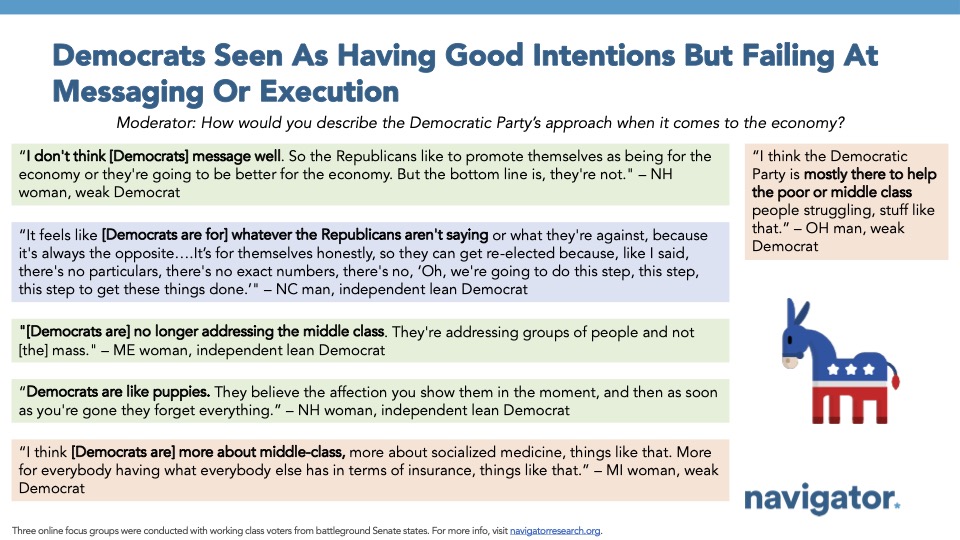
Participants believe Democratic lawmakers are well intentioned but ineffective –due to messaging issues and focus on political games.
“I don’t think [Democrats] message well. So the Republicans like to promote themselves as being for the economy or they’re going to be better for the economy. But the bottom line is, they’re not.” – NH woman, weak Democrat
“It feels like [Democrats are for] whatever the Republicans aren’t saying or what they’re against, because it’s always the opposite….It’s for themselves honestly, so they can get re-elected because like I said, there’s no particulars, there’s no exact numbers, there’s no, ‘Oh, we’re going to do this step, this step, this step to get these things done.’” – NC man, independent lean Democrat
“[Democrats are] no longer addressing the middle class. They’re addressing groups of people and not mass.” – NH woman, independent lean Democrat
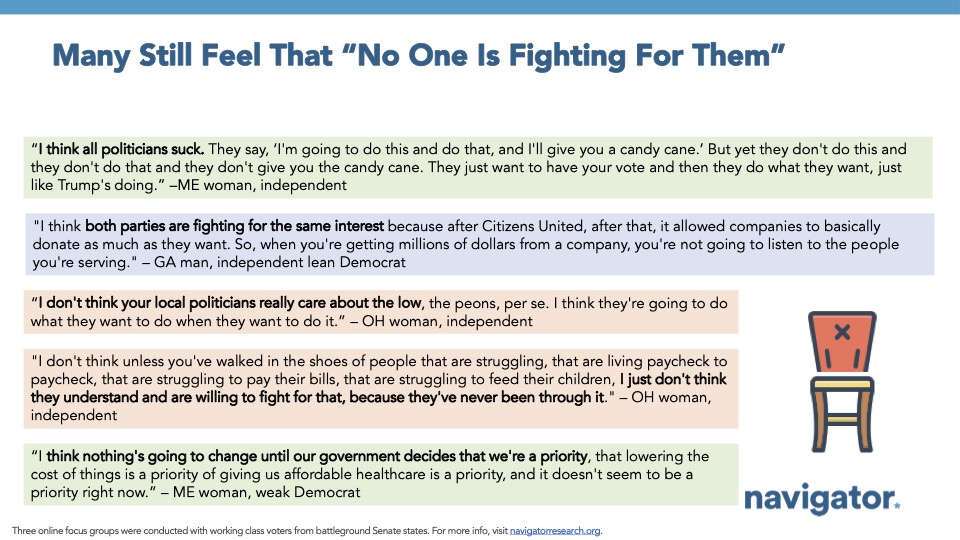
Participants do not see elected officials as fighting for them, or as having the lived experience to really understand the affordability crisis. Bernie Sanders is the one exception across groups.
“I think nothing’s going to change until our government decides that we’re a priority, that lowering the cost of things is a priority, of giving us affordable health care is a priority, and it doesn’t seem to be a priority right now.” – ME woman, weak Democrat
“I don’t think unless you’ve walked in the shoes of people that are struggling, that are living paycheck to paycheck, that are struggling to pay their bills, that are struggling to feed their children, I just don’t think they understand and are willing to fight for that, because they’ve never been through it.” – OH woman, independent
“I think the only person who [understood what I was going through economically] would be Bernie Sanders, I feel like just talking about stuff like how bad student loans are for the youth and how important universal health care is, I feel like those are two things he is always been consistent about.” –GA man, independent lean Democrat
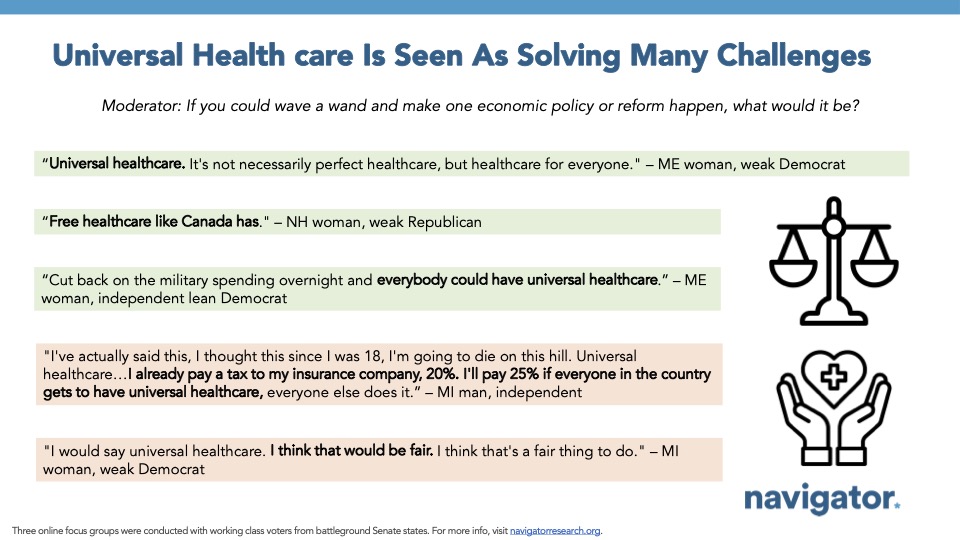
Across groups of participants, universal health care is seen as solving many economic challenges.
“Cut back on the military spending overnight and everybody could have universal health care.” – NH woman, independent lean Democrat
“I’ve actually said this, I thought this since I was 18, I’m going to die on this hill. Universal health care…I already pay a tax to my insurance company, 20%. I’ll pay 25% if everyone in the country gets to have universal health care, everyone else does it.” – MI man, independent
“Universal health care. It’s not necessarily perfect health care, but health care for everyone.” – ME woman, weak Democrat
This Navigator Research report covers research from multiple surveys fielded between June 4 - July 27, on how Americans of different generations characterize their political identity, economic sentiment, and news consumption habits.
This Navigator Research report covers survey and qualitative data on how Americans feel about artificial intelligence (AI) and how they’re using it, if at all.