Individual Rights and Freedoms Are Top of Mind Regarding American Identity
When it comes to what it means to be an American, Black and Latino focus group participants cited freedom of speech, voting, and a shared value of acceptance. Diversity also emerged as a theme of what it means to be American and what sets the United States apart from other countries.
- “Being an American means just sharing a certain set of values like freedom and wanting to have the best kind of life you can live….Sharing ideals as opposed to any specific heritage or language or this or that. We just all want to be the best we can be and enjoy the land that allows that to happen.” – WI woman, Latina independent
- “It’s my heritage. It’s my right to be able to vote because people that came before me, they died trying to get the right to vote. And to me, it’s very important…having that right, being a US citizen.” – GA man, Black strong Democrat
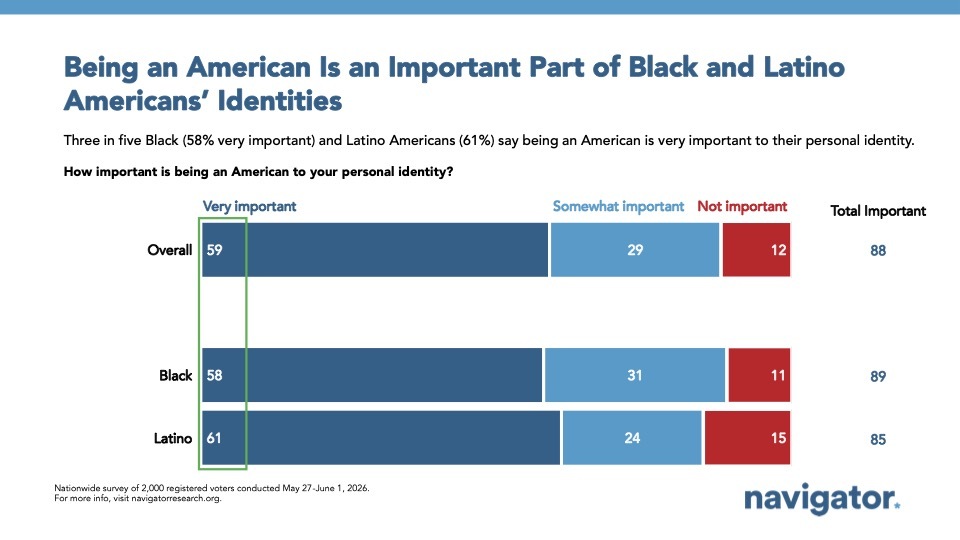
A recent Navigator survey focused on America’s 250th anniversary found over 80% of Black and Latino Americans say being American is important to their personal identity, including three-in-five who say it is “very” important. Only 11% of Black Americans and 15% of Latino Americans say it is not important to their personal identities – a similar percentage to white Americans (12%).
Many Feel a Loss of Freedoms and Lack of Belonging
Focus group participants widely agreed on a number of American values, though many simultaneously felt their rights and freedoms are slowly being eroded. With the deterioration of rights and freedoms, participants expressed feeling a lack of belonging in America today.
- “Being American, it’s almost negative sometimes because if you don’t agree with this current administration, then you’re not American….So I feel like I’m not 100% American anymore because I don’t agree 100% with these values that are being presented by this current administration.” – TX man, Latino strong Democrat
- “By being an African American, I can come in and be a convicted felon and get an X amount of years, but someone else comes in with a different color and may be charged with the same crime, but get a different sentence on the color of their skin. And that’s not justice.” – MS man, Black strong Republican
- “They’re stripping away all our voting rights for the African American….Trump has gerrymandered these maps and these states are taking away all the Black voting rights. They killed the 1965 Voting Rights Act.” – GA man, Black strong Democrat
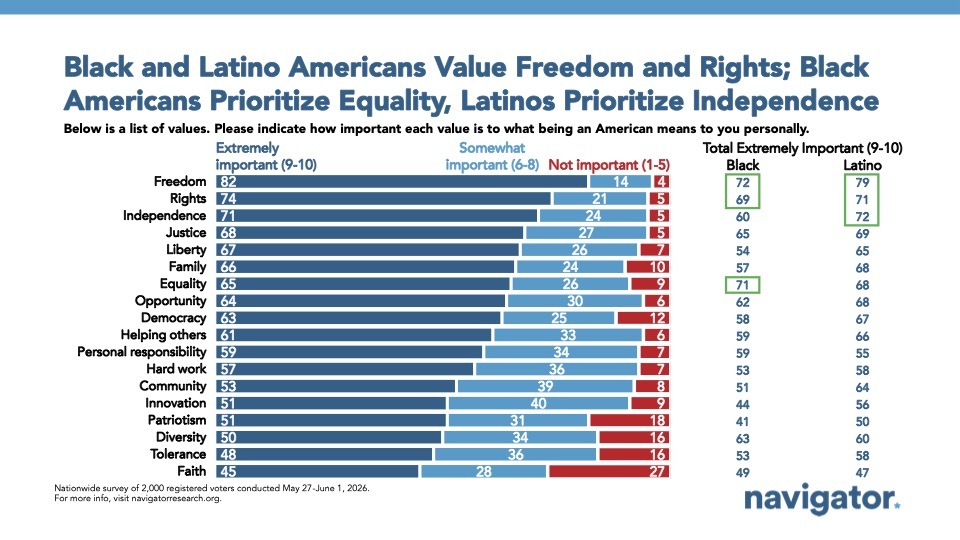
Navigator’s special America250 survey found “freedom” and “rights” are among the most important American values to Black and Latino Americans – the same for Americans overall. Black Americans are more likely than Americans overall to list “equality” as an American value most important to them, with 71% saying it is “extremely” important. Latino Americans list “independence” as an important value, with 72% saying it is “extremely” important.
The American Dream is Largely Defined by Economic Freedom – But Most See it as Increasingly Unattainable
Black and Latino focus group participants defined the American dream as earning a decent income, owning a home, and the ability to support a family. Some participants also related the American dream to rights and freedoms or to religious values. Participants expressed that the American dream used to be more feasible, but with rising costs, stagnant wages, and an erosion of rights, has become more unattainable.
- “The American Dream is earning a decent amount of income, having a nice house, having a nice family, raising your family in a Christian-centered home.” – MS man, Black strong Republican
- “Growing up, you work hard and you just get….at least middle class or whatever or something, but now you work hard for nothing…because everything is so high, inflation and all that.” – PA man, Black independent
- “We kind of peaked 30 years ago maybe or something when…that American Dream that we kind of talked about was a little bit more achievable, economically speaking. Racial tensions were very low compared to the past.” – WI woman, Latina independent
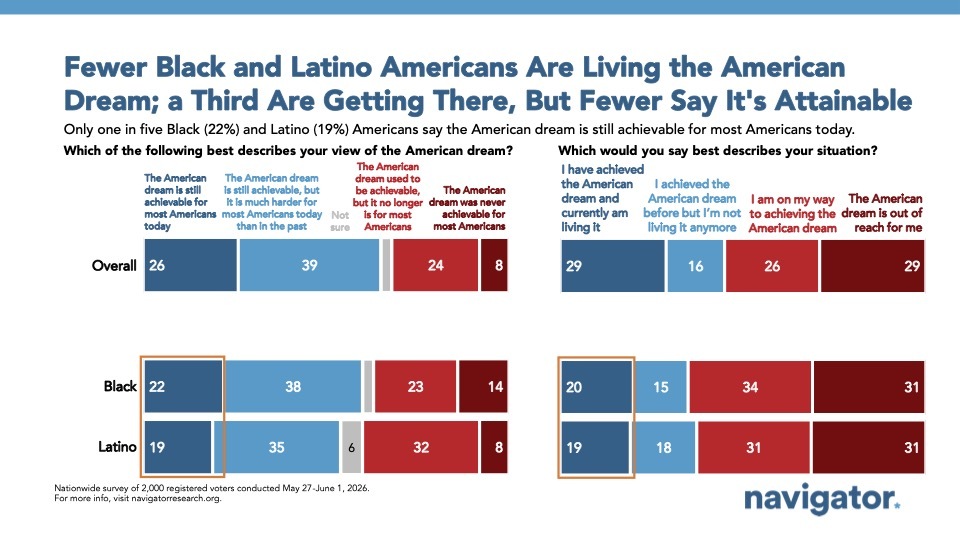
Only one-in-five Black and Latino Americans say the American dream is still achievable for most Americans today (22% and 19%, respectively), compared to 27% of white Americans. Latino Americans are the most likely to say the American dream used to be achievable for most Americans but isn’t any longer (32%), compared to 24% of Americans overall.
Racism and Policy Decisions make Black and Latino Americans less Proud, but Optimism for the Future Remains
Black and Latino Americans cited policy decisions past and present to illustrate how the government is constantly changing the rules to stack the odds against them. While pragmatism was widespread among participants, there was still a sense that the only option was to be hopeful for a better future.
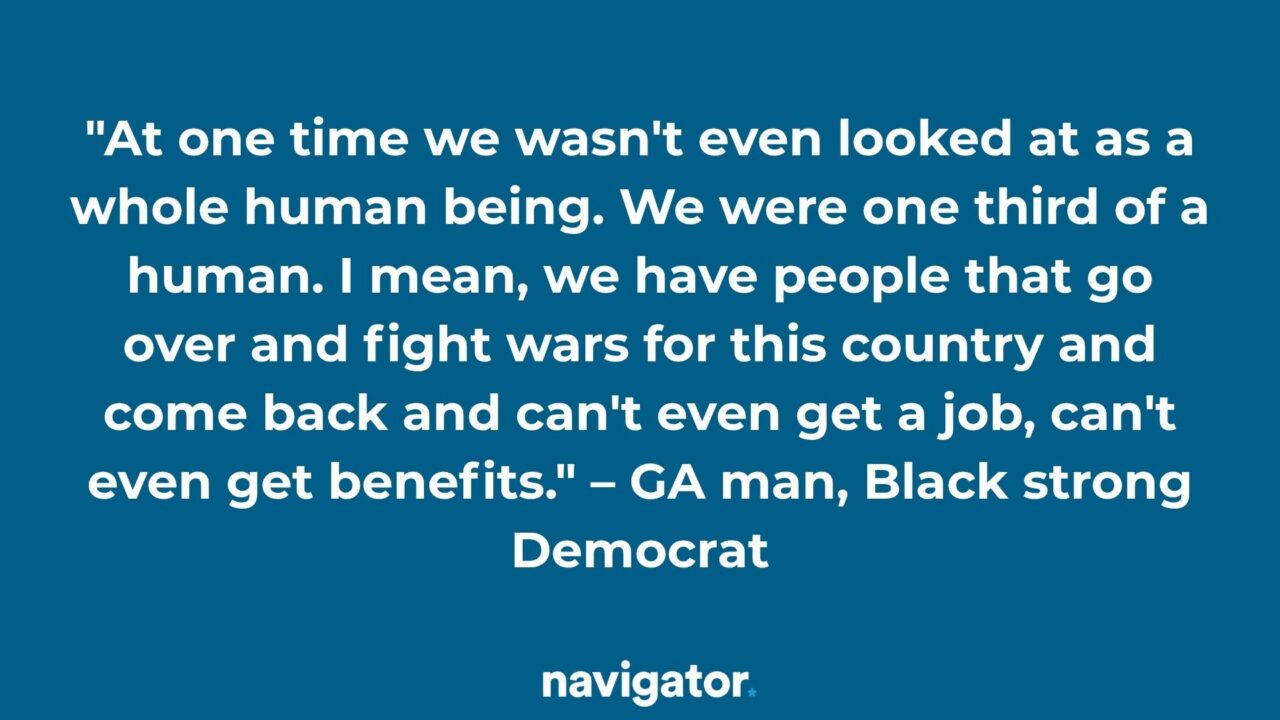
- “The administration going to certain states that he knows are pro Trump asking them to redo their voting rights, or voting districts, in the middle of a census period….He’s gone to his deep red states where he dominated in the last election to have their voting districts redrawn so that the minority vote is dismantled.” – TX man, Latino strong Democrat
- “People are very optimistic. We hope for better things. We strive for better things. I think we have a fighting spirit in America….We know we have the power to make change, and not everyone feels that way where they live, that they can make a real difference.” – WI woman, Latina independent
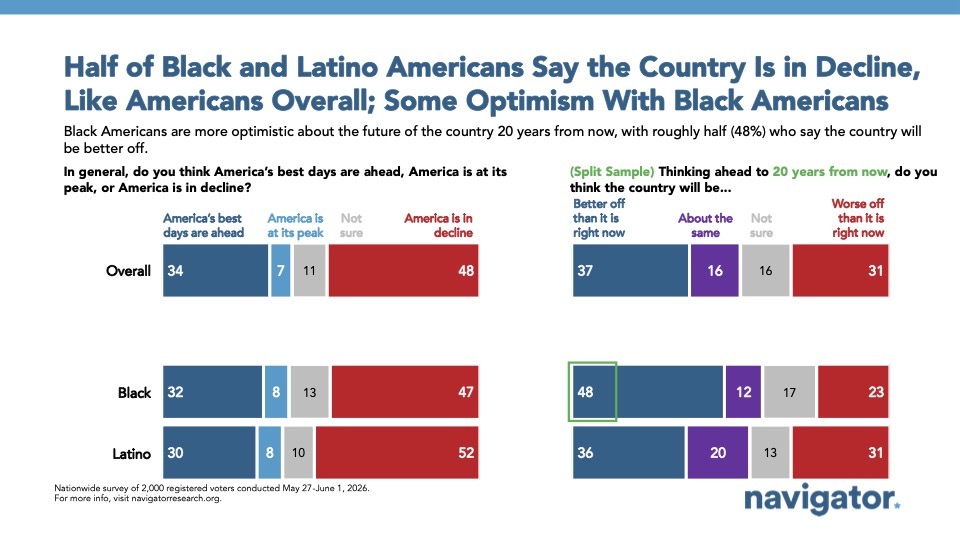
A majority of Black Americans (52%) and 47% of Latino Americans believe America is in decline – compared to less than a third who say America’s best days are ahead (32% Black Americans, 30% Latino Americans). Though when asked specifically if America will be better off 20 years from now, Black Americans show the most optimism, with 48% saying the country will be better off and only 23% saying it will be worse. Latino Americans are slightly more split (36% better off – 20% about the same – 31% worse off).
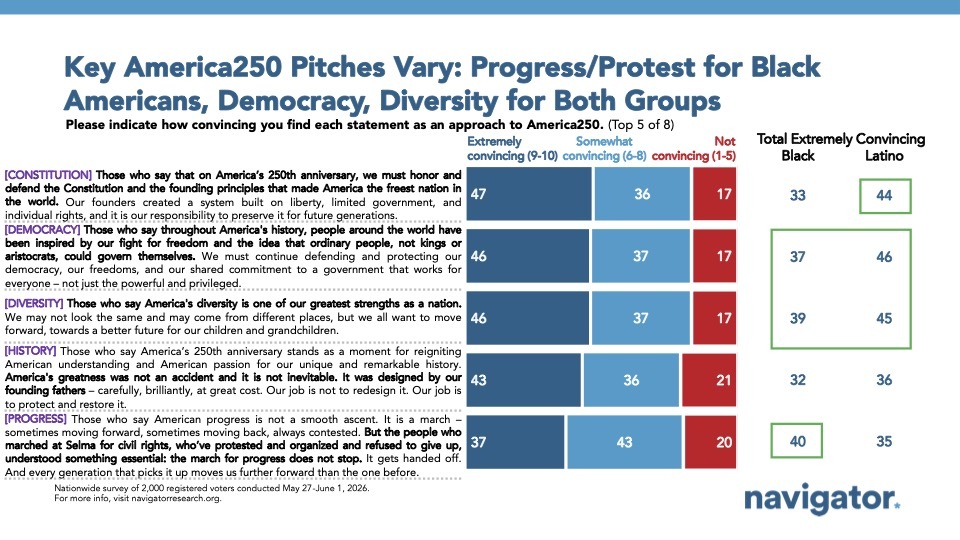
Most Effective Messages on America’s 250th Focus on Democracy, Diversity, and Progress
Approaches to America250 that particularly resonate with Latino Americans include ideas such as:
- Throughout America’s history, people around the world have been inspired by our fight for freedom and the idea that ordinary people, not kings or aristocrats, could govern themselves.
- America’s diversity is one of our greatest strengths as a nation.
- On America’s 250th anniversary, we must honor and defend the Constitution and the founding principles that made America the freest nation in the world.
Among Black Americans the statements that resonate most are:
- American progress is not a smooth ascent. It is a march – sometimes moving forward, sometimes moving back, always contested. But the people who marched at Selma for civil rights, who’ve protested and organized and refused to give up, understood something essential: the march for progress does not stop.
- America’s diversity is one of our greatest strengths as a nation.
- Throughout America’s history, people around the world have been inspired by our fight for freedom and the idea that ordinary people, not kings or aristocrats, could govern themselves.