
A Year After Liberation Day, Americans Still Dislike Tariffs and Want Their Money Back

Poll: Tariffs

This Navigator Research report covers Americans’ views on tariffs, including their views on tariff rebate checks.
Tariffs Remain Broadly Unpopular

One year after so-called “Liberation Day” – President Trump’s April 2025 announcement of sweeping global tariffs that sent markets reeling – Americans remain deeply opposed to tariffs. Six-in-10 Americans are unfavorable toward tariffs (59%), while just three-in-10 Americans are favorable (29%) – a 30-point gap. Tariffs are about as unpopular as they were in Navigator’s April 2025 polling immediately after Liberation Day (30% favorable). Partisanship remains a guiding factor: just 7% of Democrats and 17% of independents report favorable views of tariffs, compared to just over half of Republicans (55%). That said, opposition from Democrats is far stronger than support from Republicans.

  • Seven-in-10 MAGA Republicans say they view tariffs favorably (69%), compared to only a third of non-MAGA Republicans (34%).
Line graph from Navigator Research titled: Tariffs Remain Broadly Unpopular

When asked specifically if they support or oppose President Trump’s tariff plan, Americans broadly oppose. Net support for Trump’s tariff plan is at -21 (36% support – 57% oppose), while Democrats are at a net -81 (7% support – 88% oppose) and independents at net -42 (21% support – 63% oppose). Support for Trump’s tariff plan is significantly higher among MAGA than non-MAGA Republicans: MAGA Republicans support the plan by 77 points (87% support – 10% oppose), while net support from non-MAGA Republicans sits at just +2 (44% support – 42% oppose).

Bar graphs from Navigator Research titled: A Majority Continue to Oppose Trump's Tariff Plan

Support for Potential Tariff Rebate Checks Transcends Partisanship 

Two-thirds of Americans support $2,000 tariff rebate checks for consumers (66%). Three quarters of Republicans favor sending the tariff checks (75%), while 61% of Democrats and 56% of independents say the same.

Bar graphs from Navigator Research titled: Tariff Rebate Checks Are Popular Across Party Lines
  • If checks were to go out, Americans overwhelmingly prefer sending them to consumers who paid higher prices rather than businesses that paid import taxes. Nearly eight-in-10 Americans say they would prefer consumers get the checks (78%), while just 9% say they should go to businesses. 

Americans Find Tariff Rebate Check Arguments Centered on Rising Costs More Compelling Than Arguments Focused on Legal Processes 

Tariff check arguments centered on how tariffs have raised costs are more compelling than arguments on legal processes. 

Compared to a conservative message about tariffs’ success, a cost-focused message outperforms it by 30 percentage points, while a legal-process message outperforms it by 14 points.


Conservative message: “The tariffs worked to bring in billions of dollars to the United States and now Americans should share in the success of this policy.” 

Cost-focused message (+30): “The tariffs raised costs for Americans by thousands of dollars a year, and therefore Americans should get a rebate from the money that was collected.”

Legal-process message (+14): “The Supreme Court ruled recent tariffs illegal and therefore Americans should get a rebate from the money that was stolen from them.”

Bar graphs from Navigator Research titled: The GOP Tariff Rebate Argument Can Be Beaten - Especially With Focus on How Tariffs Raised Costs, More So Than Their Illegality

Americans Want a Budget that Prioritizes Programs Cut by President Trump and Republicans in Congress

Poll: Budget

This Navigator Research report covers what Americans think the government is spending too much and too little on.

Americans Think The Government Spends Too Much On Renovating The White House, Foreign Wars, And ICE

Almost two-thirds of Americans think the government is spending too much money renovating the White House (62% too much), including nearly half (47%) who say the government is spending “way” too much money. While many of the planned renovations to the White House, including the $400 million ballroom, are being paid for with private funds from donors and corporations, experts say that taxpayer dollars will be necessary in the future to maintain and keep up the structure.

Four times as many Republicans say the government is spending too much on White House renovations as say not enough (42% too much – 34% right amount – 10% not enough). Even 30% of MAGA Republicans say the renovations are costing too much while just 10% say not enough.

Bar chart from Navigator Research titled: Nearly Two in Three Americans Think the Government Spends Too Much Money Renovating the White House

Nearly three-in-five Americans say the government is spending too much money on foreign wars (59% too much), including Republicans by nearly a 30-point margin (42% too much – 37% right amount – 13% not enough). This survey was fielded days before the Pentagon announced it was seeking $200 billion in additional funds for the war in Iran.

When framed as “national defense” instead of “foreign conflicts and wars”, the margin here narrows slightly. 38% say the government is spending too much on national defense and 17% say not enough. 32% say the government is spending the right amount on national defense.

Bar graphs from Navigator Research titled: Three in Five Say the Government Spends Too Much Money on “Foreign Conflicts and Wars”; Fewer on “National Defense”

On ICE, a majority of Americans think the government is spending too much on the agency (54% too much – 22% right amount – 15% not enough). Even a plurality of Fox News viewers say the government is spending too much on ICE (42% too much – 33% right amount – 20% not enough). ICE has seen its budget increase from less than $10 billion to more than $80 billion in just one year. When the issue is framed as “border security”, Americans are less likely to say the government is spending too much. Only 41% say the government is spending too much on border security and 17% say not enough.

Slide from Navigator Research titled: A Majority Say the Government Spends Too Much Money on ICE; Fewer Say the Same on “Border Security”

Americans Say Government Isn’t Spending Enough On Programs Cut By President Trump And Republicans In Congress

Bar chart from Navigator Research titled: Americans Say the Government Spends Too Little Money on Retirement Programs, Public Education, Health Care

Three-in-five Americans think not enough money is being spent on retirement programs like Social Security and Medicare (60% not enough – 20% right amount – 10% too much). This trend is consistent across party lines, with even 44% of MAGA Republicans and 58% of non-MAGA Republicans saying the government is not spending enough on these programs. According to the Congressional Budget Office (CBO), the Republican budget will trigger nearly half-a-trillion dollars in cuts to Medicare. And last year after widespread outrage, the Trump administration backed away from a plan to cut Social Security disability payments for older Americans.

Similarly, 58% of Americans say the government isn’t spending enough on health care, namely Medicaid and the Affordable Care Act (ACA). There is a 13-point gender gap here, with 60% of women saying the government isn’t spending enough on health care compared to 47% of men. Trump and most Republicans in Congress have railed against extended tax credits to make ACA plans more affordable for millions of Americans. Additionally, the Republican budget cut nearly $1 trillion from Medicaid.

A majority of Americans think the government is not spending enough money on K – 12 public education (57% not enough – 19% right amount – 12% too much). This trend is consistent across political parties, with 72% of Democrats, 50% independents, and 45% of Republicans saying the government isn’t spending enough on K – 12 public education. The Trump administration has been working to dismantle the Department of Education, which has been charged with overseeing public education across the country. Additionally, the Republican budget’s Medicaid cuts will harm public schools across the country.

By a two-to-one margin, Americans say not enough money is being spent on food assistance or SNAP (45% not enough – 22% right amount – 22% too much). Even a quarter of people who voted for Trump in 2024 say not enough money is being spent on the program (25% not enough). Last year, as part of the Republican budget, Trump and Republicans in Congress cut SNAP by more than $180 billion.

Media Consumption and Views on the Iran War

Poll: Media Consumption and Views on the Iran War

This Navigator Research report covers how Americans’ views on the war with Iran differs by their media habits.

Republicans Who Watch Fox News Report Greater Support for the Iran War Across a Variety of Metrics

Americans are net negative on the war with Iran and Trump’s handling of foreign policy, but their attitudes are different depending on where they get their news. Nine-in-10 Republicans who say they watch Fox News approve of President Trump’s job in office, and 87% approve of his handling of foreign policy. Among Republicans who do not watch Fox News, just 69% approve of Trump’s job in office and 66% approve of his handling of foreign policy.

Republicans who report watching Fox News are 25 points more likely to support the war with Iran than Republicans who do not watch Fox News (83% support and 58% support, respectively).

  • Republicans who watch Fox News are 21 points more likely than Republicans who do not to say they feel President Trump has a clear timeline and goals for the military operation in Iran (70% and 49%, respectively).
Bar graph from Navigator Research titled, Republicans Who Watch Fox News Are Consistently More Supportive of President Trump and the Iran War

Republicans who watch Fox News are more likely to point to more positive reasons why President Trump decided to conduct military operations in Iran – 73% say a top three reason was that President Trump “felt Iran’s nuclear and missile programs posed an imminent threat,” compared to only 47% of Republicans who do not watch Fox News that say the same. 

  • Still, both groups share the same top three reasons they thought Trump conducted military operations against Iran: that he thought their missile program posed an imminent threat (73% Fox – 47% non-Fox), that he wants to liberate the Iranian people (66% Fox – 40% non-Fox), and that he wants regime change in Iran (55% Fox – 40% non-Fox).

Passive News Consumers Report Higher Opposition to Iran War, but Are Less Certain on Other Metrics

Passive news consumers (those who say the news comes to them) are more opposed to the war in Iran than active news consumers (those who say they seek out the news). By 15 points, passive news consumers say they oppose the war (35% support – 50% oppose), compared to active news consumers who oppose the war by 5 points (44% support – 49% oppose). 

Conversely, passive news consumers report less concern the U.S. will end up in a prolonged conflict, though both groups are more concerned than not:

  • More than two-thirds of active news consumers are concerned (70% concerned – 24% not concerned)
  • Passive news consumers are 32 points more concerned than not (61% concerned – 29% not concerned).

Other questions on the war with Iran demonstrate more alignment between passive and active news consumers – although passive news consumers are more apt to say they are “not sure” or that they “don’t know.” 

Bar graph from Navigator Research titled, Passive News Consumers Often Land Towards the Middle, or are Unsure

Support for the War with Iran Varies Between Viewers of Major Cable News Channels, as Do Views on Why President Trump Conducted the Operation

Americans who watch Fox News are far more supportive of the Iran war than those who watch CNN or MSNBC/MSNOW. While six-in-10 Americans who watch Fox News say they support the military operation in Iran, just 37% of both CNN and MSNBC/MSNOW viewers say the same.

Fox News viewers and CNN and MSNBC/MSNOW viewers are also divided on why they think President Trump launched a war against Iran. While half of Fox News viewers say a top three reason for President Trump conducting the operation is that “he felt Iran’s nuclear and missile programs posed an imminent threat” (51%), just 32% of CNN viewers and 31% of MSNBC/MSNOW viewers say the same. Meanwhile, 48% of CNN viewers and 51% of MSNBC/MSNOW viewers say a top three reason for President Trump conducting the operation is that “he wants to use the conflict to distract from other issues, like the Epstein files,” while 26% of Fox News viewers say the same.

Bar graph from Navigator Research titled, Americans Watching Different Channels Have Different Ideas of Why Trump Conducted Operation Against Iran

Americans on Different Social Media Platforms View the War Differently

Americans on different social media platforms harbor differing views of the war. Americans who check Twitter/X daily support the U.S. military operation in Iran by two points (48% support – 46% oppose), while daily Facebook users are opposed by three points (43% support – 46% oppose). Daily TikTok users are far less supportive, opposing the war in Iran by 16 points (37% support – 53% oppose).

Americans on Twitter/X or TikTok tend to be younger, while Facebook is most popular among older Americans:

  • Nearly 59% of daily TikTok users and 58% of daily Twitter/X users are ages 44 and under, while 59% of daily Facebook users are ages 45 and older.
Bar graph from Navigator Research titled, Net Support for the Iran War Varies by Social Media Platform

Quick Takeaways

  • Where and how Americans get their news is both shaped by their previous political views and how they understand events as they unfold – including the Iran War.
  • Passive news consumers are a large group whose opinions are often unsettled. Reaching these people is critical for changing public opinion.
  • While conversations in the political space often unfold on Twitter/X, Twitter users are already engaged – 73% of daily users are active news consumers, the highest portion on any platform – and increasingly steeped in right-wing content promoted by the site’s algorithms. Finding less engaged Americans on Facebook, Instagram, or TikTok may prove more useful when trying to influence public opinion.

Focus Group Report: Women in the Battleground

Focus Group: Women in America

This Navigator Research report contains findings from focus groups conducted among women in battleground states on the state of the country, the economy, and life as a woman in America.

Women Are Disproportionately Struggling with Rising Costs

Women report not being able to get by on a single income, as many provide examples of things they’ve done to supplement their income, including food delivery jobs and online customer service jobs. Others say they have turned to couponing or using buy now pay later services.

  • You need multiple incomes in order to survive and provide for your family because everything is going up and it’s just like the interest rates are high and you don’t know if they’re going to go up and how much more is gas going to go up and how much more the egg’s going to be. I mean, it’s just ridiculous.” – GA white woman, independent
Slide from Navigator Research titled: Women Report Struggling Mightily With Personal And Economic Challenges

The Government Is Seen as Rigged for the Wealthy and Powerful

Women believe government officials are out of touch and are more concerned with working for special interests than the American people. Few believe there are any leaders that actually get what it’s like to be a woman in America.

  • “I feel like the political leaders, even the women political leaders, are so out of touch with reality and what it’s like to be a real American woman.” – PA Hispanic woman, weak Republican
Slide from Navigator Research titled: Some See The Government And Society As Rigged And Toxic

Mothers Don’t Feel Supported

Women with children report having far less support than they anticipated, whether it be from their jobs, people in their lives, or the government. Women without children see mothers in their lives as struggling.

  • “I saw [my mom] almost lose the house, not make enough money to feed herself sort of thing. So [before having kids] I would want to be married, on the same page, have some kind of buffer, idea of what to expect, I guess.” – MI white woman, independent
Slide from Navigator Research titled: Motherhood Demands Support, And Not All Women Feel They've Had It (Or Would Want It)

Women Feel Disrespected In The Workplace And Society In General

Feelings that women lack respect in society cut across the different groups of women. Many cite how the media talks about women and toxic beauty standards, while others cite experiences of unfair treatment at their jobs.

  • “When I was incarcerated, I got my CDL driver’s license, my truck driver’s license. And when I came home and started doing it, working local, I felt like the guys were just treating me as it wasn’t a woman’s job, a woman shouldn’t do this, it isn’t meant for women to drive trucks.” – MI Black woman, independent lean Democrat
Slide from Navigator Research titled: Many Lament Unfair Societal Expectations And A Lack Of Respect For Women

Health and Safety of Food Comes Up Organically

The safety and accessibility of food comes up organically in conversations with women in battleground states. Many worry about the standards of food safety in America and how they compare to other countries, while others generally worry about processed foods and the affordability of healthy food. Though concern around health spanned across groups, most were unfamiliar with “MAHA.”

  • “They’ve been trying to kill us since the beginning of time. If it’s not with our food, it’s with the pharmaceuticals.” – WI white woman, weak Republican
Slide from Navigator Research titled: MAHA As A Movement Is Not Widely Known, But Interest In Healthier Food And Medicine Is Widespread

Abortion Restrictions Cause Fear – So Does Safety of Birth Control

Abortion restrictions and bans are concerning for women across partisanship, even among women who aren’t necessarily familiar with specifics of abortion laws. Many expressed fear about not being able to access an abortion in a medical emergency, for themselves or loved ones. When it came to birth control, many women cited medical misinformation, saying the birth control pill was dangerous. Even among those believing the birth control pill is dangerous, there was a sense that it was better than the alternative of getting pregnant.

  • “It’s like a carcinogenic or something….To be very honest, I’m trying not to get paranoid in this world, so I limit what I truly can control and research in my own mind. I’d rather just have birth control and no more babies and have to worry about putting them out in this type of world.” – MI white woman, independent
Slide from Navigator Research titled: Abortion Rights Comes Up Unaided, But It's Not Everyone Top Of Mind Concern

Read More

January 21, 2026

Focus Group Report: Trump Regrets … They’ve Had A Few

Focus group report on Americans in battleground states who voted for Trump in 2024 and expressed regret or misgivings about their vote.

Julie Alderman Boudreau
December 3, 2025

Focus Group Report: Working Class Americans and the Affordability Crisis

Focus group report that covers groups conducted among working class Americans in Senate battleground states on their personal financial situations, their greatest economic concerns, and perceptions of elected officials tackling affordability.

Rachael Russell, Ian Smith & Maryann Cousens
November 3, 2025

Focus Group Report: Americans and Political Dysfunction

Focus group report on government dysfunction.

Rachael Russell, Ian Smith, Maryann Cousens & Camille Keene
October 9, 2025

Focus Group Report: MAHA Curious

Focus Groups report on “MAHA-Curious” Americans* on the state of the health and wellness in the country today, including where they look to for information and how they assess the “Make America Healthy Again” (MAHA) movement.

Rachael Russell and Erica Seifert

Special Battleground Report on Food and Health Part II: Messages

Poll: Food & Agriculture

This Navigator Research report covers messaging guidance to effectively communicate on food and health-related issues to Americans in the battleground.

Food-related Issues as a Messaging Opportunity 

Food-related issues, especially costs and food safety, are not niche concerns — they are top-tier priorities for Americans in the battleground. Ensuring our food is safe ranks as an “extremely high priority” for 61% of respondents, nearly matching lowering the cost of health care (which 68% view as an “extremely high priority”) at the top of Americans’ concerns. Making food more affordable registers at 50% who say it is extremely important. These numbers hold remarkably consistent across both House and Senate battlegrounds, among independents, and critically, among persuadable Americans who haven’t yet chosen a side in the 2026 elections.

Bar chart from Navigator Research titled Food Safety Rivals Healthcare As Voters' Top Priority

The data reveals that Americans view food and agriculture issues through economic and public health lenses, not as a narrow agricultural policy concern. The consistency of these priorities across different segments of the population demonstrates that food issues transcend traditional political divides. Americans in the battleground prioritize food safety and affordability at rates that match or exceed many issues typically considered more politically salient, suggesting that concerns about the food families are putting on the table and what they pay for it are deeply personal and universal. The polling also shows that these aren’t abstract policy preferences: Americans connect food issues directly to their economic security and their families’ health outcomes. 

Messages On SNAP, Impacts On Children, And Price Gouging Resonate With Americans In The Battleground

Messages that highlight how President Trump and Republicans in Congress cut SNAP, hurt children’s access to healthy foods, and enabled price gouging by large food corporations are most effective in raising concerns about Trump and Congressional Republicans’ policy agenda on food and agriculture. The most effective messages were:

  • Trump and Republicans are hurting American children and setting them up for worse health outcomes than previous generations by making it harder for them to access healthy foods. They cut funding to support farm to school programs and food banks, passed the largest cut to food assistance in history, and ended the decades-old practice of putting fluoride in water to reduce tooth decay. They have even allowed food companies to use cancer-causing chemicals in snack foods targeted to children (64% concerned, 46% with very serious concerns).
  • Trump and Republicans made the largest cuts to SNAP in history making it more difficult for over 40 million Americans, including 16 million children and 8 million seniors, to access healthy foods and forcing them to rely on the cheapest possible foods for survival, which is often the most ultra-processed foods (59% concerned, 46% with very serious concerns).
  • Trump and Republicans have allowed food companies to take advantage of inflation to raise prices to increase their profits. The CEO of one grocery company said that inflation is “good for business” and that it allowed them to raise prices on milk and eggs higher than necessary (68% concerned, 44% with very serious concerns).
Table from Navigator Research titled Messages On SNAP, Impacts on Kids, Price Gouging Resonate

Messaging Recommendations On Food, Health, And Agriculture

Based on Navigator’s latest research, advocates should follow three steps to effectively message on food, health, and agriculture policy issues:

Slide from Navigator Research titled Message Framework

Dos And Don’ts On Communicating On Food, Health, And Agriculture

Table from Navigator Research

Food for Thought: Special Battleground Report on Food and Health

Poll: Food and Agriculture

This Navigator Research report covers party trust, which policies battleground constituents think will make Americans healthier, and food-related issues they think Congress should address.

Americans in the Battleground Want a Focus on Food Safety and Lowering Grocery Costs 

Food safety closely follows lowering health care costs as a top congressional priority for battleground constituents with 61% saying ensuring our food is safe is an extremely high priority, compared to lowering health care costs (68%). Other top priorities for Congress include food affordability (48% see it as an extremely high priority), lowering the cost of everyday goods (47%), and support for small, local and family farms (46%).

Bar graph from Navigator Research: Food Safety Rivals Healthcare As Voters' Top Priority

President Trump And Secretary Kennedy Are Underwater with Battleground Americans, MAHA is Viewed Favorably

President Trump is underwater in the battleground on overall favorability (-6) and overall job rating (-8). Health and Human Services Secretary Robert F. Kennedy Jr. is also underwater on overall favorability (-7) and even more so on his job rating (-12). The Make America Healthy Again movement (MAHA) fares better with overall favorability (+7), especially among independents (+10) and battleground constituents who think food issues should be a high priority (+16).

A slide with bar graphs from Navigator Research titled RFK Jr.'s Popularity And Job Rating Is Underwater Across Both Battlegrounds

Americans in the Battleground Want Government Action on Food and Agriculture 

A majority of battleground constituents (61%) believe the government should play a major role in ensuring people have accurate, science-backed information on their health compared to just 35% who think the government should let people make their own health choices based on what is best for themselves. 

Battleground Constituents Say Banning Chemicals from Food and Crops Would Make Americans Healthier

Battleground constituents believe food safety measures would make Americans a lot healthier. 76% say banning cancer-causing chemicals in food would make Americans “a lot healthier.” 65% say the same about banning Paraquat, an herbicide linked to Parkinson’s disease that is already banned in 70 other countries. And 55% believe banning ultra-processed foods from school lunches would significantly improve Americans’ health.

Bar graph from Navigator Research titled, Battleground Constituents Think Banning Chemicals From Food And Crops Will Be The Most Effective Policies To Get People Healthier

Battleground Americans Strongly Support Policies Aimed at Banning Certain Chemicals From Food and Supporting Farmers

Support among battleground constituents is especially high for banning cancer-causing chemicals in food (85% strongly support) and increasing support for local farmers selling to schools and grocery stores (79% strongly support). Other policies including increasing access to grocery stores, restricting unhealthy foods for people using food assistance, and requiring warning labels on ultra-processed foods were less popular.

Americans in the Battleground are Concerned About Cuts to SNAP and Lack of Funding for School Lunches

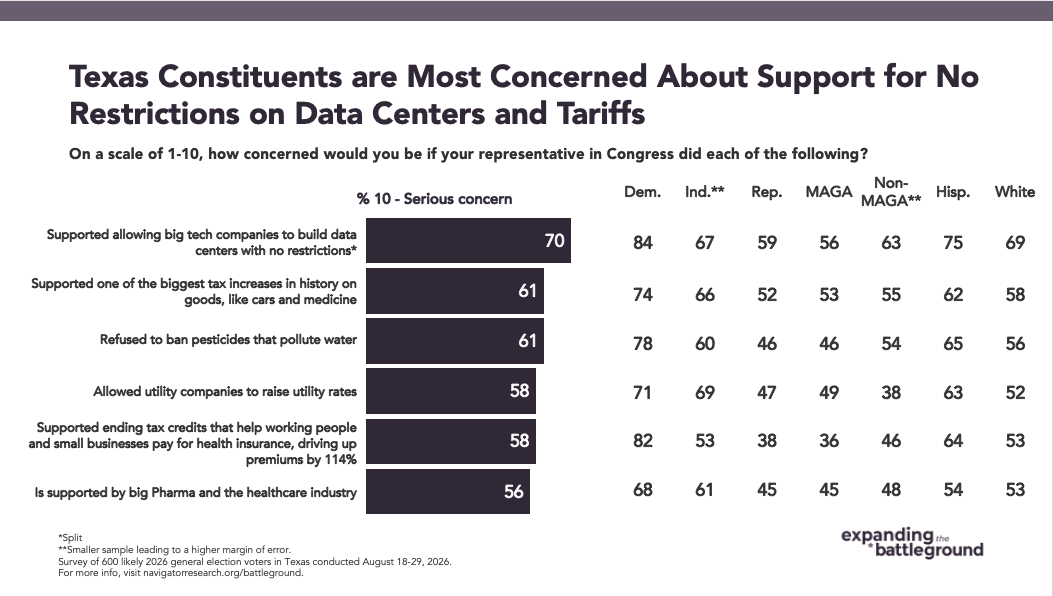
Battleground constituents are concerned about cuts to SNAP (49% say it’s a top concern) and lack of funding for school lunches (28% say it’s a top concern) as well as Trump’s refusal to ban dangerous pesticides (46%) and cutting funding for food safety inspections (26%). They’re also concerned about potential corruption from Trump putting former food and agriculture lobbyists in charge of the country’s food policies (41%) and the administration giving more power to the corporate food industry (26%). 

Table from Navigator Research titled SNAP Cuts, Use of Dangerous Pesticides, And Corruption In Food Policies Are The Most Concerning Food And Ag Issues

Americans in the Battleground Trust Democrats’ Agenda on Food-Related Issues and Republicans’ Agenda on Processed Food and Farmers

Battleground constituents are nearly evenly split on whether policies from the Trump administration and Republicans in Congress are making Americans more or less healthy (42% more healthy; 44% less healthy). Americans in the battleground trust Congressional Democrats’ policies more on food-related issues while Republican policies have an edge on getting ultra-processed food out of schools and supporting small, local farms. 

Democrats’ policies are more trusted when it comes to making Americans less likely to get sick (+10), improving the health of Americans (+7), making food more affordable (+6), ensuring our food is safe (+5), making healthy food more affordable (+3).

Bar graph from Navigator Research titled Democrats Hold Advantages On Most Food-Related Issues, Though Significant Shares Are Still Unsure Of Who To Trust

Making Gains on Food-Related Issues

After hearing more information on Trump and Republicans’ policies, Congressional Democrats make significant gains on building party trust when it comes to ensuring our food is safe (+6 gain) making healthy food more affordable (+4 gain) and easier to get (+4 gain) as well as supporting small, local and family farms (+4 gain).