State of the Battleground

Poll: Landscape

This Navigator Research report covers perceptions of government leaders, including which party is more trusted to handle the issues that matter most to Americans in the battleground, and who is seen as having the right priorities.

Leaders Across Both Parties Viewed Negatively

Frustration with both political parties is palpable among battleground constituents. Democrats and Republicans in Congress are both viewed overwhelmingly unfavorably (63% and 61%, respectively), though named Democratic incumbents fare better than Republican incumbents with a narrow but positive favorability rating of net +1. Republican incumbents are struggling more significantly and are underwater by 13 points.

A majority of battleground constituents view President Trump negatively (54%), including a majority of independents who break against him by eight points (43% favorable – 51% unfavorable).This is aligned with findings at the national level with 56% of Americans viewing Trump unfavorably. Independents in the national survey are slightly more unfavorable towards Trump, with 58% viewing him unfavorably and just 32% favorably.

Similarly, 54% of battleground constituents view Vice President Vance negatively and opinions are notably intense, with over half (51%) saying they see him “very” unfavorably.
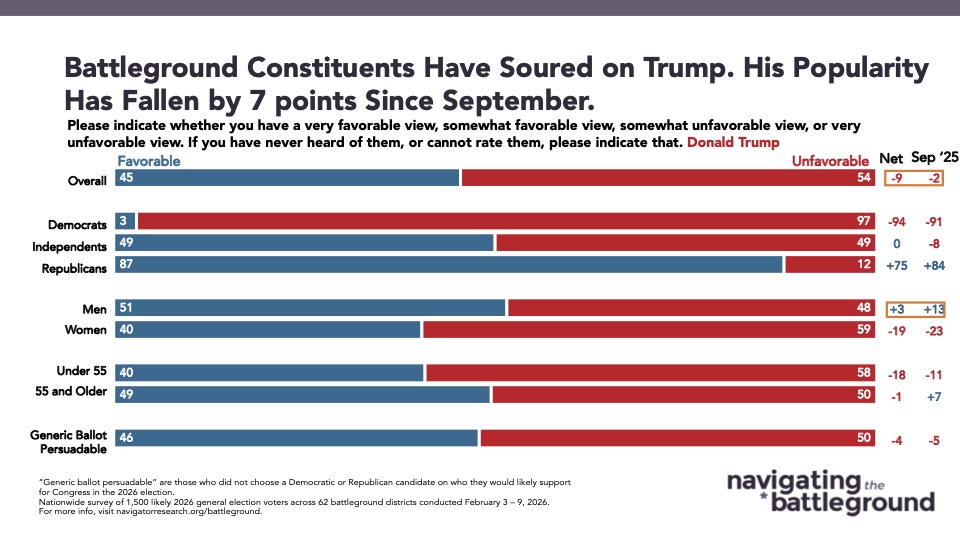
Bar chart from Navigator Research, titled: Battleground Constituents Have Soured on Trump. His Popularity Has Fallen by 7 points Since September.

Economy, Corruption, Threats to Democracy Remain Top Priorities

The cost of living, jobs, and the broader economy dominate the concerns of battleground constituents. More than four-in-ten (42%) of battleground constituents rank economic issues among their top priorities, with inflation and cost of living leading the list (29% inflation and cost of living, 13% jobs and the economy).

Concerns about the health of our democracy and government corruption are also top of mind. One-third list government corruption (36%) and threats to democracy (33%) among their top two priorities, and nearly a quarter (23%) say protecting democracy should be the number one issue Congress is focused on.
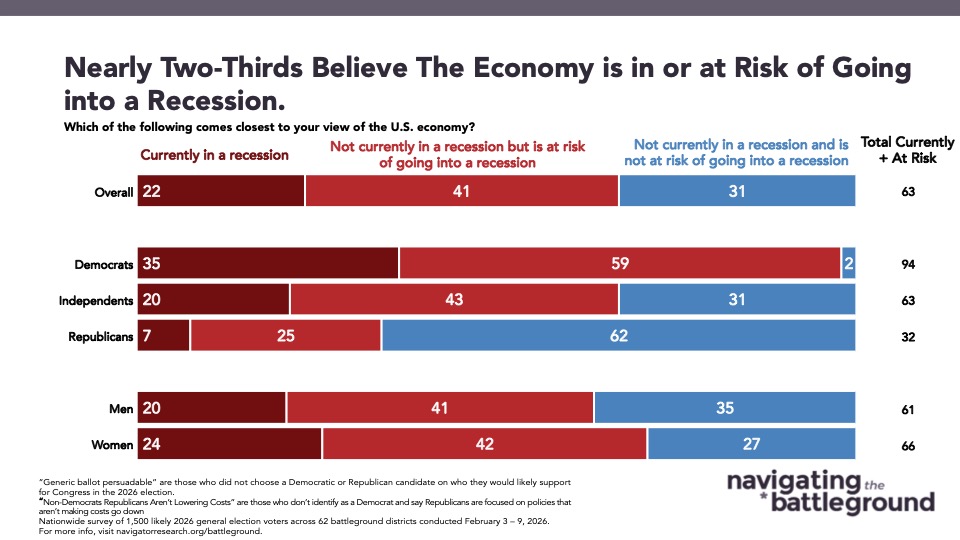
Nearly Two-Thirds Believe The Economy is in or at Risk of Going into a Recession.

Additionally, nearly two-thirds believe the economy is currently in or at risk of going into a recession. While many battleground constituents want Congress to focus on the economy and lowering the cost of living, a decisive majority believe Republicans in Congress are focused elsewhere. A clear majority (59%) believe Congressional Republicans are instead focused on immigration, followed by 17% who say they are focused on national security. Yet immigration ranks as the top issue for fewer than one in ten battleground voters (9%), and national security barely registers as the most urgent priority (only 4%).

This misalignment of priorities is clear to battleground constituents. By an 18-point margin, they say Donald Trump and Republicans in Congress are focused on the wrong things (39% right things – 57% wrong things). A majority believe they are most focused on non-economic issues (58%), rather than economic issues (39%) even as the latter is a top priority for battleground Americans.

On Top Issues, Battleground Constituents Are Split On Who They Trust

Democrats in Congress hold a slight trust advantage with battleground constituents on several cost of living issues. They’re more trusted on lowering costs for working families (net +8), making health care and prescription drugs more affordable (net +8), and looking out for “people like me” (net +3). These advantages aren’t overwhelming, but they suggest that on day-to-day affordability issues, Democrats have a slight trust advantage over Republicans.

However, Republicans in Congress do hold a small advantage over Democrats on handling the economy (net +3), a longstanding strength for the party that still resonates, even for battleground constituents. This is similar to the net +2 advantage Republicans in Congress hold over their Democratic counterparts on handling jobs and the economy in Navigator’s latest national survey.

Democrats in Congress hold commanding trust advantages on ensuring the wealthy pay their fair share in taxes (net +23) and standing up to corporate special interest (net +9). When it comes to broader issues of corruption and changing the system, Americans in the battleground are essentially split on who they trust. By only 1 point, Democrats in Congress are more trusted to stand up to corruption (with 25% saying they trust neither party), and to bring needed change (24% trust neither party). Congressional Republicans hold a 5-point advantage over Democrats in Congress when it comes to fixing a broken system in Washington – though a plurality trust neither party (36% trust neither – 33% trust Republicans – 28% trust Democrats). This signals a significant share of Americans remain unconvinced that either party can meaningfully deliver for them.

Congressional Democrats and Helping Working People

While Democrats in Congress have a slight trust advantage on lowering costs for working families and looking out for “people like me,” battleground constituents don’t believe “cares about people like me” describes Congressional Democrats well (37% describes well – 60% does not describe well).

Nearly as many aren’t convinced that Democrats “look out for working people” (40% describes well – 59% does not describe well). Slightly more than half say the word “elitist” is a fit description for Democrats in Congress (53%).

That disconnect shows up again when battleground constituents are asked who Democrats are helping. Congressional Democrats are seen as more likely to be focused on helping “other people than people like me” (55%) rather than helping “people like me” (30%). Even so, a plurality say the economic policies of Democrats in Congress most favor the middle and working class (38% middle/working class – 30% wealthy/corporations – 18% the poor).

Message Guidance on Tariff SCOTUS Ruling

Poll: Tariffs

This Navigator Research report covers the latest perceptions of tariffs, including the share of Americans who support Trump’s tariff plan and how tariffs are seen as impacting costs.

Tariff Favorability and Support

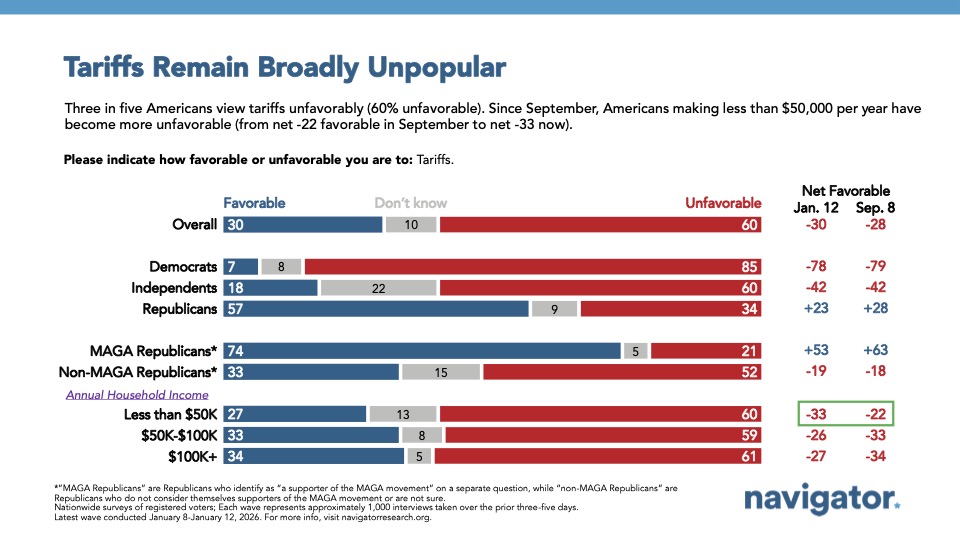
Tariffs remain overwhelmingly underwater, with 60% of Americans viewing them unfavorably and only 30% holding favorable views as of January.

Bar chart from Navigator Research, titled: Tariffs Remain Broadly Unpopular

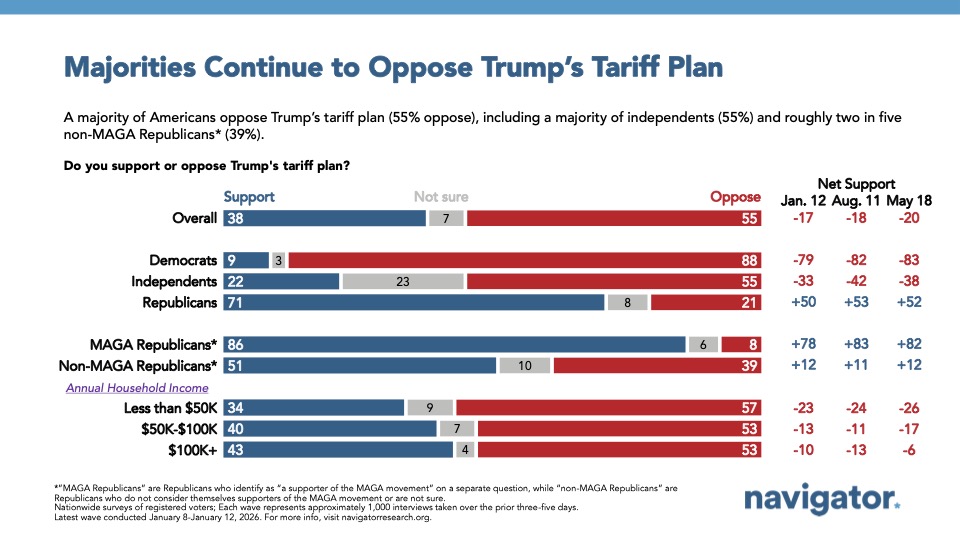
A similar margin opposes President Trump’s tariff plan, with 55% opposing and only 38% in support. Support for Trump’s tariff plan is largely partisan, opposed by 88% of Democrats, 55% of independents, and 21% of Republicans. Among Republicans though, there’s a split in support – with MAGA Republicans being 35 points more likely to support Trump’s tariff plan (86% MAGA – 51% non-MAGA).

  • Across income groups, Americans oppose Trump’s tariff plan, including among those who identify as “middle class” (43% support – 51% oppose).
  • Americans earning less than $50,000 a year have become 11 points more negative on Trump’s tariff plan since September, shifting from -22 in September to -33 in January.
Bar chart from Navigator Research, titled: Majorities Continue to Oppose Trump’s Tariff Plan

Tariffs and Costs

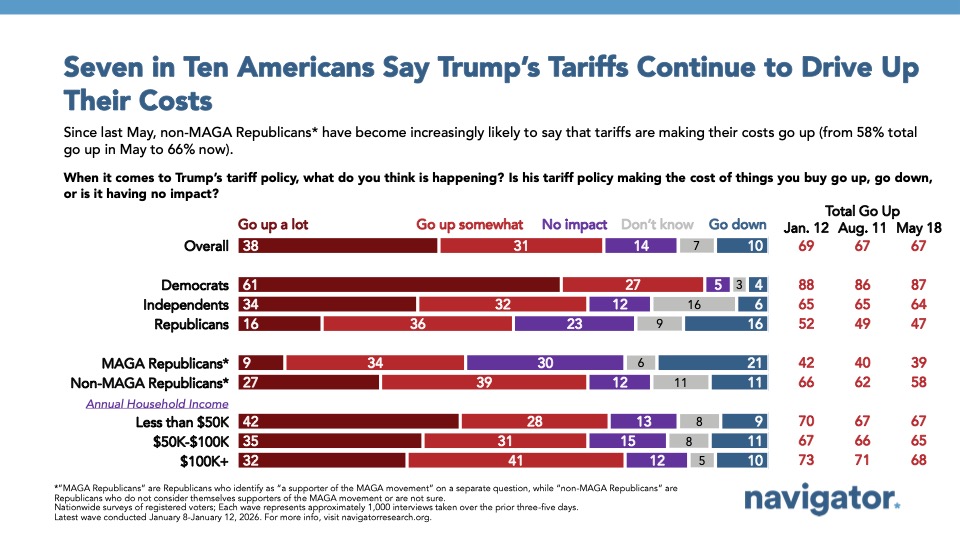
A majority across partisanship believe tariffs have led to an increase in their costs (69%), including 88% of Democrats, 65% of independents, and 52% of Republicans. Two-thirds of passive news consumers, those who say news comes to them, believe tariffs have increased their costs (66%), a similar share as active news consumers (71%). Only 10% of Americans say tariffs have made their costs go down.

Bar chart from Navigator Research, titled: Seven in Ten Americans Say Trump’s Tariffs Continue to Drive Up Their Costs

As Americans continue to believe their costs are increasing, majorities disapprove of President Trump’s handling of inflation and the cost of living (58% disapprove – 37% approve).

Message Guidance

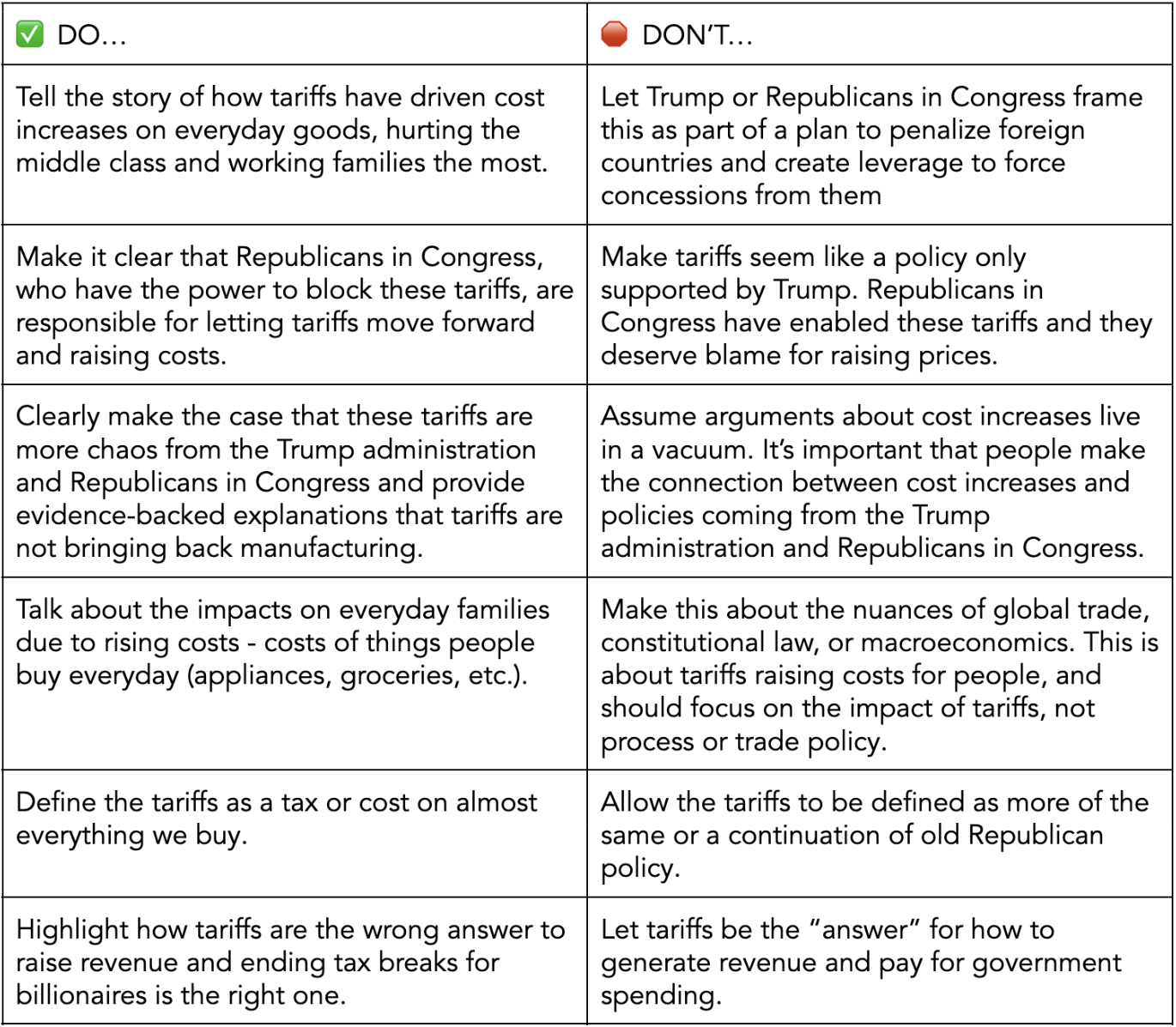
Despite the decision from the Supreme Court this morning, many of the Republican tariffs will continue. Additionally, it is likely that President Trump continues many of his tariffs in one way or another through a different mechanism. Even in the interim, it’s crucial to continue to tell the stories of how these tariffs, imposed by Trump and backed by Republicans in Congress, are raising costs for things people buy every day.

Here are some tips for how best to communicate on the negative impacts of tariffs:

Do's and Don't From Navigator Research

Read More

March 18, 2026

Perceptions And Concerns About Trump’s War Against Iran

Maryann Cousens & Melissa Toufanian
February 9, 2026

Do’s and Don’ts about Discussing ICE and Immigration

Do’s and Don’ts about Discussing ICE and Immigration

Navigator Research
February 5, 2026

All eyes are on ICE

This Navigator Research report covers Trump’s handling of immigration and mass deportations as well as messaging guidance on ICE.

Maryann Cousens

Americans Do Not See Their Government as a Democracy

Poll: Authoritarianism vs. Democracy

This Navigator Research report covers Americans’ views of democracy, authoritarianism, and the federal government.

Democracy is Underwater

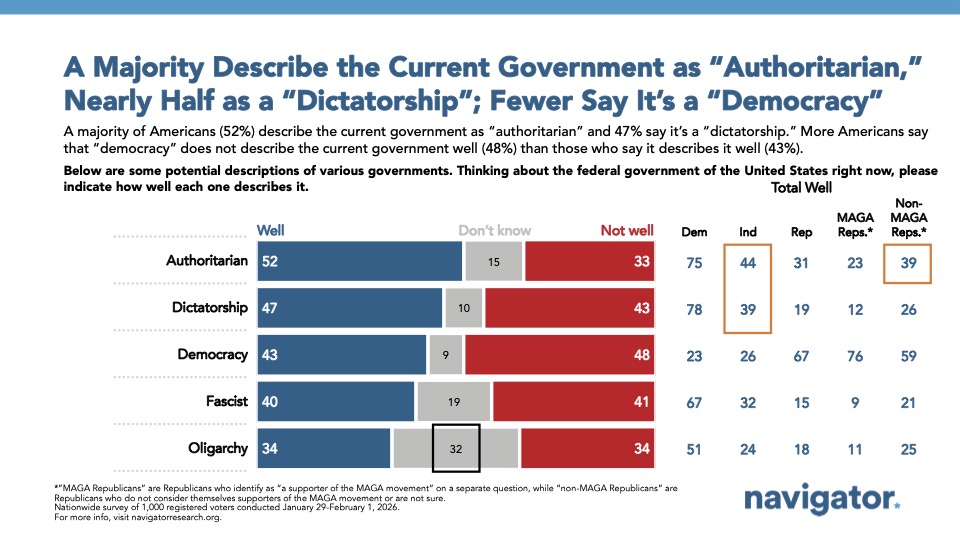
We asked Americans how well or not well the following words described our current federal government: authoritarian, dictatorship, democracy, fascist, oligarchy. A majority of Americans today believe the federal government can be described as “authoritarian” (52%). When asked how well “democracy” describes the federal government, Americans are five points more likely to say “not well” than “well” (48% and 43%, respectively).

Significant shares of Americans also agree that other undemocratic forms of government aptly describe the federal government, including:

  • Dictatorship: (net +4; 47% say well – 43% say not well)
  • Fascist: (net -1; 40% say well – 41% say not well)
  • Oligarchy: (net 0; 34% say well – 34% say not well).
Bar chart from Navigator Research, titled: A Majority Describe the Current Government as “Authoritarian,” Nearly Half as a “Dictatorship”; Fewer Say It’s a “Democracy”

Among tested terms, Americans appear least familiar with “oligarchy.” About one third of Americans say they “don’t know” how well the term describes the federal government (32%).

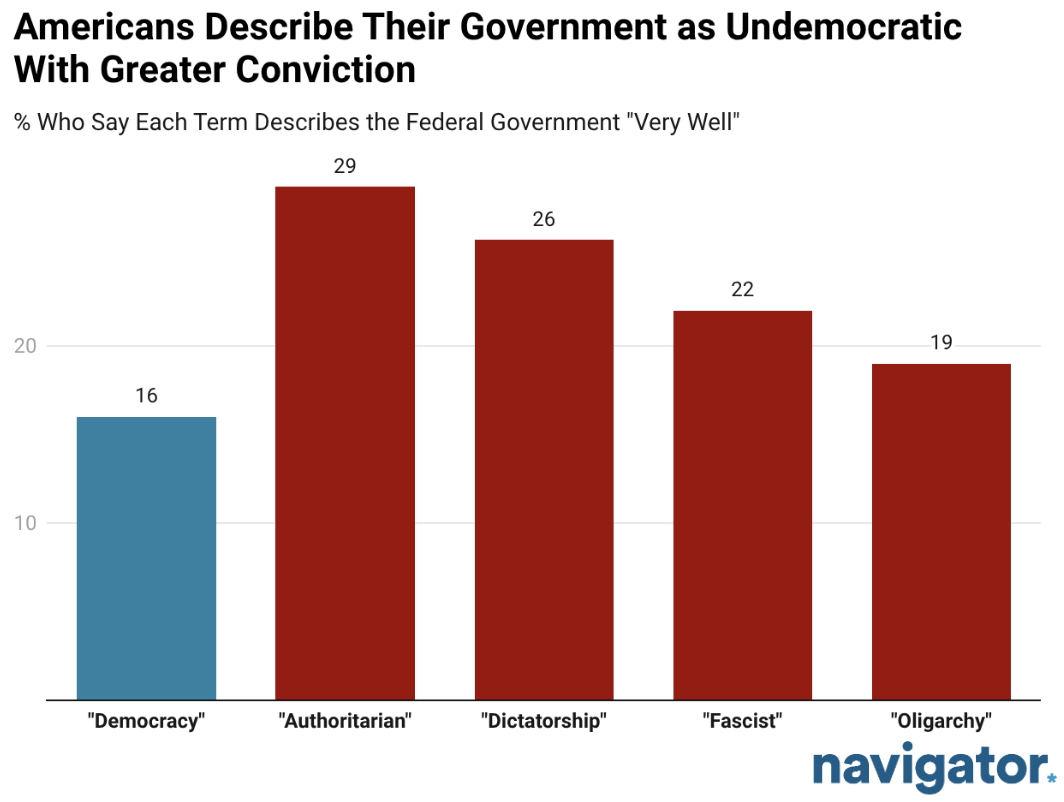
Americans are more likely to describe their current government as undemocratic than democratic. Just 16% say “democracy” describes the federal government “very well” – 10 points less than the share who say “dictatorship” describes the federal government “very well” (26%) and 12 points less than the share who say “authoritarian” describes the federal government “very well” (29%). Americans are also more likely to say “fascist” (22%) and “oligarchy” (19%) describe the federal government “very well.”

Bar chart from Navigator Research, titled: Americans Describe Their Government as Undemocratic With Greater Conviction

Gen Z, Active News Consumers, and MAGA v. Non-MAGA Republicans

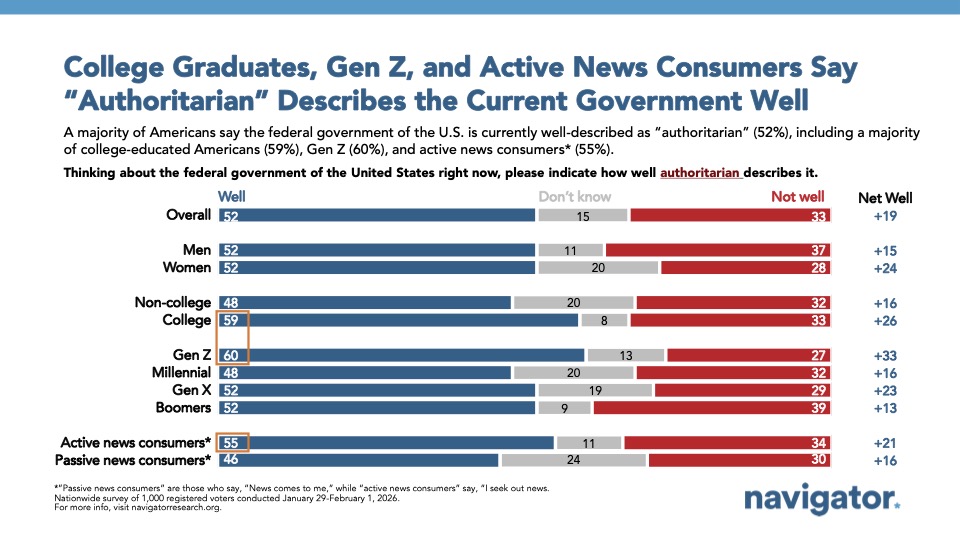
While each generation was more likely than not to describe the federal government as “authoritarian,” Gen Z adults are particularly inclined to see their government as undemocratic. Just 36% of Gen Z respondents feel “democracy” appropriately describes the federal government, with majorities of Gen Z adults instead agreeing with descriptors like “authoritarian” (60%), “fascist” (51%), or “dictatorship” (54%). Just under one third (31%) of Gen Z adults say “fascist” describes the federal government “very well” – nearly twice the number who say “democracy” describes the federal government “very well” (16%).

55% of active news consumers (those who say they seek out the news, rather than letting the news come to them) say “authoritarian” describes the federal government well – nine points greater than the share of passive news consumers who say the same (46%). Passive news consumers were also 13 points more likely to say they “don’t know” if “authoritarian” describes the federal government well (24% of passive news consumers).

Bar chart from Navigator Research, titled: College Graduates, Gen Z, and Active News Consumers Say “Authoritarian” Describes the Current Government Well

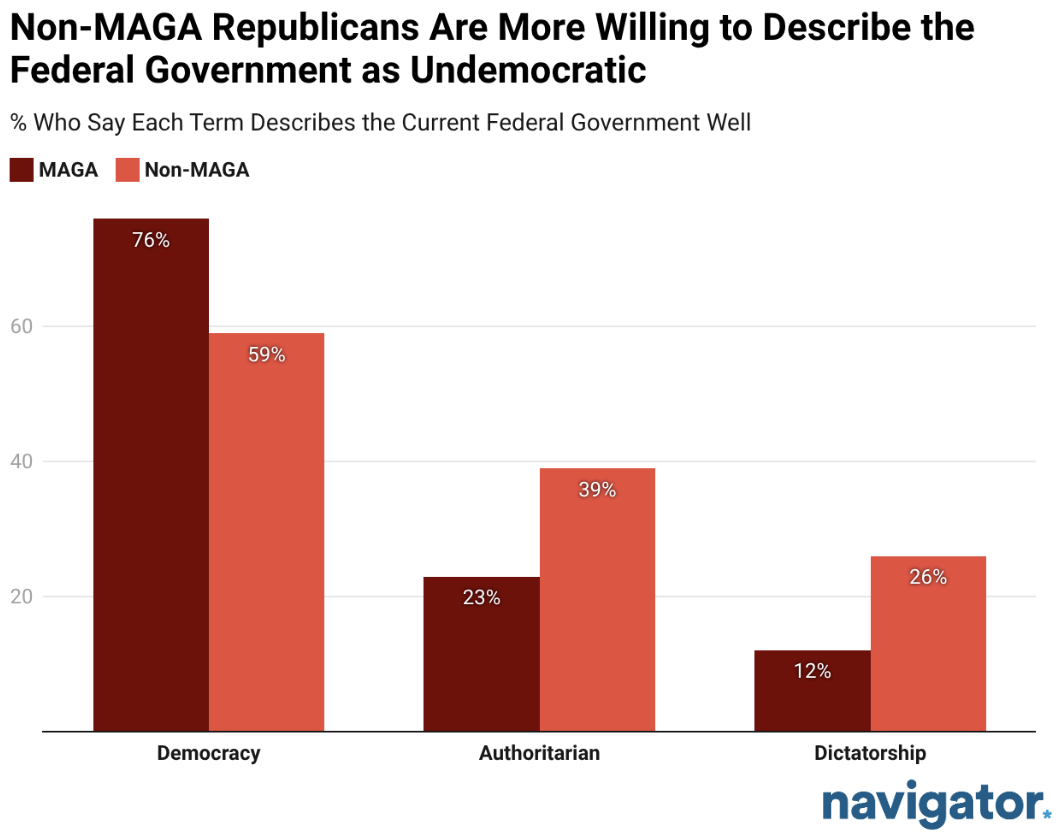
Republicans who do and do not consider themselves supporters of the MAGA movement also demonstrate strong differences in how they view the federal government. Non-MAGA Republicans are 17 points less likely than MAGA Republicans to say “democracy” describes the federal government well (59% and 76%, respectively). Non-MAGA Republicans are 16 points more likely to describe the federal government as “authoritarian” (39% and 23%, respectively), and 14 points more likely to say “dictatorship” describes the federal government well (26% and 12%, respectively).

Bar chart from Navigator Research, titled: Non-MAGA Republicans Are More Willing to Describe the Federal Government as Undemocratic

Read More

April 8, 2026

Americans Blame Trump for Rising Gas Prices

This Navigator Research report includes new data on gas prices, including to what extent Americans believe gas prices have increased and perceptions of who’s to blame.

Maryann Cousens

Why Americans Don’t Trust Their Elected Officials – And How to Fix it

Poll: Corruption

This Navigator Research report covers the most recent perceptions of why elected officials are unable to get things done, including who Americans believe are more likely to be beholden to special interests, and how elected officials can show they can be trusted.

Why Elected Officials Can’t Get Things Done

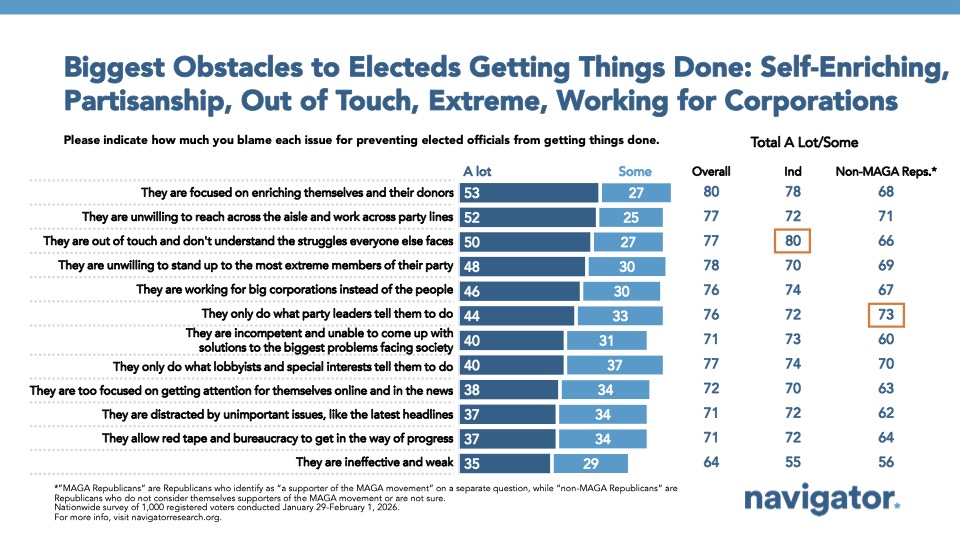
Eight-in-10 Americans believe elected officials’ focus on enriching themselves and their donors stops them from getting things done, including 86% of Democrats, 78% of independents, and 74% of Republicans. Other top barriers to progress include: an unwillingness to reach across the aisle (77%), being out of touch and not understanding the struggles everyone else faces (77%), unwillingness to stand up to the most extreme members of their party (78%), and working for corporations instead of people (76%).

  • Among both independents and rural Americans, the perceived greatest barrier to elected officials getting things done is that they don’t understand the struggles everyone else faces (80%).
  • Among non-MAGA Republicans, the perceived greatest barrier is only doing what party leaders tell them to do (73%).
Bar chart from Navigator Research titled: Biggest Obstacles to Electeds Getting Things Done: Self-Enriching, Partisanship, Out of Touch, Extreme, Working for Corporations

Republicans Seen as More Likely to Be Working for Corporations Instead of the People

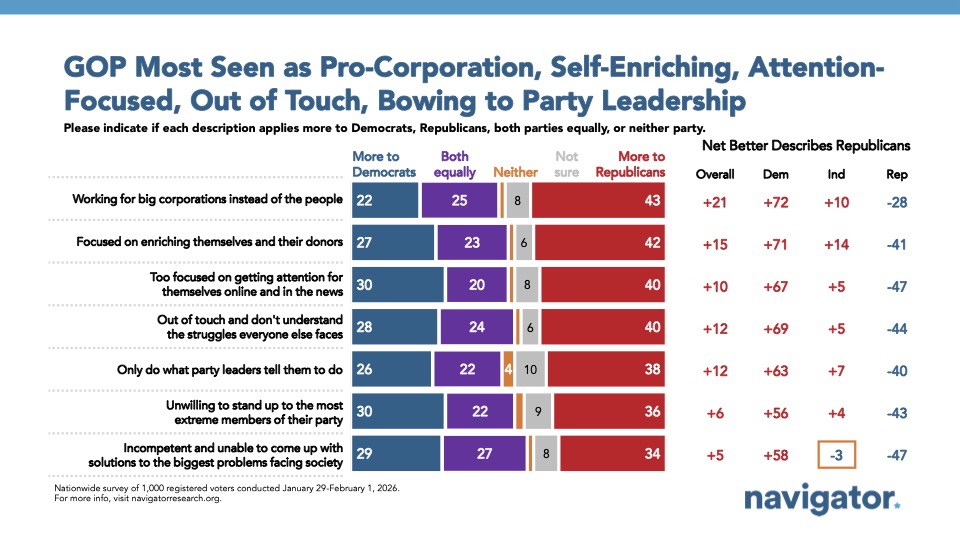
By 21 points, Americans believe Republicans are better described as “working for big corporations instead of the people” than Democrats (43% Republicans – 22% Democrats). By similar margins, Republicans are more viewed as: 

  • Focused on enriching themselves and their donors (net +15)
  • Out of touch and don’t understand the struggles everyone else faces (net +12)
  • Too focused on getting attention for themselves online and in the news (net +10)
Bar chart from Navigator Research titled: GOP Most Seen as Pro-Corporation, Self-Enriching, Attention-Focused, Out of Touch, Bowing to Party Leadership

Both Parties Viewed as Swayed by Special Interests

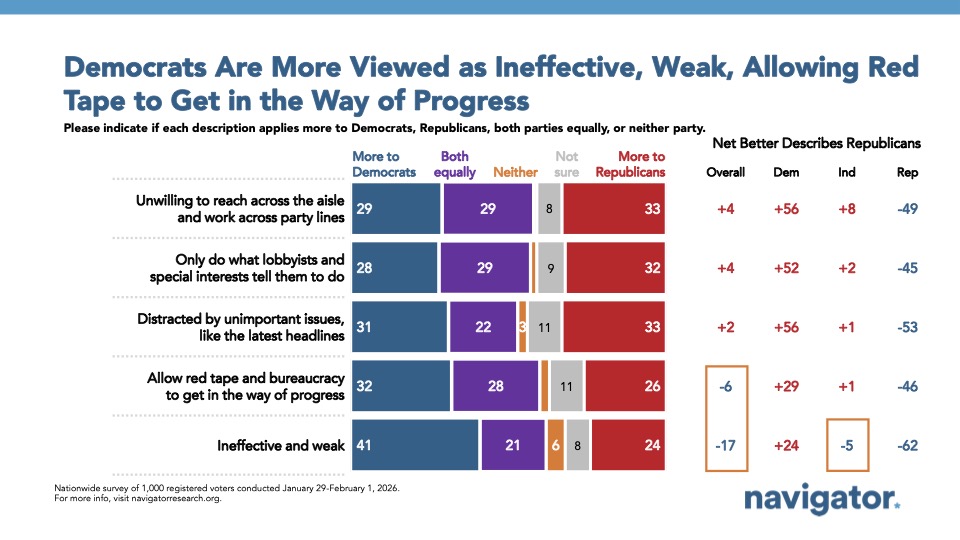
Americans are split on which party is better described as “incompetent and unable to come up with solutions to the biggest problems” (29% Democrats – 34% Republicans – 27% both equally), “only do what lobbyists and special interests tell them to do,” (28% Democrats – 32% Republicans – 29% both equally) and “distracted by unimportant issues” (31% Democrats – 33% Republicans – 29% both equally). For each of these descriptors, nearly half of independents believe they describe both parties equally.

Democrats Seen as More Ineffective and Weak

By 17 points, Americans believe “ineffective and weak” better describes Democrats than Republicans, though a plurality of independents believe it best describes both parties equally (40%).  By a six-point margin, Americans also believe “allow red tape and bureaucracy to get in the way of progress” better describes Democrats than Republicans.

Bar chart from Navigator Research titled: Democrats Are More Viewed as Ineffective, Weak, Allowing Red Tape to Get in the Way of Progress

How Elected Officials Can Build Trust with Americans

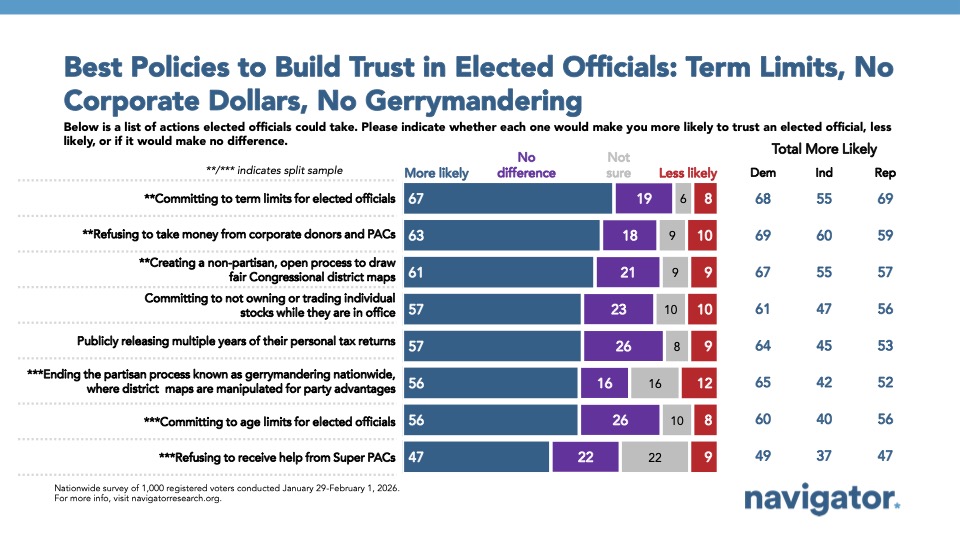
Across partisanship, majorities are more likely to trust an elected official who commits to term limits (67%), including 68% of Democrats, 55% of independents, and 69% of Republicans. Similarly, an elected official who refuses to take money from corporate donors and PACs would be viewed as more trustworthy (63%), including by 42% who say they would be “much” more likely to trust that elected official. Other popular reforms include:

  • Creating a non-partisan, open process to draw fair Congressional district maps (more likely to trust among 67% of Democrats, 55% of independents, 57% of Republicans)
  • Committing to not owning or trading individual stocks while in office (more likely to trust among 61% of Democrats, 47% of independents, 56% of Republicans).
  • Publicly releasing multiple years of their personal tax returns (more likely to trust among 64% of Democrats, 45% of independents, 53% of Republicans).
Bar chart from Navigator Research titled: Best Policies to Build Trust in Elected Officials: Term Limits, No Corporate Dollars, No Gerrymandering

Read more from Navigator: An early 2025 survey found that 74% believe the American political and economic system needs major changes. Within that three-quarters majority, 12% are so discontented that they believe the system needs to be torn down completely. Remarkably, this cuts fairly evenly across party lines. Our October 2025 focus groups on political dysfunction further underscored frustrations with the status quo and despair with the state of American politics.

Read More

April 8, 2026

Americans Blame Trump for Rising Gas Prices

This Navigator Research report includes new data on gas prices, including to what extent Americans believe gas prices have increased and perceptions of who’s to blame.

Maryann Cousens

Trump’s Priorities Still Seen as Out of Whack

Poll: The Economy

This Navigator Research report covers the most recent perceptions of the economy, including how Americans are viewing the national economy, their own personal financial situations, and who they see in the government as best equipped to handle the cost of living.

Trump Approval

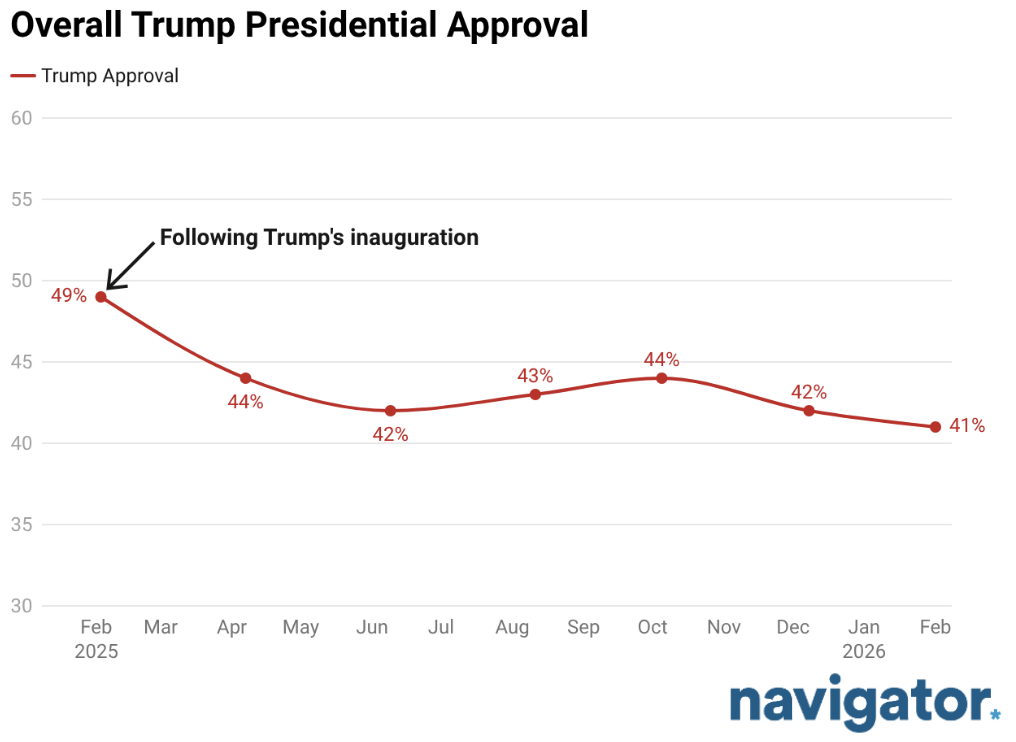
Trump’s approval ratings are deeply underwater. Just 41% of Americans approve of Trump’s handling of the presidency and 40% approve of his handling of the economy. Compared with Navigator’s polling conducted at the same time last year, presidential approval has sunk from net +2 in late January/early February 2025 (49% approve – 47% disapprove) to net -15 now (41% approve – 56% disapprove). Approval of Trump’s handling of the economy has seen a similar dip, falling from net +1 in early 2025 (47% approve – 46% disapprove) to net -17 (40% approve – 57% disapprove).

Line graph from Navigator Research, titled: Overall Trump Presidential Approval

Among independents and other groups, he’s even weaker. Just 24% of independents approve of Trump’s handling of the economy, and 30% approve of his handling of the presidency overall. Three quarters of Black Americans (75%) disapprove of Trump’s job as president, as do 64% of Hispanic Americans. Economic approval is similarly low for both groups – only 23% of Black Americans and 30% Hispanic Americans approve of Trump’s handling of the economy. While he’s underwater across generations, Gen Z stands out in their frustration with Trump’s job in office. Among Gen Z, approval of Trump’s presidency is net -34 (32% approve – 66% disapprove) and approval of his job handling the economy is net -30 (33% approve – 63% disapprove).

Economic Sentiments

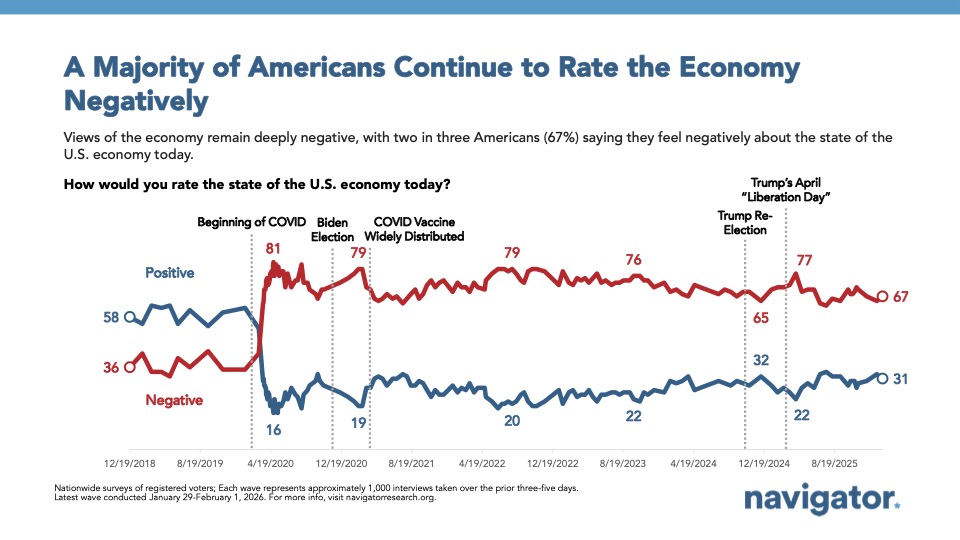
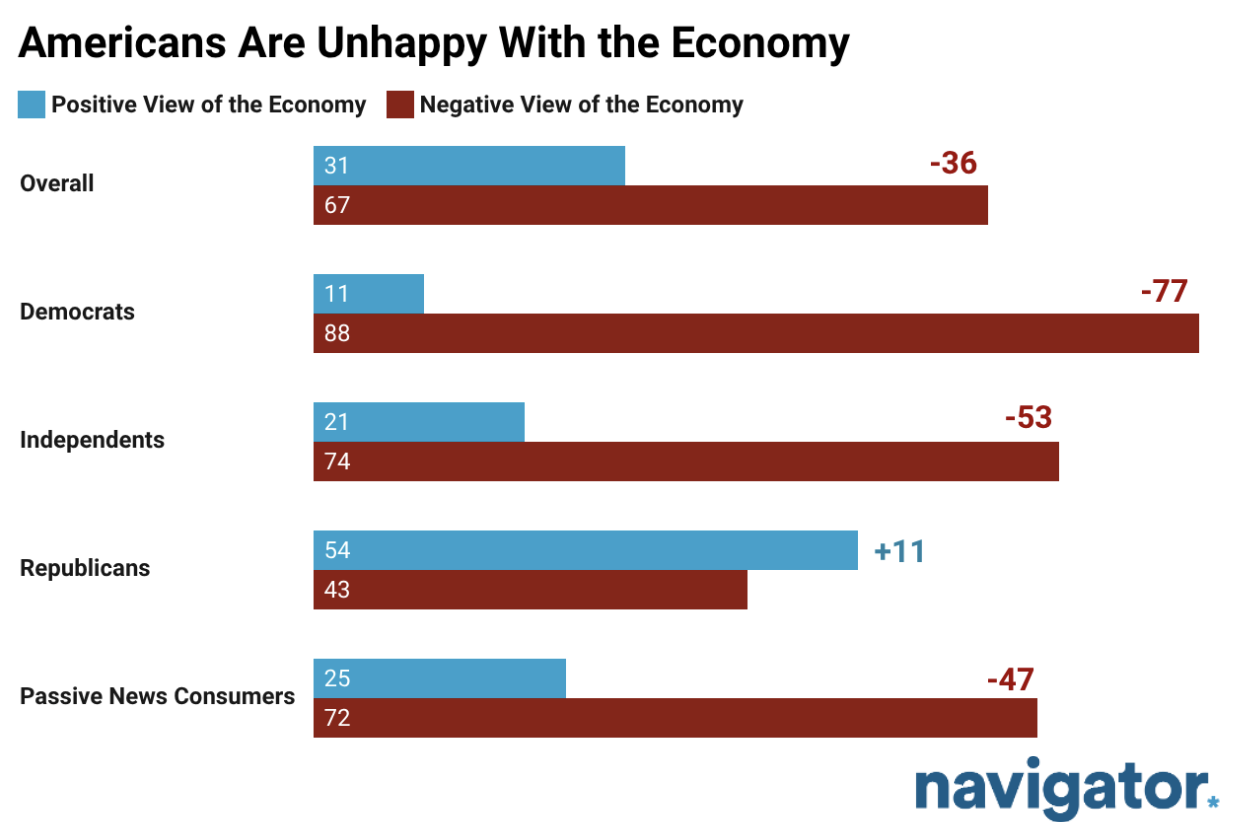
Americans remain uneasy about their economic futures. Just 31% of Americans give the economy a positive rating, and only 4% would describe the economy as “excellent.” Americans’ views on the economy are guided heavily by their partisanship – though even many Republicans are negative. Only one-in-10 Democrats (11%) offer a positive assessment of the economy, while just over half of Republicans (54%) rate the economy positively – still, only 7% of Republicans would rate the economy as “excellent.” Independents remain unhappy with the economy; only 21% feel the economy today is in good shape.

Line graph from Navigator Research, titled: A Majority of Americans Continue to Rate the Economy Negatively

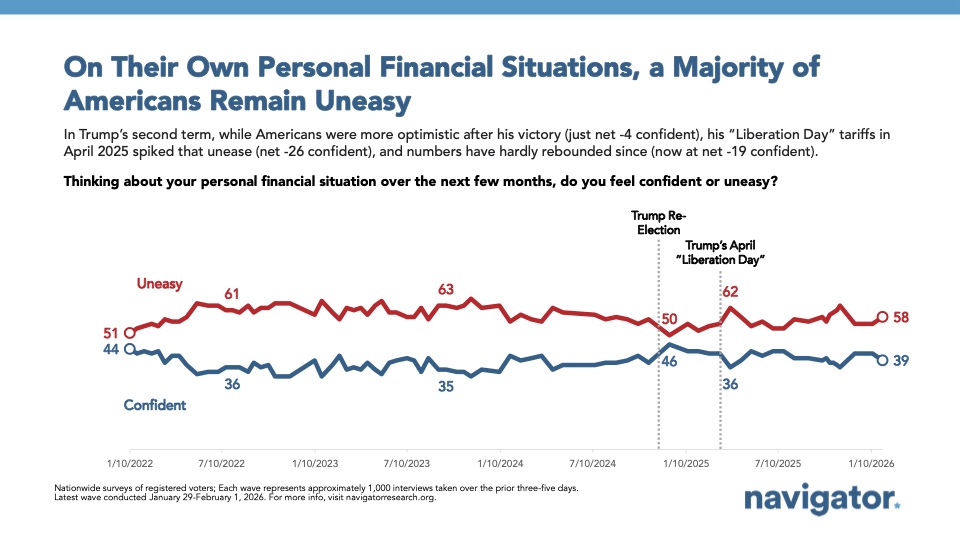
Americans feel a bit more optimistic about their own situation – but not by much. Overall, 39% feel confident, while 58% reported feeling “somewhat” or “very” uneasy about their pocketbooks. Again, partisanship plays a role: three-quarters of Democrats (75%) feel uneasy about their personal financial situations, while a slight majority (57%) of Republicans feel confident. As with overall economic sentiments, independents lean pessimistic. Only 32% of independents feel “confident” about their personal finances.

Line graph from Navigator Research, titled: On Their Own Personal Financial Situations, a Majority of Americans Remain Uneasy

Just 25% of passive news consumers (those who say their news comes to them, rather than them seeking it out) give the overall economy a positive rating, while only 31% are confident in their own finances. In comparison, active news consumers are 10-points more positive on the overall economy (35% v. 25%) and 13-points more confident in their personal finances (44% v. 31%).

Bar chart from Navigator Research, titled: Americans Are Unhappy With the Economy

Americans and Trump Remain on Different Pages

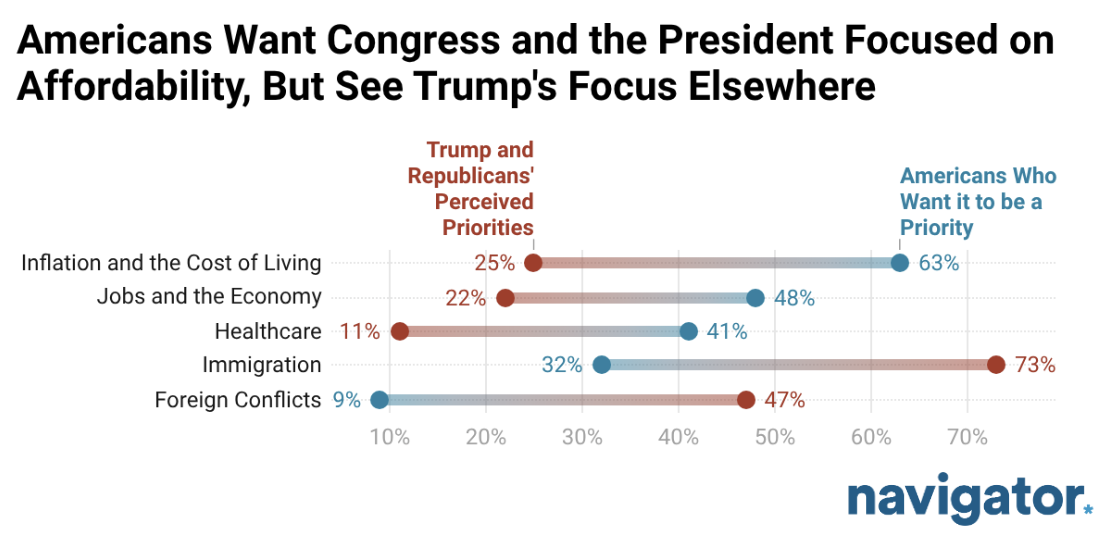
The disparity between Americans‘ priorities and what they think are Trump and Congressional Republicans’ priorities is stark. While 63% of Americans prioritize inflation and the cost of living, only 25% see it as a top focus of Republicans, a 38-point gap. While immigration is narrowly a top five priority for Americans at 32%, this is still 41 points lower than where they see the Trump administration’s focus (73%). Even among Republicans, just 51% place immigration in their top five desired areas of focus. The number two perceived focus of Trump and Congressional Republicans, foreign conflicts (47%), is of little interest to either Democrats (9%) or Republicans (11%).

Chart from Navigator Research, titled: Americans Want Congress and the President Focused on Affordability, But See Trump's Focus Elsewhere

Read More

April 8, 2026

Americans Blame Trump for Rising Gas Prices

This Navigator Research report includes new data on gas prices, including to what extent Americans believe gas prices have increased and perceptions of who’s to blame.

Maryann Cousens

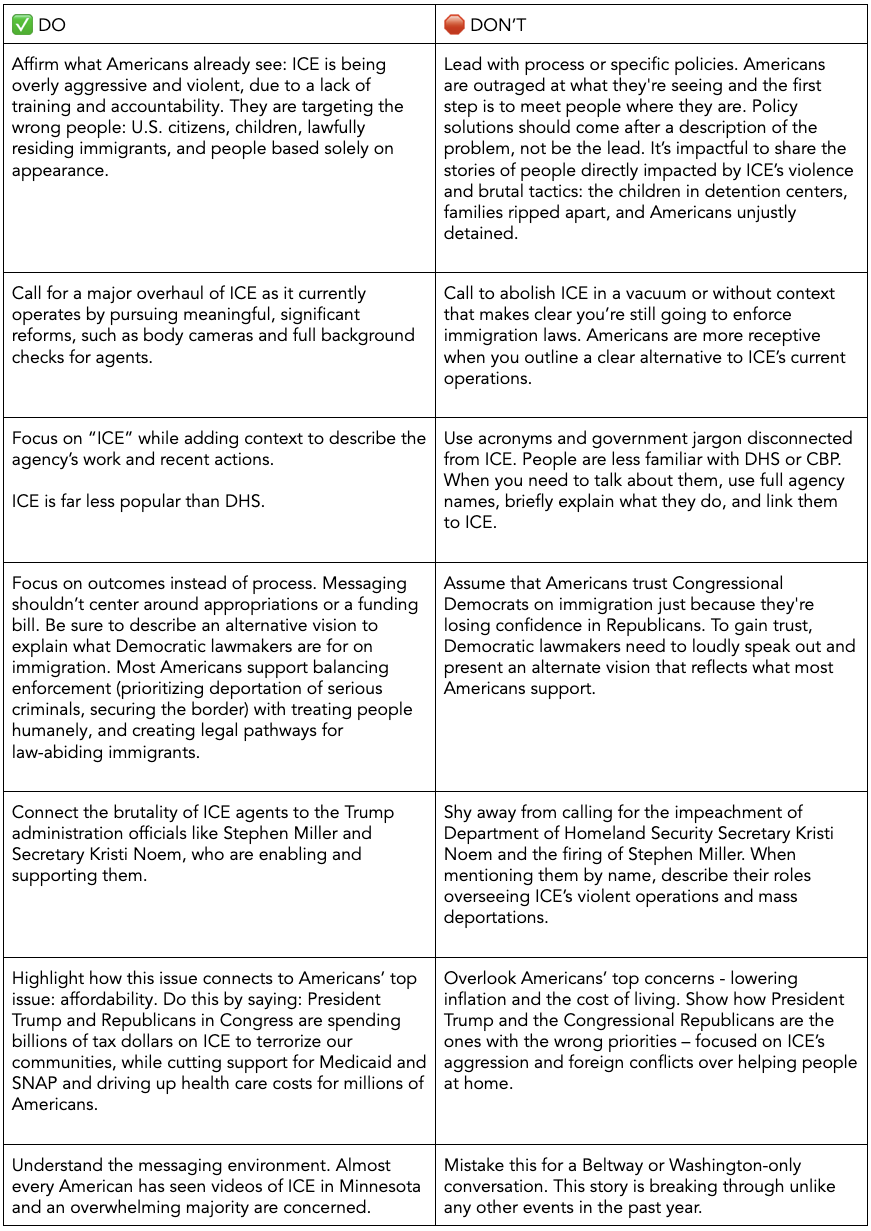
Do’s and Don’ts about Discussing ICE and Immigration

Do’s and Don’ts about Discussing ICE and Immigration

As lawmakers discuss guardrails and reforms to ICE and stopping Trump’s unpopular immigration agenda, these topics will continue to dominate news coverage for the days and weeks ahead. Recent polling from Navigator found Americans are overwhelmingly supportive of reforms to ICE. There’s also support for withholding funding from ICE if Democrats in Congress don’t get the reforms they’re looking for, even if it risks a government shutdown.

Here are some tips to effectively communicate about immigration and ICE:

Read More

March 18, 2026

Perceptions And Concerns About Trump’s War Against Iran

Maryann Cousens & Melissa Toufanian
February 20, 2026

Message Guidance on Tariff SCOTUS Ruling

Polling report covering the latest perceptions of tariffs, including the share of Americans who support Trump’s tariff plan and how tariffs are seen as impacting costs.

Navigator Research
February 5, 2026

All eyes are on ICE

This Navigator Research report covers Trump’s handling of immigration and mass deportations as well as messaging guidance on ICE.

Maryann Cousens