
Americans Struggle to Keep Up with Rising Costs

President Trump’s Economic Approval Rating Is At Historical Low, One of Worst Ever

With costs continuing to rise, Americans are feeling the effects first hand. A majority disapprove of President Trump’s handling of the economy (net -19; 40% approve – 59% disapprove) and his handling of his job as president (net -18; 40% approve – 58% disapprove). Notably, economic disapproval is even higher among independents (72% disapprove), and includes a plurality of non-MAGA Republicans (39% disapprove). 
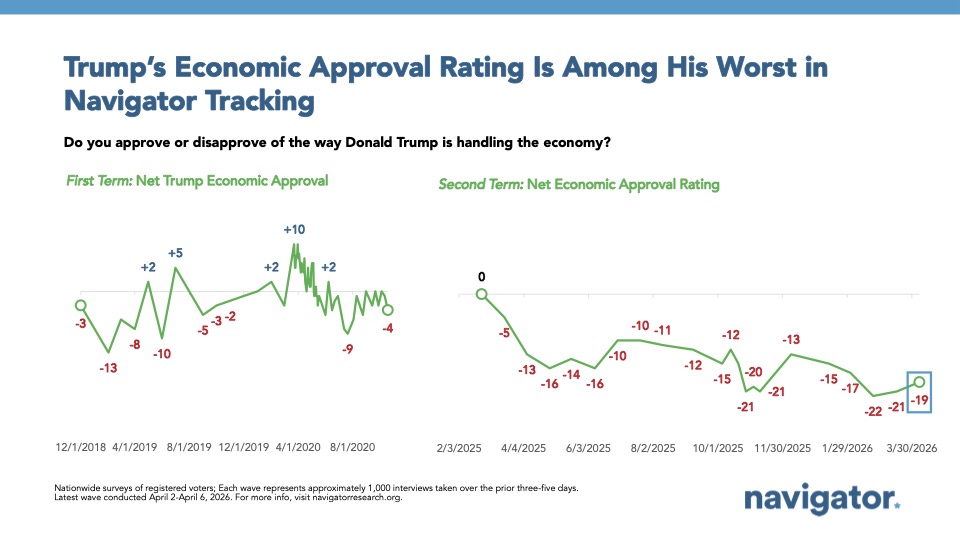
Line graph from Navigator Research titled: Trump's Economic Approval Rating Is Among His Worst in Navigator Tracking

While Americans are expressing their disapproval of President Trump’s handling of the economy, they also feel strongly that he is focused on the wrong things (55% overall, including 63% of independents). People are pessimistic about the direction of the country by double-digit margins; Americans feel we will be worse off a year from now (43%) and that we were better off a year ago (40%).

Americans Lack Confidence in Both the Economy At-Large and Their Own Personal Financial Situation

Americans continue to rate both the economy and their own personal financial situation negatively. By a 37-point margin, Americans believe the state of the U.S. economy is “poor” or “not so good” (68% negative – 31% positive), including 82% independents and 63% of non-MAGA Republicans. And by a 19-point margin, Americans are feeling uneasy (58% uneasy – 39% confident) about their personal financial situation, including 71% of independents and nearly half (49%) of non-MAGA Republicans.
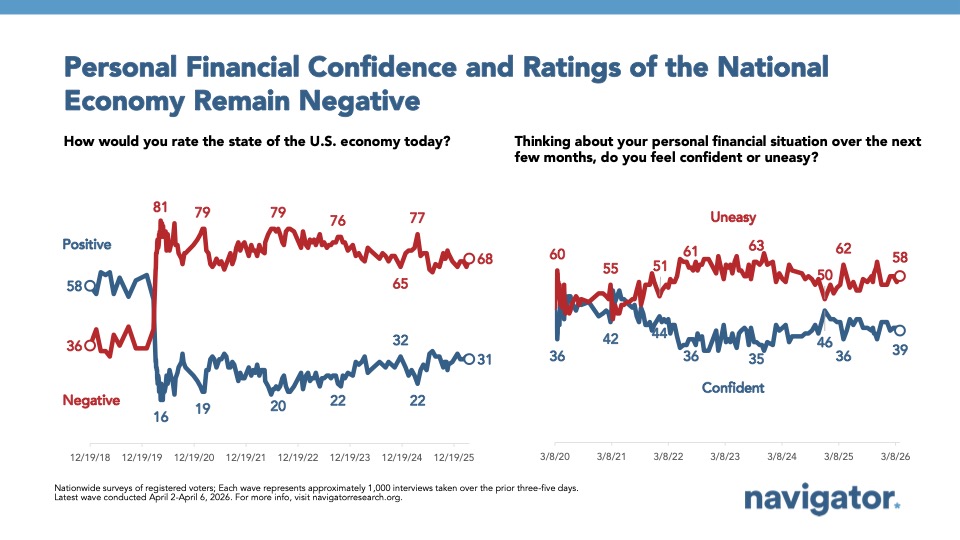
Line graphs from Navigator Research titled: Personal Financial Confidence and Ratings of the National Economy Remain Negative
  • Women are feeling more economic unease than men; 63% of women do not feel confident about their own financial situation compared to 53% of men.
  • Self-identified service workers are most likely to rate the economy as “poor” or “not so good” (78%) and feel similarly uneasy about their personal finances (71%). 
  • By a 15-point margin, Americans who watch CNN or MSNBC are more likely to rate the economy poorly compared to Fox News watchers. They are also more likely to feel uneasy about their personal finances by a 12-point margin. 

Americans are Feeling the Pain of Rising Costs 

Across demographics and within every cost category, an overwhelming majority of Americans are feeling squeezed by rising costs. As many as nine-in-10 people feel gas prices are going up, eight-in-10 feel costs, generally, are going up and even seven-in-10 feel the cost of utilities is going up. It’s across the board. 
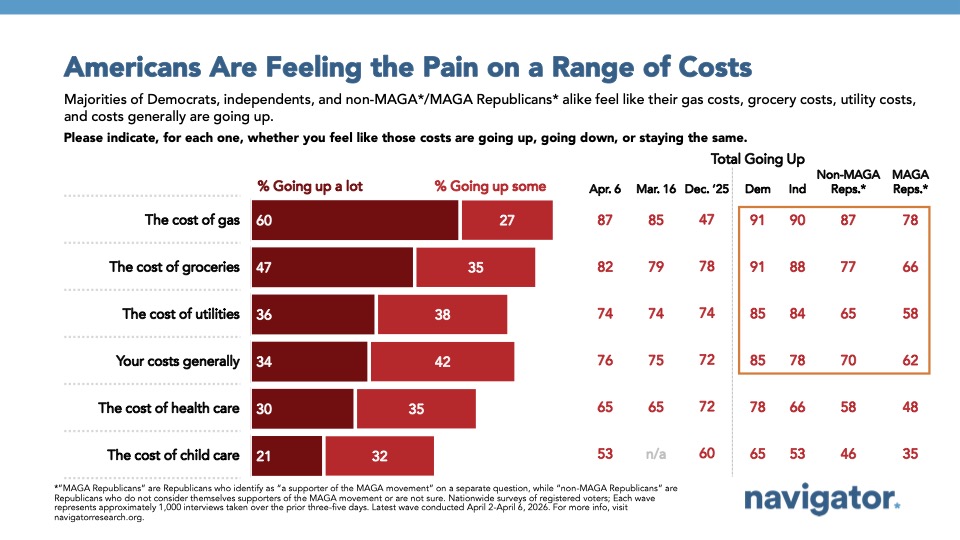
Bar graph from Navigator Research titled: Americans Are Feeling the Pain on a Range of Costs

People Judge the Economy Personally, Not Systemically

Americans’ biggest economic concerns center on rising costs of their day-to-day needs, like groceries, gas, and utility bills. Americans are less concerned about economic indicators like economic growth (12%), jobs reports (19%), or consumer confidence (12%). It’s the micro and personal, not the macro, that drives opinion. 
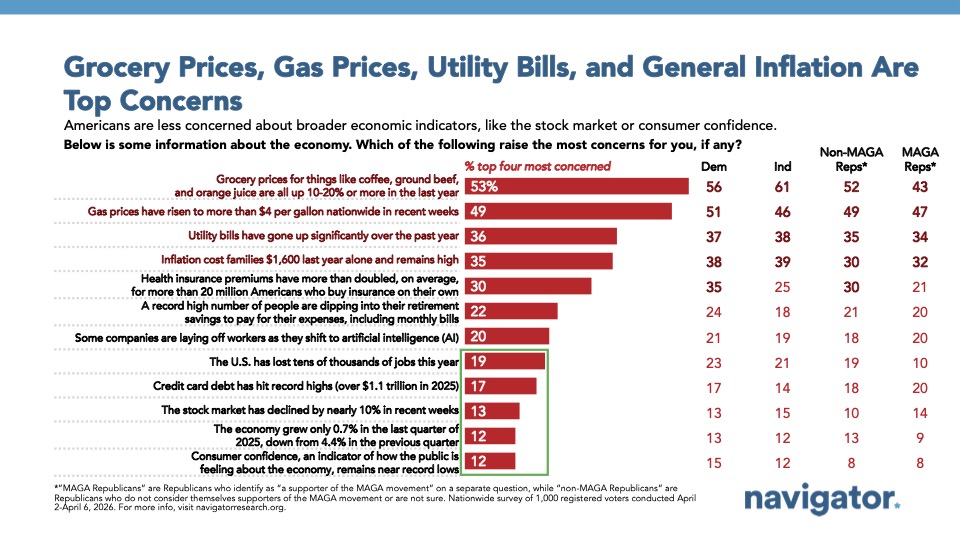
Bar graph from Navigator Research titled: Grocery Prices, Gas Prices, Utility Bills, and General Inflation Are Top Concerns

To Save Money or Increase Income, Many Americans Are Making Dramatic Changes

Americans across ideologies are making changes to their day-to-day lives in order to combat rising costs. Over half of Americans are cutting back and going out less in order to save money (52%). Two-in-five are cutting coupons or shopping for discounts (41%), while nearly one-third are cancelling subscriptions (29%). 
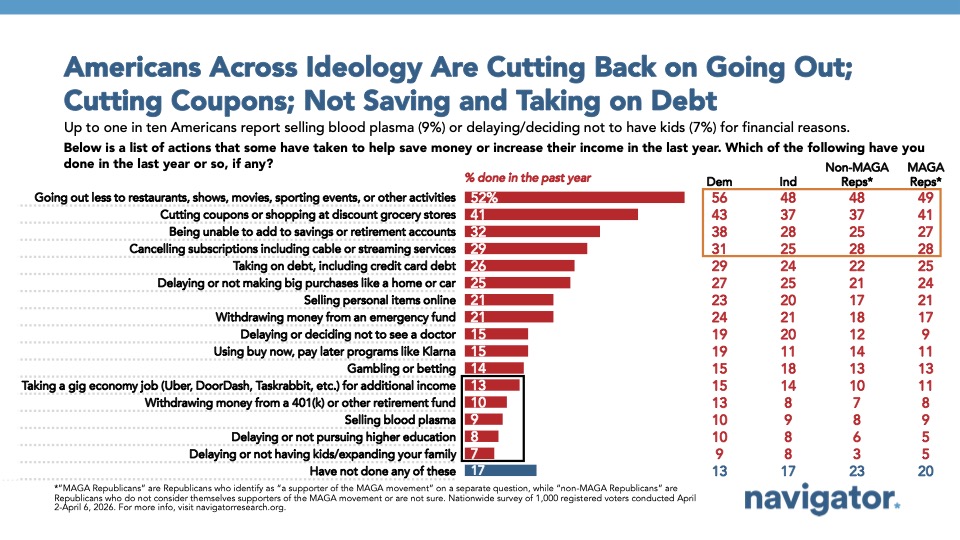
Bar graph from Navigator Research titled: Americans Across Ideology Are Cutting Back on Going Out; Cutting Coupons; Not Saving and Taking on Debt

Americans are not only cutting back on non-essentials. They are also making large changes that can significantly impact their quality of life. A quarter have delayed buying a home or car in the last year (25%), 15% have delayed or decided not to see a doctor in order to save money, 8% have delayed and decided to not pursue higher education, 7% have delayed or decided against having kids, and nearly one-in-10 have even sold their blood plasma (9%). 

As Americans try to keep up with rising costs, they also report taking on more debt (26%), using buy-now-pay-later programs (15%), and withdrawing from emergency funds (21%). 

Democrats Have the Trust Advantage on the Issue Americans Care Most About 

Americans don’t feel that President Trump and Republicans in Congress are prioritizing the most salient issue impacting them today—costs—and Democrats hold a trust advantage on a range of costs like health care, child care, groceries, housing, utilities, gas and more – albeit narrow on certain issues. However, one-in-4 do not yet trust either party to lower costs. 
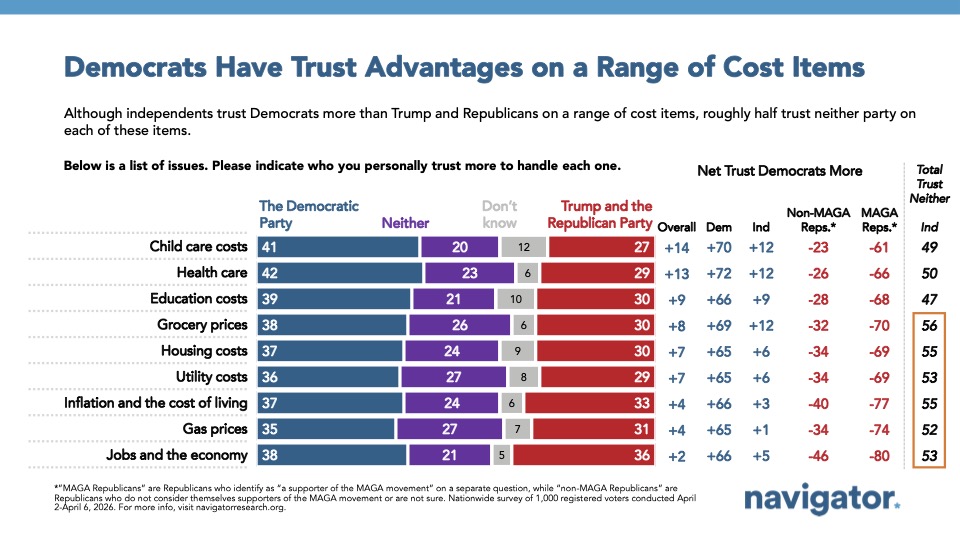
Bar graph from Navigator Research titled: Democrats Have Trust Advantages on a Range of Cost Items

Views on Republican Tax Policies

Americans Still Don’t Like the Republican Tax Law and Do Not Think It Benefits The Middle Class 

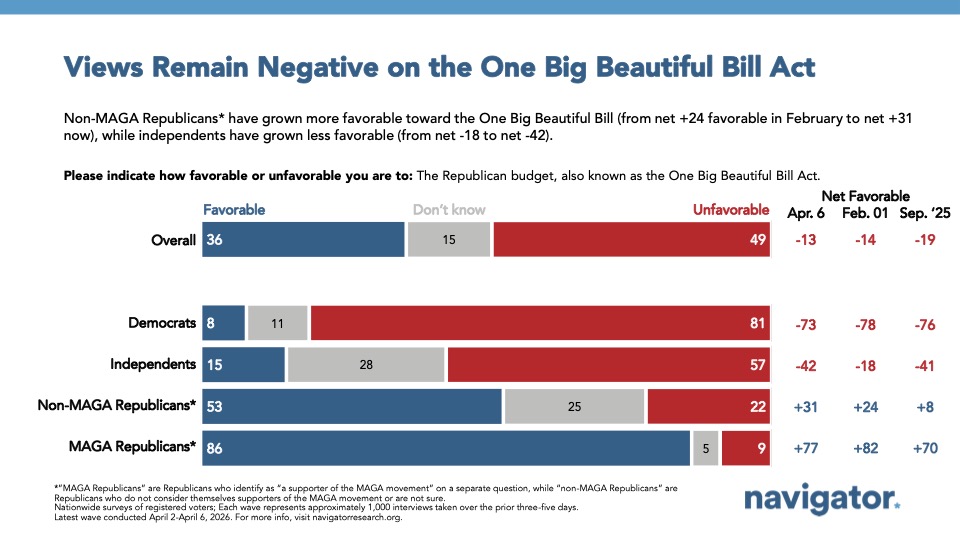
With most Americans having filed their 2025 income taxes, they still oppose the Republican tax law. The law’s favorability is net -13 (36% favorable – 49% unfavorable), still in the negative by double digits as it was when it passed last summer. In August, the law had a favorability of net -19 (33% favorable – 52% unfavorable).

  • The law is more favorable among those who filed their taxes by April 6 (net -7; 41% favorable – 48% unfavorable) compared to those who hadn’t yet (net -20; 31% favorable – 51% unfavorable).
  • Despite efforts from the Trump administration and Republicans in Congress to highlight the Republican tax law’s provisions on tips and overtime, the law is especially unpopular among self-identified service industry workers (net -24; 28% favorable – 52% unfavorable).
Bar graph from Navigator Research titled: Views Remain Negative on the One Big Beautiful Bill Act

By a 20-point margin, more Americans believe the law does not benefit the middle class (48%) than those who say it lowers taxes for everyone for all Americans (28%). 24% of Americans – and 39% of independents – say they don’t know enough to say. That’s a greater margin than the share who say that the law’s costs outweigh its benefits (13-point margin, 44% agree – 31% disagree).

Republicans Have Lost Their Narrow Advantage On Taxes, With About a Quarter Saying They Don’t Trust Either Party

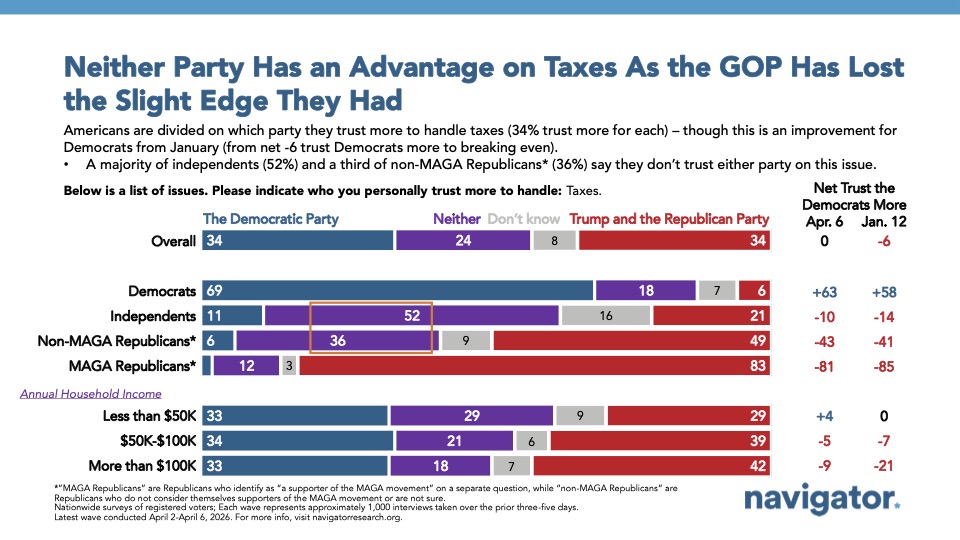
Americans are evenly divided on which party they trust more to handle taxes: 34% say the Democratic Party and 34% say President Trump and the Republican Party, with 24% saying neither and 8% saying they did not know.. In January, Trump and Republicans held a six-point advantage in trust on taxes (Democrats: 32% – Trump and Republicans: 38%) with 24% saying they don’t trust either party.

Bar graph from Navigator Research titled, Neither Party Has an Advantage on Taxes As the GOP Has Lost the Slight Edge They Had

The Vast Majority Are Paying About the Same or More Than Expected in Taxes

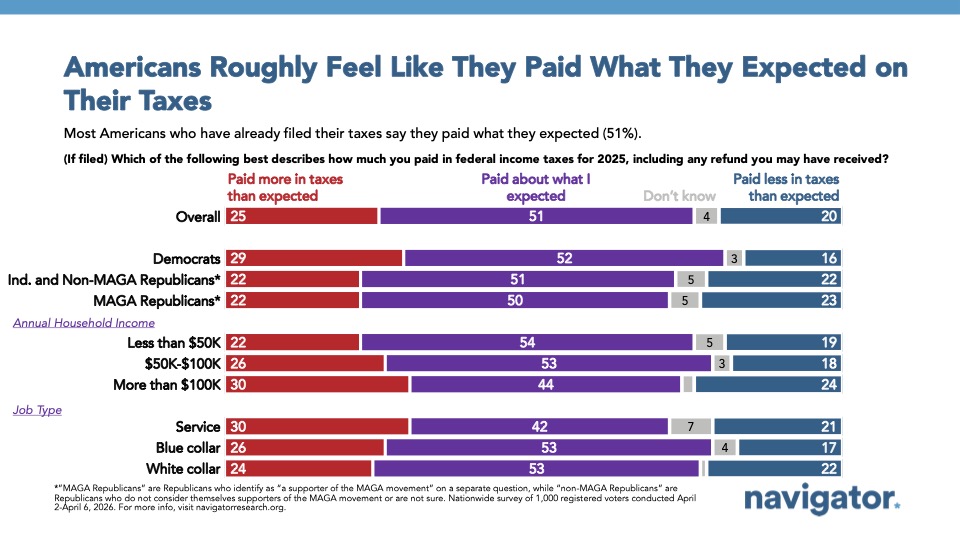
Despite claims from President Trump and Republicans in Congress that Americans across the board will be paying less in taxes due to the Republican tax law, most say they paid about what they expected or more this year.

Among those who already filed their taxes for 2025, only 20% say they paid less than they expected, 25% say they paid more than expected, and 51% say they paid about what they expected.

Bar graph from Navigator Research titled, Americans Roughly Feel Like They Paid What They Expected on Their Taxes

Among those who had yet to file their taxes for 2025, only 18% expect to pay less in taxes this year. 21% say they expect to pay more and 31% say they expect to pay about the same amount they have in previous years. Another 30% say they don’t know.

Messages Highlighting the Republican Tax Law’s Cuts to Medicaid and SNAP Are Most Effective

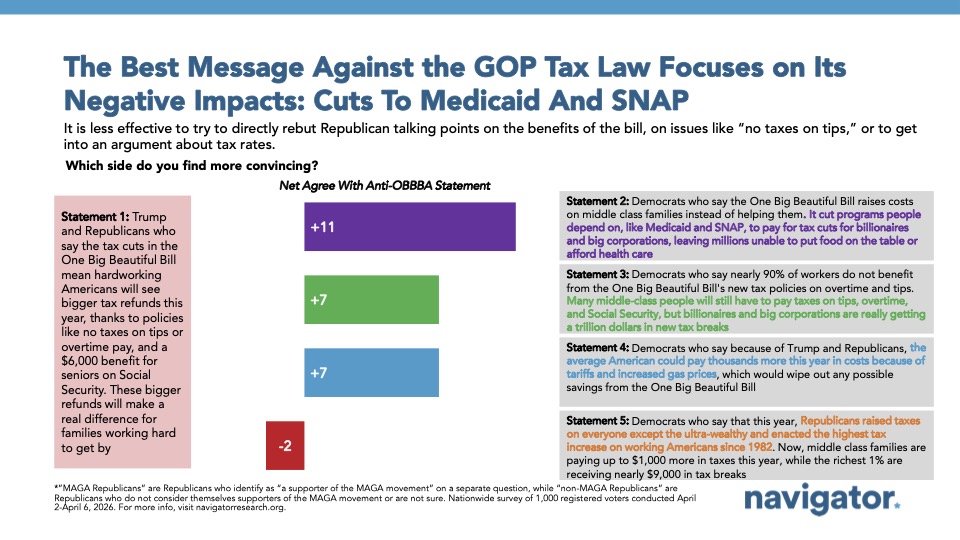
The most effective rebuttal to praise for the Republican tax law’s provisions focused on how the law cuts programs like Medicaid and SNAP:

  • “Democrats who say the One Big Beautiful Bill raises costs on middle class families instead of helping them. It cut programs people depend on, like Medicaid and SNAP, to pay for tax cuts for billionaires and big corporations, leaving millions unable to put food on the table or afford health care.”

Less powerful but still successful messages focus on how tariffs and high gas prices would wipe out any potential tax savings from the law and called out that many would not benefit from the tax law at all and would still pay tax on tips, overtime, and Social Security:

  • “Democrats who say because of Trump and Republicans, the average American could pay thousands more this year in costs because of tariffs and increased gas prices, which would wipe out any possible savings from the One Big Beautiful Bill.”
Chart from Navigator Research titled, The Best Message Against the GOP Tax Law Focuses on Its Negative Impacts- Cuts To Medicaid And SNAP

A message that focuses on process and specifics of the Republican tax law is ineffective and sends Americans into their partisan corners.

For more messaging recommendations on the Republican tax law, check out Navigator’s Dos and Don’ts from last summer.

Americans Oppose an “Expensive,” “Unnecessary,” and “Dangerous” War with Iran

Americans Remain Opposed to the War with Iran 

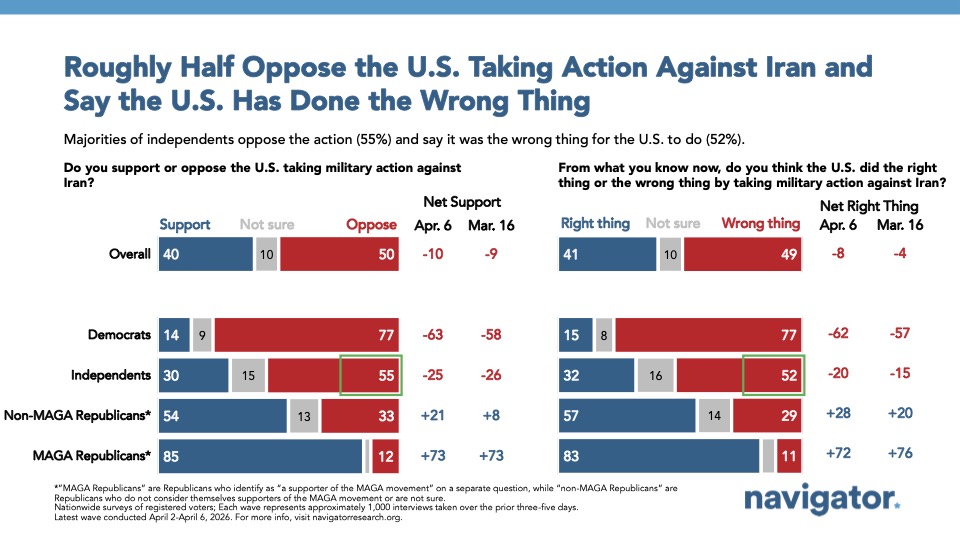
Over one month into the conflict, Americans oppose the war with Iran by 10 points (40% support – 50% oppose). This is roughly the same as in March, when support for the war was underwater by nine points (40% support – 49% oppose). 

More Americans think the U.S. did the wrong thing by taking military action against Iran than think it was the right thing to do (41% right thing – 49% wrong thing). This eight-point gap is slightly wider than what it was in March when 43% viewed military action as the right thing and 47% viewed it as the wrong thing.

Bar charts from Navigator Research titled, Roughly Half Oppose the U.S. Taking Action Against Iran and Say the U.S. Has Done the Wrong Thing

Plurality Say the Iran War Makes Their Families and Communities Less Safe

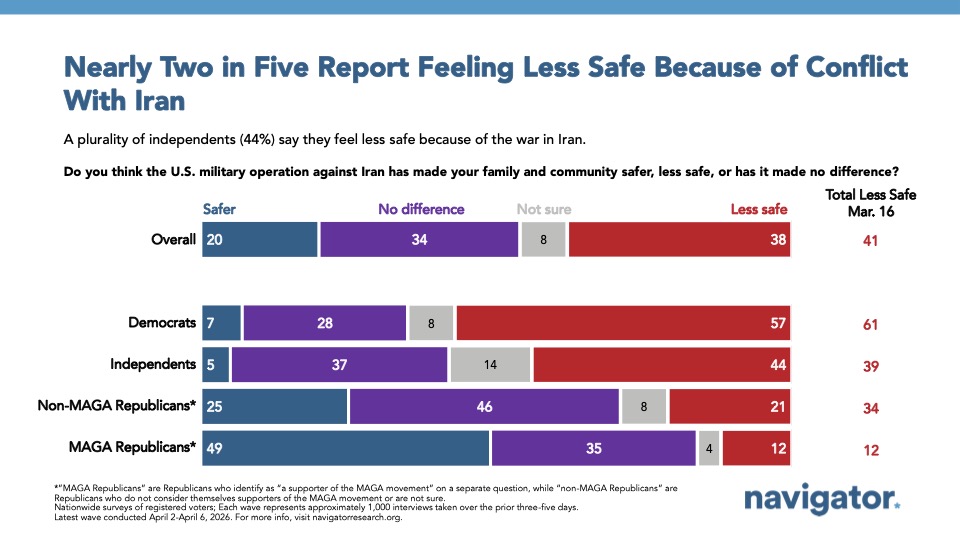
President Trump claims the Iran War “is necessary for the safety of America.” Many Americans disagree. A plurality of nearly four-in-10 say the war is making their family and community less safe (38%). Just over one-third say the war has made no difference to their safety (34%), while only one-in-five believe the war is making their community safer (20%). 

Democrats and independents are especially likely to say the war is making them less safe.Only 5% of independents say the war has made their family and community safer, while 7% of Democrats say the same. Likewise, 44% of independents and 57% of Democrats say the war has made them less safe – gaps of 39 and 50 points, respectively. Republicans are more likely to say the war has made their communities safer than less safe (37% safer – 16% less safe), though a plurality (40%) say it has made no difference.

Bar chart from Navigator Research titled, Nearly Two in Five Report Feeling Less Safe Because of Conflict With Iran

Americans Across Parties are Deeply Concerned About the Potential for Prolonged Conflict with Iran

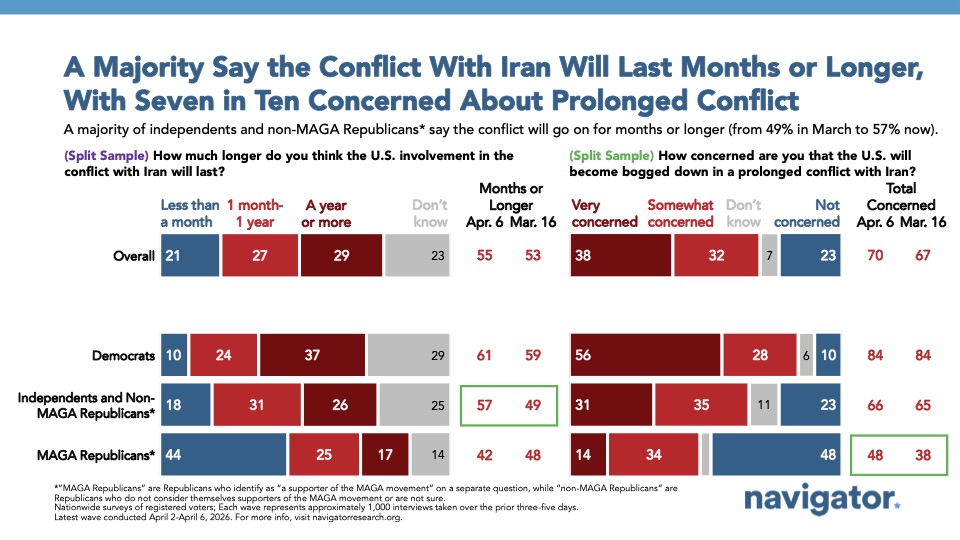
As President Trump has consistently shifted the timeline for the war in Iran, seven-in-10 Americans say they are concerned the U.S. will become bogged down in a prolonged conflict with Iran, compared to just 23% who are not. Concern persists across partisanship, as majorities of Democrats (84%), independents (75%), and Republicans (54%) all say they are concerned about a prolonged conflict with Iran. Concern has risen since March, when the gap between those concerned and those not was 41 points, compared to 47 points today.

  • While MAGA Republicans report more confidence in President Trump’s handling of the war on a variety of indicators, concern over a potential prolonged conflict is evenly split (Net 0; 48% concerned – 48% not concerned).

When asked how long they expect the war with Iran will last, Americans tend to aim high. Over half believe the war will last a month or longer (56%), including nearly three-in-10 who think the war will continue on for a year or longer (29%). Still, about a quarter of Americans say they “don’t know” about the duration (24%). Just about one-in-five think the war will be over in less than a month (21%). 

Bar charts from Navigator Research titled, A Majority Say the Conflict With Iran Will Last Months or Longer, With Seven in Ten Concerned About Prolonged Conflict

Americans See President Trump Lacking Clear Goals for War in Iran

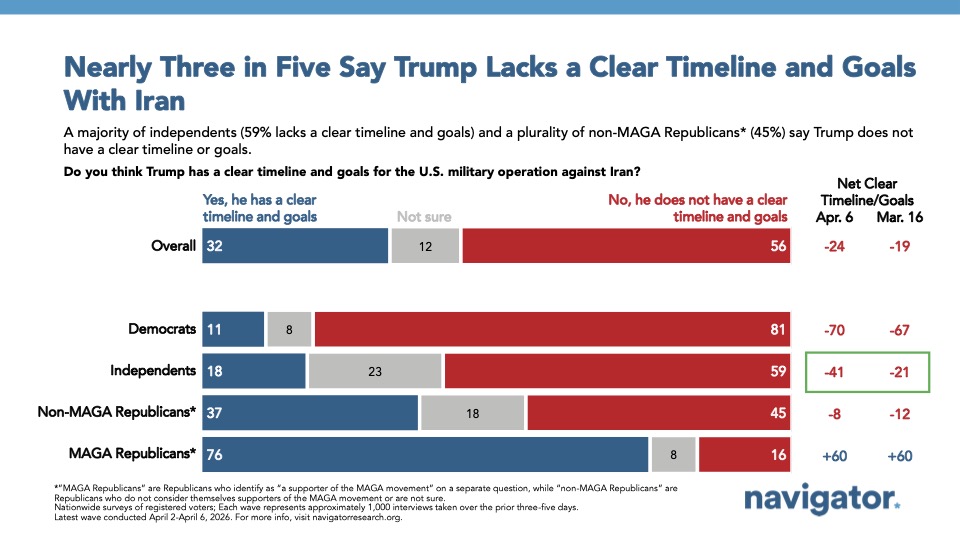
Despite President Trump’s recent efforts to make his case for the war, Americans remain unconvinced he has a clear timeline and goals. Over half say the president does not have a clear timeline and goals for the war with Iran (56%), while just one-in-three (34%) say he does. Confidence that the president has a clear timeline and goals in Iran is driven largely by MAGA Republicans, with 76% thinking he does and only 16% thinking he does not.

Bar chart from Navigator Research titled, Nearly Three in Five Say Trump Lacks a Clear Timeline and Goals With Iran

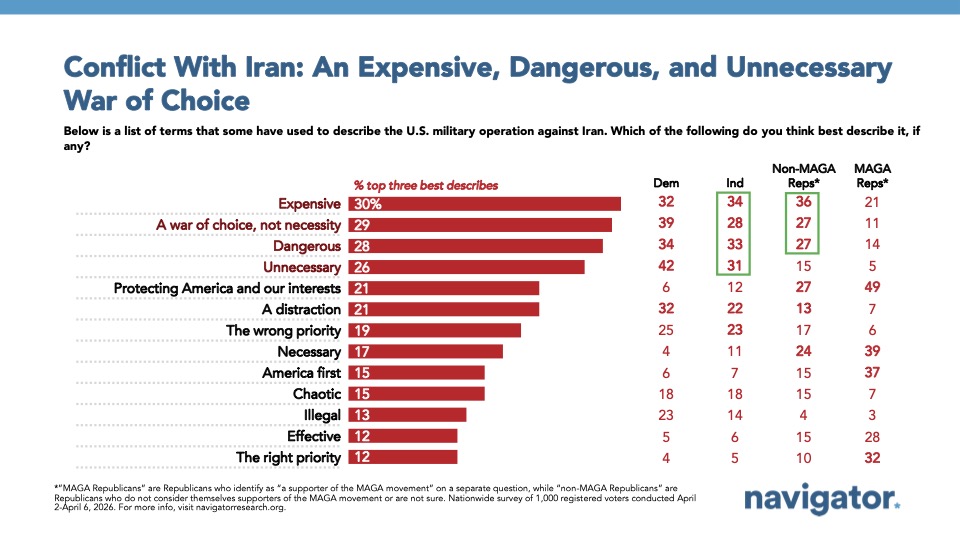
Americans Describe U.S. Involvement in Iran as Expensive, Unnecessary, and Dangerous

When asked to select up to three terms that best describe U.S. involvement in Iran,Americans are most likely to describe the war as “expensive,” (30%) “a war of choice, not necessity,” (29%) “dangerous,” (28%) and “unnecessary” (26%).

Bar chart from Navigator Research titled, Conflict With Iran: An Expensive, Dangerous, and Unnecessary War of Choice

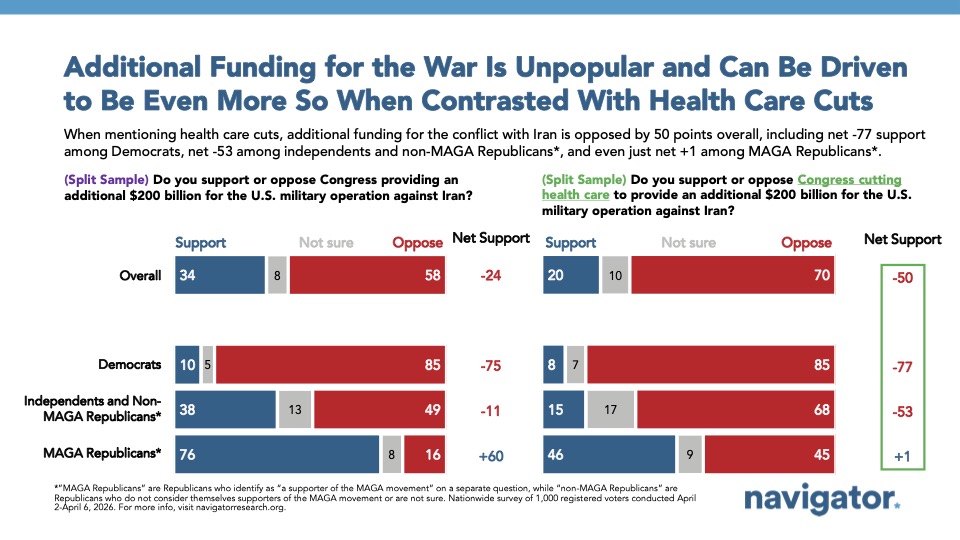
Americans Oppose Congress Providing $200 Billion for the War – Cuts to Health Care Make It a Non-Starter 

On its own, support for Congress providing $200 billion in additional funding for the war is underwater by a net -24 points (34% support – 58% oppose). When adding the context that $200 billion for a foreign war could come with cuts to health care spendingat home, net support drops to -50 (20% support – 70% oppose).

Bar charts from Navigator Research titled, Additional Funding for the War Is Unpopular and Can Be Driven to Be Even More So When Contrasted With Health Care Cuts

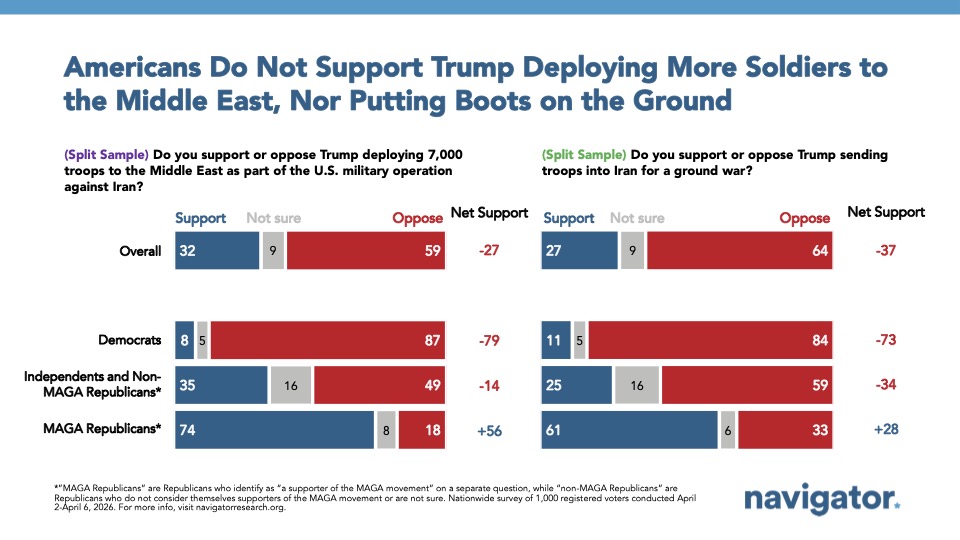
Americans Do Not Want Boots on the Ground in Iran

By a 37-point margin, Americans oppose President Trump sending U.S. troops to fight a ground war in Iran (27% support – 64% oppose). Once again, Democrats and independents are relatively aligned: 84% of Democrats and 71% of independents oppose sending in troops for a ground war. Republicans are more supportive than not, as 48% say they support sending troops into Iran, while 41% are opposed.

  • MAGA and Non-MAGA Republicans are split on this question. Among non-MAGA Republicans, net support for a ground war in Iran is underwater by a net -19 points, while MAGA Republicans support sending troops into Iran by a net +28 points.
Bar charts from Navigator Research titled, Americans Do Not Support Trump Deploying More Soldiers to the Middle East, Nor Putting Boots on the Ground

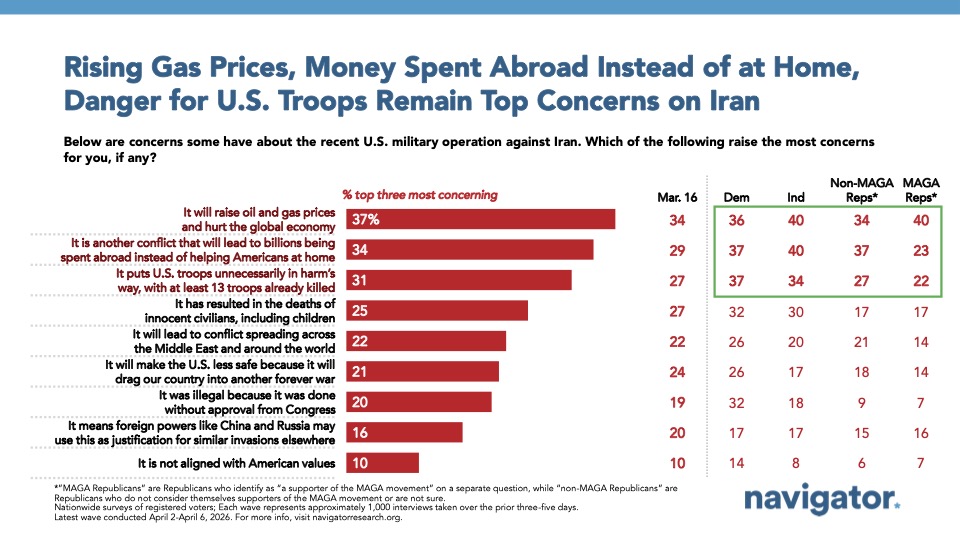
Americans are Most Concerned the Iran War Will Hurt the Economy, and put U.S. Troops and Innocent Civilians in Harm’s Way

When asked to select their top three concerns with the war, Americans point first to economic concerns, and then to endangering the lives of U.S. troops and innocent civilians.

Bar chart from Navigator Research titled, Rising Gas Prices, Money Spent Abroad Instead of at Home, Danger for U.S. Troops Remain Top Concerns on Iran

Recommendations:

  • Connect the war in Iran to the costs back home. Americans are feeling this war in their wallets through increased gas prices, and they’re opposed to spending more money on it, especially if it means further cuts to health care. 
  • Highlight the mismatch in priorities: Americans want their government focused on lowering the cost of living and other issues at home – this war does the opposite. 
  • Many Americans are already defining the war as expensive, unnecessary, and dangerous – don’t fight that framing, use it. Messaging that mirrors how the public already thinks is more persuasive than trying to introduce new language or arguments. For example, a focus on illegality is far less compelling than a focus on costs.
  • Make clear this costly war could drag on – and Americans don’t want that. Americans aren’t buying the administration’s timelines, and their concern about a prolonged conflict is very real.

Americans Blame Trump for Rising Gas Prices

Nearly Nine in Ten Say Gas Prices Are Increasing

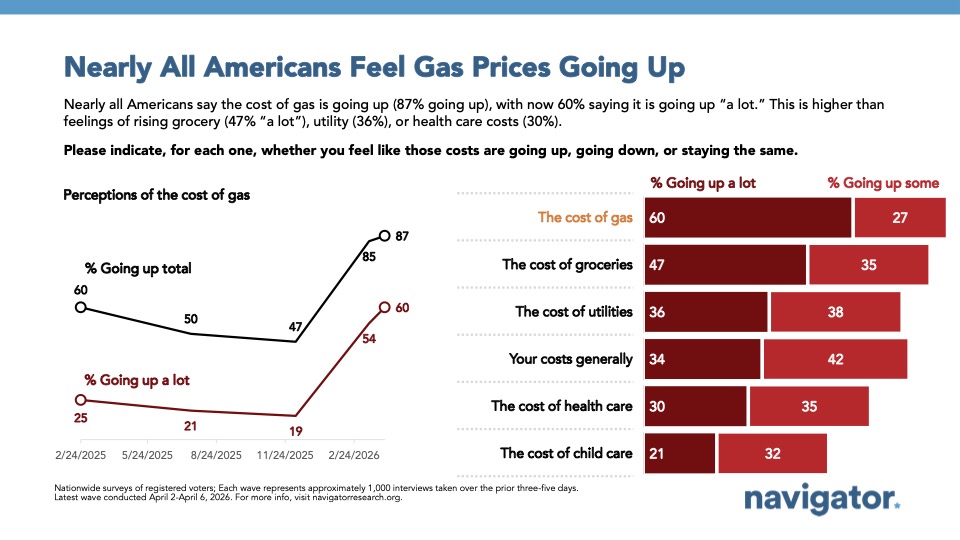
87% of Americans say the cost of gas is going up, including 60% who say it’s going up “a lot.” By comparison, 82% of Americans say the cost of groceries is going up, with 47% saying it’s going up “a lot.” Though views of the economy are often partisan, gas price increases are being felt across parties, with 91% of Democrats, 90% of independents, and 81% of Republicans saying costs are increasing.

Slide from Navigator Research titled: Nearly All Americans Feel Gas Prices Going Up

Trump’s Approval on Gas Prices Hits Rock Bottom

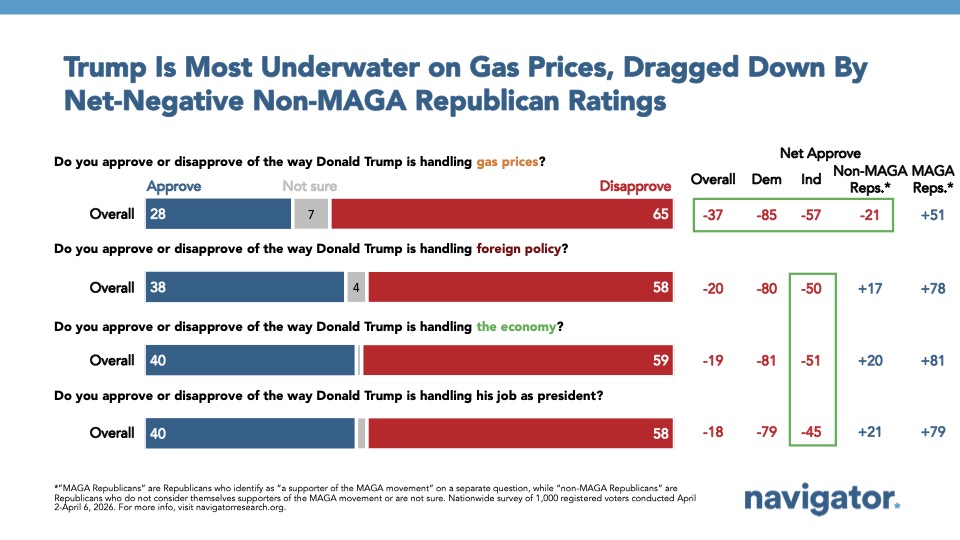
Americans disapprove of Trump’s handling of gas prices by 37 points (28% approve – 65% disapprove), with independents disapproving by 57 points (15% approve – 72% disapprove). Republicans are slightly more positive, approving of Trump’s handling of gas prices by 18 points (55% approve – 37% disapprove), though this approval is significantly worse than their overall approval rating of the president (net +52; 75% approve – 23% disapprove), signaling significant discontent within Trump’s own party. 

The rise in gas prices reveals fractures within the GOP, with non-MAGA Republicans disapproving of Trump’s handling of the issue by 21 points (33% approve – 54% disapprove), and Republican women only approving by 11 points (51% approve – 40% disapprove)  compared to Republican men who approve by 24 points (59% approve – 35% disapprove). In contrast, MAGA Republicans approve of Trump’s handling of gas prices by 51 points (73% approve – 22% disapprove).

Bar graph from Navigator Research titled: Trump Is Most Underwater on Gas Prices, Dragged Down By Net-Negative Non-MAGA Republican Ratings

Trump’s War with Iran Seen as the Culprit

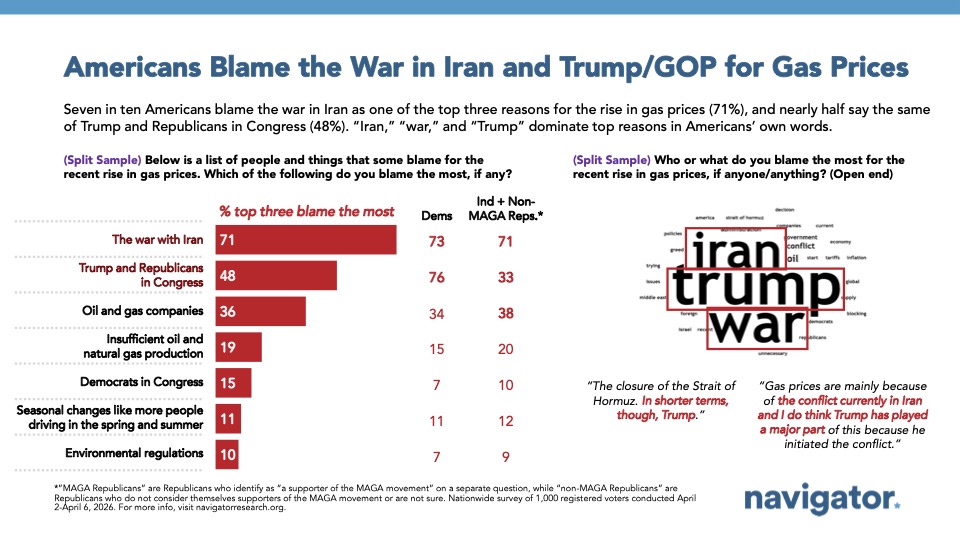
Whether open-ended or closed-ended, the war in Iran is considered the top driver of high gas prices. More Americans see the war as responsible for rising gas prices (71%), than Trump and Republicans in Congress (48%), or oil and gas companies (36%). An overwhelming majority also blame Trump and Republicans in Congress more for rising gas prices than Democrats in Congress (60% blame Trump and Republicans in Congress – 16% blame Democrats in Congress). When adding the phrase “because of the war,” blame for Trump and Republicans in Congress increases (64% blame Trump and Republicans – 12% blame Democrats in Congress).

  • Across parties, Americans say “President Trump and Republicans in Congress because of the war with Iran” are more to blame than Democrats in Congress, including Democrats by 84 points, independents by 58 points, and Republicans by 18 points.
Slide from Navigator Research titled Americans Blame the War in Iran and Trump/GOP for Gas Prices

The Democratic Party Holds Narrow Advantage on Handling Gas Prices

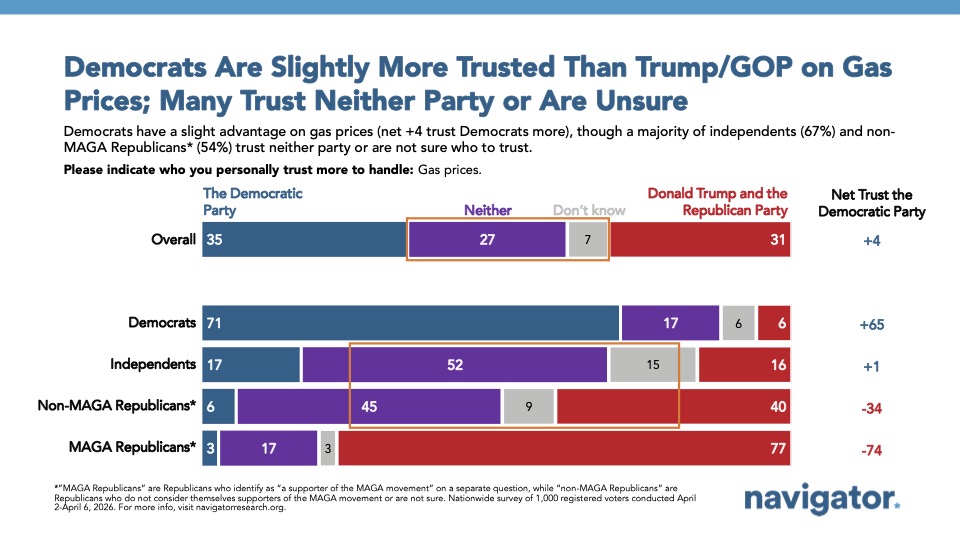
By 4 points, Americans trust the Democratic Party more to handle gas prices than Trump and the Republican Party (35% trust Democratic Party – 31% trust Trump and Republican Party). Over one-in-four don’t trust either party to handle gas prices (27%), including a majority of independents (52%) and nearly half of non-MAGA Republicans (45%).

Bar graph from Navigator Research titled Democrats Are Slightly More Trusted Than Trump:GOP on Gas Prices; Many Trust Neither Party or Are Unsure

Pulled in Every Direction: How American Women Are Struggling to Make Ends Meet

Poll: Women

This Navigator Research report covers what the women want the government to prioritize, impacts of specific cost increases, and perceptions of elected officials.

In honor of Women’s History Month, Navigator conducted focus groups among women in battleground states and from a variety of backgrounds, and heard their personal accounts of their economic experiences and views on being a woman in society. One major theme emerged: Women across the country, no matter their background or occupation, are struggling to make ends meet and are feeling an overwhelming lack of support. This special Navigator report will dig into our survey research to better understand the economic pain points and why so many women in America feel left behind.

Women Are More Likely to Say Costs Are Increasing

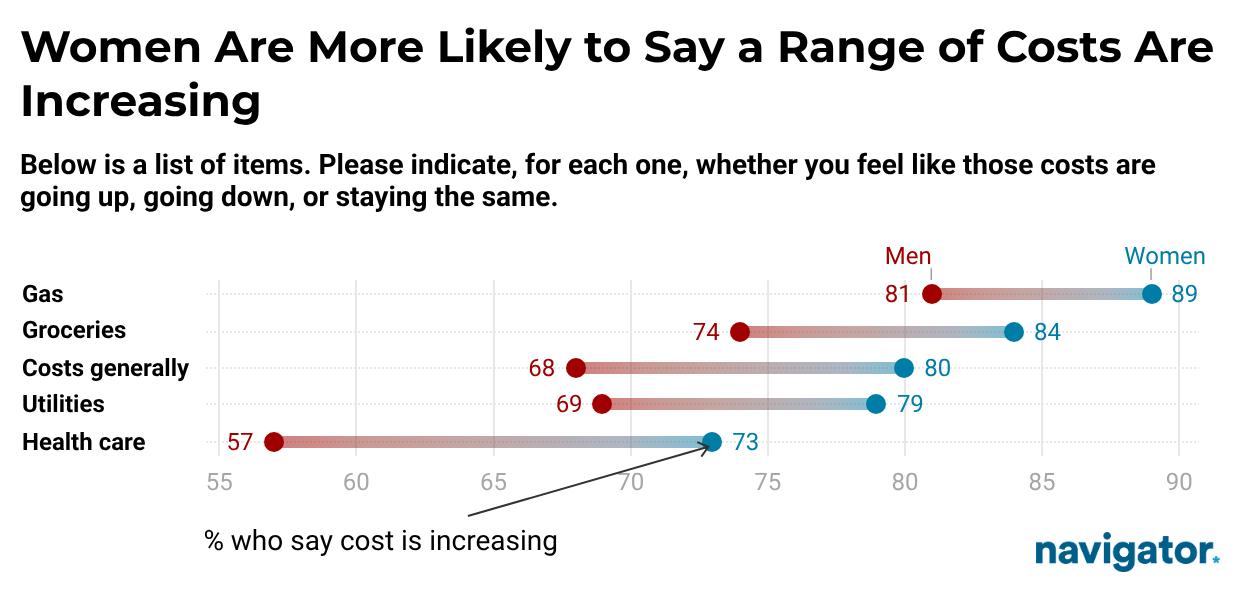
Recent Navigator polling found Americans overall are struggling with costs, as three in four report rising costs (75%), but women are more likely than men to say a range of their costs are increasing. Women are 16 points more likely to say the cost of health care is increasing (women: 73% increasing – men: 57% increasing) and 12 points more likely to say their costs generally are increasing (women: 80% increasing – men: 68% increasing). Women are also 10 points more likely to say both the cost of groceries (women: 84% increasing – men: 74% increasing) and utilities are increasing (women: 79% increasing – men: 69% increasing).

  • On the cost of health care, Democratic women are 10 points more likely to say it’s increasing than Democratic men. Independent women are 15 points more likely to say the cost of health care is increasing than independent men, and Republican women are 18 points more likely than Republican men.
  • On the cost of groceries: Democratic women are six points more likely to say the cost is increasing than Democratic men, independent women are 10 points more likely, and Republican women 14 points more likely.
Dot range plot from Navigator Research titled: Women Are More Likely to Say a Range of Costs Are Increasing

Women Want Lawmakers to Prioritize Lowering Costs and Health Care

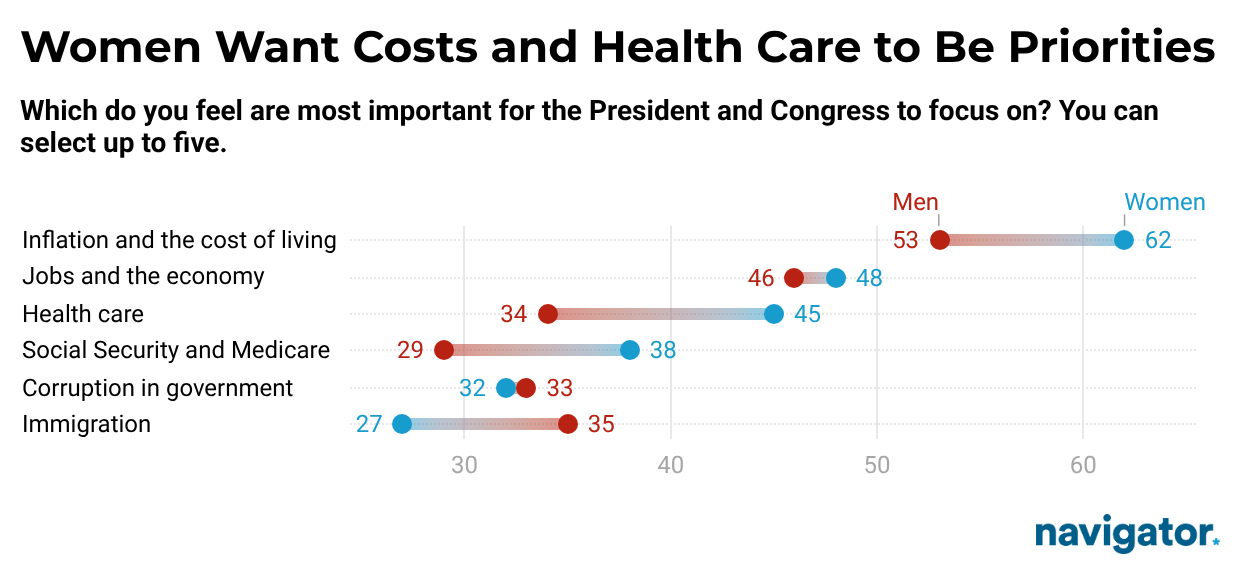
As costs continue to rise, it’s no surprise that Americans want the president and Congress to focus on the cost of living, the economy, and health care. As women are more likely to be feeling the pain of rising costs, they are also even more likely to want the president and Congress to prioritize the cost of living, the economy and health care. Notably, women are 11 points more likely to say health care should be a priority for the president and Congress (women: 45% – men: 34%). Women are eight points less likely than men to want the government to focus on immigration (women: 27% – men: 35%).

Women across parties are more likely to want the government to prioritize costs and health care: Democratic women are six points more likely to want the government to prioritize the cost of living, and nine points more likely to believe health care should be a priority compared to Democratic men. For independent women, the gap is net +7 on the cost of living and net +14 on health care. Republican women are net +9 on wanting the cost of living to be a priority compared to Republican men, and net +9 on health care.

Dot range plot from Navigator Research titled: Women Want Costs and Health Care to Be Priorities

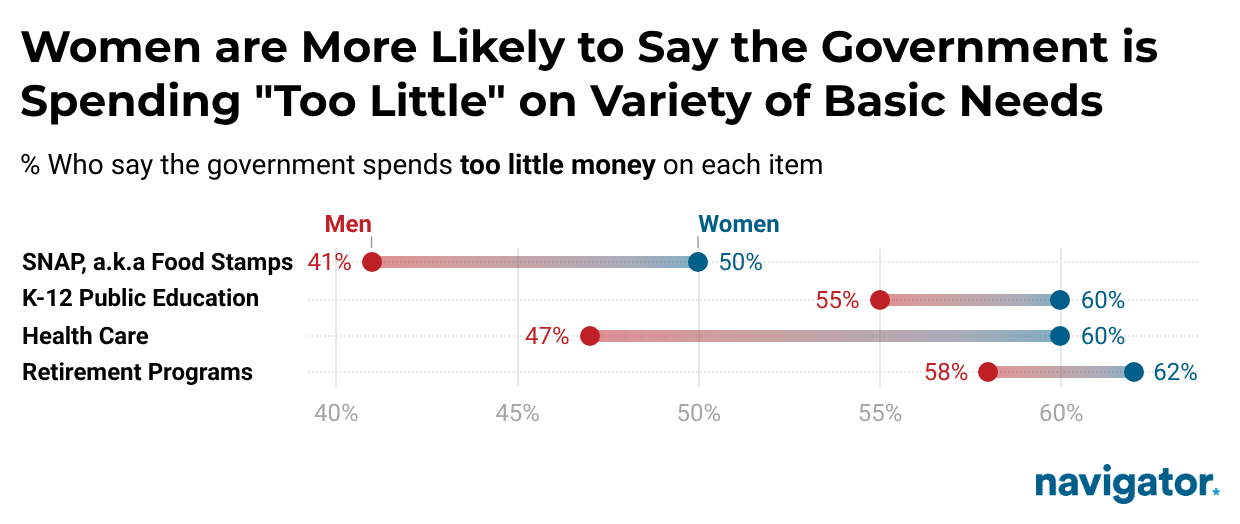
As women want the government to focus on costs and health care, they also are more likely to say the government spends too little on a range of issues and programs. Half of women say the government spends too little on SNAP (women: 50%  – men: 41%). 60% of women say the government spends too little on health care – compared to only 47% of men who say the same. 

  • 59% of men and women say the government spends too much money on foreign wars and conflicts, including mothers by 53 points (60% too much – 7% too little).
Dot range plot from Navigator Research titled: Women are More Likely to Say the Government is Spending "Too Little" on Variety of Basic Needs

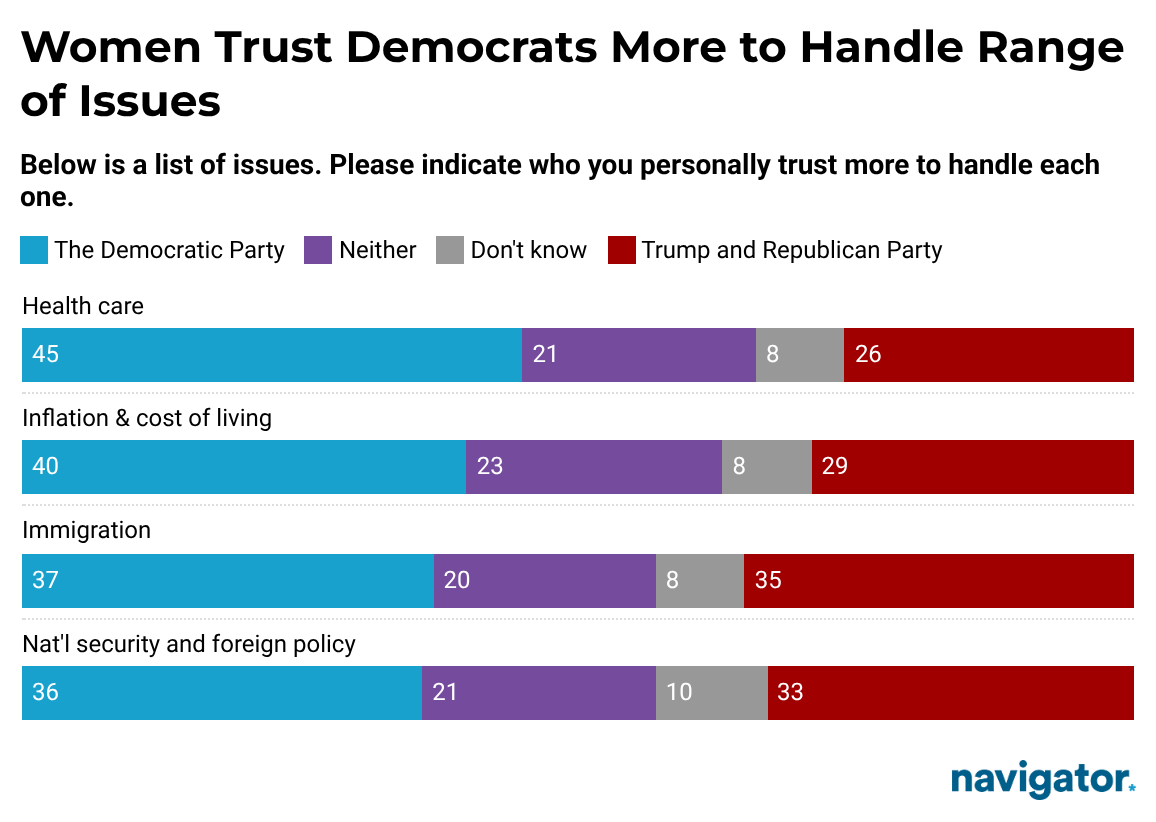
Women trust Democrats in Congress more to handle the issues most important to them. By 11 points, women trust Democrats more to handle inflation and the cost of living (40% trust Democrats in Congress – 29% trust Republicans), and trust them more to handle health care by nearly 19 points (45% trust Democrats in Congress – 26% trust Republicans in Congress). Notably, across a range of issues, one in five women say they trust neither party.

Bar graph from Navigator Research titled: Women Trust Democrats More to Handle Range of Issues

Women Believe the Political System is Dysfunctional, But Fixable

An October 2025 Navigator survey found that 74% of both women and men believe the political system is dysfunctional. Then when asked if the system is fixable, a majority of women said the political system is fixable (56%) and just less than half of men said the same (49%).

When it comes to why Americans believe elected officials can’t get things done – the leading culprits are self-enrichment and that they’re out of touch with the American people. A January Navigator survey found that among both men and women, elected officials being too focused on enriching themselves and their donors is seen as the top reason leading them to not getting things done (78% of women – 81% of men). Among men, a close second is that they are unwilling to stand up to the most extreme members of their party (81%). Among women, the second most selected reason is that they are out of touch and don’t understand the struggles everyone else faces (78%).

  • From Navigator’s March focus groups: “I feel like the political leaders, even the women political leaders, are so out of touch with reality and what it’s like to be a real American woman.” – PA Hispanic woman, weak Republican

Looking out for People like Me 

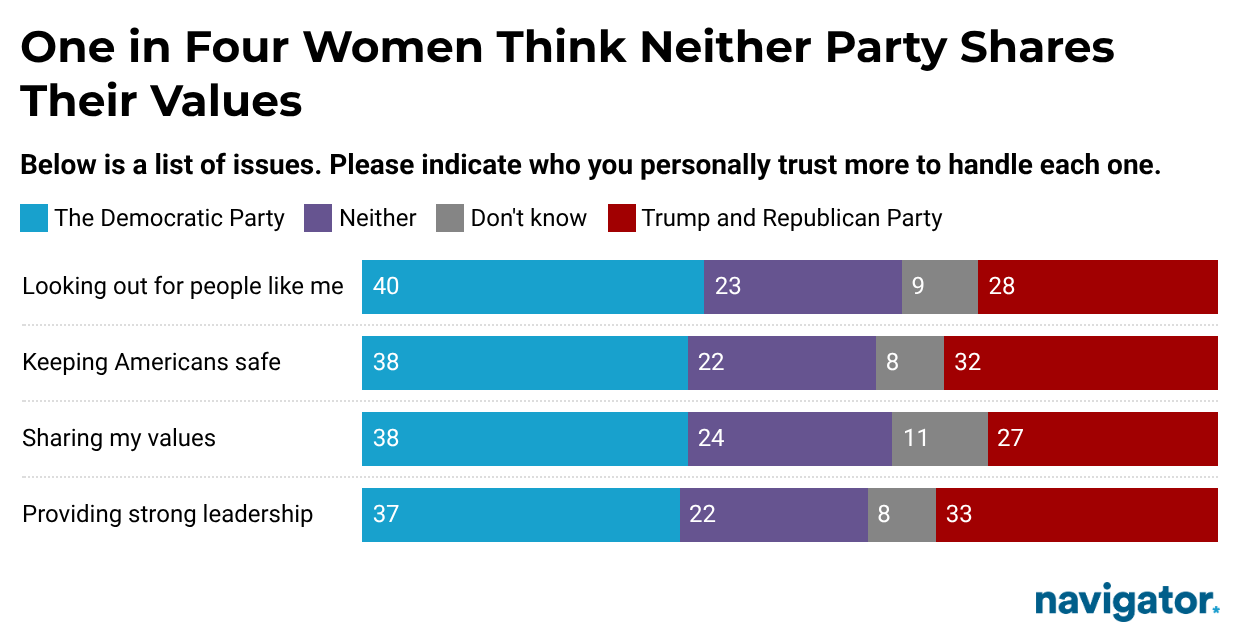
Women trust Democrats more to look out for people like them (net +12; 40% trust Democrats in Congress – 28% trust Republicans in Congress). Similarly, Democrats are seen as more trusted when it comes to “sharing my values” (net +11; 38% trust Democrats in Congress – 27% trust Republicans in Congress). However, when it comes to “sharing my values” and “looking out for people like me,” over one in five say they don’t trust either party (23% and 24%, respectively). Women with children under the age of 18 are even more likely to trust neither party to look out for people like them – with 29% saying they trust neither party (compared to 20% of women without children).

Bar graph from Navigator Research titled: One in Four Women Think Neither Party Shares Their Values

Recommendations:

  • Women are inclined to trust Democrats in Congress more, and it’s not a surprise, with Trump saying ‘it’s not possible’ to do the things women say they care about. Yet this trust is not pervasive; in fact, a large number of women say they don’t trust either party. 
  • Health care concerns are not limited to Medicaid cuts or ACA subsidies. Women report concerns about the safety of the medicine they take and the food they eat, and worry they are not getting the right information or the best care.
  • Women face a wide variety of tough challenges, and feel they are on their own, without any support or even empathy from elected officials. To establish rapport and trust, progressives need to demonstrate they truly get it, and have — or aspire to — walk a mile in women’s shoes.

Read More

May 22, 2026

Americans Want Major Change, But Aren’t Sure if Leaders Can Deliver

This Navigator Research report covers how Americans feel about democracy, institutions, and systems and whether anyone can fix them.

Julie Alderman Boudreau
May 21, 2026

Following Callais: Views on Supreme Court Remain Mixed But Reforms Are Popular

This Navigator Research report covers views of the Supreme Court and what type of reforms Americans support.

Tina Tang
May 20, 2026

Low Awareness, High Stakes: Views on the Recent Supreme Court Ruling on the Voting Rights Act

This Navigator Research report covers how Americans are reacting to the recent Supreme Court decision, Louisiana v. Callais, which gutted protections under the Voting Rights Act.

Tina Tang
May 14, 2026

SPECIAL REPORT: Asian Americans on the Economy and President Trump

This Navigator Research Report focuses on economic sentiment among Asian Americans and how they view President Trump’s job performance across a range of important issues.

Tina Tang & Aidan Harty

A Year After Liberation Day, Americans Still Dislike Tariffs and Want Their Money Back

Poll: Tariffs

This Navigator Research report covers Americans’ views on tariffs, including their views on tariff rebate checks.

Tariffs Remain Broadly Unpopular

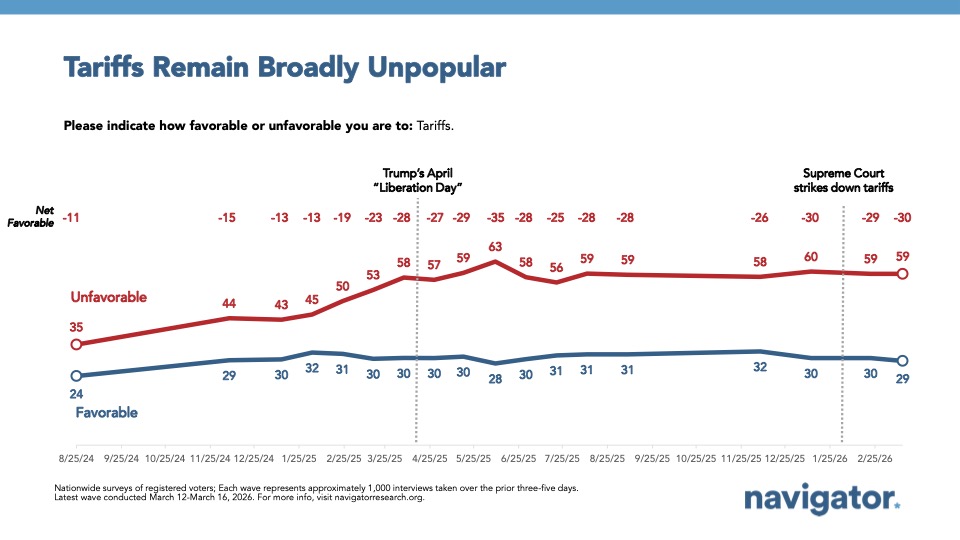
One year after so-called “Liberation Day” – President Trump’s April 2025 announcement of sweeping global tariffs that sent markets reeling – Americans remain deeply opposed to tariffs. Six-in-10 Americans are unfavorable toward tariffs (59%), while just three-in-10 Americans are favorable (29%) – a 30-point gap. Tariffs are about as unpopular as they were in Navigator’s April 2025 polling immediately after Liberation Day (30% favorable). Partisanship remains a guiding factor: just 7% of Democrats and 17% of independents report favorable views of tariffs, compared to just over half of Republicans (55%). That said, opposition from Democrats is far stronger than support from Republicans.

  • Seven-in-10 MAGA Republicans say they view tariffs favorably (69%), compared to only a third of non-MAGA Republicans (34%).
Line graph from Navigator Research titled: Tariffs Remain Broadly Unpopular

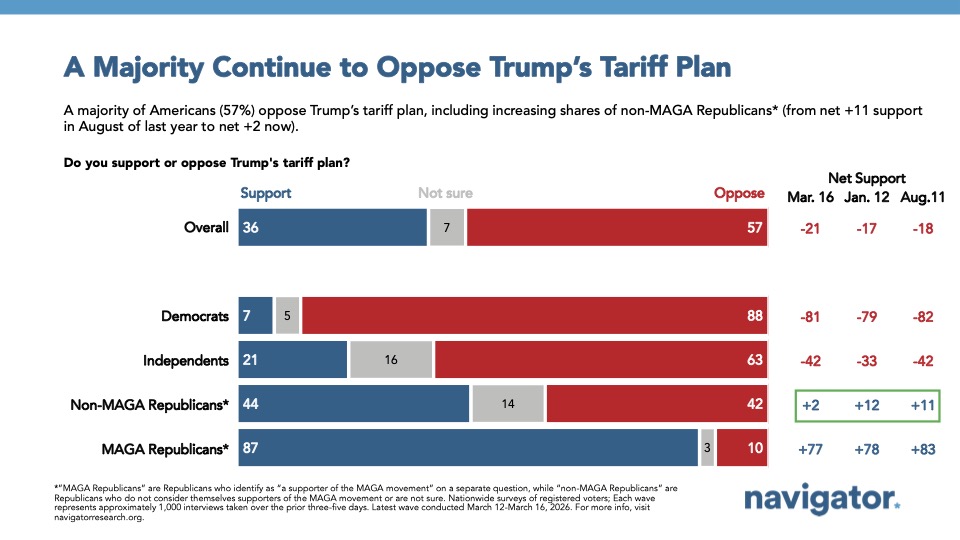
When asked specifically if they support or oppose President Trump’s tariff plan, Americans broadly oppose. Net support for Trump’s tariff plan is at -21 (36% support – 57% oppose), while Democrats are at a net -81 (7% support – 88% oppose) and independents at net -42 (21% support – 63% oppose). Support for Trump’s tariff plan is significantly higher among MAGA than non-MAGA Republicans: MAGA Republicans support the plan by 77 points (87% support – 10% oppose), while net support from non-MAGA Republicans sits at just +2 (44% support – 42% oppose).

Bar graphs from Navigator Research titled: A Majority Continue to Oppose Trump's Tariff Plan

Support for Potential Tariff Rebate Checks Transcends Partisanship 

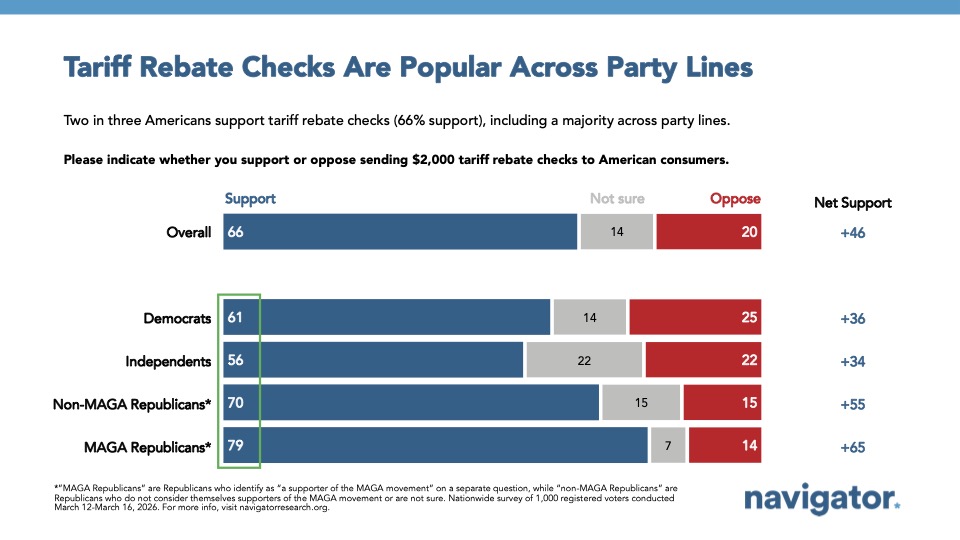
Two-thirds of Americans support $2,000 tariff rebate checks for consumers (66%). Three quarters of Republicans favor sending the tariff checks (75%), while 61% of Democrats and 56% of independents say the same.

Bar graphs from Navigator Research titled: Tariff Rebate Checks Are Popular Across Party Lines
  • If checks were to go out, Americans overwhelmingly prefer sending them to consumers who paid higher prices rather than businesses that paid import taxes. Nearly eight-in-10 Americans say they would prefer consumers get the checks (78%), while just 9% say they should go to businesses. 

Americans Find Tariff Rebate Check Arguments Centered on Rising Costs More Compelling Than Arguments Focused on Legal Processes 

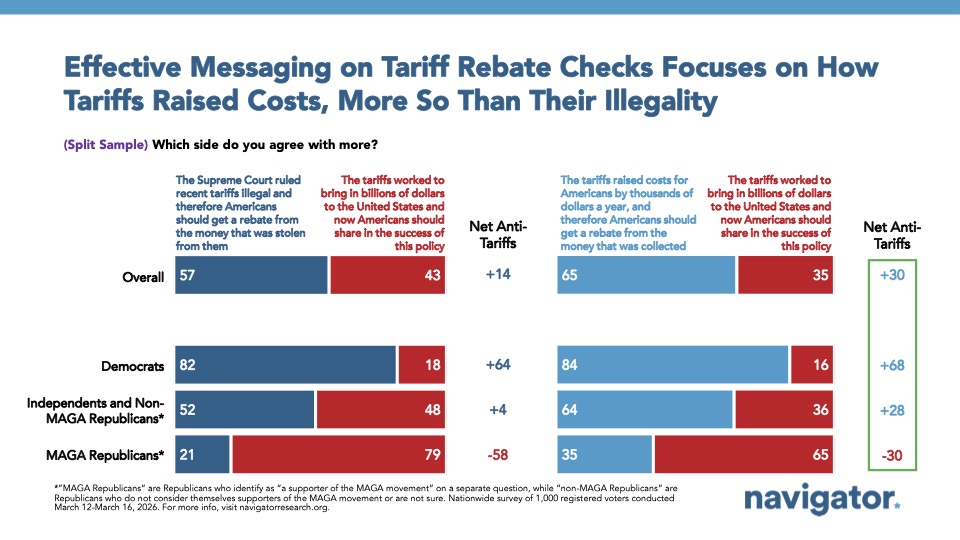
Tariff check arguments centered on how tariffs have raised costs are more compelling than arguments on legal processes. 

Compared to a conservative message about tariffs’ success, a cost-focused message outperforms it by 30 percentage points, while a legal-process message outperforms it by 14 points.


Conservative message: “The tariffs worked to bring in billions of dollars to the United States and now Americans should share in the success of this policy.” 

Cost-focused message (+30): “The tariffs raised costs for Americans by thousands of dollars a year, and therefore Americans should get a rebate from the money that was collected.”

Legal-process message (+14): “The Supreme Court ruled recent tariffs illegal and therefore Americans should get a rebate from the money that was stolen from them.”

Bar graphs from Navigator Research titled: The GOP Tariff Rebate Argument Can Be Beaten - Especially With Focus on How Tariffs Raised Costs, More So Than Their Illegality

Read More

May 22, 2026

Americans Want Major Change, But Aren’t Sure if Leaders Can Deliver

This Navigator Research report covers how Americans feel about democracy, institutions, and systems and whether anyone can fix them.

Julie Alderman Boudreau
May 21, 2026

Following Callais: Views on Supreme Court Remain Mixed But Reforms Are Popular

This Navigator Research report covers views of the Supreme Court and what type of reforms Americans support.

Tina Tang
May 20, 2026

Low Awareness, High Stakes: Views on the Recent Supreme Court Ruling on the Voting Rights Act

This Navigator Research report covers how Americans are reacting to the recent Supreme Court decision, Louisiana v. Callais, which gutted protections under the Voting Rights Act.

Tina Tang
May 14, 2026

SPECIAL REPORT: Asian Americans on the Economy and President Trump

This Navigator Research Report focuses on economic sentiment among Asian Americans and how they view President Trump’s job performance across a range of important issues.

Tina Tang & Aidan Harty