
Latest Report Card for Public Education

Poll: Education

This Navigator Research report covers perceptions of the K-12 public school system, gaps Americans are seeing, and who is most trusted to improve it.

As children across the country head back to school, Americans offer a mixed picture of the state of public education in 2025. While Americans are broadly favorable toward public schools (67 percent favorable, including majorities across all parties), underneath this affection are concerns about quality, funding, and safety — as well as partisan divides about the direction of public education.

Despite holding favorable views of public schools, just a third (32 percent) of Americans say public schools nationally are doing an excellent or good job for kids. As is typical, Americans (and parents in particular) give their local schools a higher rating (46 percent excellent/good) suggesting that Americans’ experiences with local public schools are more positive than the national narrative about public schools. Half (50 percent) of parents give their local schools a positive rating, which rises to 60 percent among early grade parents.

Concerns About Health, Safety, and Quality

Both parents of students across grade level and non-parents express broad concerns about public education. These concerns focus on the health, safety, and wellbeing of kids at school, as well as the quality of instruction. Democrats are more likely to point to school resources than instructional quality.
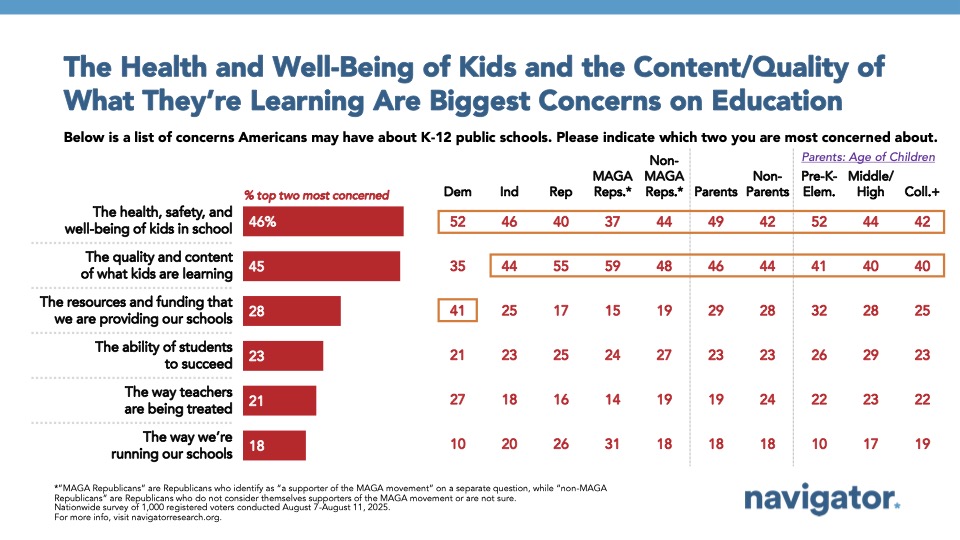
Bar charts from Navigator Research. Titled: The Health and Well-Being of Kids and the Content/Quality of What They’re Learning Are Biggest Concerns on Education

The threat of violence and school shootings also rises to the top of school concerns. 59 percent of Americans overall, including 61 percent of parents, say they are extremely concerned about school safety, including majorities across the political spectrum.

While majorities of Americans across partisanship point to student learning as a specific concern, this is a top concern for non-MAGA Republicans but just a second tier concern for Democrats. In an illustration of the ways in which public education has become increasingly partisan, the top issue among each group differs in telling ways:

  • Democrats: School shootings
  • Independents: Students not learning what they need to be successful
  • Non-MAGA Republicans: Teachers imposing ideology
  • MAGA-Republicans: Gender identity and sports
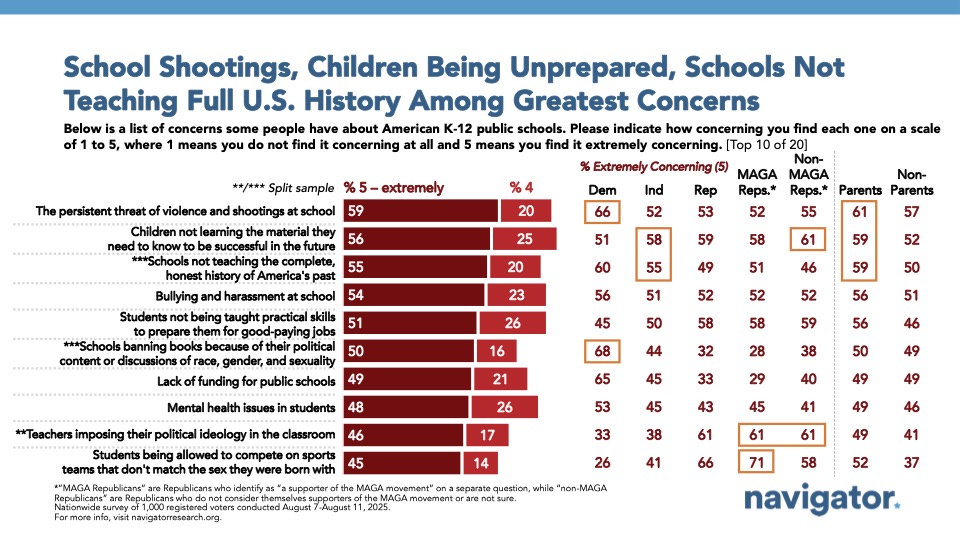
Bar charts from Navigator Research. Titled: School Shootings, Children Being Unprepared, Schools Not Teaching Full U.S. History Among Greatest Concerns

Republican Education Proposals

Recent education proposals from Republicans in Congress and the Trump Administration, including in the One Big Beautiful Bill, fare poorly. In alignment with Navigator’s July survey, this latest survey finds an overwhelming majority (85 percent) oppose taking away school lunches from students, including 72 percent who are strongly opposed. That is followed by threatening special education funding (60 percent strongly oppose), eliminating Head Start (58 percent strongly oppose), and cutting Pell Grants (55 percent strongly oppose).

When framed as “defunding public education and moving money to private schools instead,” 59 percent strongly oppose school vouchers, including 56 percent of independents and 37 percent of Republicans. In this framing, 66 percent of Black Americans and 63 percent of Hispanic respondents strongly oppose school vouchers. However, when asked about “creating a school voucher program to subsidize private school tuition,” just 28 percent of all Americans strongly oppose it, including 24 percent of independents and 15 percent of Republicans. In this framing, just 27 percent of African Americans and 26 percent of Hispanic respondents strongly oppose school vouchers.
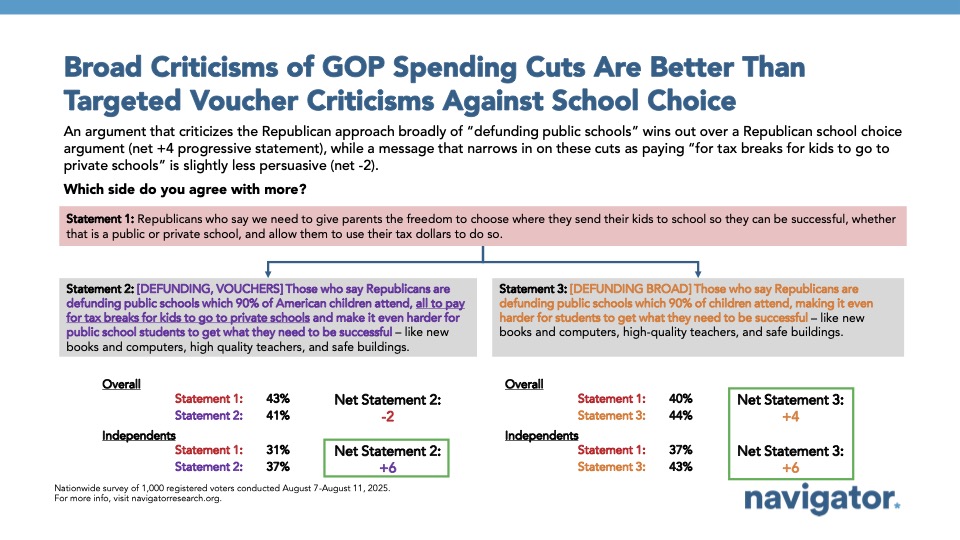
Polling from Navigator Research. Titled: Broad Criticisms of GOP Spending Cuts Are Better Than Targeted Voucher Criticisms Against School Choice

While Americans believe school children should be fed, regardless of framing, there is more power in saying “taking school lunches away from low-income kids” than “cutting kids from the free-reduced price school meal program.”
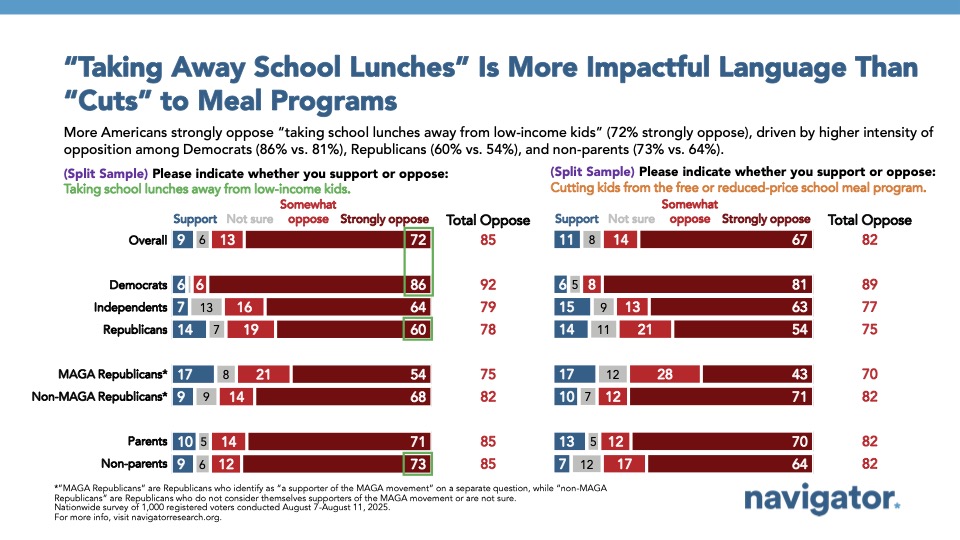
Bar charts from Navigator Research. Titled: “Taking Away School Lunches” Is More Impactful Language Than “Cuts” to Meal Programs

When it comes to the impact of cuts, Americans are most concerned about students losing access to school meals, students falling behind in reading and math, eliminating programs for students with disabilities, and kids not being prepared for the workforce. There are divisions across partisanship, but a majority — regardless of party identification — are concerned about the impact on students falling behind in school.
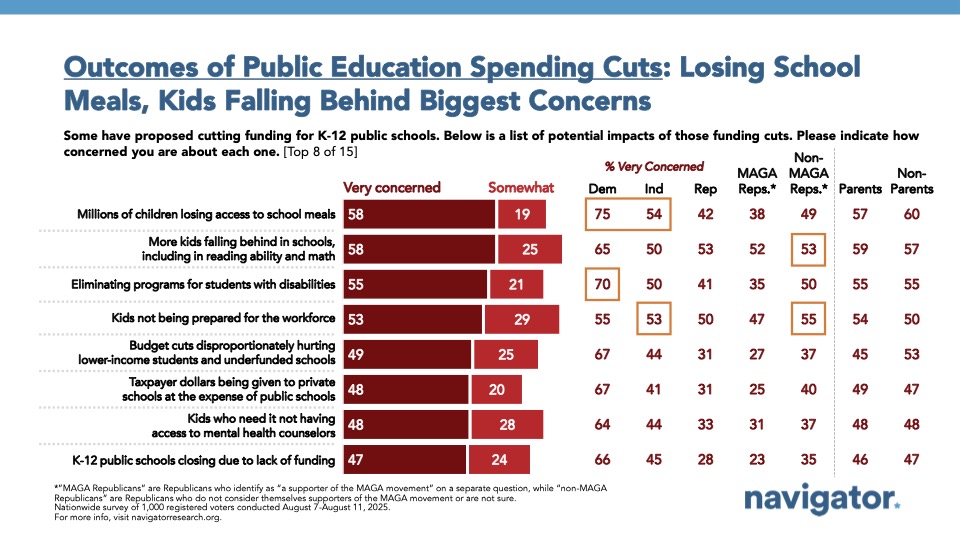
Bar charts from Navigator Research. Titled: Outcomes of Public Education Spending Cuts: Losing School Meals, Kids Falling Behind Biggest Concerns

Messaging

In a head-to-head debate, public education advocates are better positioned by leading with an anti-status quo message that acknowledges that the public education system is broken. When advocates lead by acknowledging that the system is broken, they improve from +9 to +14 overall and from +2 to +18 among independents.

Conservative message: We should give states back control over their own public schools, increase vocational training, and make sure parents have school choice and a say over where their kids go to school and what they are taught.

Standard progressive message: What Republicans are doing on education isn’t working: we need to make sure students get what they need to be successful, and that means making sure schools have the resources to pay teachers a fair wage and to hire enough of them to prevent overfilled classrooms, to buy up-to-date textbooks, and to invest in science and math education.
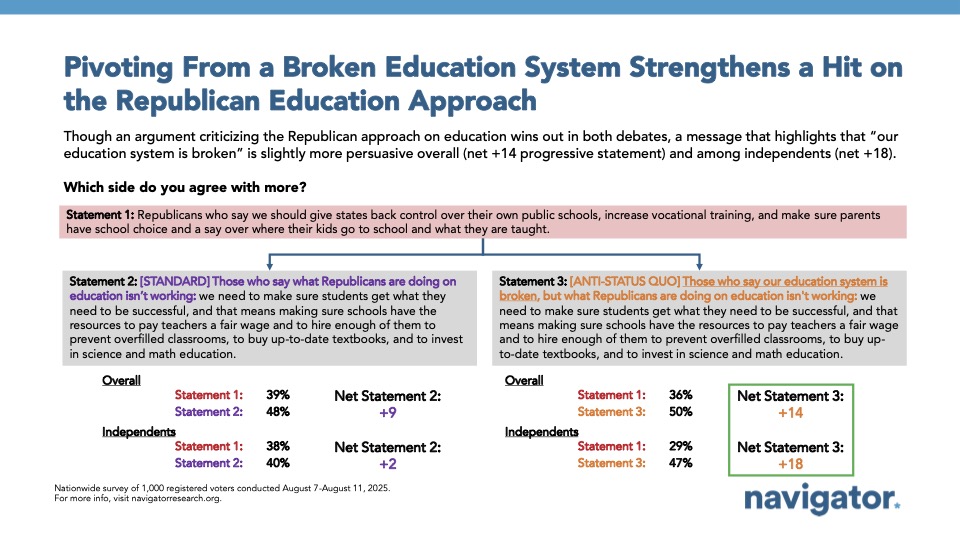
Broken System progressive message: Our education system is broken, but what Republicans are doing on education isn’t working: we need to make sure students get what they need to be successful, and that means making sure schools have the resources to pay teachers a fair wage and to hire enough of them to prevent overfilled classrooms, to buy up-to-date textbooks, and to invest in science and math education.

Polling from Navigator Research. Titled: Pivoting From a Broken Education System Strengthens a Hit on the Republican Education Approach

In a head-to-head debate on vouchers, public education advocates are better positioned by leading with a broad critique of cuts to education funding than a specific message about vouchers. When advocates use a “broader cuts” message, they improve from -2 to +4 overall. This can be bolstered by using the language highlighted above, which leans into concerns about cuts, describing vouchers as “defunding public education and moving money to private schools instead.”

Recommendations:

  1. Lead by acknowledging the public education system is broken. Americans don’t like Republicans’ solutions but they want a sharp departure from the status quo, which they do not believe is meeting the needs of America’s students.
  2. Americans are concerned about further cuts to education, but the impact of cuts is more important than cuts in general. Lead with the most dire impact: taking away school lunches from low-income kids.
  3. Americans are voucher-curious. Rather than messaging about vouchers specifically, talk about funding cuts and the impact of defunding public education.
Read More

June 10, 2026

America at 250: The State of Our Union

This Navigator Research Report explores that gap between the way America is being celebrated and portrayed by this administration, and the America people believe in.

Tina Tang & Melissa Toufanian
June 8, 2026

Americans in the Battleground See Rising Costs, But Are Unsure Who Can Lower Them

This Navigator Research report covers how Americans in the battleground feel about the economy and rising costs as well as who they trust to lower them.

Julie Alderman Boudreau
June 4, 2026

Americans Are Split on How Safe our Food Is

This Navigator Research report covers perceptions of food safety and the health and wellness concerns that are top of mind for Americans.

Maryann Cousens
June 3, 2026

The Overreach Backfires: Battleground Americans Reject Abuse of Government Power

This Navigator Research report covers government weaponization, including which actions concern battleground constituents the most and how to message about them.

Julie Alderman Boudreau

Two-Thirds of Americans Rate the Economy Negatively

Poll: Political Landscape

This Navigator Research report covers perceptions of the current political and economic landscape.

Trump Approval and News

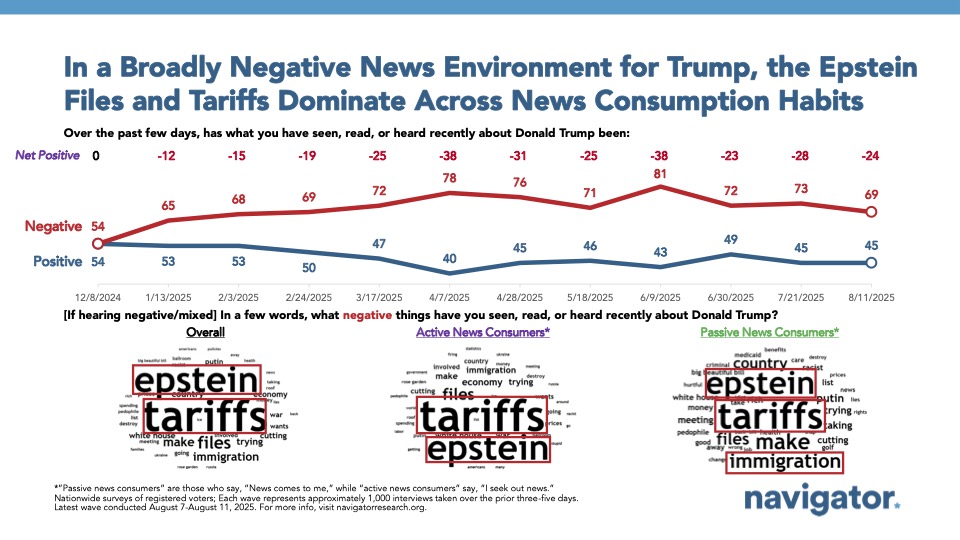
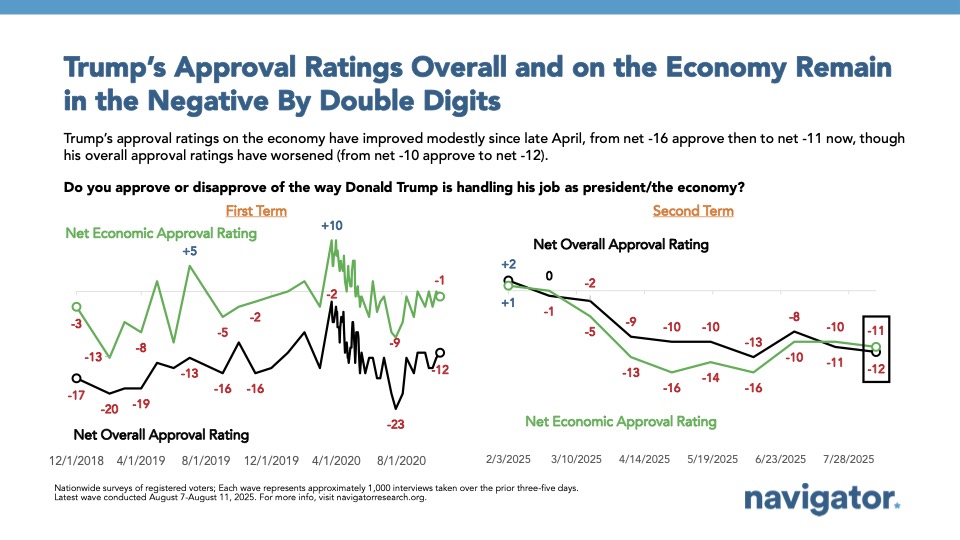
President Trump’s job and economic approval are both underwater by double digits (net -12 and net -11, respectively). Trump’s approval has followed a steady decline throughout Navigator’s tracking, with his overall approval at net +2 in early February, to net -9 the first week of April, to now at net -12. Trump’s economic approval has followed a similar trend, though his economic approval has improved slightly from its lowest point in late April at net -16.

Line charts from Navigator Research. Titled: Trump’s Approval Ratings Overall and on the Economy Remain in the Negative By Double Digits

Pluralities are hearing mostly negative news about President Trump, with 44 percent hearing mostly negative news, 25 percent hearing a mix of positive and negative news, and 20 percent hearing mostly positive news. Among Americans who are passive news consumers, 39 percent are hearing mostly negative news about Trump, 25 percent are hearing a mix, 15 percent are hearing mostly positive news, and 20 percent report not hearing any news about Trump.

Phrases used to describe the positive news surrounding Trump include: tariffs, Putin, meeting, and America

Phrases used to describe the negative news surrounding Trump include: Epstein, tariffs, and immigration

Line charts and word clouds from Navigator Research. Titled: In a Broadly Negative News Environment for Trump, the Epstein Files and Tariffs Dominate Across News Consumption Habits

Perceptions of the Economy

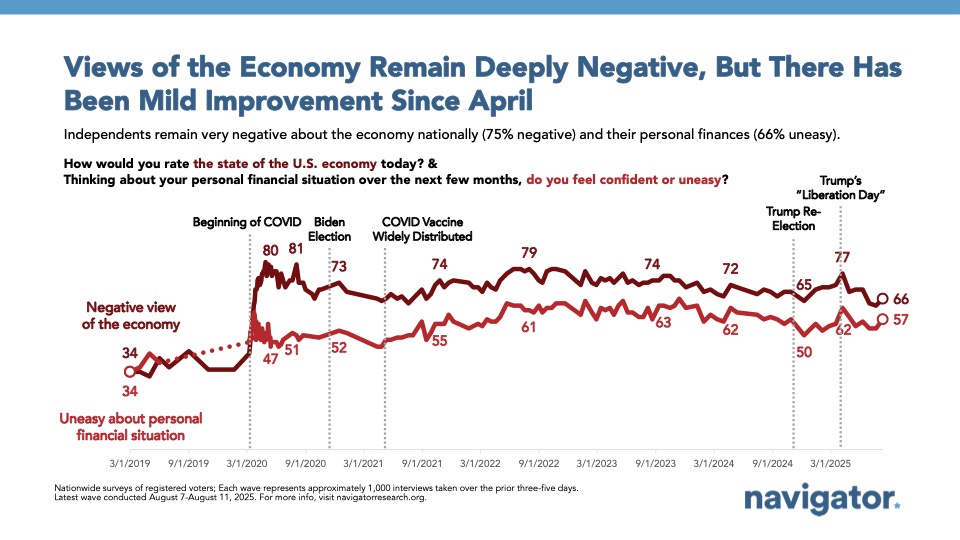
Two thirds of Americans are negative about the current state of the economy (66 percent), including 84 percent of Democrats, 75 percent of independents, and 46 percent of Republicans. While still negative, economic ratings have improved slightly from the lowest point this year in early April, where 77 percent rated the economy negatively.

Similarly, by a 17-point margin, Americans report feeling uneasy about their personal financial situations. Women under the age of 55 are the most likely to feel uneasy about their personal financial situations (66 percent uneasy – 31 percent confident) compared to men under the age of 55 who are most likely to feel confident about their financial situations (47 percent uneasy – 51 percent confident).

Line charts from Navigator Research. Titled: Views of the Economy Remain Deeply Negative, But There Has Been Mild Improvement Since April

Half believe the economy is getting worse (50 percent), including 51 percent of passive news consumers. Americans who passively consume news are also nine points less likely than active news consumers to say the economy is getting better (18 percent passive news consumers – 27 percent active news consumers).

Trust in Handling the Issues

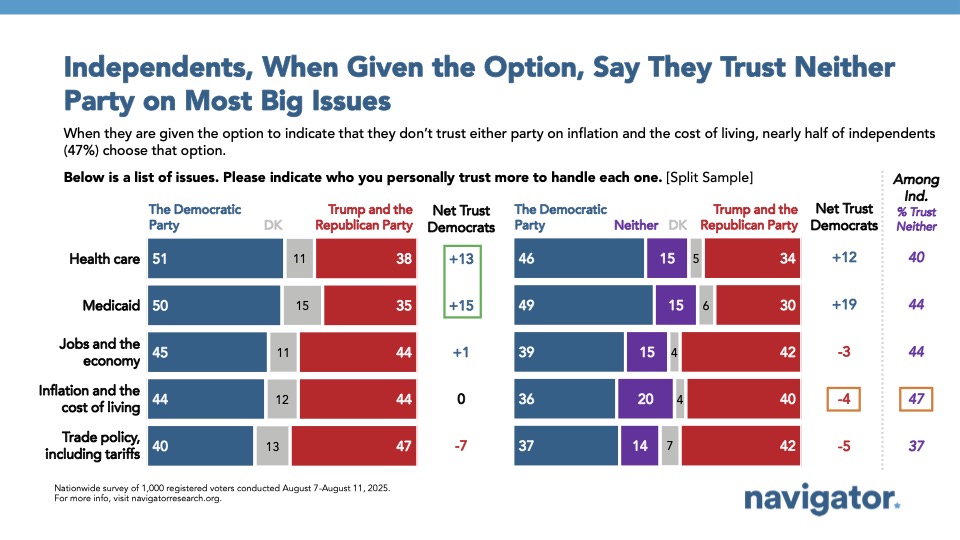
Congressional Democrats continue to hold a strong advantage over Trump and Republicans when it comes to trust in handling issues like health care (net +13), Medicaid (net +15), and education (net +9). This is especially true among independents, where Democrats hold a 32-point advantage on trust in handling health care and a 31-point advantage on trust in handling Medicaid.

Americans are more split when it comes to who they trust to handle the cost of living and the economy as a whole. On the issue of inflation and the cost of living, 44 percent trust Democrats more and 44 percent trust Trump and Republicans more. Similarly, on the issue of jobs and the economy, 45 percent trust Democrats more and 44 percent trust Trump and Republicans more. In February, Trump and Republicans had a 10-point advantage on handling inflation and the cost of living, which has steadily declined.

Notably, when given the option, pluralities of independents say they don’t trust either party to handle the issues of inflation and the cost of living or jobs and the economy.

Bar charts from Navigator Research. Titled: Independents, When Given the Option, Say They Trust Neither Party on Most Big Issues

Read More

June 10, 2026

America at 250: The State of Our Union

This Navigator Research Report explores that gap between the way America is being celebrated and portrayed by this administration, and the America people believe in.

Tina Tang & Melissa Toufanian
June 8, 2026

Americans in the Battleground See Rising Costs, But Are Unsure Who Can Lower Them

This Navigator Research report covers how Americans in the battleground feel about the economy and rising costs as well as who they trust to lower them.

Julie Alderman Boudreau
June 4, 2026

Americans Are Split on How Safe our Food Is

This Navigator Research report covers perceptions of food safety and the health and wellness concerns that are top of mind for Americans.

Maryann Cousens
June 3, 2026

The Overreach Backfires: Battleground Americans Reject Abuse of Government Power

This Navigator Research report covers government weaponization, including which actions concern battleground constituents the most and how to message about them.

Julie Alderman Boudreau

Most Americans Would Blame Trump and Republicans in Congress for Government Shutdown

Poll: Government Shutdown

This Navigator Research report covers perceptions of a potential government shutdown, including who Americans would blame most.

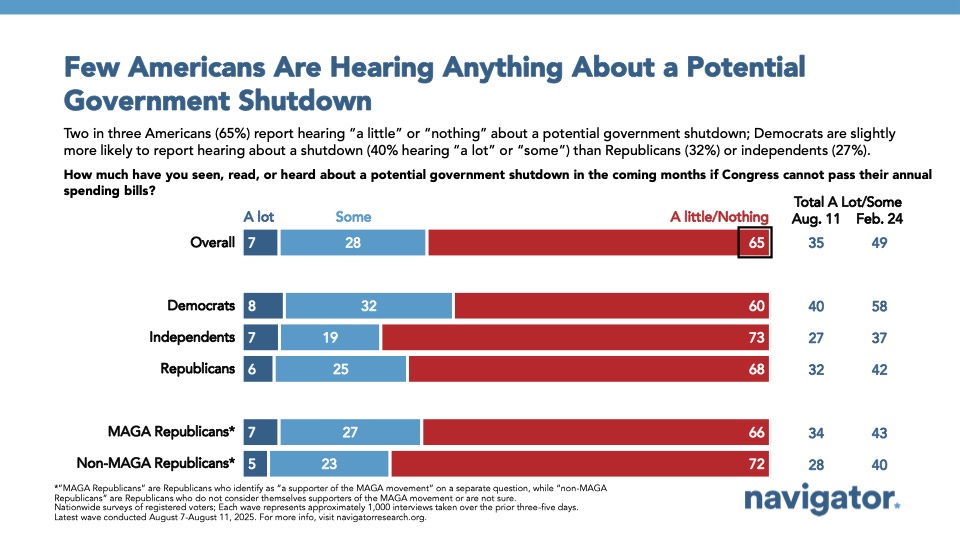
Just one-third of Americans are hearing news about a potential government shutdown in the coming months if Congress cannot pass their annual spending bills (35 percent), a decrease from this past February when Congress previously faced a shutdown (49 percent).

Americans who actively seek out news are nearly 20 points more likely to be hearing about a government shutdown than those who passively consume news (42 percent active news consumers – 24 percent passive news consumers).

Bar chart from Navigator Research. Titled: Few Americans Are Hearing Anything About a Potential Government Shutdown

The Blame Game

Though awareness remains low, a plurality of Americans say President Trump and Republicans in Congress would be to blame if the government were to shut down in the coming months (net +22; 48 percent Trump and Republicans in Congress – 26 percent Democrats in Congress), including independents by a 25-point margin. This past February when Congress was previously on the brink of a shutdown, a similar share said Trump and Republicans would be to blame (net +20).

Americans say they would blame Trump and Republicans more than Congressional Democrats regardless of whether they are active news consumers (net +20; 49 percent Trump and Republicans in Congress – 29 percent Democrats in Congress) or passive news consumers (net +26; 46 percent Trump and Republicans in Congress – 20 percent Democrats in Congress).

Bar chart from Navigator Research. Titled: Large Pluralities Continue to Say Shutdown Responsibility Would Lie With Trump and Republicans

Positioning Progressives

Support is higher for Democrats framing the funding debate as supporting bills as long as they meet certain conditions, rather than opposing them unless they meet certain conditions. We tested two arguments against the following: “Democrats who say that without the majority there’s not much they can do to stop Trump, and so they should at least keep the government working.” The best testing message positioned progressives as fighting for Americans’ best interests, rather than purely against Trump and Republicans:

  • Democrats who say they should be willing to support the spending bills, as long as they meet conditions: that they don’t cut funding for public schools, take away health care that people depend on, or defund research into lifesaving cures (net +18, including net +34 among independents); and,
  • Democrats who say they need to oppose the spending bills and threaten to shut down the government, unless they are able to stop Trump’s power grab and Republicans’ outrageous budget cuts (net +2; including net -4 among independents).
Bar chart from Navigator Research. Titled: In Framing the Funding Debate, Better to Focus on Spending Conditions to Support Than Opposition Unless Meeting Conditions

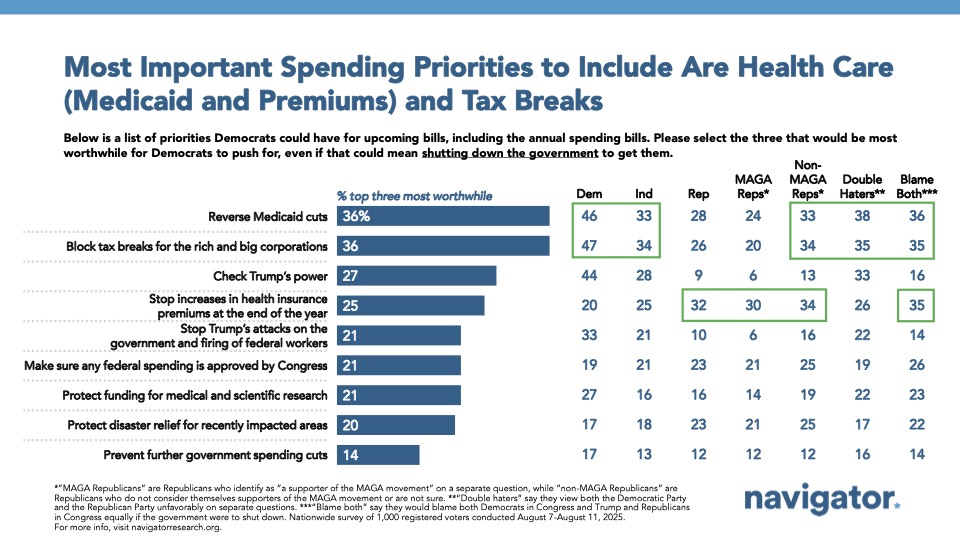
While most agree Democrats in Congress should support spending bills if their policy priorities are met, some priorities are seen as more worth fighting for if it means shutting the government down. When selecting three policy priorities that would be worth Democrats in Congress pushing for even if it means shutting the government down, 36 percent say reversing Medicaid cuts would be worthwhile, including 46 percent of Democrats, 33 percent of independents, and 28 percent of Republicans. Similarly, 36 percent say blocking tax breaks for the rich and powerful would be worth Democrats in Congress pushing for. Among Republicans, the greatest policy priority worth pushing for – even if it meant shutting the government down – is stopping increases in health insurance premiums (32 percent).

Bar chart from Navigator Research. Titled: Most Important Spending Priorities to Include Are Health Care (Medicaid and Premiums) and Tax Breaks

Read More

June 10, 2026

America at 250: The State of Our Union

This Navigator Research Report explores that gap between the way America is being celebrated and portrayed by this administration, and the America people believe in.

Tina Tang & Melissa Toufanian
June 8, 2026

Americans in the Battleground See Rising Costs, But Are Unsure Who Can Lower Them

This Navigator Research report covers how Americans in the battleground feel about the economy and rising costs as well as who they trust to lower them.

Julie Alderman Boudreau
June 4, 2026

Americans Are Split on How Safe our Food Is

This Navigator Research report covers perceptions of food safety and the health and wellness concerns that are top of mind for Americans.

Maryann Cousens
June 3, 2026

The Overreach Backfires: Battleground Americans Reject Abuse of Government Power

This Navigator Research report covers government weaponization, including which actions concern battleground constituents the most and how to message about them.

Julie Alderman Boudreau

Less Than One Third of Americans View Tariffs Favorably

Poll: Tariffs

This Navigator Research report covers perceptions of tariffs and President Trump’s priorities as costs increase for everyday Americans.

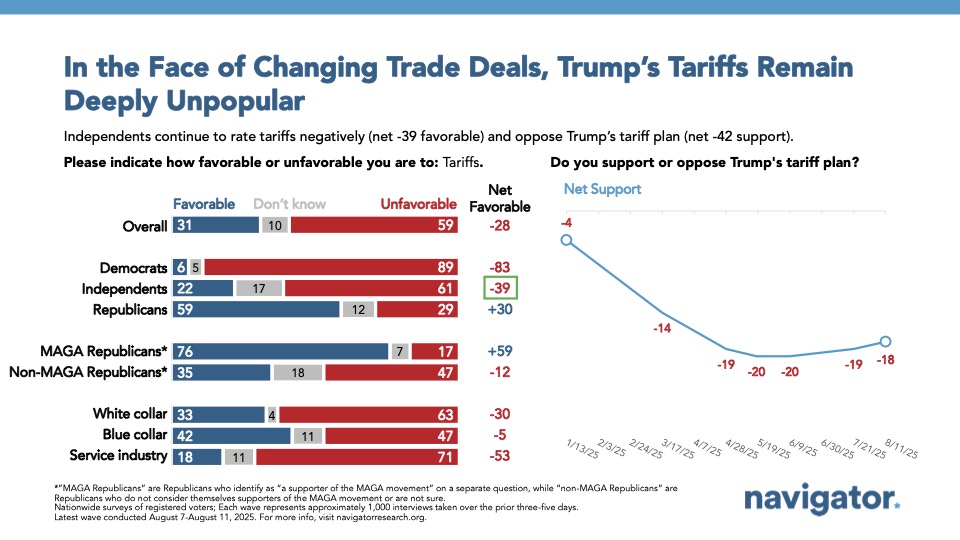
As President Trump’s newest tariffs take effect, less than one-third of Americans report a favorable view of tariffs (31 percent), including only six percent of Democrats, 22 percent of independents, and 59 percent of Republicans. Besides partisanship, job type shows some division in how Americans perceive tariffs. Tariffs are still underwater across job types, but Americans working blue-collar jobs are more split (net -5), compared to Americans working white-collar jobs (net -30) or in the service industry (net -53).

Bar chart from Navigator Research. Titled: In the Face of Changing Trade Deals, Trump’s Tariffs Remain Deeply Unpopular

Effects of Tariffs

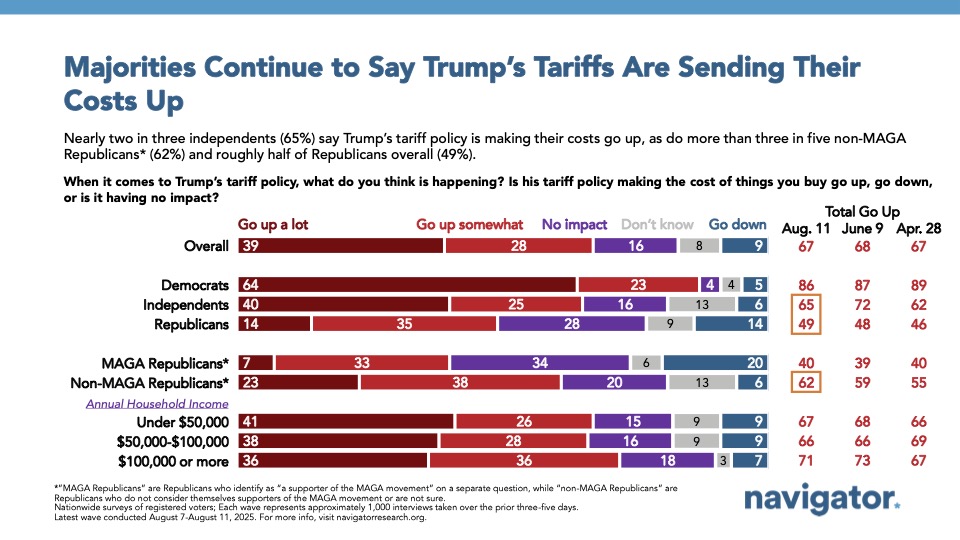
Two-thirds of Americans believe tariffs are making the cost of things they buy go up (67 percent), including 39 percent who believe they are making costs go up “a lot.” Majorities of both Democrats (86 percent) and independents (65 percent) believe tariffs are increasing costs, and around half of Republicans say the same (49 percent). Among Americans who voted for Trump but do not strongly approve of his handling of the presidency, 56 percent believe tariffs are increasing costs.

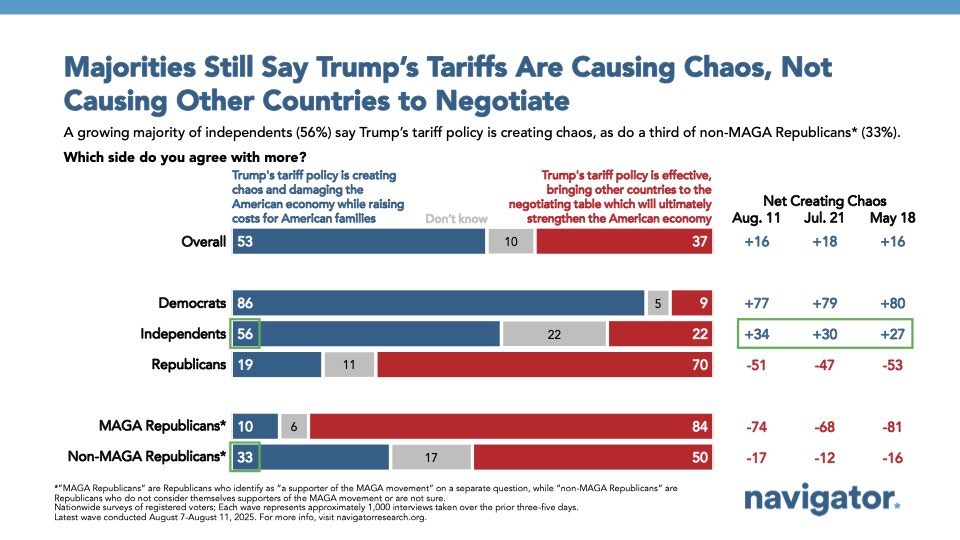
A 16-point majority agree that “Trump’s tariff policy is creating chaos and damaging the economy while raising costs for American families” as opposed to being “effective, bringing other countries to the negotiating table which will ultimately strengthen the American economy.”

Bar chart from Navigator Research. Titled: Majorities Continue to Say Trump’s Tariffs Are Sending Their Costs Up
Bar chart from Navigator Research. Titled: Majorities Still Say Trump’s Tariffs Are Causing Chaos, Not Causing Other Countries to Negotiate

Priorities of Trump and Republicans

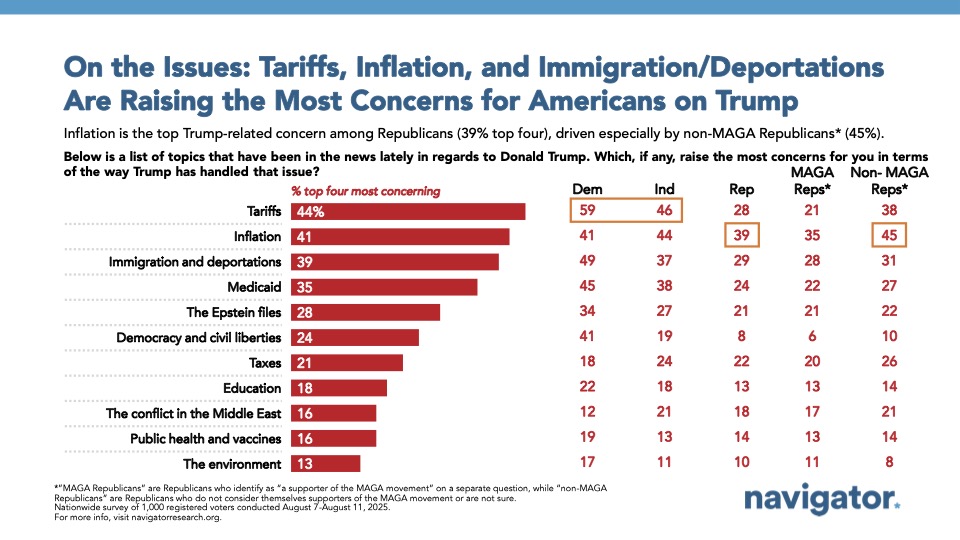
Americans are most concerned about the way Trump has handled tariffs and inflation. When asked to select up to four topics that raise the most concern over the way Trump has handled them, 44 percent said tariffs and 41 percent said inflation.

Bar chart from Navigator Research. Titled: On the Issues: Tariffs, Inflation, and Immigration/Deportations Are Raising the Most Concerns for Americans on Trump

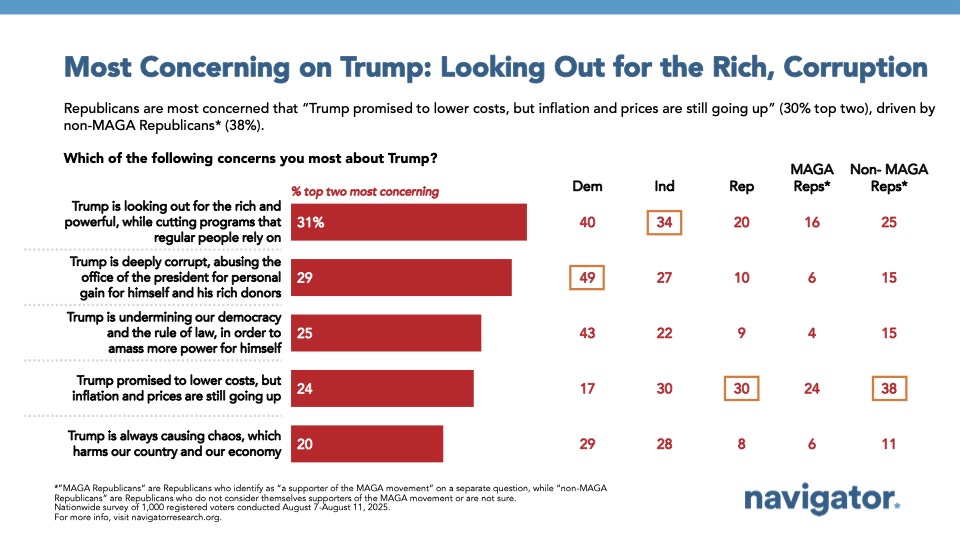
The most concerning message on the way Trump has handled the presidency is:

  • Trump is looking out for the rich and powerful while cutting programs people rely on.

Followed by:

  • Trump is deeply corrupt, abusing the office of the president for personal gain for himself and his rich donors.

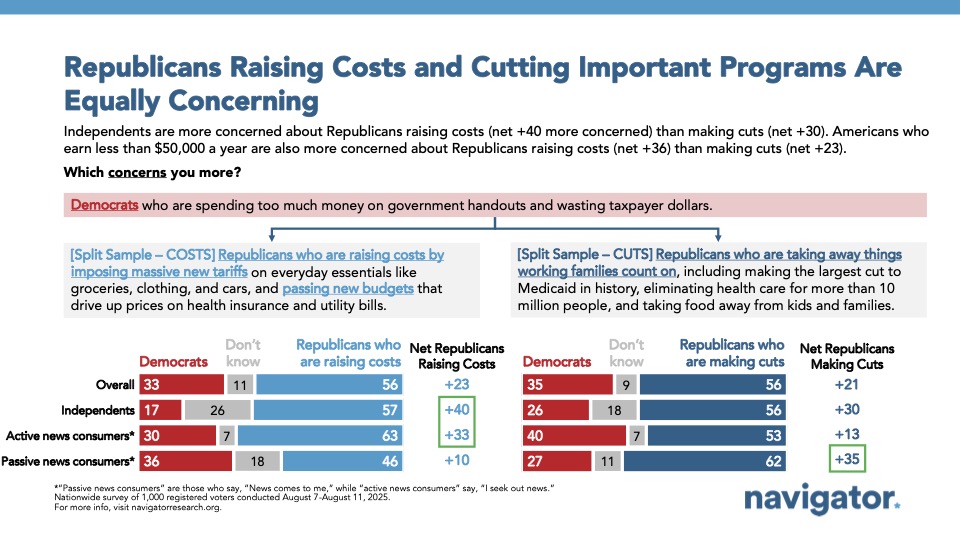
Similarly, messages regarding both Republicans raising costs by imposing new tariffs (net +23) and Republicans cutting programs that Americans rely on (net +21) are popular.

Bar chart from Navigator Research. Titled: Most Concerning on Trump: Looking Out for the Rich, Corruption

A majority are more concerned by a message on Republicans increasing costs and by a message on Republicans cutting programs Americans rely on. These messages are equally more concerning than a message that “Democrats who are spending too much money on government handouts and wasting taxpayer dollars.”

Republicans who are raising costs by imposing massive new tariffs on everyday essentials like groceries, clothing, and cars, and passing new budgets that drive up prices on health insurance and utility bills (net +23; 56 percent more concerned); and,

Republicans who are taking away things working families count on, including making the largest cut to Medicaid in history, eliminating health care for more than 10 million people, and taking food away from kids and families (net +21; 56 percent more concerned).

Bar chart from Navigator Research. Titled: Republicans Raising Costs and Cutting Important Programs Are Equally Concerning

Recommendations:

1. Highlight Trump’s priorities:

Trump’s new tariffs are yet another example of him looking out for his own special interests and the rich and powerful – and that’s driving up costs for everyday Americans.

2. Message on both costs and cuts:

Republicans are increasing costs through new tariffs and cutting programs millions of Americans rely on, including the largest cut to Medicaid in history.

Read More

June 10, 2026

America at 250: The State of Our Union

This Navigator Research Report explores that gap between the way America is being celebrated and portrayed by this administration, and the America people believe in.

Tina Tang & Melissa Toufanian
June 8, 2026

Americans in the Battleground See Rising Costs, But Are Unsure Who Can Lower Them

This Navigator Research report covers how Americans in the battleground feel about the economy and rising costs as well as who they trust to lower them.

Julie Alderman Boudreau
June 4, 2026

Americans Are Split on How Safe our Food Is

This Navigator Research report covers perceptions of food safety and the health and wellness concerns that are top of mind for Americans.

Maryann Cousens
June 3, 2026

The Overreach Backfires: Battleground Americans Reject Abuse of Government Power

This Navigator Research report covers government weaponization, including which actions concern battleground constituents the most and how to message about them.

Julie Alderman Boudreau

Americans Oppose Texas Redistricting by Double-Digit Margins

Poll: Texas Redistricting

This Navigator Research report covers reactions to Texas lawmakers attempts to redraw the state’s congressional maps.

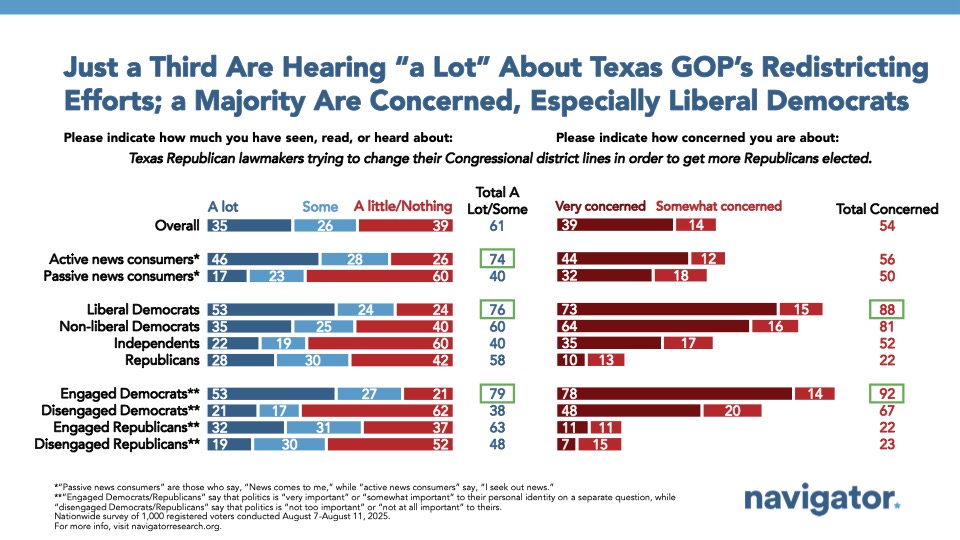
Most Americans say they have seen something and are concerned about Texas Republicans trying to change their congressional district lines—but partisanship is driving intensity.

Six in ten (61 percent) say they have seen, read, or heard something about Texas Republican lawmakers trying to change congressional district lines in order to get more Republicans elected, including 69 percent of Democrats and 58 percent of Republicans. Just 40 percent of independents have heard something about it.

Liberal Democrats (76 percent), active news consumers (74 percent), and those who say politics is very important to their personal identity (76 percent) are hearing the most about this.

Bar chart from Navigator Research. Titled: Just a Third Are Hearing “a Lot” About Texas GOP’s Redistricting Efforts; a Majority Are Concerned, Especially Liberal Democrats

A 54 percent majority say they are concerned about the changing of congressional district lines, including 39 percent who are very concerned. Democrats are most concerned (85 percent, including 70 percent very concerned), compared to independents (52 percent, including 39 percent very concerned).

Views of the Gerrymander

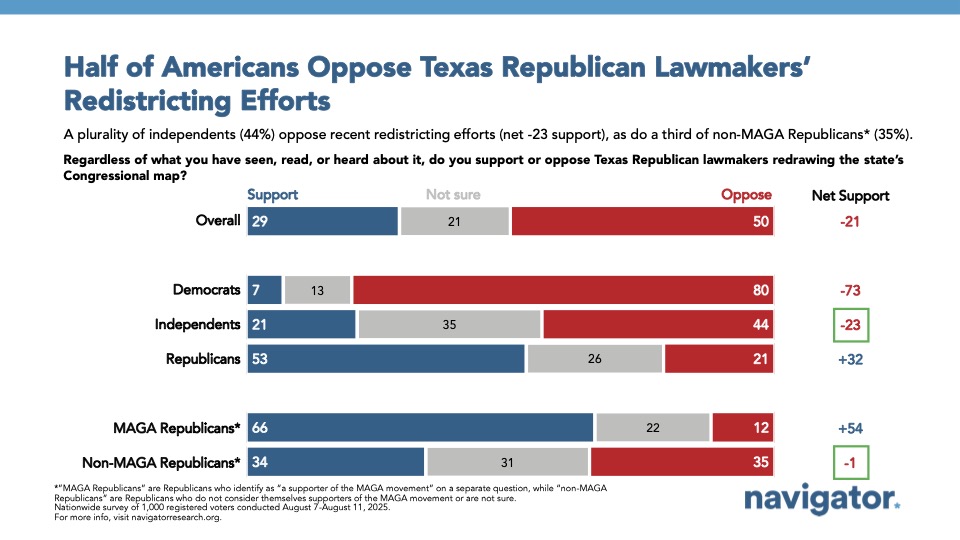
By a 21-point margin, half of Americans (50 percent) oppose Texas lawmakers redrawing the state’s congressional maps. Again, Democrats drive the intensity (80 percent oppose, 70 percent strongly oppose), though a plurality of independents and one in five Republicans also oppose the redistricting.

Bar chart from Navigator Research. Titled: Half of Americans Oppose Texas Republican Lawmakers’ Redistricting Efforts

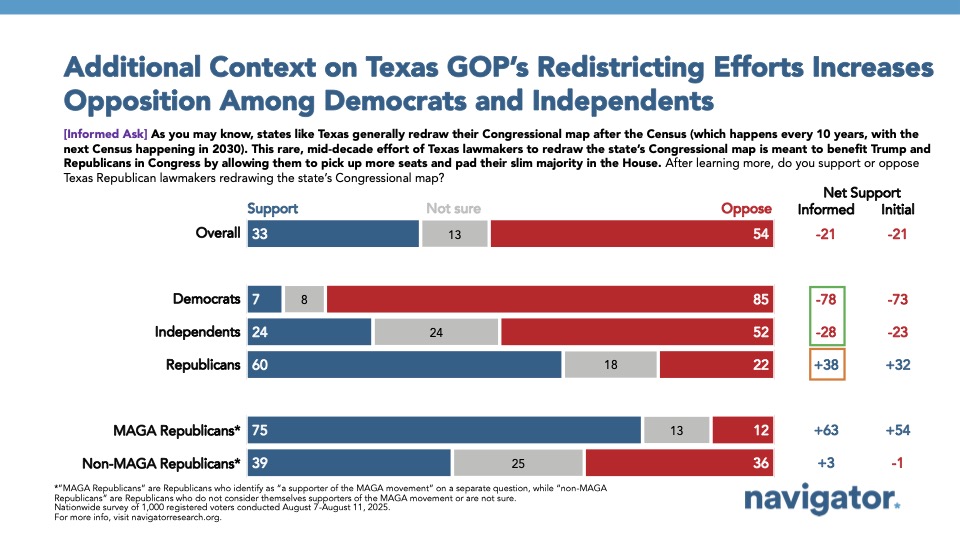
Opposition grows to a 54 percent majority after learning that:

As you may know, states like Texas generally redraw their congressional map after the Census (which happens every 10 years, with the next Census happening in 2030). This rare, mid-decade effort of Texas lawmakers to redraw the state’s congressional map is meant to benefit Trump and Republicans in Congress by allowing them to pick up more seats and pad their slim majority in the House.

Opposition grows among Democrats (from 80 percent to 85 percent) and independents (from 44 percent to 52 percent). One in five Republicans (22 percent) remain opposed to the redistricting, however those who were previously unsure move to supporting the redistricting (from 53 percent to 60 percent).

Bar chart from Navigator Research. Titled: Additional Context on Texas GOP’s Redistricting Efforts Increases Opposition Among Democrats and Independents

A power grab

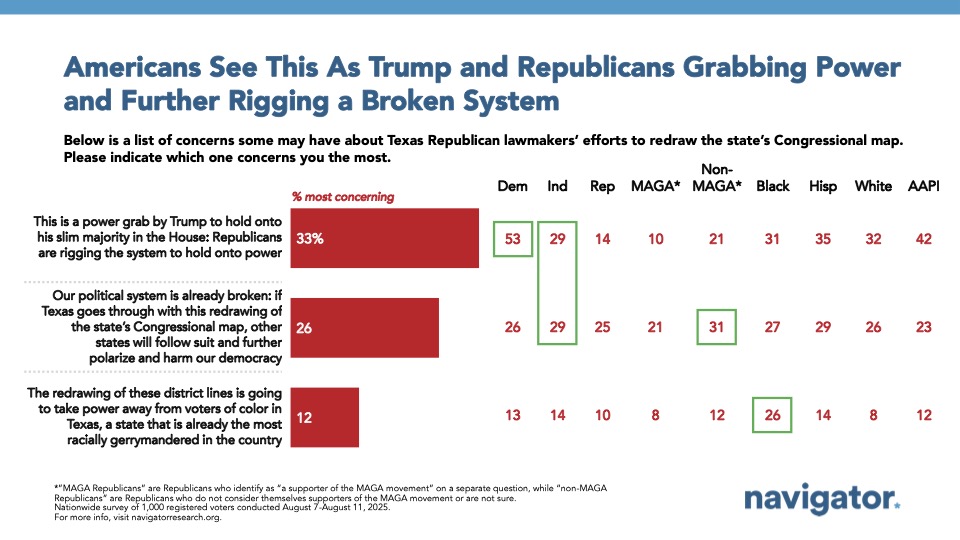
Americans are split on what concerns them most about Texas Republican lawmakers’ efforts to redraw the state’s congressional map:

Power grab: This is a power grab by Trump to hold onto his slim majority in the House: Republicans are rigging the system to hold onto power (33 percent find this concerning, including 53 percent of Democrats and 29 percent of independents);

Polarized: Our political system is already broken: if Texas goes through with this redrawing of the state’s congressional map, other states will follow suit and further polarize and harm our democracy (26 percent find this concerning, including 29 percent of independents, 25 percent of Republicans and 31 percent of non-MAGA Republicans).

An argument about racial gerrymandering was less compelling overall, but it was the strongest argument among African American respondents.

Independents are equally split on “power grab,” “polarized,” and finding none of these concerning.

Bar chart from Navigator Research. Titled: Americans See This As Trump and Republicans Grabbing Power and Further Rigging a Broken System

Recommendations:

1. Lead with information about what this is, there is an awareness and education gap to be addressed:

As you may know, states like Texas generally redraw their congressional map after the Census (which happens every 10 years, with the next Census happening in 2030). But, this timing is an unprecedented step—doing it when it suits them and to gain more power, instead of more properly representing people.

2. Explain WHY legislators are attempting to do this:

They are manipulating the maps to benefit Trump and Republicans in Congress by allowing them to pick up more seats and pad their slim majority in the House.

3. Acknowledge the rigged system that allows this:

Our political system is already broken:

For base audience: This is a power grab by Trump to hold onto his slim majority in the House: Republicans are rigging the system to hold onto power.

For a broader audience: Texas goes through with this redrawing of the state’s congressional map, other states will follow suit and further polarize and harm our democracy.

Read More

June 10, 2026

America at 250: The State of Our Union

This Navigator Research Report explores that gap between the way America is being celebrated and portrayed by this administration, and the America people believe in.

Tina Tang & Melissa Toufanian
June 8, 2026

Americans in the Battleground See Rising Costs, But Are Unsure Who Can Lower Them

This Navigator Research report covers how Americans in the battleground feel about the economy and rising costs as well as who they trust to lower them.

Julie Alderman Boudreau
June 4, 2026

Americans Are Split on How Safe our Food Is

This Navigator Research report covers perceptions of food safety and the health and wellness concerns that are top of mind for Americans.

Maryann Cousens
June 3, 2026

The Overreach Backfires: Battleground Americans Reject Abuse of Government Power

This Navigator Research report covers government weaponization, including which actions concern battleground constituents the most and how to message about them.

Julie Alderman Boudreau

A Majority of Americans See Climate Change as a Serious Problem Today

Poll: Climate Change

This Navigator Research report covers Americans’ perceptions of extreme weather, including Americans’ concerns on climate change and how they believe this year’s weather compares to that of past years.

While partisanship primarily shapes the perception of climate change, experiences of heat, floods, and disaster fallout are creating new realities in the climate divide — especially among independents and younger Americans.

Extreme heat and flooding define 2025’s climate experience

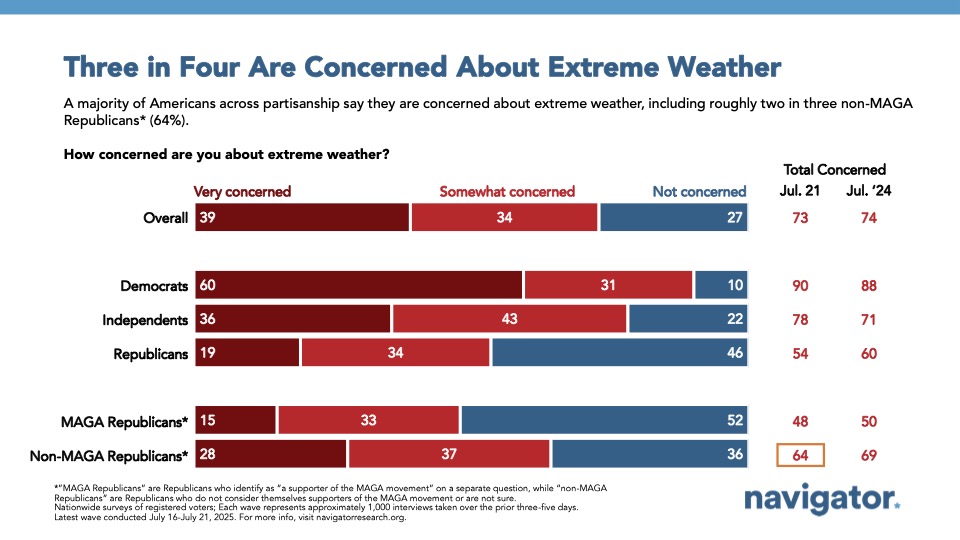
Three quarters (73 percent) of Americans are concerned about extreme weather, including 39 percent who say they are very concerned.

Bar graph of polling data from Navigator Research. Title: Three in Four Are Concerned About Extreme Weather

Only 27 percent trust Trump and Republicans to handle climate change and the environment, while 51 percent trust Democrats.

Americans are split on who they trust to respond to natural disasters. 44 percent place their trust in the Democrats, with 41 percent trusting Trump and Republicans.

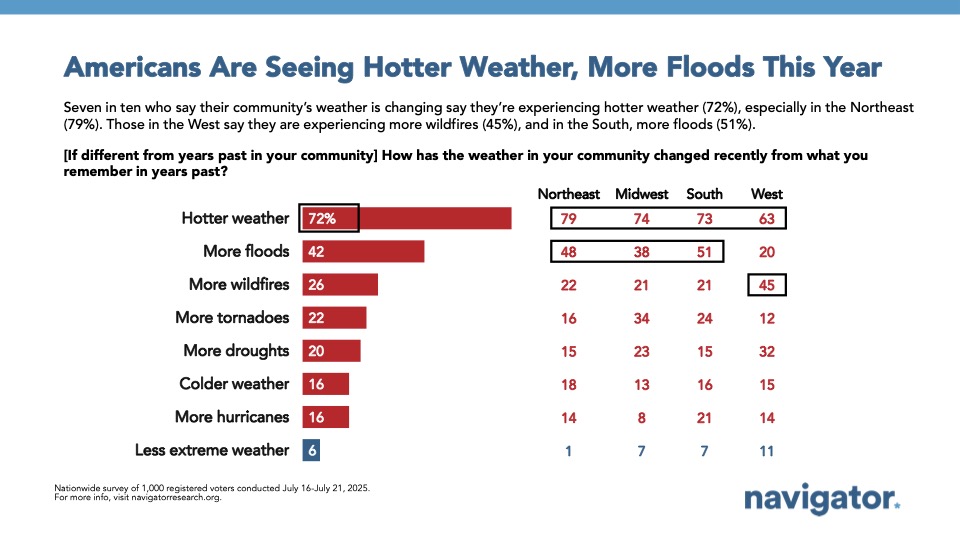
Americans are primarily experiencing changing weather through hotter temperatures (72 percent) and increases in floods (42 percent). With 85 percent of Americans hearing about catastrophic floods in Texas and other states, it’s no surprise that majorities across partisanship are concerned about extreme weather.

Bar graph of polling data from Navigator Research. Title: Americans Are Seeing Hotter Weather, More Floods This Year

Experiences of intensifying weather differ across regions: In the West, hotter temperatures (63 percent), increased wildfires (51 percent), and increased drought (32 percent) top the list. Midwesterners cite hotter temperatures (74 percent), increased floods (38 percent), and increased tornadoes (34 percent).

Climate change is seen as a serious problem — but intensity varies by party

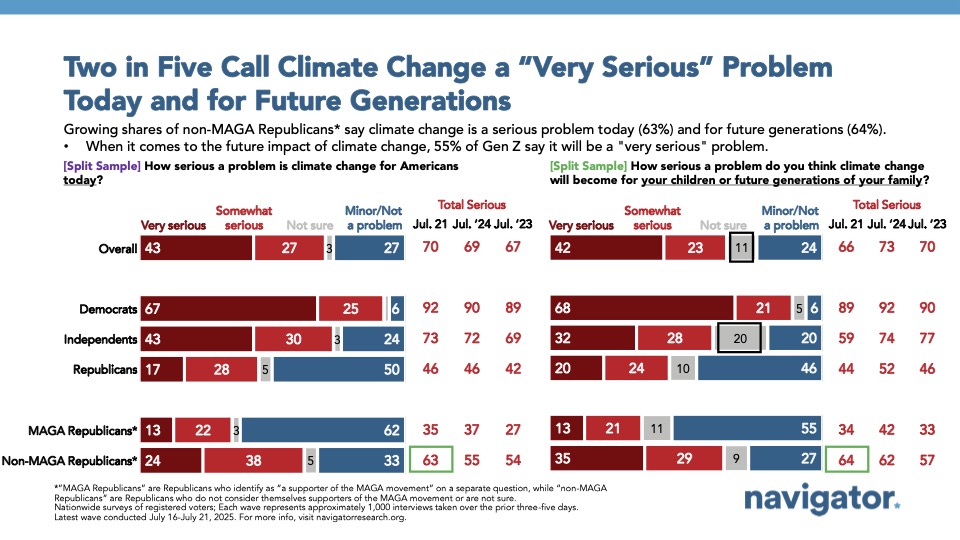
With extreme weather dominating news cycles throughout 2025, 70 percent of Americans believe climate change is a serious problem today, including most independents (73 percent) and non-MAGA Republicans (63 percent).

Bar graph of polling data from Navigator Research. Title: Two in Five Call Climate Change a “Very Serious” Problem Today and for Future Generations

92 percent of Democrats believe climate change is a serious problem (67 percent very serious).

46 percent of Republicans believe climate change is a serious problem, but with a stark divide between MAGA and non-MAGA Republicans. While 34 percent of MAGA Republicans say climate change is a serious problem, 63 percent of non-MAGA Republicans say climate change is a serious problem.

A majority of independents (73 percent) believe climate change is a serious problem today and 43 percent state it’s a very serious

Just under 80 percent of Gen Z cites climate change as a serious problem, with 41 percent stating it’s a very serious problem. Compared to other generations that cite climate change as a serious problem, Gen Z is 3 points higher than Millennials, 14 points higher than Gen X and 12 points higher than Boomers.

Americans are split on the causes of weather change

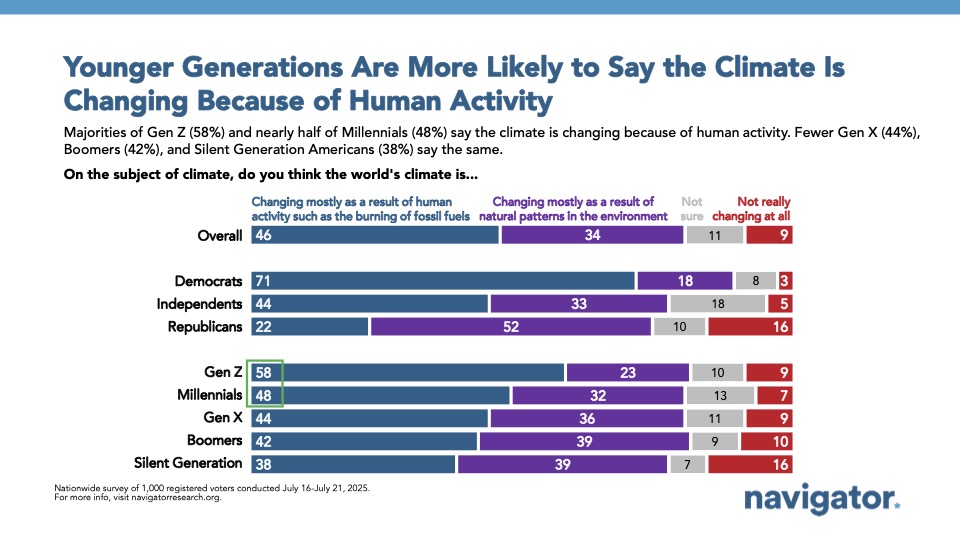
A plurality (46 percent) say the weather is changing mostly as a result of human activity, such as the burning of fossil fuels, while 34 percent say the weather is changing mostly as a result of natural patterns.

Bar graph of polling data from Navigator Research. Title: Younger Generations Are More Likely to Say the Climate Is Changing Because of Human Activity

Both MAGA and non-MAGA Republicans are most likely to attribute changing weather to natural patterns (52 percent), with 16 percent stating the weather is not changing at all.

44 percent of independents say the weather is changing as a result of human activity, while 33 percent attribute changing weather to natural patterns.

Bipartisan support for emergency weather services

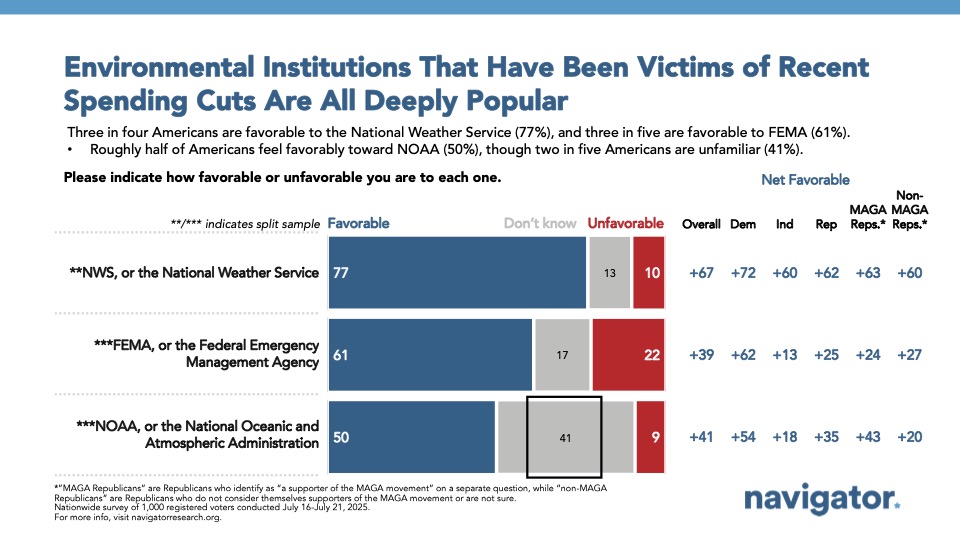
Despite the Trump administration recently cutting funding to agencies responsible for weather reporting and disaster response, these agencies remain popular with the public.

  • 77 percent of Americans are favorable to the National Weather Service.
  • 61 percent of Americans are favorable to the Federal Emergency Management Agency.
  • 50 percent of Americans are favorable to the National Oceanic and Atmospheric Administration.
Bar graph of polling data from Navigator Research. Title: Environmental Institutions That Have Been Victims of Recent Spending Cuts Are All Deeply Popular

In the Midwest, an area particularly devastated by floods and tornadoes, 68 percent express favorability for FEMA.

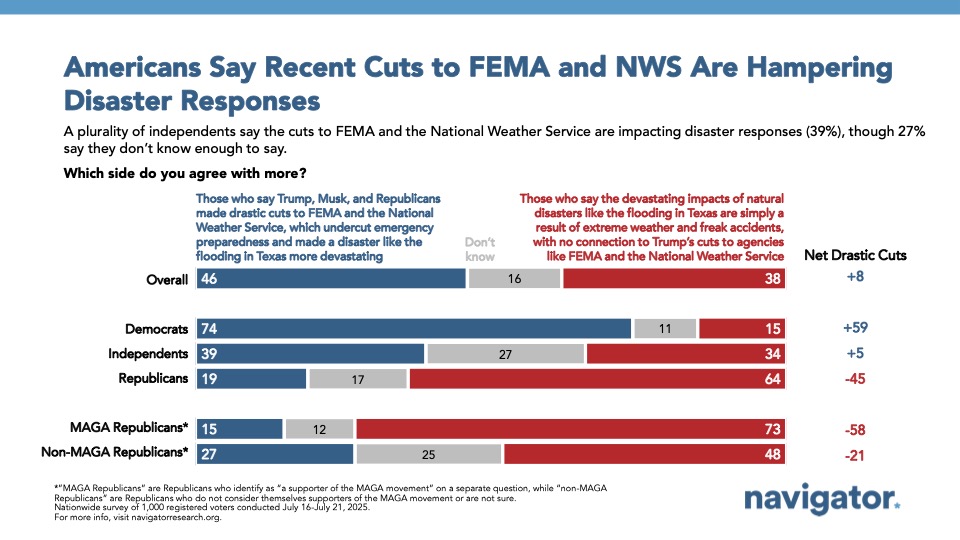
A plurality (46 percent) of Americans believe that cuts made to these institutions undercut emergency preparedness and have made extreme weather disasters worse. The results are largely partisan: 74 percent of Democrats say Trump’s cuts are to blame, while 64 percent of Republicans say the agency cuts have no connection to extreme weather. Independents are divided, with 28 percent unsure.

Bar graph of polling data from Navigator Research. Title: Americans Say Recent Cuts to FEMA and NWS Are Hampering Disaster Responses

Read More

June 10, 2026

America at 250: The State of Our Union

This Navigator Research Report explores that gap between the way America is being celebrated and portrayed by this administration, and the America people believe in.

Tina Tang & Melissa Toufanian
June 8, 2026

Americans in the Battleground See Rising Costs, But Are Unsure Who Can Lower Them

This Navigator Research report covers how Americans in the battleground feel about the economy and rising costs as well as who they trust to lower them.

Julie Alderman Boudreau
June 4, 2026

Americans Are Split on How Safe our Food Is

This Navigator Research report covers perceptions of food safety and the health and wellness concerns that are top of mind for Americans.

Maryann Cousens
June 3, 2026

The Overreach Backfires: Battleground Americans Reject Abuse of Government Power

This Navigator Research report covers government weaponization, including which actions concern battleground constituents the most and how to message about them.

Julie Alderman Boudreau