MAHA Message Guidance

MAHA Message Guidance

Messaging guidance on the “Make America Healthy Again” (MAHA) movement.

The “Make America Healthy Again” (MAHA) movement blends common-sense health advice with fringe – and sometimes dangerous – ideas. Its leaders say they want to tackle America’s chronic disease crisis and improve wellness, but their proposals often reveal something else: a distrust of science and a readiness to exploit public frustration with the health care system. As Health and Human Services Secretary Robert F. Kennedy Jr. remakes the nation’s public health establishment, his agenda leans heavily on two emotional threads: fear of illness and anger at a system people feel is broken.

Navigator Research completed a study of public attitudes towards health and wellness, as well as perceptions of the MAHA movement and what progressive messages appeal most to those in the MAHA-curious cohort. (deck here).

Values

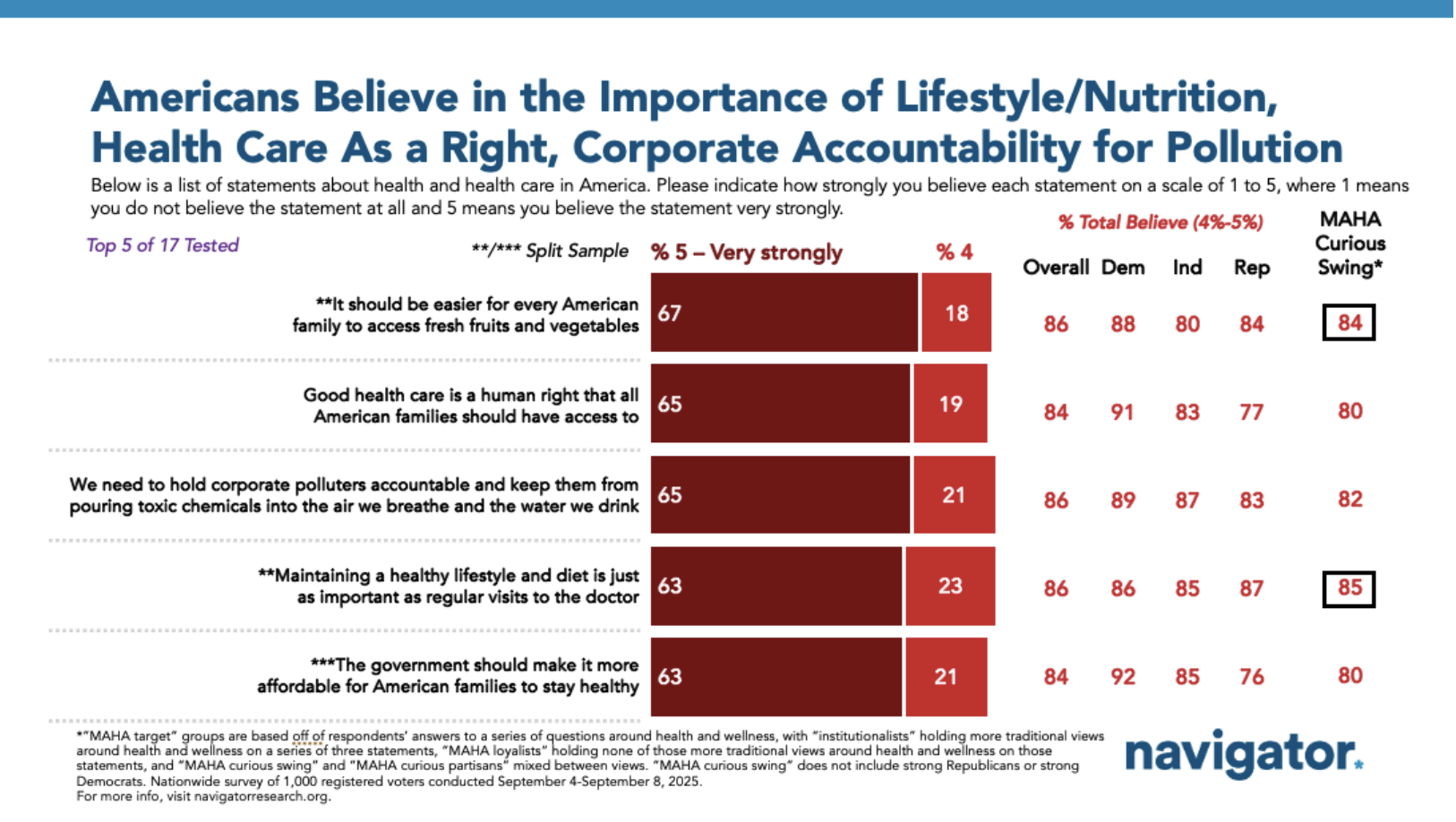
While Robert F. Kennedy may be divisive, an overwhelming majority of Americans across partisanship share common values about health and wellness:

  • The government should make it more affordable for American families to stay healthy.
  • Good health care is a human right that all American families should have access to.
  • It should be easier for every American family to access fresh fruits and vegetables.
  • Maintaining a healthy lifestyle and diet is just as important as regular visits to the doctor.
  • We need to hold corporate polluters accountable and keep them from pouring toxic chemicals into the air we breathe and the water we drink.
Messaging to Meet the Moment

A message that addresses the faults in our health care system and focuses on cracking down on corporate interests persuades Democrats and independents, non-MAGA Republicans, and also “MAHA curious” persuadables.

Our health care system is broken, but the answer is not to cut medical research, take away healthy school meal options from kids, or limit vaccines. Instead we should be cracking down on special interest influence in our government and putting science and facts ahead of politics.

Message Path:

  1. Acknowledge the system is broken: Most Americans are not satisfied with, or confident in, the existing health care system.
  2. Point out that Republicans’ proposed solution is not right: Americans oppose cuts to medical research, taking away healthy school meals from kids, and ending all vaccine mandates.
  3. Provide an alternative: Cracking down on special interest influence in our government is particularly persuasive when talking about health and wellness in the country today.
  4. Lean into common sense consensus solutions: Americans overwhelmingly agree that healthcare should be a right and that government should make it more affordable for people to stay healthy.

Read More

April 22, 2026

Fraud Is Real. Cuts Are Worse. How to Win This Fight.

While Americans are worried about both fraud and budget cuts, when forced to choose they are far more worried about cuts. Denying, dismissing, or minimizing fraud works against us.

Tina Tang
April 14, 2026

Views on Republican Tax Policies

This Navigator Research report covers how Americans feel about taxes, including the Republican tax law.

Julie Alderman Boudreau
April 9, 2026

Americans Oppose an “Expensive,” “Unnecessary,” and “Dangerous” War with Iran

This Navigator Research report covers Americans’ views on the ongoing war with Iran.

Melissa Toufanian & Aidan Harty

MAHA: The Policies and Messages

Poll: MAHA

This Navigator Research report covers perceptions of health and wellness policies in the United States and message guidance to meet the moment.

As we explored in the first report on the “Make America Healthy Again” (MAHA) movement, Americans across the political spectrum share a wide range of values on health and wellness. This is borne out in their agreement on certain policies and the role of government in advancing health and wellness.

The Policies

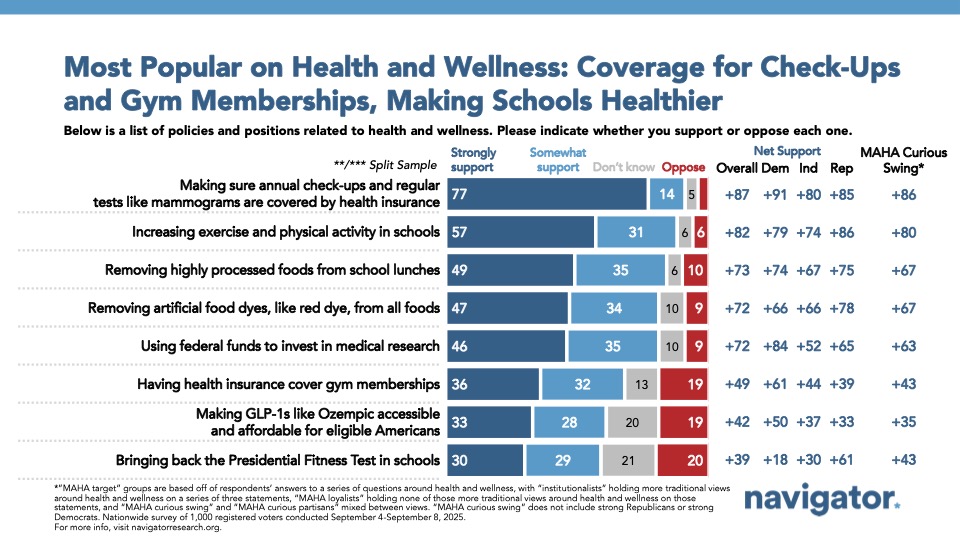
There is overwhelming bi-partisan support for health and wellness policies that seek to make health insurance cover preventative care, increase exercise and physical activity in school, remove highly processed foods from schools and artificial food dyes from all foods, hold corporations who pollute accountable, and use federal funds to invest in medical research.

Bar chart from Navigator Research. Title: Most Popular on Health and Wellness: Coverage for Check-Ups and Gym Memberships, Making Schools Healthier

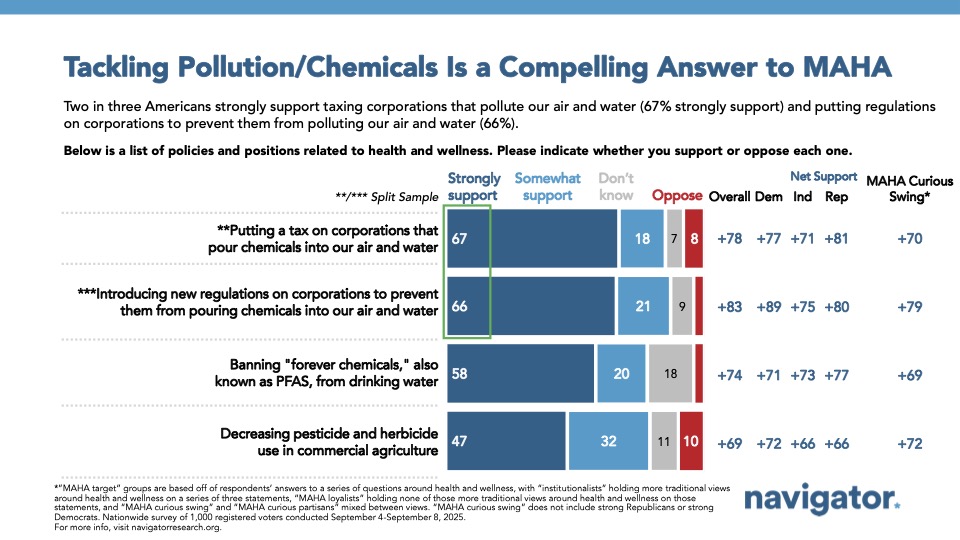
Other popular policies include banning “forever chemicals” from drinking water, decreasing pesticide and herbicide use in commercial agriculture, having health insurance cover gym memberships, making GLP-1s like Ozempic accessible and affordable for eligible Americans, and bringing back the Presidential Fitness Test in schools.

Bar chart from Navigator Research. Title: Tackling Pollution/Chemicals Is a Compelling Answer to MAHA

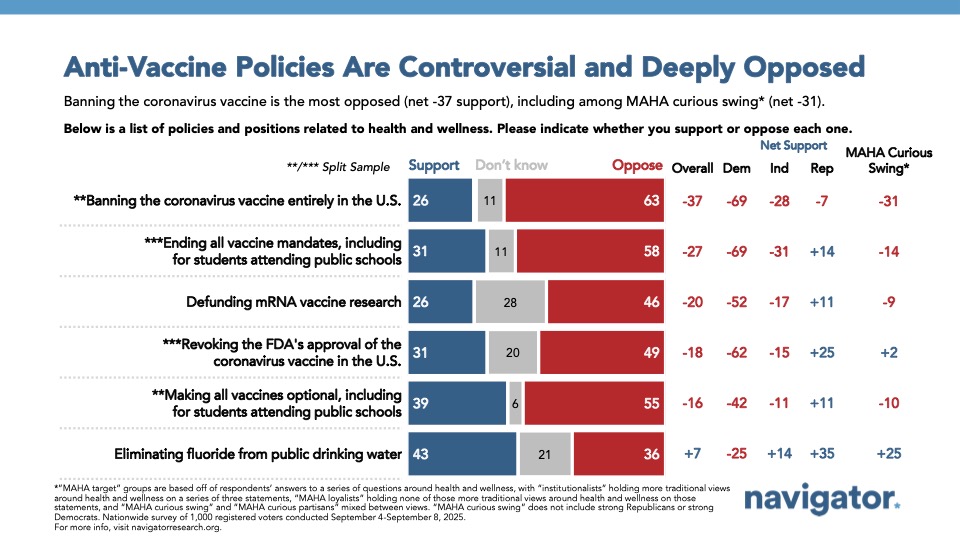
Less popular and more partisan are eliminating fluoride from public drinking water (43 percent support) and defunding mRNA vaccine research (just 26 percent support). These policies receive the most support among the MAHA loyalist cohort.

Bar chart from Navigator Research. Title: Anti-Vaccine Policies Are Controversial and Deeply Opposed

Anti-vaccine policies are the most controversial and opposed: a majority of Americans oppose making all vaccines optional, including for students attending public schools, ending all vaccine mandates, and banning the coronavirus vaccine entirely in the U.S.

The “MAHA curious” cohort are more divided than the overall electorate, but still more oppose ending all vaccine mandates, making all vaccines optional, and banning the coronavirus vaccine.

Vaccines

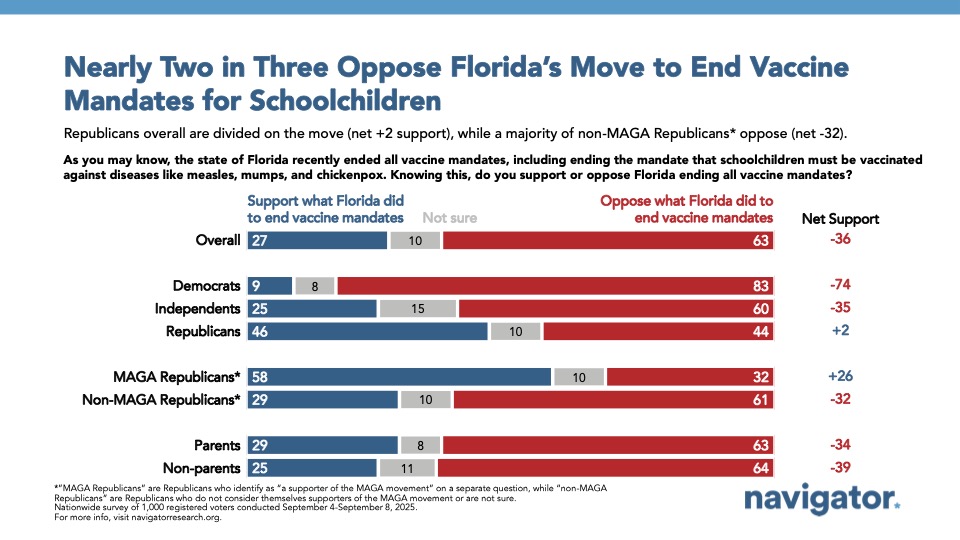
Actions to remove vaccine mandates for children are opposed by most, including those who are MAHA curious. Changes to childhood vaccine mandates in Florida draw fervent opposition (63 percent oppose), including among independents (60 percent) and the MAHA curious (54 percent). These sweeping changes outright divide Republicans (46 percent support – 44 percent oppose).

Bar chart from Navigator Research. Title: Nearly Two in Three Oppose Florida’s Move to End Vaccine Mandates for Schoolchildren

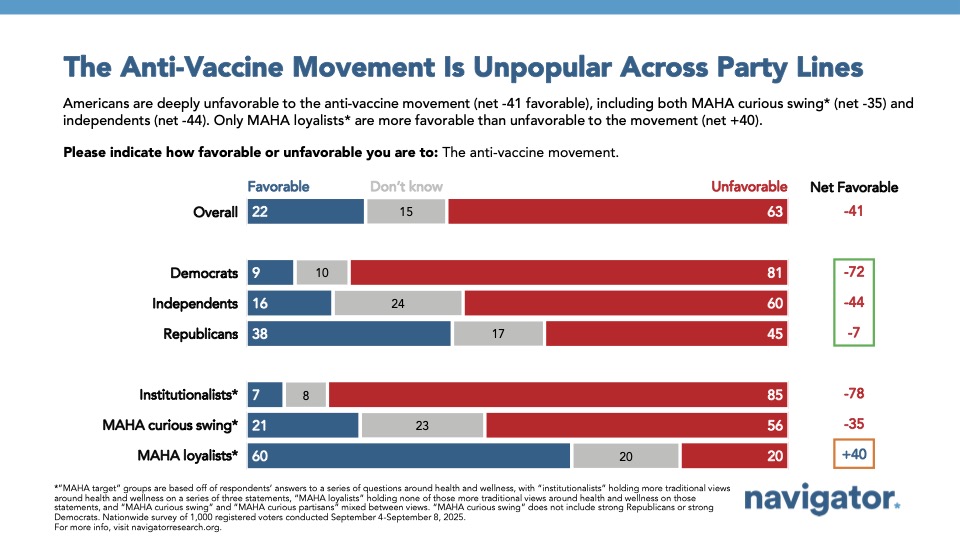
The anti-vaccine movement is viewed overwhelmingly negatively across party lines (-41), including by Republicans (-7), the MAHA curious (-31), independents (-44), and Democrats (-72).

Bar chart from Navigator Research. Title: The Anti-Vaccine Movement Is Unpopular Across Party Lines

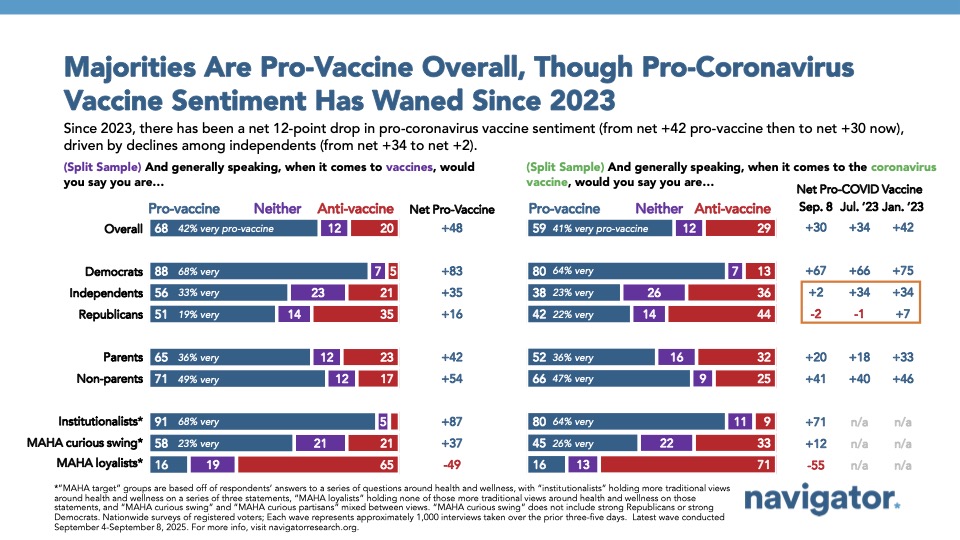
Bipartisan majorities of Americans identify generally as “pro-vaccine” (68 percent) over “anti-vaccine” (20 percent). 12 percent say they are neither pro-vaccine nor anti-vaccine, including 21 percent of the MAHA curious.

Bar chart from Navigator Research. Title: Majorities Are Pro-Vaccine Overall, Though Pro-Coronavirus Vaccine Sentiment Has Waned Since 2023

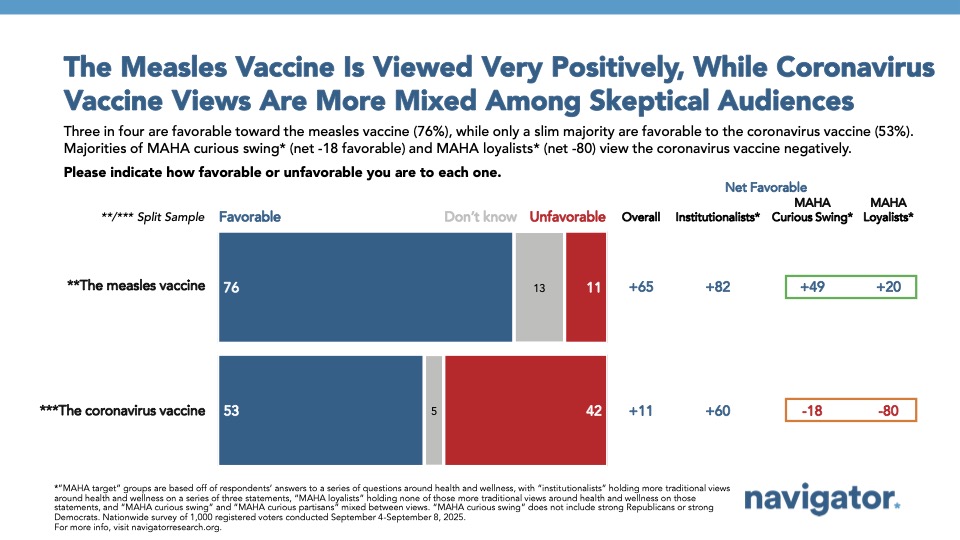
The coronavirus vaccine is where we find the most division. Americans overwhelmingly view the measles vaccine favorably (+66), including the MAHA curious (+49). By comparison, the coronavirus vaccine is viewed favorably by 11 points, and underwater among the MAHA curious (-18).

Bar chart from Navigator Research. Title: The Measles Vaccine Is Viewed Very Positively, While Coronavirus Vaccine Views Are More Mixed Among Skeptical Audiences

And when it comes to the coronavirus vaccine in particular, we see a 10-point drop in those who identify as pro-vaccine (59 percent), increasing anti-vaccine identification among both independents and Republicans and the MAHA curious.

A reminder that the MAHA curious group is deeply unfavorable to the anti-vaccine movement, oppose ending all vaccine mandates and the changes to vaccine mandates in Florida, and identify as “pro-vaccine” generally. All of this begs the question; how much of this is a COVID hangover or something that will have a lasting impact on public health and trust in vaccines?
Messaging to Meet the Moment

A message that addresses the faults in our health care system and focuses on cracking down on corporate interests is the best lane for progressives, including with MAHA curious Americans. In response to the conservative message that:
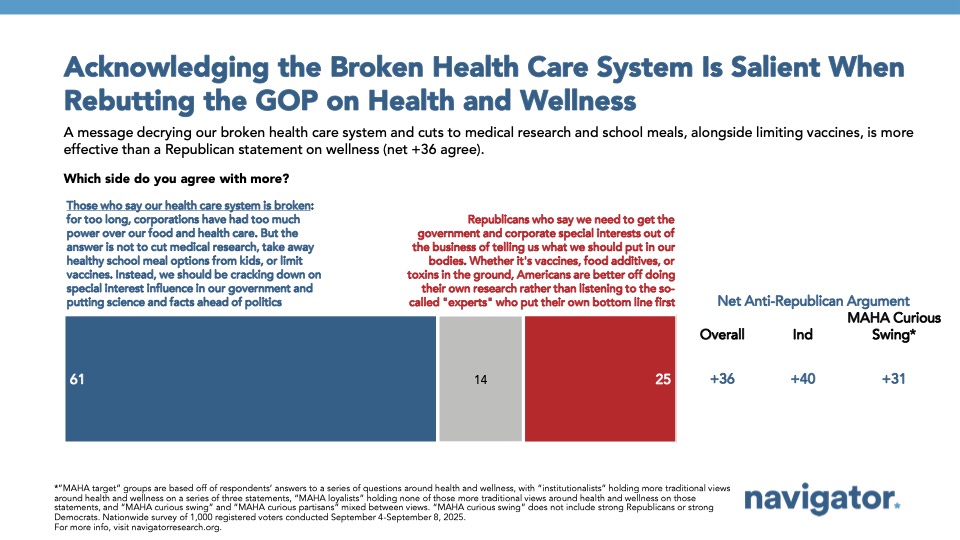
We need to get the government and corporate special interests out of the business of telling us what we should put in our bodies. Whether it’s vaccines, food additives, or toxins in the ground, Americans are better off doing their own research rather than listening to the so-called “experts” who put their own bottom line first.

We found the most persuasive response to be a message that acknowledge our health care system is broken, refutes the GOP solution, and provides an alternative, in particular cracking down on special interest influence:

Our health care system is broken, but the answer is not to cut medical research, take away healthy school meal options from kids, or limit vaccines. Instead we should be cracking down on special interest influence in our government and putting science and facts ahead of politics

Six in ten agree more with the latter, including the MAHA curious and independents. A version of the same message that concedes that “for too long, corporations have had too much power over our food and health care” is similarly effective.

Bar chart from Navigator Research. Title: Acknowledging the Broken Health Care System Is Salient When Rebutting the GOP on Health and Wellness

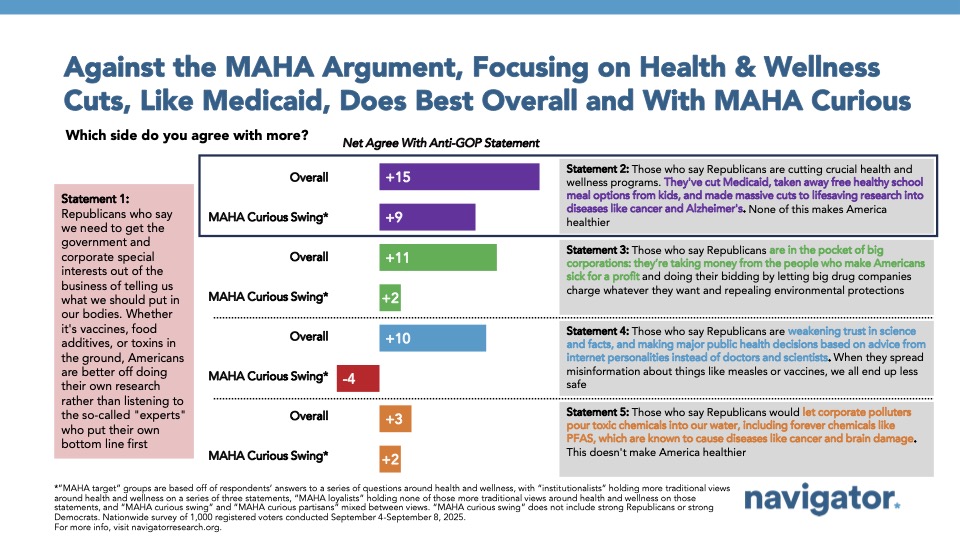
The most persuasive hit on Republican policies emphasizes cuts to Medicaid and school meals, as well as cuts to government-funded disease research.

Republicans are cutting crucial health and wellness programs. They’ve cut Medicaid, taken away free healthy school meal options from kids, and made massive cuts to lifesaving research into diseases like cancer and Alzheimer’s. None of this makes America healthier

Messages that solely take on corporate polluters, focus only on big corporations, and the idea that Republicans are trusting the wrong people for public health advice, are convincing to the institutionalists, but are far less convincing to MAHA curious audiences.

Bar chart from Navigator Research. Title: Against the MAHA Argument, Focusing on Health & Wellness Cuts, Like Medicaid, Does Best Overall and With MAHA Curious

Recommendations:

  1. Acknowledge the system is broken: Most Americans are not satisfied with, or confident in, the existing health care system.
  2. Point out that the proposed solution is not right: Americans oppose cuts to medical research, taking away healthy school meals from kids, and ending all vaccine mandates.
  3. Provide an alternative: Cracking down on special interest influence in our government is particularly persuasive when talking about health and wellness in the country today.

Read More

June 10, 2026

America at 250: The State of Our Union

This Navigator Research Report explores that gap between the way America is being celebrated and portrayed by this administration, and the America people believe in.

Tina Tang & Melissa Toufanian
June 8, 2026

Americans in the Battleground See Rising Costs, But Are Unsure Who Can Lower Them

This Navigator Research report covers how Americans in the battleground feel about the economy and rising costs as well as who they trust to lower them.

Julie Alderman Boudreau
June 4, 2026

Americans Are Split on How Safe our Food Is

This Navigator Research report covers perceptions of food safety and the health and wellness concerns that are top of mind for Americans.

Maryann Cousens
June 3, 2026

The Overreach Backfires: Battleground Americans Reject Abuse of Government Power

This Navigator Research report covers government weaponization, including which actions concern battleground constituents the most and how to message about them.

Julie Alderman Boudreau

MAHA: Americans and Health and Wellness

Poll: MAHA

This Navigator Research report covers the latest perceptions of health and wellness in the United States. 

The “Make America Healthy Again” (MAHA) movement espouses ideas that range from common sense to fringe — with the purported aim of tackling America’s chronic disease crisis. As Health and Human Services Secretary Robert F. Kennedy Jr. has begun to reshape the nation’s public health establishment, many of his ideas pull on two simple threads: fear of sickness and frustration with our health care system. And, while there has been a decline in satisfaction and confidence with Americans’ health care coverage, the debate is not simply about health insurance, but more specifically about who and what Americans’ trust to keep them well. 

The Establishment

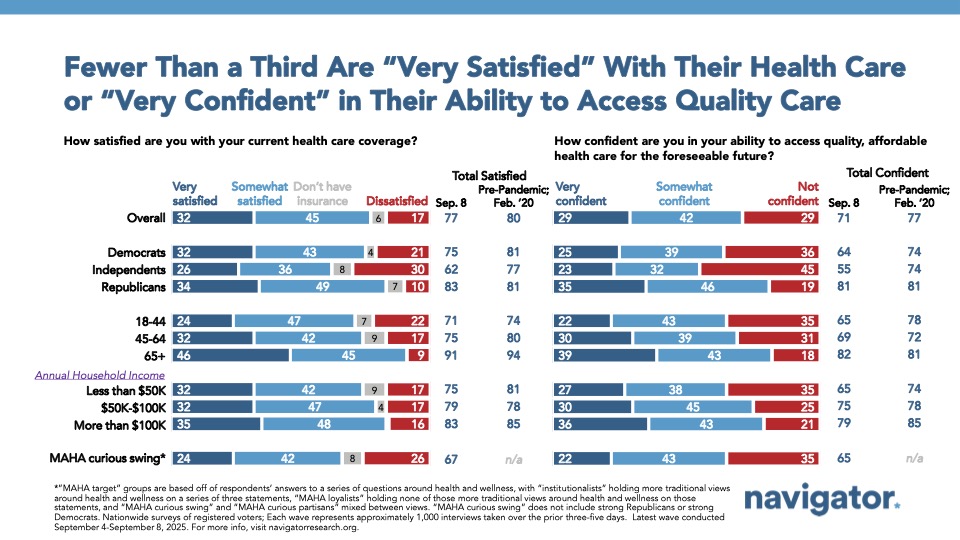
Just 32 percent of Americans overwhelmingly are very satisfied with their own health care coverage and just 29 percent are very confident in their ability to access quality, affordable health care for the foreseeable future. 

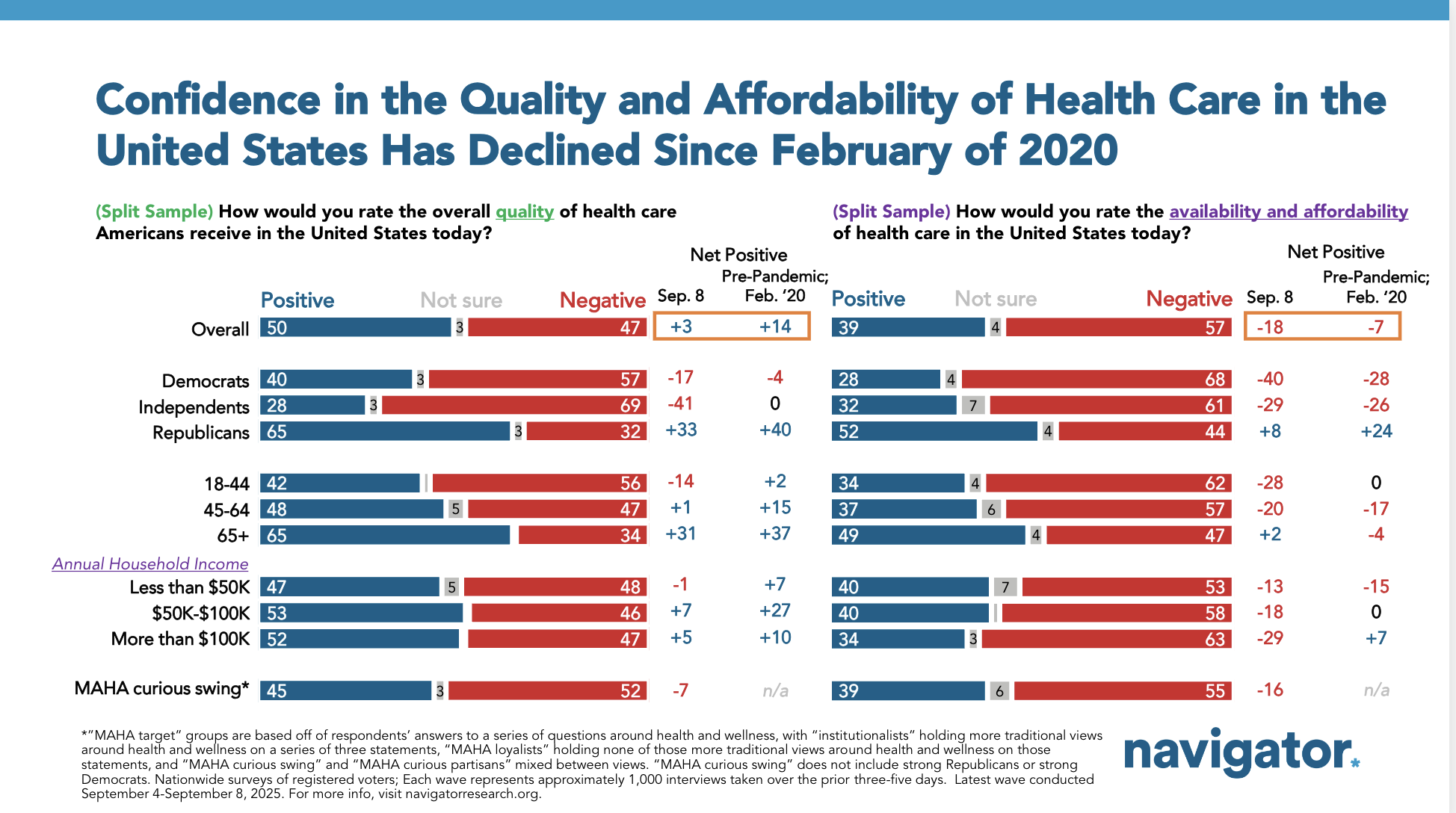
Just half of Americans are positive about the overall quality of health care Americans receive in the country today, a five point drop from February 2020. Just 39 percent give a positive rating to the availability and affordability of health care nationally. Millennials are the least satisfied with their own coverage, confidence in ability to access care, and rating of the overall quality of health care in the country. 

Perceptions of the public health establishment are lukewarm, if not positive, but declining: in a January survey, 63 percent rated the Centers for Disease Control and Prevention (CDC) favorably, including a majority of independents. The CDC has taken a partisan hit since the pandemic: in March of 2020 its favorability was +62, it now sits at +38. The National Institutes of Health (NIH) is also favorable to a plurality of Americans. 

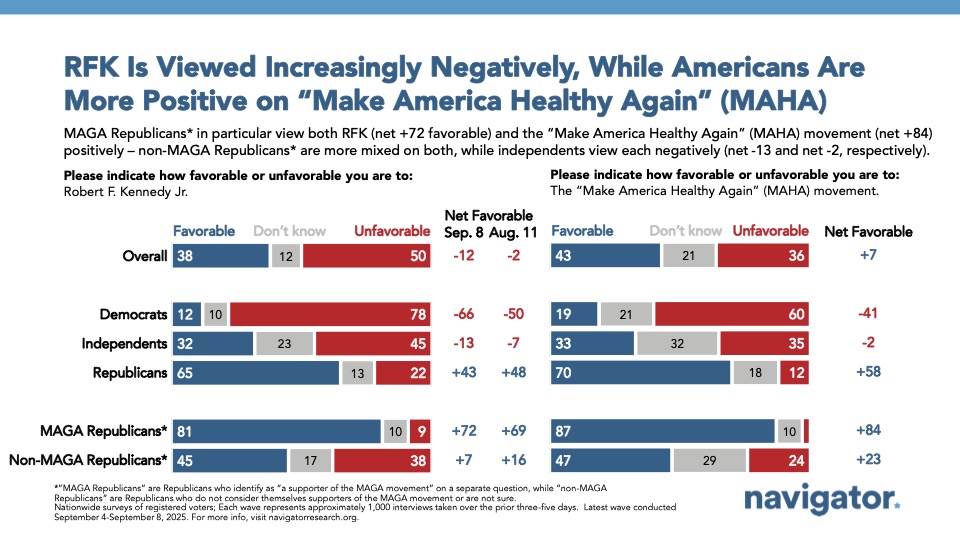
RFK Jr. and the MAHA movement are far more divisive than these institutions. The MAHA movement is favorable to a narrow plurality (+7), and RFK Jr. has seen a precipitous drop since his tense congressional hearing (-12), shifting 10 points in the last month (from -2). 

While the cohort that intensely supports RFK Jr. and MAHA make up between 15 to 20 percent of the electorate and are largely conservative, the pathways into MAHA are not purely based on the pundits and vocal MAHA advocates, but more so on the values MAHA claims. 

The Values 

An overwhelming majority of Americans across partisanship believe basic values about health and wellness:

  • It should be easier for every American family to access fresh fruits and vegetables (86 percent);
  • We need to hold corporate polluters accountable and keep them from pouring toxic chemicals into the air we breathe and the water we drink (86 percent);
  • Good health care is a human right that all American families should have access to (84 percent); 
  • Maintaining a healthy lifestyle and diet is just as important as regular visits to the doctor (86 percent); and,
  • The government should make it more affordable for American families to stay healthy (84 percent).

Where there is slightly more division, but still overwhelming agreement is on trusted sources, vaccines, and the health industry, but seven-in-ten still agree on the following:

  • Doctors and scientists should be trusted more than politicians or influencers to share medical advice (79 percent);
  • It’s alarming that America has a serious chronic disease problem and worse health outcomes than any other developed nation (72 percent);
  • It’s important for children to be vaccinated (71 percent); and,
  • Our health system is designed so drug and insurance companies make more money when Americans are sick (71 percent).

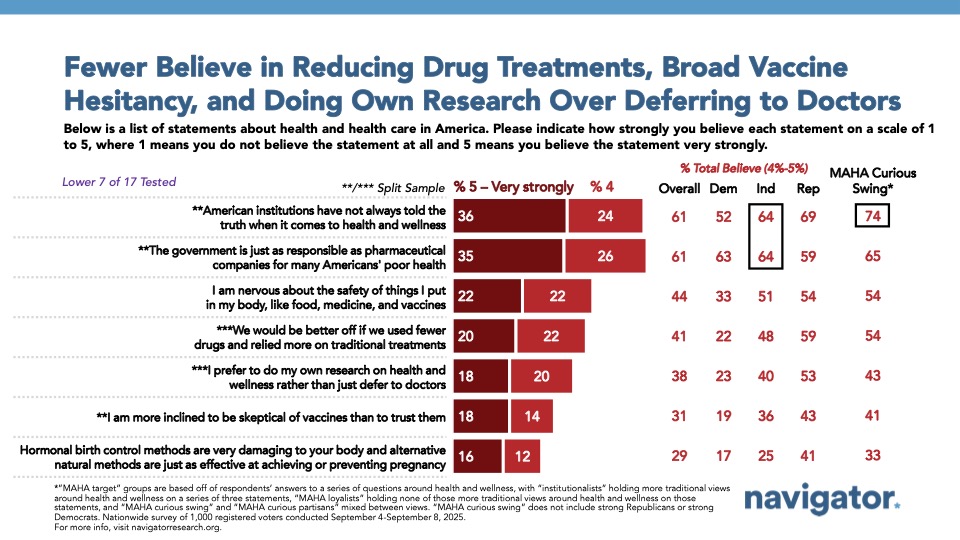
The most divisive beliefs focus on skepticism of hormonal birth control, vaccines, and a preference to “do your own research” over trusting doctors. 

 Trusted Sources

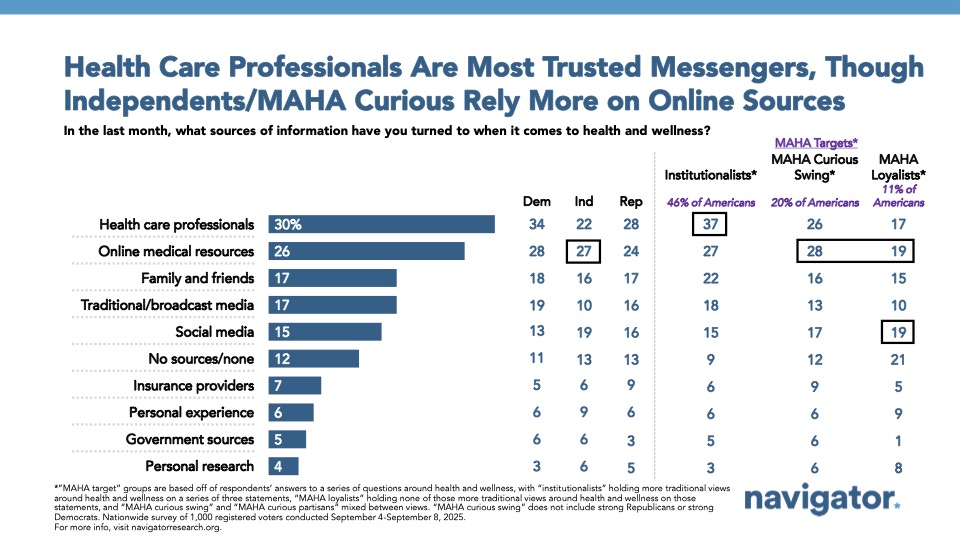
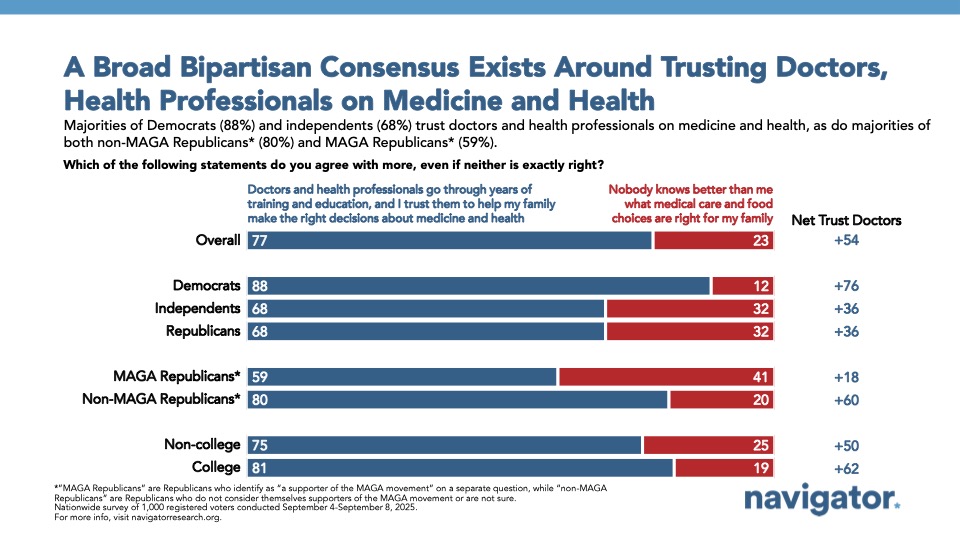
Americans overwhelmingly say they trust doctors and health care professionals to help them make the right decisions about medicine and health (77 percent), though many also say they turn to social media and online sources for information. Many also rely on friends and family, as well as news articles. With the rise of the health and wellness industry in online spaces, it is difficult to quantify what information is deemed as trustworthy or just another piece of content served up by the algorithm.

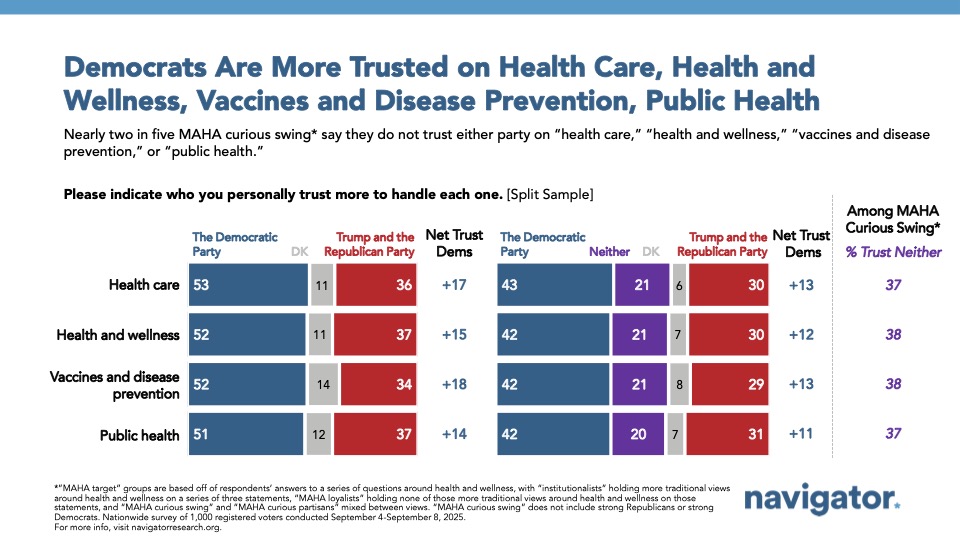
When it comes to political leaders and health, Democrats have a clear advantage over Republicans. Democrats are more trusted on health care broadly (+17), health and wellness (+15), vaccines and disease prevention (+18) and public health (net +14), including among most independents for each. When given the option of “not trusting either Democrats or Republicans” on these issues, a plurality of independents opt for it. In this scenario, Democrats lose ground while Republican trust remains stable when the option for neither is introduced. 

MAHA Curious

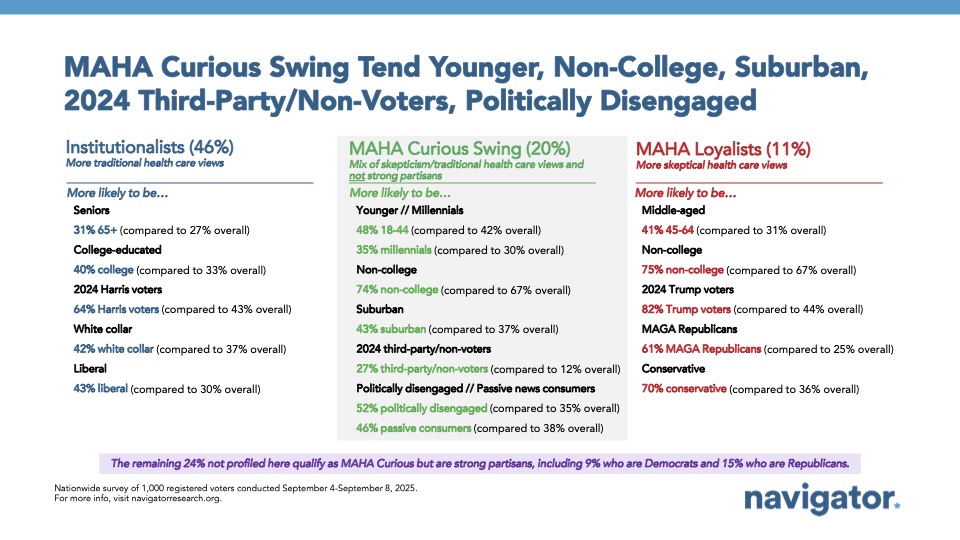
In an effort to understand those who are somewhat skeptical of our health system but not completely against institutions and traditional medicine, we segmented the electorate into three groups: institutionalists (answered solely option A), MAHA-loyalists (answered solely option B), and MAHA-curious (answered a mix of A and B), based on which response they agreed with:

Trusted Sources: 

A: Doctors and health professionals go through years of training and education, and I trust them to help my family make the right decisions about medicine and health (77 percent agree)

B: Nobody knows better than me what medical care and food choices are right for my family (23 percent agree)

Medical Reliance: 

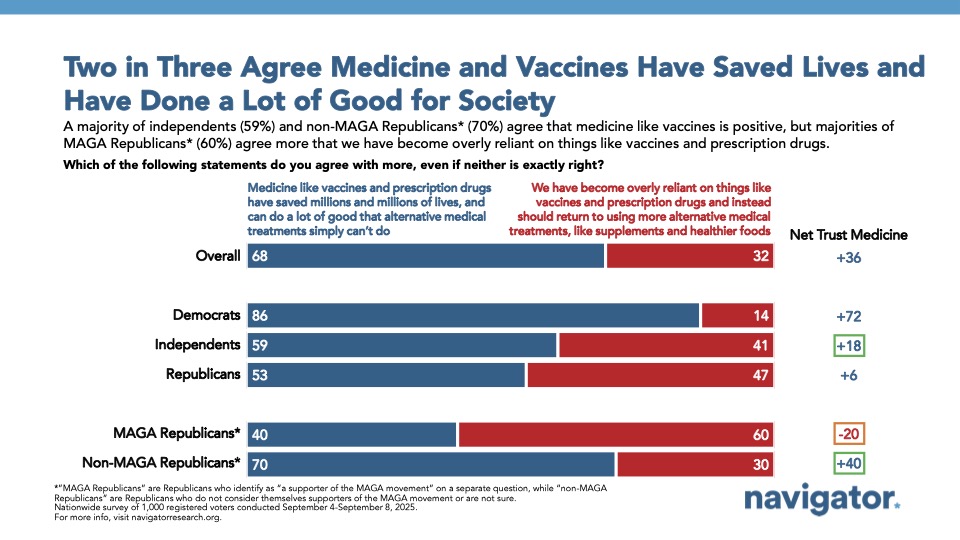
A: Medicine like vaccines and prescription drugs have saved millions and millions of lives, and can do a lot of good that alternative medical treatments simply can’t do (68 percent agree)

B: We have become overly reliant on things like vaccines and prescription drugs and instead should return to using more alternative medical treatments, like supplements and healthier foods (32 percent agree)

Governmental Role:  

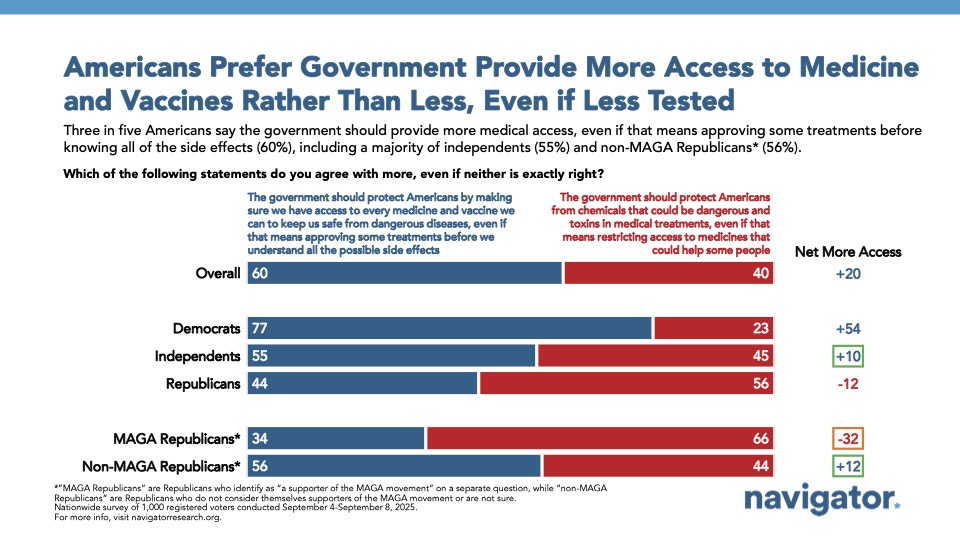
A: The government should protect Americans by making sure we have access to every medicine and vaccine we can to keep us safe from dangerous diseases, even if that means approving some treatments before we understand all the possible side effects (60 percent agree)

B: The government should protect Americans from chemicals that could be dangerous and toxins in medical treatments, even if that means restricting access to medicines that could help some people (40 percent agree)

The MAHA-curious cohort makes up 43 percent of the electorate, but for the purposes of analysis we will focus on those in this bucket who are not strong Democrats or strong Republicans, which make up 20 percent of the electorate

In part two of our report, we will go through the specific policies and messages that meet these voters where they are on the issue of health and wellness. 

Read More

June 10, 2026

America at 250: The State of Our Union

This Navigator Research Report explores that gap between the way America is being celebrated and portrayed by this administration, and the America people believe in.

Tina Tang & Melissa Toufanian
June 8, 2026

Americans in the Battleground See Rising Costs, But Are Unsure Who Can Lower Them

This Navigator Research report covers how Americans in the battleground feel about the economy and rising costs as well as who they trust to lower them.

Julie Alderman Boudreau
June 4, 2026

Americans Are Split on How Safe our Food Is

This Navigator Research report covers perceptions of food safety and the health and wellness concerns that are top of mind for Americans.

Maryann Cousens
June 3, 2026

The Overreach Backfires: Battleground Americans Reject Abuse of Government Power

This Navigator Research report covers government weaponization, including which actions concern battleground constituents the most and how to message about them.

Julie Alderman Boudreau

Trump’s National Guard Deployment: A Guide for Advocates

Poll: National Guard Deployments

This Navigator Research report covers perceptions of the Trump administration’s deployment of troops to American cities.

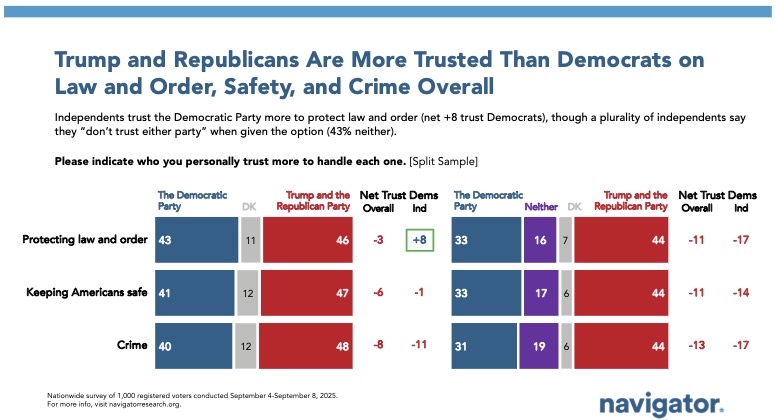
While Americans are far more focused on the economy than crime, crime remains an important issue: 22 percent of Americans believe crime should be a top priority, including a quarter of Black and Hispanic Americans, 26 percent of blue collar workers, and 25 percent of independents.

This is also an issue where President Trump and Republicans hold a durable advantage over Democrats in Congress. Half (48 percent) of Americans trust Trump and Republicans to handle crime, compared to 40 percent who trust Democrats. Republicans hold an 11-point advantage among independents, a 14-point advantage among parents, and an 8-point advantage among those who identify as middle class.

On keeping Americans safe, President Trump and Congressional Republicans are trusted by 6 points. Independents are split on which party they trust to keep Americans safe (33 percent Democrats, 34 percent Republicans).

Chart titled, "Trump and Republicans Are More Trusted Than Democrats on Law and Order, Safety, and Crime Overall"

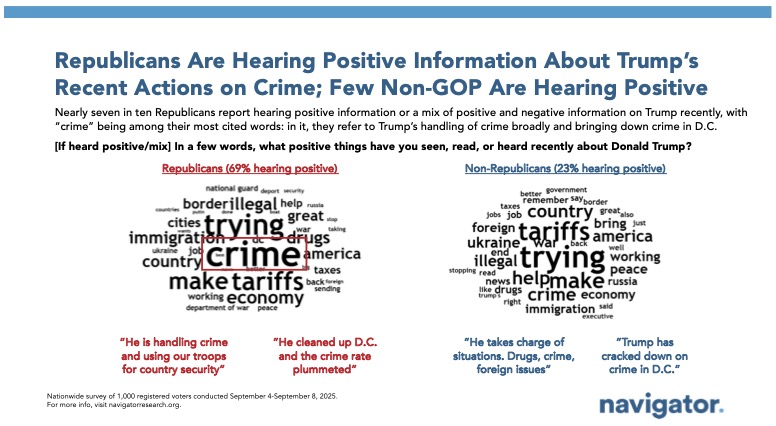
Asked open-endedly about what positive news they were hearing about Trump recently, crime clearly breaks through for many Americans, primarily Republicans, as they heard the news about his troop deployments.

Chart titled, "Republicans Are Hearing Positive Information About Trump’s Recent Actions on Crime; Few Non-GOP Are Hearing Positive"

Troop Deployments

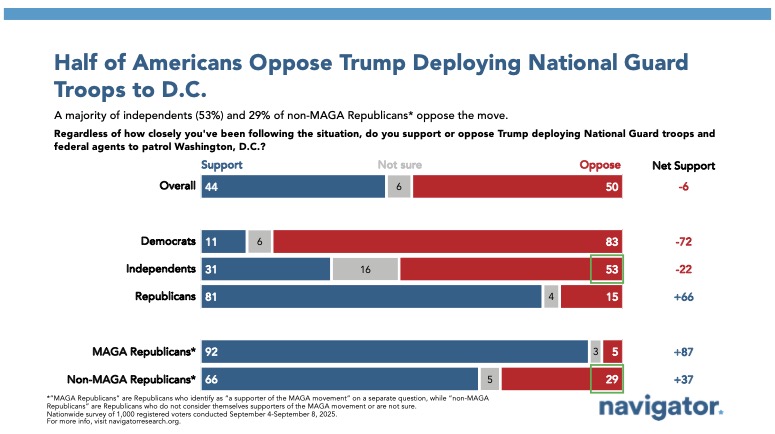
Half of Americans oppose President Trump deploying National Guard troops to DC, including 53 percent of independents and 57 percent of Americans living in urban areas. Half of passive news consumers (those who say the news comes to them, primarily via social media) also oppose the deployment to the nation’s capital.

Chart titled, "Half of Americans Oppose Trump Deploying National Guard Troops to D.C."

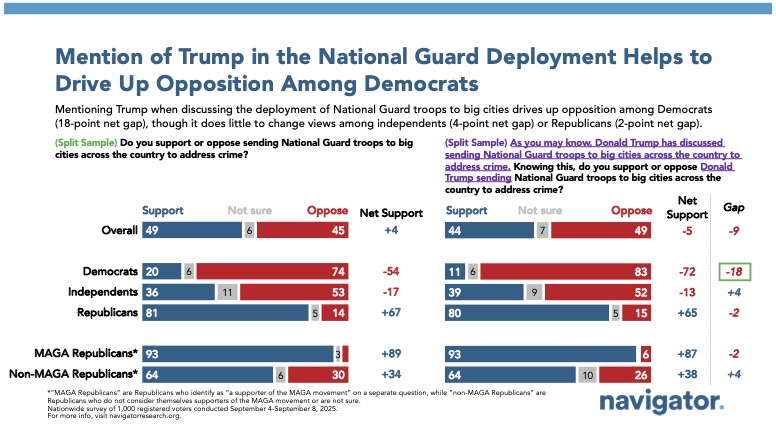
When asked broadly about deploying troops to American cities to address crime, Americans support the measure by 4 points (49 percent support, 45 percent oppose). However, when given the context that “Donald Trump has discussed sending National Guard troops to big cities across the country to address crime,” Americans oppose the proposal by 5 points (44 percent support, 49 percent oppose). The shift in opposition when Donald Trump is added to the framing is driven by Democrats, and people of color, in particular.

Chart titled, "Mention of Trump in the National Guard Deployment Helps to Drive Up Opposition Among Democrats"

Concerns

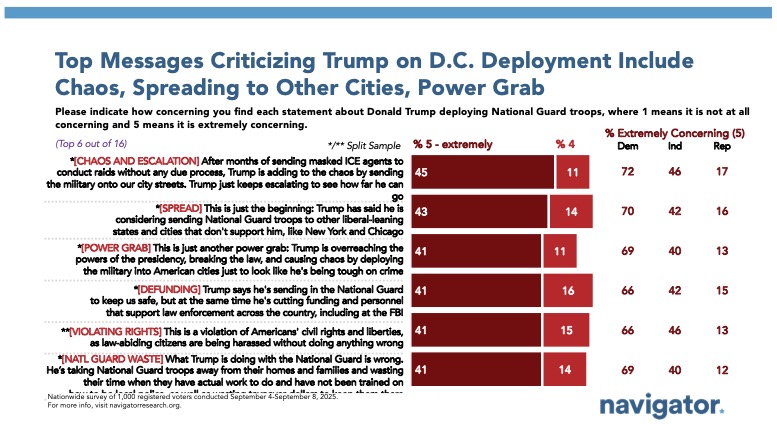
The biggest concerns regarding Trump’s deployment of National Guard troops are:

  1. He’s going to keep escalating and creating chaos to see how far he can go.
  2. This is just the beginning and more liberal leaning cities like Chicago and New York are next.

Independents are also concerned about civil liberties violations and that law-abiding citizens are being harassed without doing anything wrong.

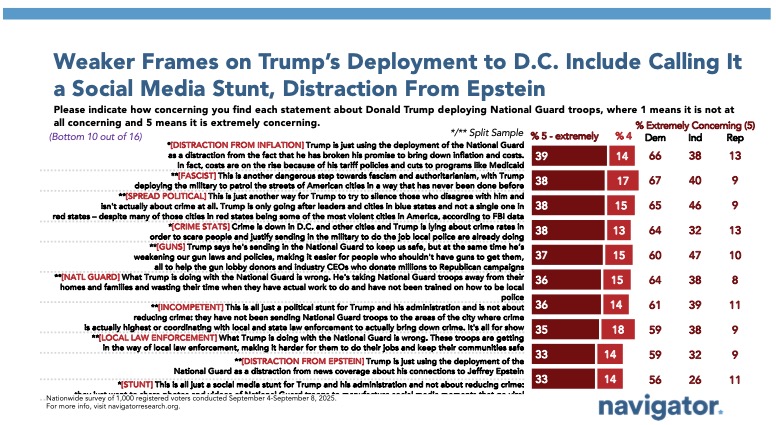
Citing crime statistics, e.g. stating that crime is actually down in DC, or arguing that this is a distraction from the Epstein case, are less effective.

Chart titled, "Top Messages Criticizing Trump on D.C. Deployment Include Chaos, Spreading to Other Cities, Power Grab"
Chart titled, "Weaker Frames on Trump’s Deployment to D.C. Include Calling It a Social Media Stunt, Distraction From Epstein"

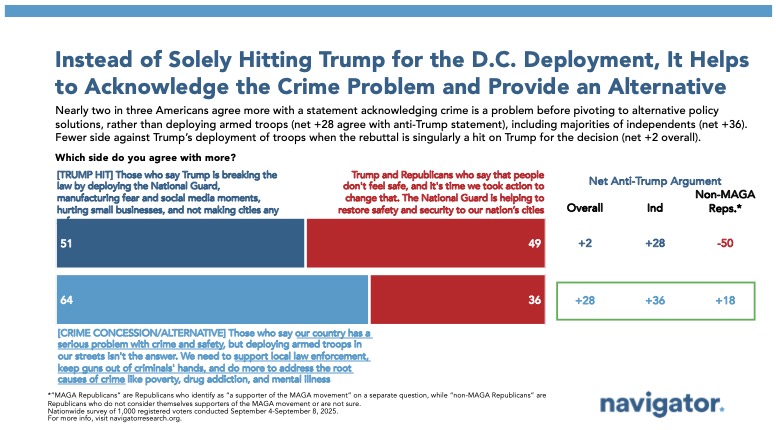
We tested two progressive crime and safety messages against the same Republican argument:

“Trump and Republicans who say that people don’t feel safe, and it’s time we took action to change that. The National Guard is helping to restore safety and security to our nation’s cities.”

One progressive message attacks President Trump’s troop deployment:

“Trump is breaking the law by deploying the National Guard, manufacturing fear and social media moments, hurting small businesses, and not making cities any safer.”

The second leads by acknowledging that crime is a problem and offers a progressive alternative.

“Our country has a serious problem with crime and safety, but deploying armed troops in our streets isn’t the answer. We need to support local law enforcement, keep guns out of criminals’ hands, and do more to address the root causes of crime like poverty, drug addiction, and mental illness.”

The attack frame beats the Republican message by 2 points overall. The solutions message beats the Republican message by 28 points overall and is far more successful among key groups.

MESSAGES WE TESTED:
  • Double haters: Trump attack: +32, Solutions: +56
  • Parents: Trump attack: -2, Solutions: +20
  • Moderates: Trump attack: +18, Solutions: +42
  • Non-MAGA Republicans: Trump attack: -50, Solutions: +8
  • Democrats: Trump attack: +68, Solutions: +80
  • Independents: Trump attack: +28, Solutions: +36
  • Passive news consumers: Trump attack: +0, Solutions: +36
Chart titled, "nstead of Solely Hitting Trump for the D.C. Deployment, It Helps to Acknowledge the Crime Problem and Provide an Alternative"

Recommendations:

  • Americans are concerned about crime and safety. While Americans are more likely to support the general idea of the National Guard addressing crime, Americans are concerned about Trump specifically deploying troops to DC.
  • Progressives do not need to cede crime and safety as a Republican issue. Progressives have a strong case to make by first acknowledging that crime is a problem and then putting forward solutions.
  • Citing crime statistics or claiming troop deployments are a distraction from the Epstein case fall flat. Instead, Americans are more concerned about an escalation and troops moving into more cities.

Read More

June 10, 2026

America at 250: The State of Our Union

This Navigator Research Report explores that gap between the way America is being celebrated and portrayed by this administration, and the America people believe in.

Tina Tang & Melissa Toufanian
June 8, 2026

Americans in the Battleground See Rising Costs, But Are Unsure Who Can Lower Them

This Navigator Research report covers how Americans in the battleground feel about the economy and rising costs as well as who they trust to lower them.

Julie Alderman Boudreau
June 4, 2026

Americans Are Split on How Safe our Food Is

This Navigator Research report covers perceptions of food safety and the health and wellness concerns that are top of mind for Americans.

Maryann Cousens
June 3, 2026

The Overreach Backfires: Battleground Americans Reject Abuse of Government Power

This Navigator Research report covers government weaponization, including which actions concern battleground constituents the most and how to message about them.

Julie Alderman Boudreau

Republicans on the Hook for Government Shutdown

Poll: Potential Government Shutdown

This Navigator Research report covers perceptions of a potential government shutdown.

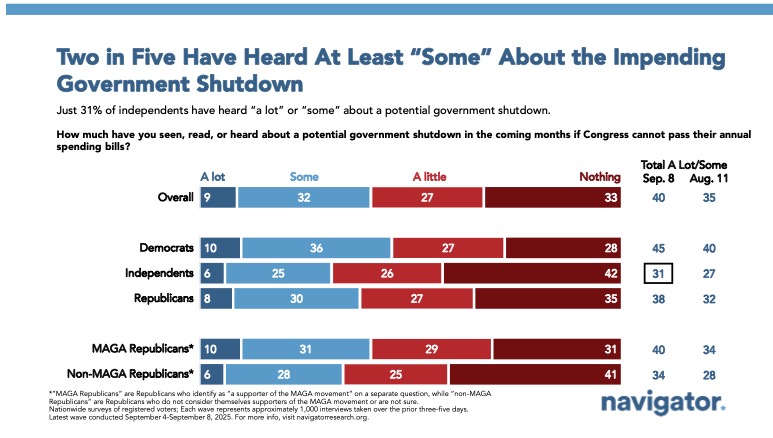
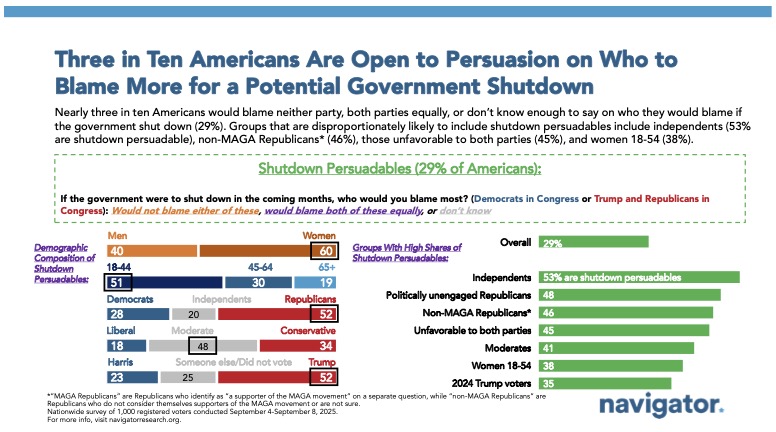
Awareness of a potential government shutdown is relatively low compared to other recent news stories. Just nine percent of Americans say they’ve seen, read, or heard “a lot” or about a possible shutdown, while 40 percent report having heard at least some. This lags well behind other news and events in our August Survey: 66 percent of Americans have heard about Trump and the congressional GOP’s Medicaid budget cuts, including 36 percent who have heard “a lot,” and 61 percent of Americans have heard about Texas redistricting.

Among active news consumers, awareness of a shutdown is noticeably higher. 48 percent have heard “a lot” or “some” about the shutdown, with just 11 percent hearing “a lot.” Passive news consumers are much less likely to have heard news about a potential shutdown, with only 28 percent hearing something, including only five percent who have heard “a lot.”

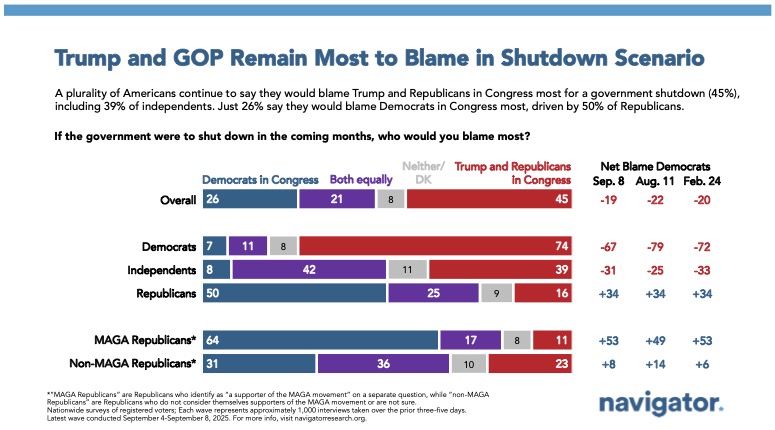
If the government were to shut down in October, Americans say they would be more likely to blame President Trump and Republicans in Congress than Democrats. 45 percent say they would blame Trump and Republicans, while 26 percent say they would blame Democrats in Congress. Another 21 percent would blame both sides equally. The American public’s perception of who should be blamed for a government shutdown has remained consistent since we began tracking in August, with virtually no movement.

Notably, in a break from what we usually see on highly partisan questions that name Trump and Republicans, 25 percent of Republicans say they would blame both sides equally, including 36 percent of non-MAGA Republicans. Independents are split: 42 percent say they would blame both parties equally, while 35 percent would blame Trump and Republicans in Congress.

For more detailed messaging guidance on the shutdown see our updated shutdown memo here.

Read More

June 10, 2026

America at 250: The State of Our Union

This Navigator Research Report explores that gap between the way America is being celebrated and portrayed by this administration, and the America people believe in.

Tina Tang & Melissa Toufanian
June 4, 2026

Americans Are Split on How Safe our Food Is

This Navigator Research report covers perceptions of food safety and the health and wellness concerns that are top of mind for Americans.

Maryann Cousens
June 2, 2026

SPECIAL REPORT: LGBTQ+ Americans on President Trump and the Country

This Navigator Research report covers economic sentiment among LGBTQ+ Americans and how they view President Trump’s job performance across a range of issues.

Maryann Cousens & Tina Tang
May 22, 2026

Americans Want Major Change, But Aren’t Sure if Leaders Can Deliver

This Navigator Research report covers how Americans feel about democracy, institutions, and systems and whether anyone can fix them.

Julie Alderman Boudreau

Focus Group Report: Educators and Parents

Poll: Education Focus Groups

This Navigator Research report covers focus groups among public educators, school support staff, and parents on the state of public education.

“I feel like the school district is doing pretty well”

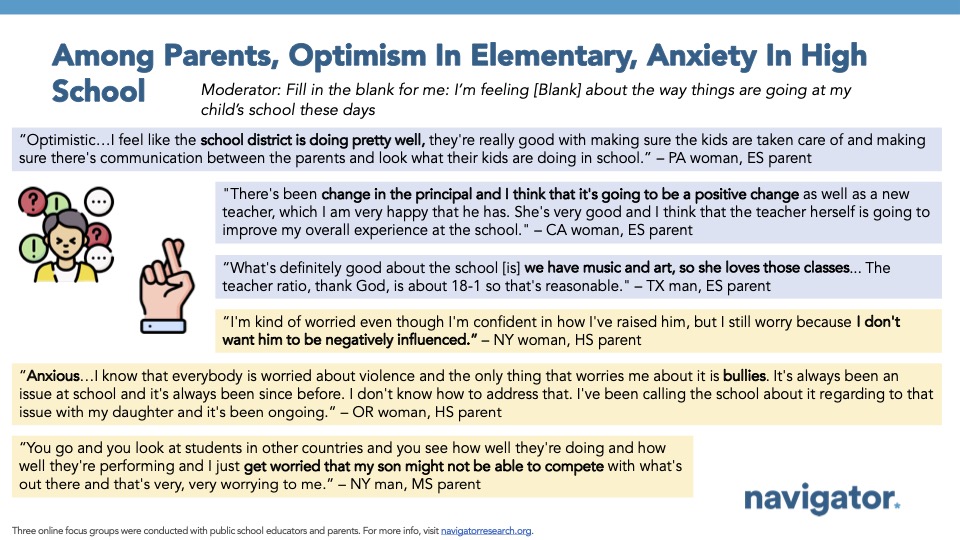
As many parents prepare for the school year, parents of elementary school students cite more optimism around their schools than middle and high school parents, as one elementary school parent from Pennsylvania said:

“I feel like the school district is doing pretty well, they’re really good with making sure the kids are taken care of and making sure there’s communication between the parents and look what their kids are doing in school.”

Parents of high school and middle school aged children cite more feelings of anxiety, due to several factors, but safety and quality of education emerge as top concerns. One high school parent from Oregon put it like this:

“I know that everybody [is] worried about violence and the only thing that worries me about it is bullies. It’s always been an issue at school and it’s always been since before. I don’t know how to address that.”

“You go and you look at students in other countries and you see how well they’re doing and how well they’re performing and I just get worried that my son might not be able to compete with what’s out there and that’s very, very worrying to me.” – Middle school parent, New York

Focus Group Quotes from Navigator Research. Title: Among Parents, Optimism In Elementary, Anxiety In High School

In the latest Navigator survey, parents of elementary school students rated their local K-12 public schools positively by 22 points, while parents of middle and high school students ranked their public schools positively by 12 points.

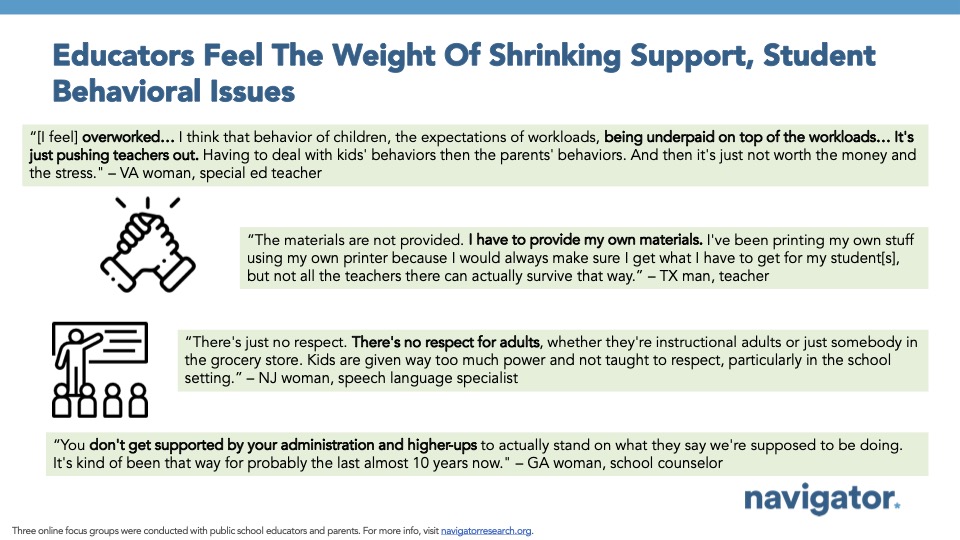
“I think that behavior of children, the expectations of workloads, being underpaid on top of the workloads… It’s just pushing teachers out.”

Educators across grade levels and classroom roles express feeling an overwhelming lack of support. Administrators and parents emerge as top sources for their lack of support, with many feeling stretched too thin. One school counselor from Georgia said:

“You don’t get supported by your administration and higher-ups to actually stand on what they say we’re supposed to be doing. It’s kind of been there for probably the last almost 10 years now.”

“The materials are not provided. I have to provide my own materials. I’ve been printing my own stuff using my own printer because I would always make sure I get what I have to get for my student[s], but not all the teachers there can actually survive that way.” – Teacher, Texas.

Educators also express challenges with student behavior and lack of respect for teachers, with some believing the benefits of the teaching profession do not outweigh the stress and lack of support. One speech and language specialist from New Jersey said:

“There’s just no respect. There’s no respect for adults, whether they’re instructional adults or just somebody in the grocery store. Kids are given way too much power and not taught to respect, particularly in the school setting.”

“[I feel] overworked…I think that behavior of children, the expectations of workloads, being underpaid on top of the workloads.. It’s just pushing teachers out.” – Special education teacher, Virginia

Educators also express challenges with student behavior and lack of respect for teachers, with some believing the benefits of the teaching profession do not outweigh the stress and lack of support. One speech and language specialist from New Jersey said:

“There’s just no respect. There’s no respect for adults, whether they’re instructional adults or just somebody in the grocery store. Kids are given way too much power and not taught to respect, particularly in the school setting.”

“[I feel] overworked…I think that behavior of children, the expectations of workloads, being underpaid on top of the workloads.. It’s just pushing teachers out.” – Special education teacher, Virginia

Focus Group Quotes from Navigator Research. Title: Educators Feel The Weight Of Shrinking Support, Student Behavioral Issues

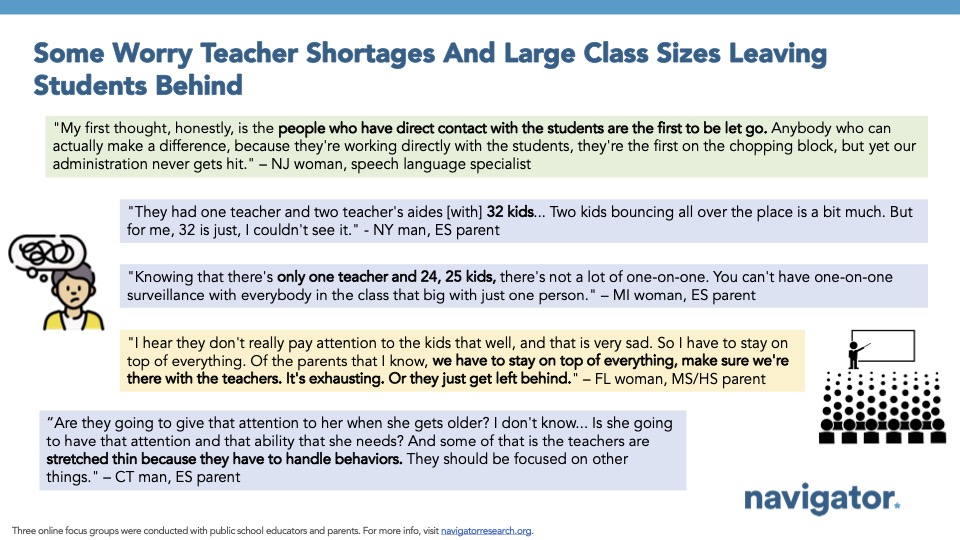
“You can’t have one-on-one surveillance with everybody in the class that big with just one person”

Student behavior has become a flashpoint for both parents and educators. This leads, at times, to parents pointing the finger at educators and educators pointing to parents as the source of the problem.

Many parents express feeling a lack of trust with their child’s teachers, either because they believe teachers are overworked and stretched too thin or because they believe their teachers are not up to the job. One elementary school parent from Connecticut expressed the latter sentiment:

“Are they going to give that attention to her when she gets older? I don’t know… Is she going to have that attention and that ability that she needs? And some of that is the teachers are stretched thin because they have to handle behaviors.”

“Knowing that there’s only one teacher and 24, 25 kids, there’s not a lot of one-on-one. You can’t have one-on-one surveillance with everybody in the class that big with just one person.” – Elementary school parent, Michigan

While one high school parent from Florida said:

“I hear they don’t really pay attention to the kids that well, and that is very sad. So I have to stay on top of everything. Of the parents that I know, we have to stay on top of everything, make sure we’re there with the teachers. It’s exhausting. Or they just get left behind.”

Focus Group Quotes from Navigator Research. Title: Some Worry Teacher Shortages And Large Class Sizes Leaving Students Behind

Educators, however, largely express parent involvement as increasingly problematic and misplaced. Though many feel parents should be more involved in their children’s education, they also believe the existing parent involvement has become increasingly combative towards educators, as one special education teacher from Virginia said:

“[I feel] overworked… Having to deal with kids’ behaviors then the parents’ behaviors. And then it’s just not worth the money and the stress.”

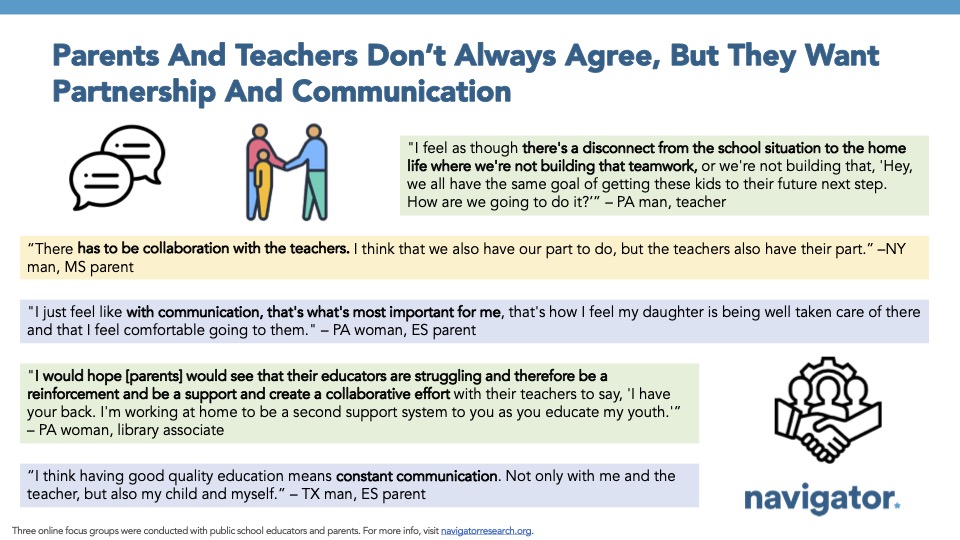
“I feel as though there’s a disconnect from the school situation to the home life where we’re not building that teamwork, or we’re not building that, ‘Hey, we all have the same goal of getting these kids to their future next step. How are we going to do it?’” – Teacher, Pennsylvania

Focus Group Quotes from Navigator Research. Title: Parents And Teachers Don’t Always Agree, But They Want Partnership And Communication

“The school shooter thing has not ever left my mind”

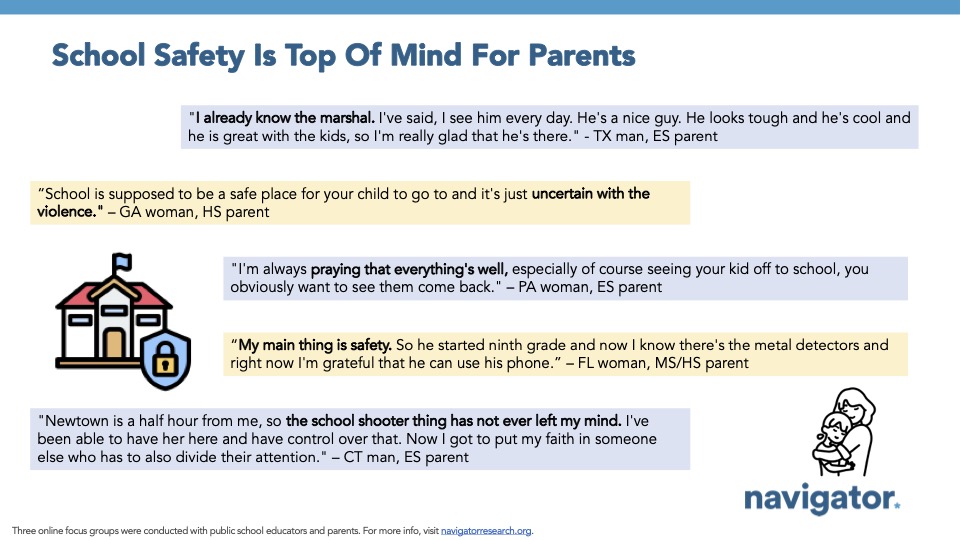
Parents across age groups overwhelmingly assert their top concern in schools as safety, particularly regarding school shootings. One elementary school parent from Connecticut said:

“Newtown is a half hour from me, so the school shooter thing has not ever left my mind. I’ve been able to have her here and have control over that. Now I got to put my faith in someone else who has to also divide their attention.”

“I’m always praying that everything’s well, especially of course seeing your kid off to school, you obviously want to see them come back” – Elementary school parent, Pennsylvania.

Participants’ concerns about school shootings mirrors Navigator’s most recent survey, where 79 percent of Americans cited feeling concerned about the persistent threat of school shootings, including 59 percent who felt “very” concerned.

Focus Group Quotes from Navigator Research. Title: School Safety Is Top Of Mind For Parents

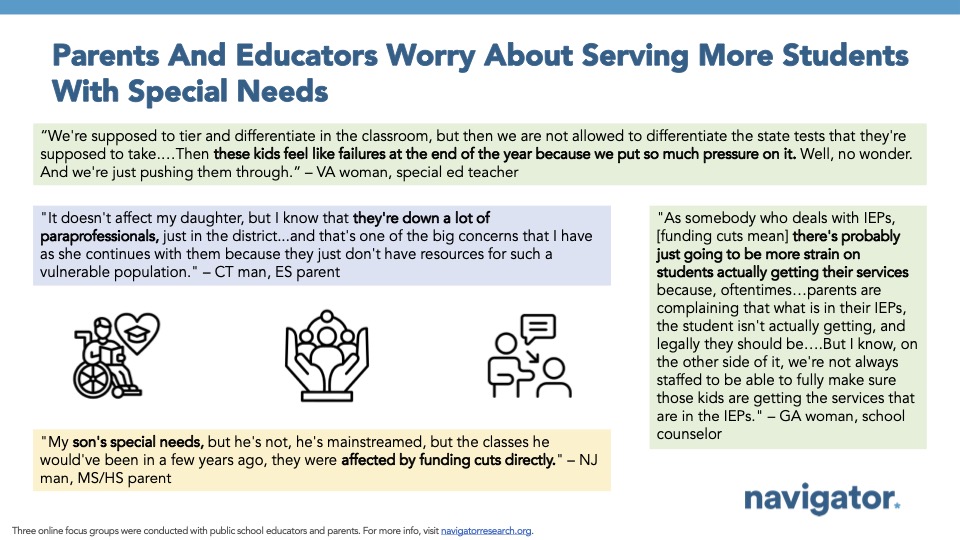
“There’s probably just going to be more strain on students actually getting their services”

Participants across groups have seen the effects of cuts to public education. Cuts to education come up organically when talking about things not going well in schools today, with emphasis around the impacts that cuts to education will have on low income students or students with disabilities. One high school parent from New Jersey said:

“My son’s special needs, but he’s not, he’s mainstreamed, but the classes he would’ve been in a few years ago, they were affected by funding cuts directly.”

Some also see cuts affecting extracurricular activities, as one middle school parent from Ohio said:

“They’ve cut back a lot of the funding. They used to have all of these after school programs for the kids that were fully paid for. They even provided transportation to and from the school. They’ve taken all of that away. And I mean, I think that those after school programs are even more so crucial for the middle school and the high school kids to get.”

Focus Group Quotes from Navigator Research. Title: Parents And Educators Worry About Serving More Students With Special Needs

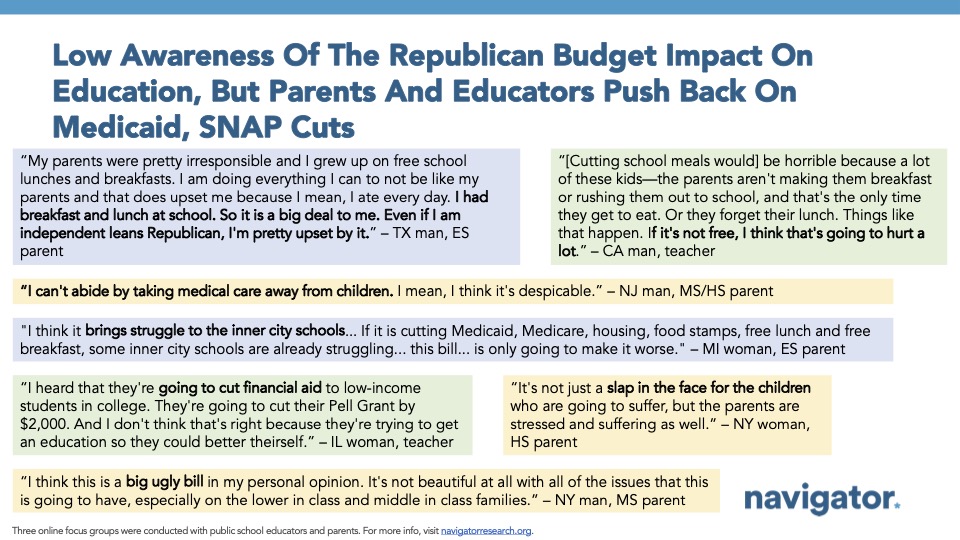
“A slap in the face for the children”

Awareness about the passage of President Trump’s One Big Beautiful Bill is still low, but parents and educators believe the cuts to Medicaid and SNAP that affect children are inexcusable. One teacher from California said on cuts to school meals:

“[Cutting school meals would] be horrible because a lot of these kids—the parents aren’t making them breakfast or rushing them out to school, and that’s the only time they get to eat. Or they forget their lunch. Things like that happen. If it’s not free, I think that’s going to hurt a lot.”

Specifically when it comes to cuts to Medicaid and health care for children, one high school parent from New Jersey said:

“I can’t abide by taking medical care away from children. I mean, I think it’s despicable.”

And one high school parent from New York expressed:

“It’s not just a slap in the face for the children who are going to suffer, but the parents are stressed and suffering as well.”

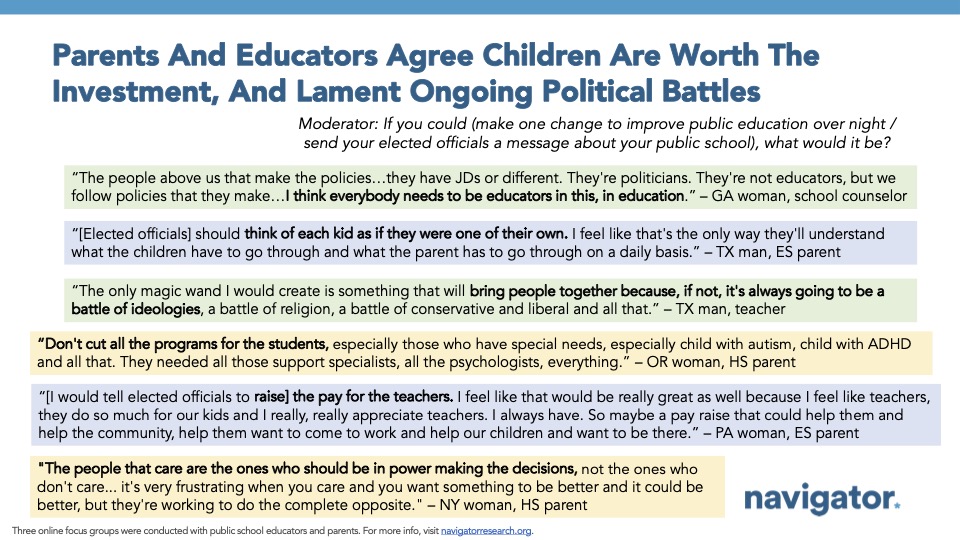
“it seems like we always have money for everything else”

While some parents and educators agree the government spends wastefully, participants unanimously agree children’s health and welfare are not where the government spends wastefully. Parents and educators both agree that the health and safety of children is not where government figures should be playing politics. One high school parent from New Jersey said:

“I agree that we don’t have money, but it seems like we always have money for everything else… I don’t care if we can’t afford to pay for medical care for kids, take more money from me, take more property taxes. I think if there’s something we’re going to just throw money at, I think even if it’s wasteful spending, morally speaking”

One middle school parent from New York said:

“You see how much money America is giving to all these different wars and all this money could be used here… It’s like, you don’t have a choice of how your funding should go, and then the politicians are not doing a good job of accounting for where the funds are going to. They don’t listen to the people. It’s getting more frustrating. It’s like our kids are our future and they just don’t care. I don’t know.”

Focus Group Quotes from Navigator Research. Title: Parents And Educators Agree Children Are Worth The Investment, And Lament Ongoing Political Battles

Read More

June 10, 2026

America at 250: The State of Our Union

This Navigator Research Report explores that gap between the way America is being celebrated and portrayed by this administration, and the America people believe in.

Tina Tang & Melissa Toufanian
May 28, 2026

Focus Group Report: Black Americans on Leadership and Voting

This Navigator Research report covers focus groups that explored how Black Americans view the state of the country, elected leaders in Washington, and voting in the wake of the Supreme Court’s Callais decision.

Maryann Cousens
May 10, 2026

What Moms Want: Affordable Healthcare and a Better Economy

This Navigator Research Report covers how mothers across the country are feeling about the economy and healthcare, including their specific pain points and who they trust more on the issues

Maryann Cousens
May 5, 2026

Focus Group Report Pt 2: Healthcare Providers Diagnose the American Healthcare System

This Navigator Research report focuses on how Americans view the healthcare system and their greatest pain points.

Tina Tang