
Focus Group Report: MAHA Curious

FOCUS GROUPS: MAHA

This Navigator Research report covers focus groups conducted among “MAHA-Curious” Americans* on the state of the health and wellness in the country today, including where they look to for information and how they assess the “Make America Healthy Again” (MAHA) movement.

Last month, we explored Americans’ views of health and wellness in the country and the MAHA movement. In assessing trusted sources, treatment type, and the government’s role in health, we segmented the electorate into institutionalists, MAHA-loyalists, and finally the “MAHA Curious”—those who are somewhat skeptical of our health system but not completely against institutions and traditional medicine. We explore how this cohort is thinking about MAHA and its goals in focus groups.
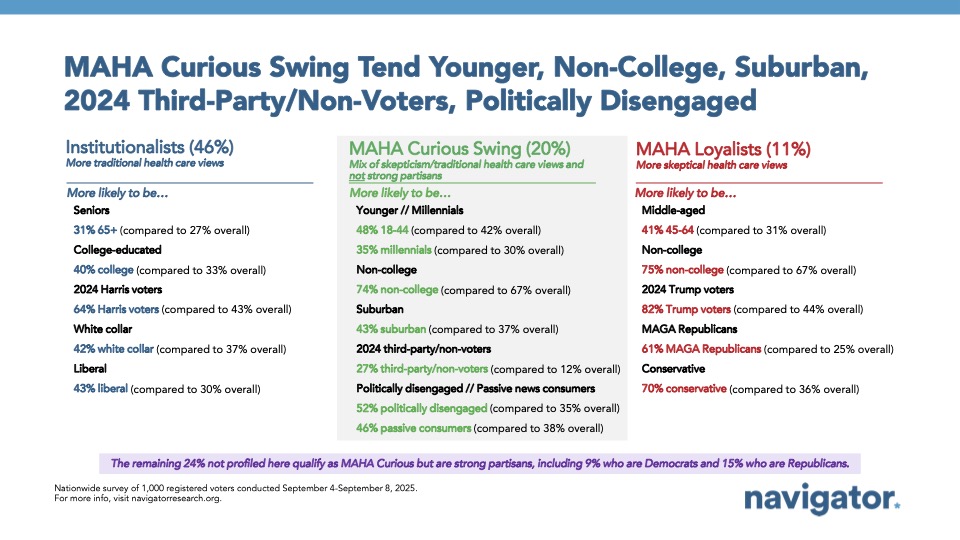
Focus group quotes from Navigator Research. Title: MAHA Curious Swing Tend Younger, Non-College, Suburban, 2024 Third-Party/Non-Voters, Politically Disengaged

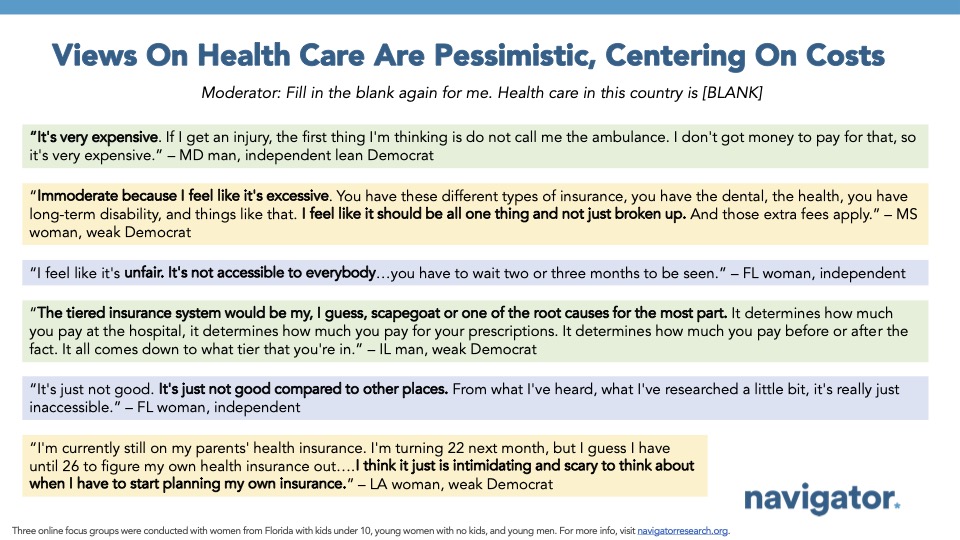
MAHA curious participants were deeply pessimistic about the state of health care in the country today, mainly due to exorbitant and unpredictable costs.

“I don’t think anything is going well as far as health care from my personal experience. Just even the emergency room, long waits, you get a diagnosis, but it’s just a quick fix. The long wait time to see doctors, the copays, it’s a lot.” – Florida woman, independent

“It’s very expensive. If I get an injury, the first thing I’m thinking is do not call me the ambulance. I don’t got money to pay for that, so it’s very expensive.” – Maryland man, independent lean Democrat
Focus group quotes from Navigator Research. Title: Views On Health Care Are Pessimistic, Centering On Costs

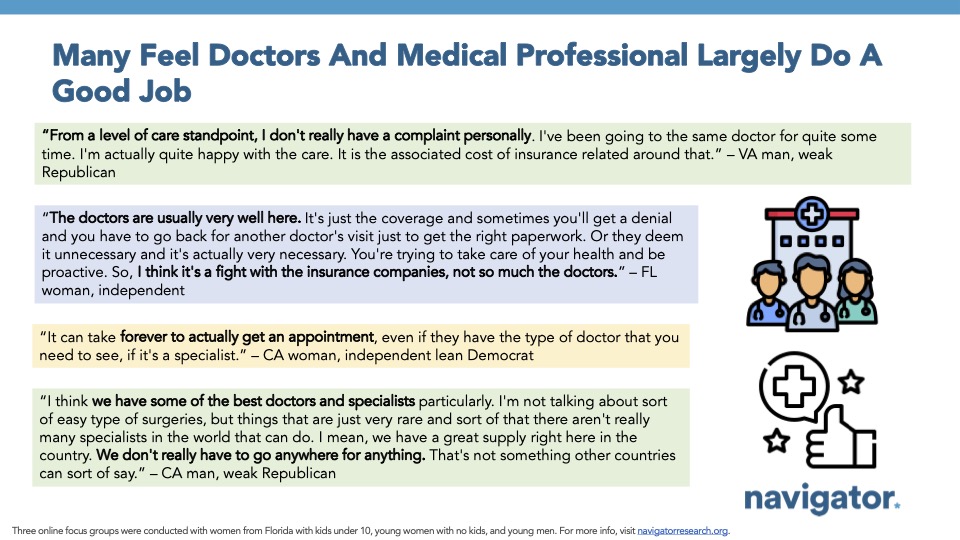
The problems are less related to the quality of care, and more about access and finding the right care.

“I think it’s broken because, like everyone else said, it’s extremely expensive, it’s hard to actually get care… It can take forever to actually get an appointment, even if they have the type of doctor that you need to see, if it’s a specialist.” – California woman, independent lean Democrat

“The doctors are usually very well here. It’s just the coverage and sometimes you’ll get a denial and you have to go back for another doctor’s visit just to get the right paperwork. Or they deem it unnecessary and it’s actually very necessary. You’re trying to take care of your health and be proactive.” – Florida woman, independent
Focus group quotes from Navigator Research. Title: Many Feel Doctors And Medical Professional Largely Do A Good Job

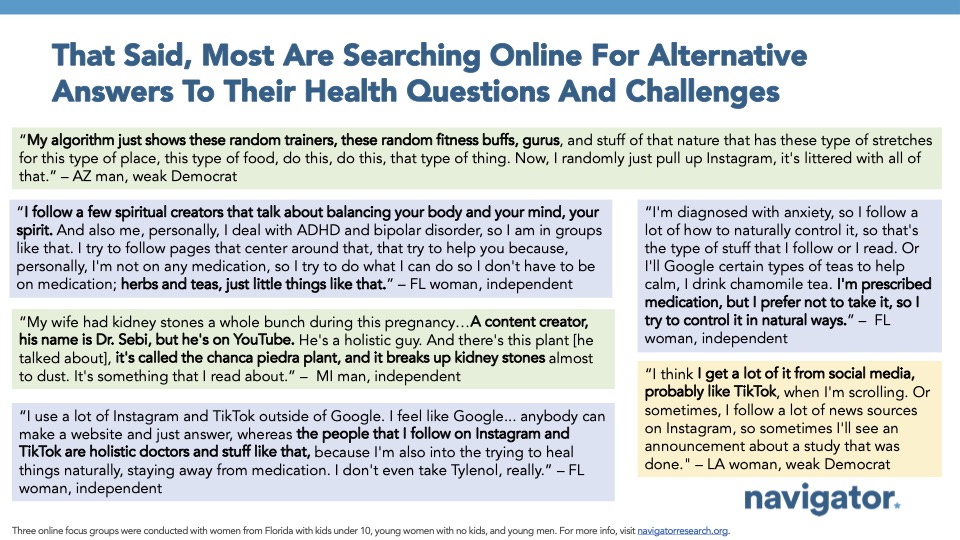
As a result, many participants turn to social media, Google, and AI for questions related to health and wellness.

“I normally go to the Health MD or I go to the orgs, like the ones that is verified… Like professionalized sources that is backed up with statistics and scientific information.” – Mississippi woman, weak Democrat

“I usually follow holistic accounts on TikTok and creators. And if I have a question, I will reference ChatGPT.” – Florida woman, independent

“I have a lot of YouTube subscriptions, so there’s a lot of people I watch on YouTube. I read Reddit a lot, so Reddit, and then I read medical journals, stuff like that.” – Illinois man, weak Democrat

“My mom and dad. They’re my go-tos, but yeah, ChatGPT as well has been my go-to.” – Florida man, independent lean Democrat
Focus group quotes from Navigator Research. Title: That Said, Most Are Searching Online For Alternative Answers To Their Health Questions And Challenges

These sources can sometimes lead participants to bring questions to doctors or change their care.

“I also get a lot of my health information from social media, which will lead me to look it up on Google and then if I’m kind of confused with my answers, because sometimes you get yeses and nos back to back and then you’re wondering which one’s correct. So then I’ll take it to my doctor and I’ll be like, ‘What do you think?’ So kind of ends there.” – Pennsylvania woman, weak Democrat

“I actually was thinking that I’ve seen that birth control, the pill can lead to cancer. I saw that in a post and I’m on the pill and I think I had an appointment with my gynecologist not too long after, and I don’t know if I said it directly, but I think it’s encouraged me to want to go off of the pill sooner and maybe go more towards an IUD.” – Louisiana woman, weak Democrat
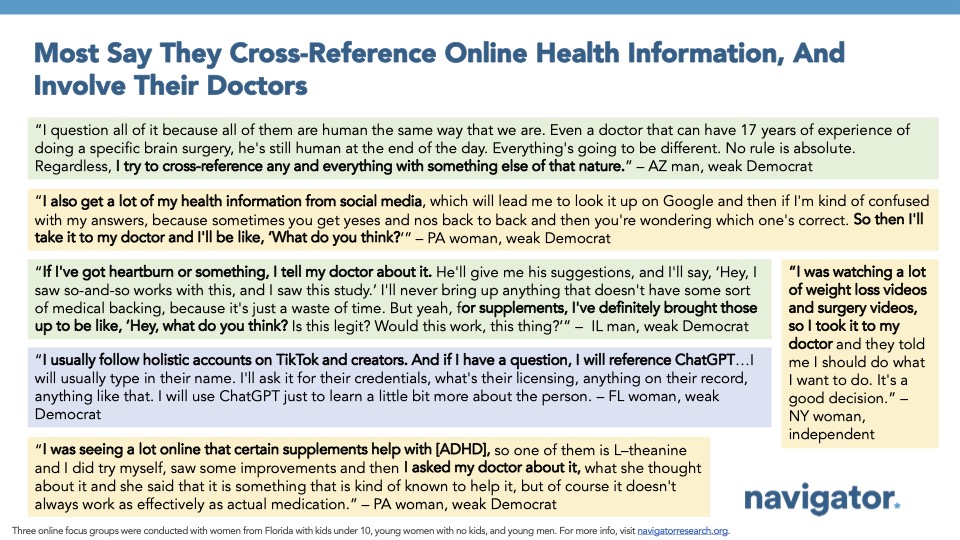
Focus group quotes from Navigator Research. Title: Most Say They Cross-Reference Online Health Information, And Involve Their Doctors

These participants overwhelmingly believe Americans are less healthy than they were 20 years ago, largely as a result of food.

“Everything has changed, the food has changed, everything has sugar, and it’s just… Yeah, if you cough, you gain weight. It’s too much.” – New York woman, independent

“When you look at trends over time, there are some things that have improved, but across the board, chronic issues or health, lifestyle issues, like diabetes, things like that, have been, like drug deaths, those have been on the rise.” – Wisconsin woman, independent lean Republican

“There’s a clear difference between what’s allowed in our food versus around the world, different countries that they have around not letting certain things into there. So, I think there’s a couple different things contribute to us being less healthy culturally.” – Virginia man, weak Republican

“I don’t feel food is real food anymore. A lot of it is, even in fruits and vegetables, there’s so much pesticides that I don’t think was in there 10 years ago, meats, all that. Also, people who can’t afford to eat fresh fruits and vegetables, they rely on a lot of rice or junk food that’s cheaper but filling at least.” – Florida woman, weak Democrat
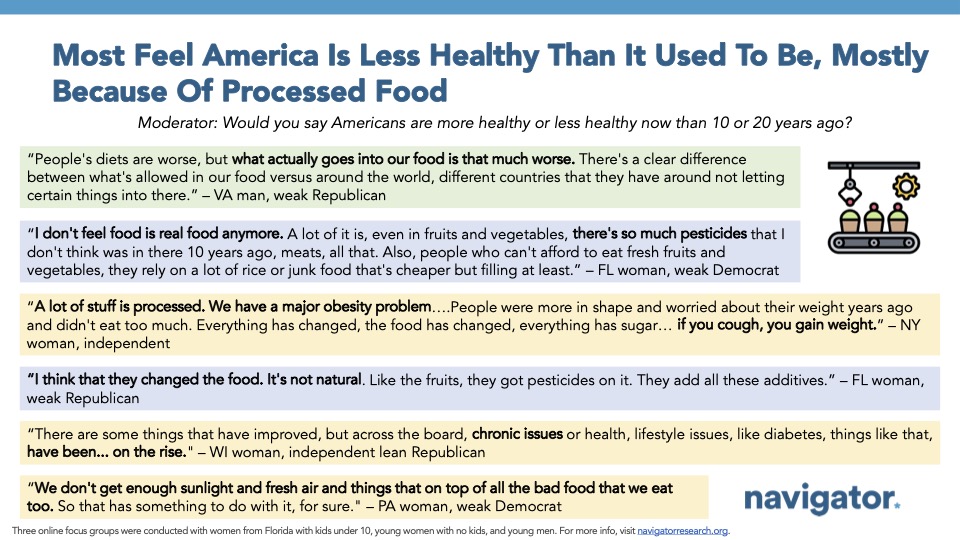
Focus group quotes from Navigator Research. Title: Most Feel America Is Less Healthy Than It Used To Be, Mostly Because Of Processed Food

The goal of making America healthy is indisputably positive to these participants, but they do question the MAHA movement’s agenda. RFK Jr. is mostly known and has mixed perceptions.

“When you take those words for their literal meaning, I agree with it. I don’t know about again, but make America healthy or do healthy things, reduce our consumption of unhealthy foods, toxins… I don’t think anybody would be opposed to that.” – California man, weak Republican

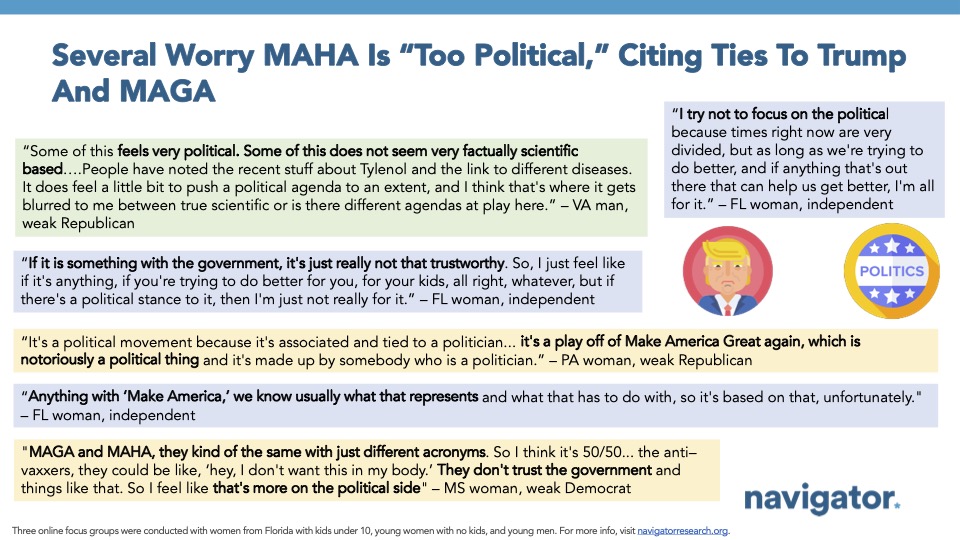
“Some of this feels very political. Some of this does not seem very factually scientific based. And I don’t know if I have specific examples as I sit here today, but just kind of seeing some of the stuff that comes out in the media… With RFK and Trump’s support in this… I do question what the true intent of this is. Is it truly to Make America Healthy Again, or are there other ulterior motives at play here?” – Virginia man, weak Republican

“It’s RFK Junior’s I guess campaign to change the way that healthcare works in America. A lot of it is trying to move away from, let’s be honest, proven remedies towards unproven holistic. There’s some fad diet stuff in there as well that’s becoming more popular and I think the most recent result of the campaign was the declaration that there is a linkage between Tylenol taken during pregnancy and autism, there’s multiple studies on that.” – Wisconsin woman, independent lean Republican

“I just find it a little bit touch and go with what he wants to do in terms of attending to pollution….[RFK] took his family to go walking in and swimming in a creek. And it was some of the dirtiest water ever that no one would ever touch in Washington, D.C. So I just think, ‘okay, is there really a leg to stand on when it comes to all of this pollution?’” – FL man, independent lean Democrat
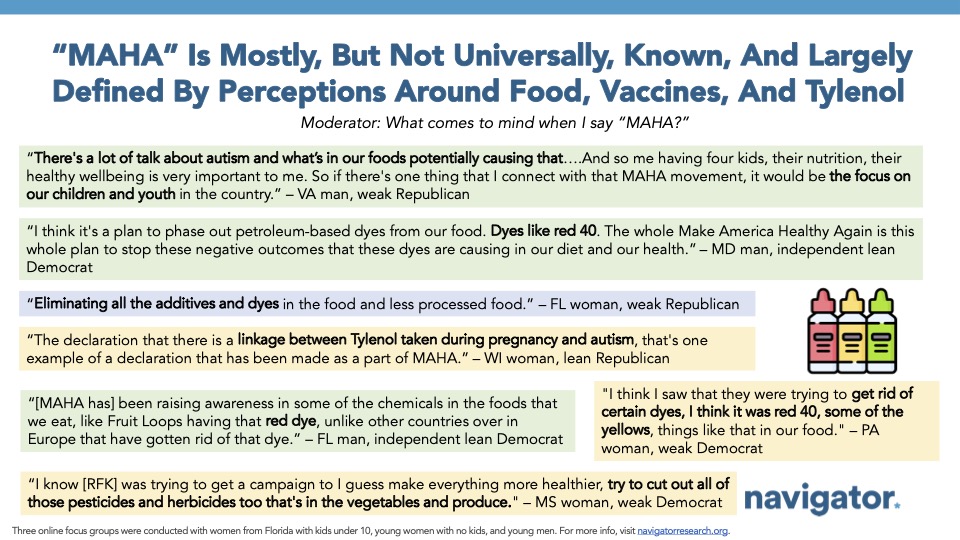
Focus group quotes from Navigator Research. Title: “MAHA” Is Mostly, But Not Universally, Known, And Largely Defined By Perceptions Around Food, Vaccines, And Tylenol
Focus group quotes from Navigator Research. Title: Several Worry MAHA Is “Too Political,” Citing Ties To Trump And MAGA

MAHA’s anti-vaccine sentiment alarms some, but importantly, they want to be able to make those decisions for themselves and their families.

“When I hear Make America Healthy Again, I also think about what they’re saying about vaccines at the moment. And I know that some vaccines are created to make America healthy, to diminish chicken pox, and measles, and polio, and things like that. I do think everybody should have a choice on what to put in their body. I’m big on that. What you want to put in your body is your choice and for your child, as well. And maybe vaccines should be spread out, but I don’t know if leading in that way not to do them at all is right either.” – Florida woman, independent

“I think the parents should decide if their kids should have it or not, and then I think that the parents should give it to them. I’m really half-and-half on that.” – Florida woman, weak Republican

“They’re creating a bit, I would say, hesitancy towards vaccines. I don’t think they’ve ever said, ‘Don’t get vaccinated,’ but they’re spreading them out. I think they have some interesting points on certain vaccines maybe, particularly Hep B.” – California man, weak Republican

“I’m a bit worried that if there’s overall lack of societal trust, if we get messaging coming out saying vaccines across the board aren’t safe, vaccines across the board aren’t good, that margin of people who will just not take any vaccines altogether or just not vaccinate their children, we’re going to lose some degree of our herd immunity and become vulnerable to diseases that were almost eradicated like 50 years ago.” – Wisconsin woman, independent lean Republican
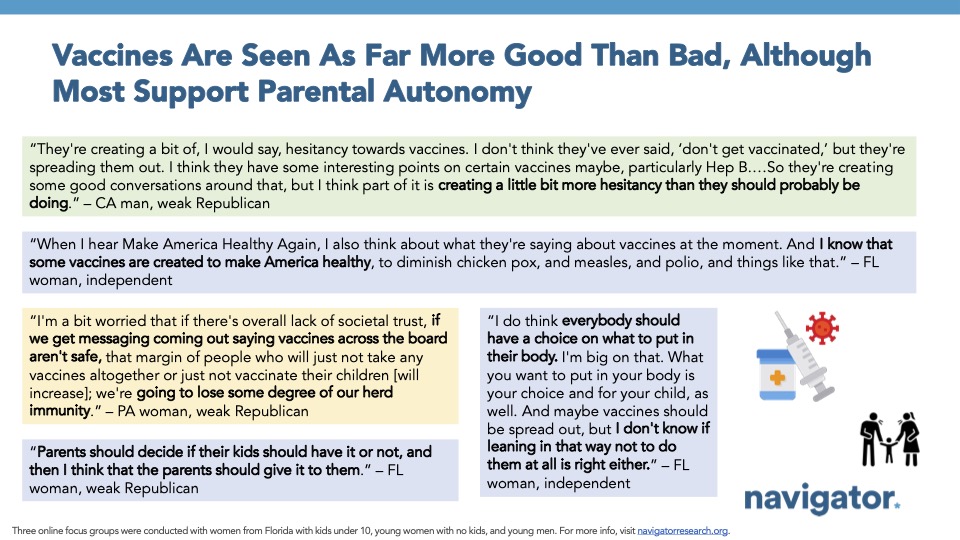
Focus group quotes from Navigator Research. Title: Vaccines Are Seen As Far More Good Than Bad, Although Most Support Parental Autonomy

A clear consensus for how to tackle America’s health problems: make foods healthier and more affordable. The recent funding cuts to the health establishment are viewed overwhelmingly negatively.

“One policy that they can do is not make those cuts to the CDC, NIH and federal government institutions like that when it comes to the health and safety of all of us as a whole, that’s number one.” – Florida man, independent lean Democrat

“I think if you had to ask me the single most important thing that I would take away from this is generally what they put in our food and the chemicals that go into it.” – Virginia man, weak Republican

“To make healthy food or organic food cheaper or more affordable across the board.” – Arizona man, weak Democrat

“Policy should be targeted on our food, the food companies, what they put inside it, how it’s made. I think that’s the baseline of our health.” – Maryland man, independent lean Democrat

“Just making sure to take out chemicals in foods that other countries don’t have chemicals in. And just trying to go back to the basics and having natural food.” – Louisiana woman, weak Democrat

“I think an overhaul of the current for-profit insurance system is absolutely necessary.” – Wisconsin woman, independent lean Republican
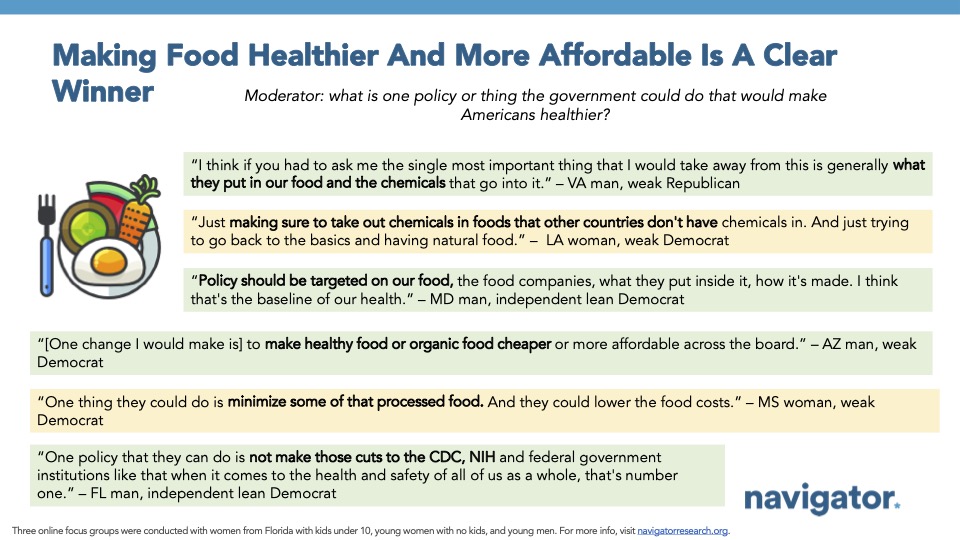
Focus group quotes from Navigator Research. Title: Making Food Healthier And More Affordable Is A Clear Winner

Read More

January 21, 2026

Focus Group Report: Trump Regrets … They’ve Had A Few

Focus group report on Americans in battleground states who voted for Trump in 2024 and expressed regret or misgivings about their vote.

Julie Alderman Boudreau
December 3, 2025

Focus Group Report: Working Class Americans and the Affordability Crisis

Focus group report that covers groups conducted among working class Americans in Senate battleground states on their personal financial situations, their greatest economic concerns, and perceptions of elected officials tackling affordability.

Rachael Russell, Ian Smith & Maryann Cousens

Government Shutdown Week 1: A Guide for Advocates

Poll: Government Shutdown

This Navigator Research report covers awareness of and blame for the government shutdown.

Shutdown News

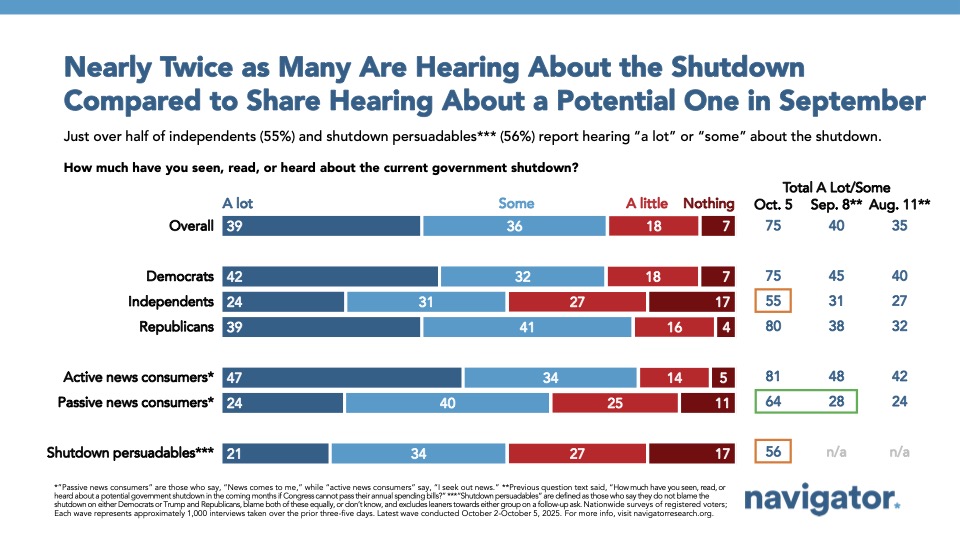
News of the government shutdown has started to break through, as 75 percent of Americans now say they have heard “some” or “a lot” about it. This is a 35-point increase from last month when 40 percent had heard something about a shutdown.

Bar chart from Navigator Research. Title: Nearly Twice as Many Are Hearing About the Shutdown Compared to Share Hearing About a Potential One in September

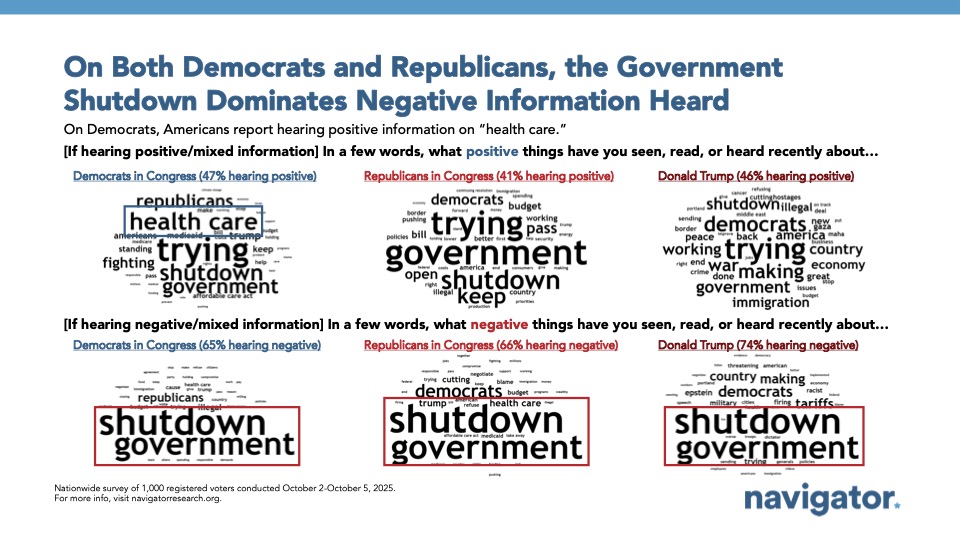
It also dominates both the positive and negative news they’re hearing about Donald Trump, as well as Democrats and Republicans in Congress.

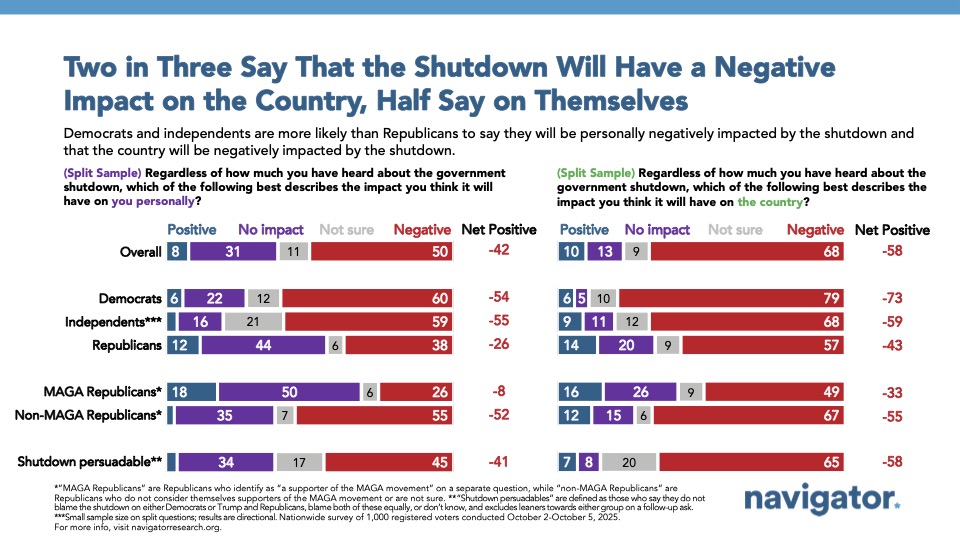
Half believe a government shutdown will have a negative impact on them personally (50 percent), and even more (68 percent) believe it will have a negative impact on the country.

Bar chart from Navigator Research. Title: Two in Three Say That the Shutdown Will Have a Negative Impact on the Country, Half Say on Themselves

Shutdown Blame

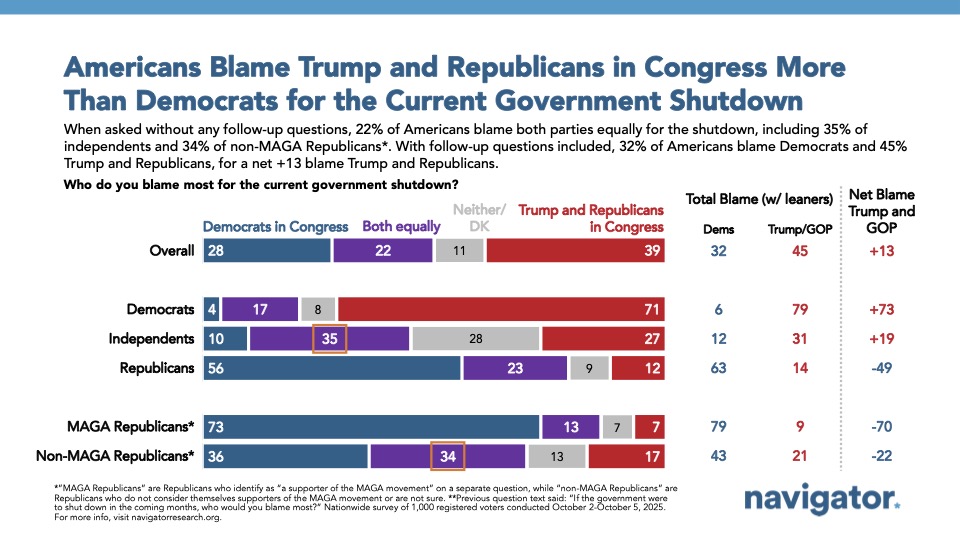
More blame Trump and Republicans than Democrats for the shutdown. A plurality (45 percent) blame Trump and Republicans, compared to fewer who blame Democrats (32 percent); a 13-point margin.

Bar chart from Navigator Research. Title: Americans Blame Trump and Republicans in Congress More Than Democrats for the Current Government Shutdown

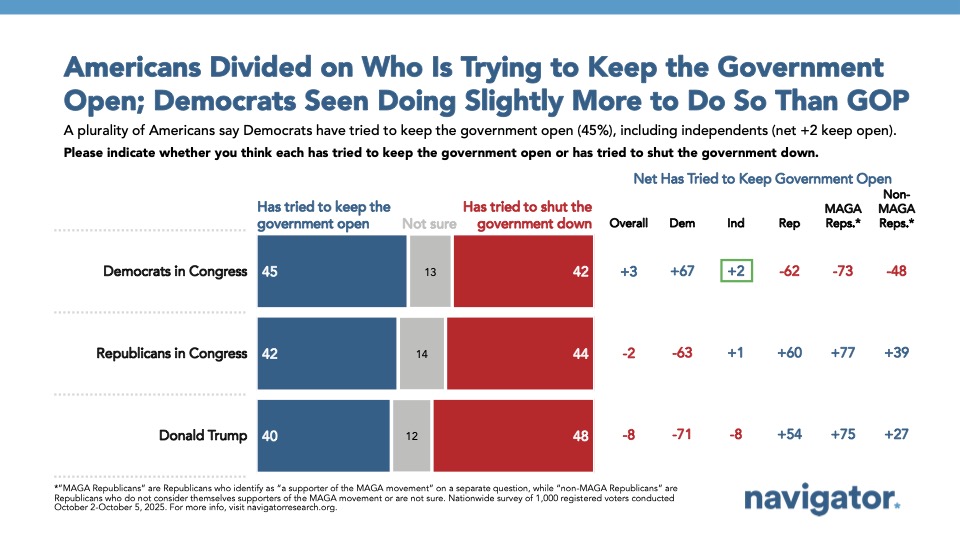
A slightly different question shows a similar result. Asked who is trying to keep the government open vs. shut it down, more cast blame on Donald Trump than on either party in Congress. By 8 points, Americans say Donald Trump has tried to shut the government down. By a 2-point margin, they say Republicans in Congress have tried to shut the government down. By contrast, Americans say Democrats are trying to keep the government open by 3 points.

Bar chart from Navigator Research. Title: Americans Divided on Who Is Trying to Keep the Government Open; Democrats Seen Doing Slightly More to Do So Than GOP

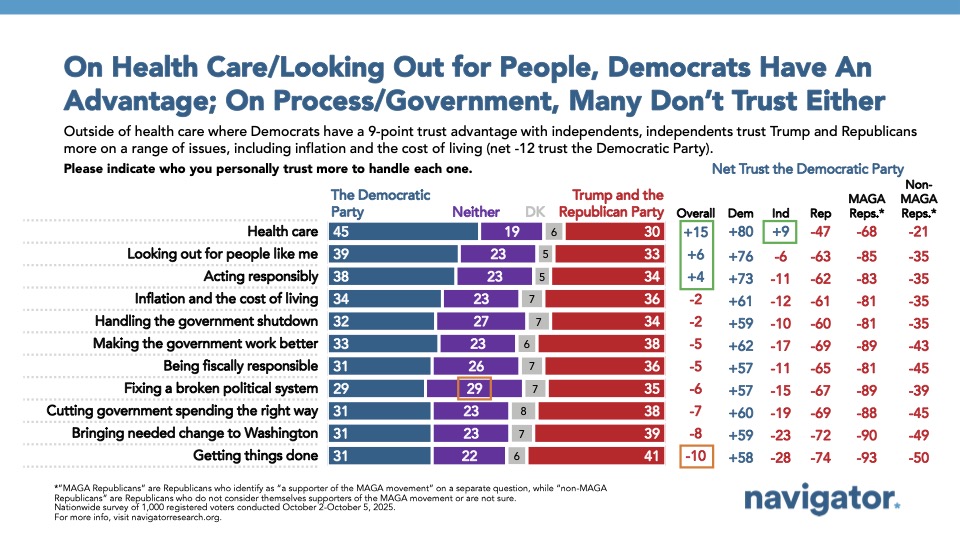
At a time when Democrats are somewhat less trusted than Republicans on a variety of traits, ‘handling the shutdown’ is one on which Americans are most evenly divided.

Bar chart from Navigator Research. Title: On Health Care/Looking Out for People, Democrats Have An Advantage; On Process/Government, Many Don’t Trust Either

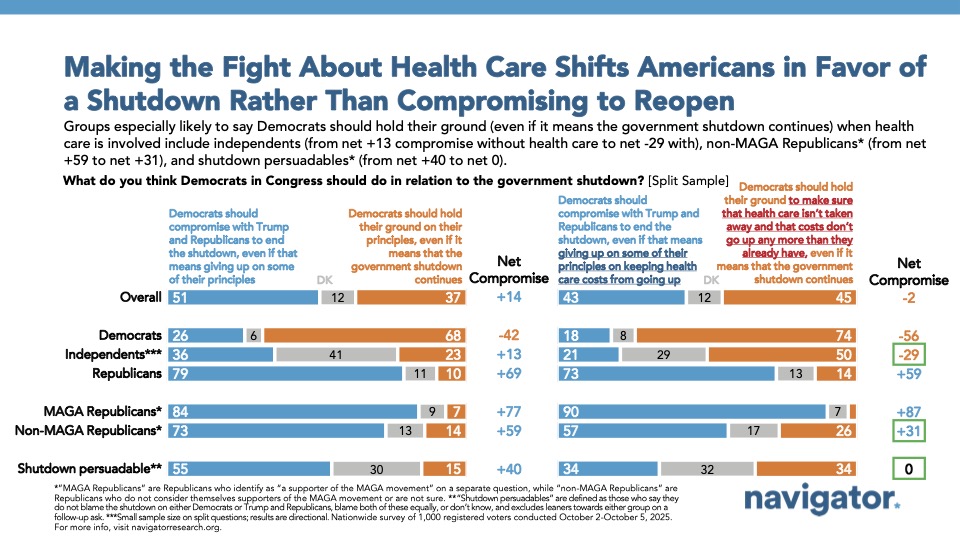
Americans want compromise, but not on health care

Asked whether Democrats should compromise or hold to their principles, Americans say compromise by 14 points.

Democrats should hold their ground on their principles, even if it means that the government shutdown continues.

However, when asked whether Democrats should compromise, even if it means health care costs going up, Americans say do not compromise by 2 points, including by 29 points among independents.

Democrats should hold their ground to make sure that health care isn’t taken away and that costs don’t go up any more than they already have, even if it means that the government shutdown continues

The Vibes

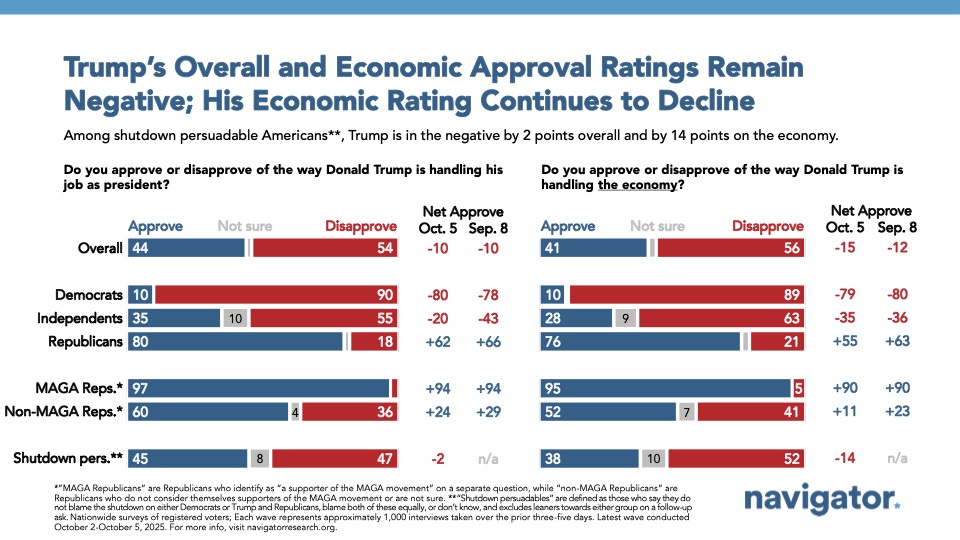
As the shutdown continues, President Trump’s overall approval rating (-10) and economic job approval (-15) remain underwater. Trump’s approval on both metrics remain nearly identical to polling from last month, indicating the shutdown may not be having an impact on him, yet.

Bar chart from Navigator Research. Title: Trump’s Overall and Economic Approval Ratings Remain Negative; His Economic Rating Continues to Decline

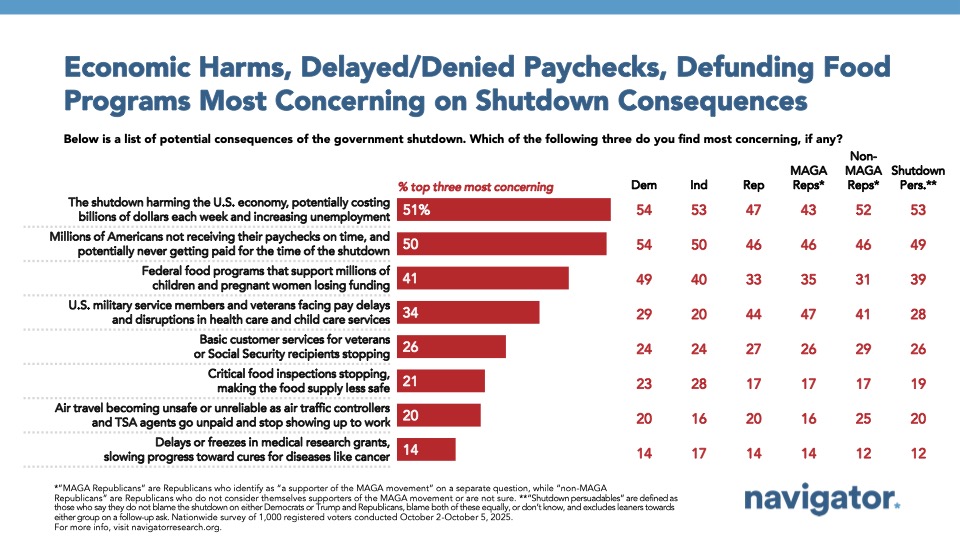
There has, however, been worsening economic perceptions in light of the shutdown, as 70 percent rate the economy negatively (a 5-point drop since last month) and 58 percent say they feel uneasy about their personal finances. The top concerning consequence of the government shutdown is the shutdown harming the U.S. economy, potentially costing billions of dollars each week and increasing unemployment.

It’s not just Democrats who feel negative on the state of the economy, but also independents, non-MAGA Republicans, and those who are undecided on who to blame for the shutdown.

Bar chart from Navigator Research. Title: Economic Harms, Delayed/Denied Paychecks, Defunding Food Programs Most Concerning on Shutdown Consequences

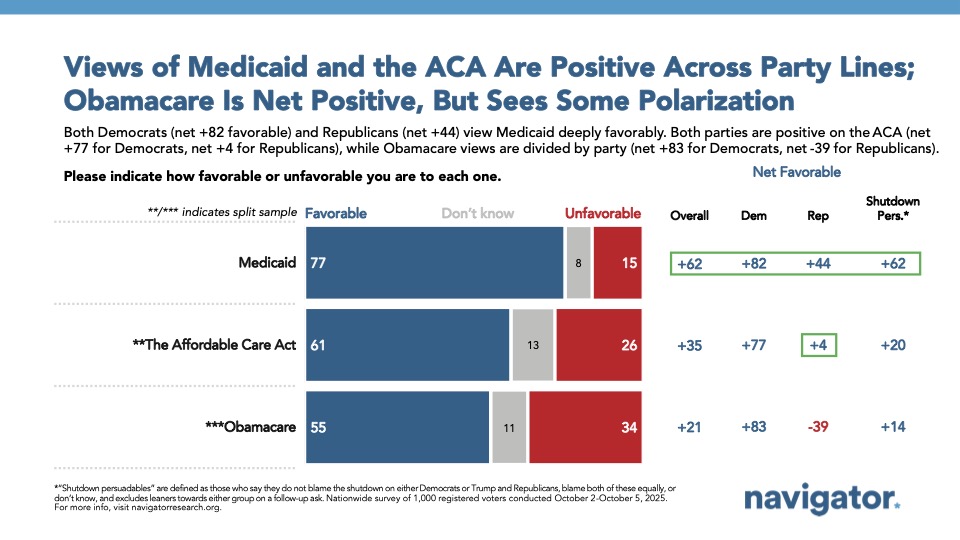
Health care programs like Medicaid (+62) and the Affordable Care Act (ACA) (+35) remain overwhelmingly popular. “Obamacare” is also viewed favorably by 21 points, but the ACA is narrowly favored by Republicans while “Obamacare” is deeply underwater among this group.

Bar chart from Navigator Research. Title: Views of Medicaid and the ACA Are Positive Across Party Lines; Obamacare Is Net Positive, But Sees Some Polarization

Americans continue to trust Democrats over Trump and Republicans to handle health care (51 percent Democrats – 36 percent Trump and Republicans), including independents by 19 points.

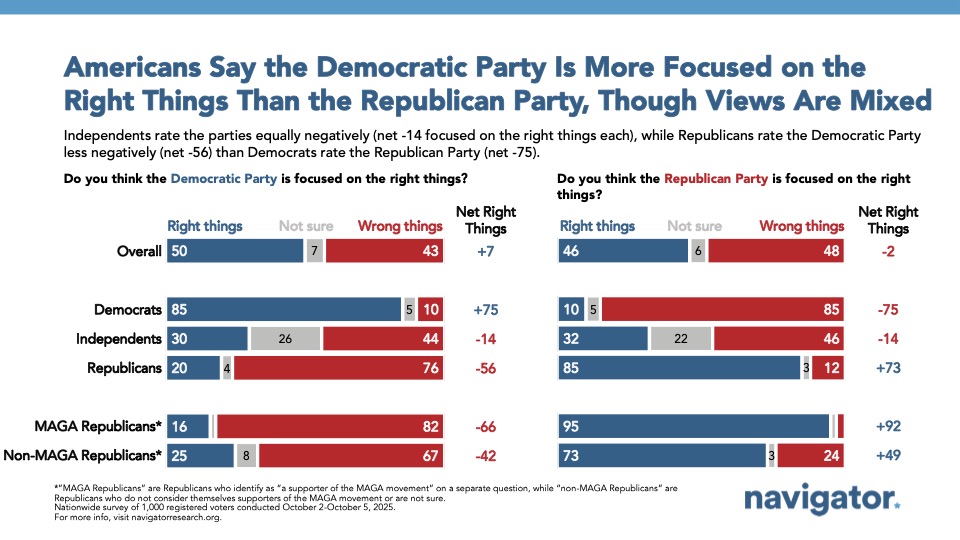
More believe Democrats in Congress are focused on the right things (50%right things – 43 percent wrong things) while Republicans in Congress are underwater on the same measure (46 percent right things – 48 percent wrong things). A plurality of independents think both Democrats and Republicans are focused on the wrong things.

Bar chart from Navigator Research. Title: Americans Say the Democratic Party Is More Focused on the Right Things Than the Republican Party, Though Views Are Mixed

Read More

April 8, 2026

Americans Blame Trump for Rising Gas Prices

This Navigator Research report includes new data on gas prices, including to what extent Americans believe gas prices have increased and perceptions of who’s to blame.

Maryann Cousens

Feeling the pressure of rising grocery costs Battleground voters lay the blame on Trump and Republicans in Congress

Poll: Tariffs

This Navigator Research report covers perceptions of tariffs in the House battleground.

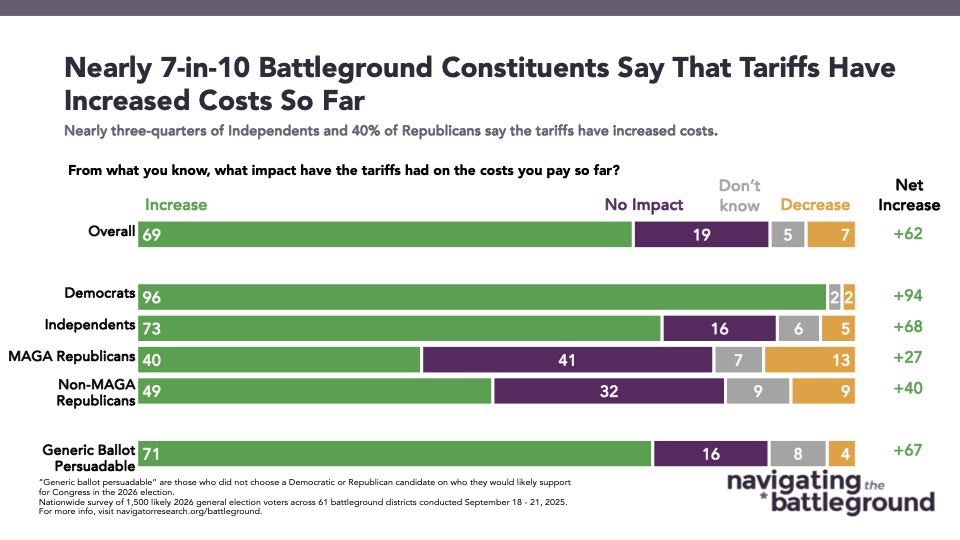
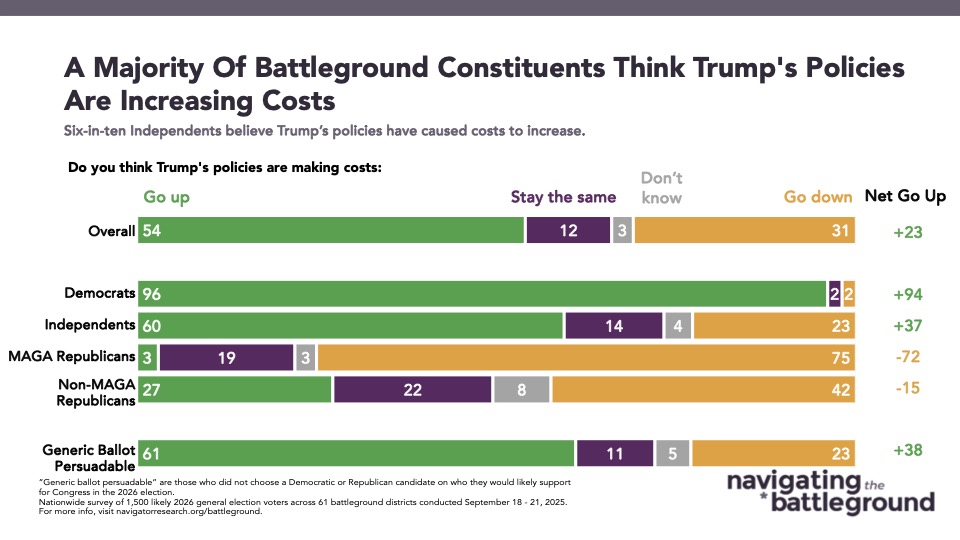
Seven in ten believe tariffs have increased costs, and half believe the worst of cost increases is yet to come. Americans living in the House battleground are clear on the impact tariffs are having on their lives with 69 percent believing tariffs have increased costs. They are also clear on who’s causing it. 54 percent of battleground constituents say President Trump’s policies are making costs go up, including 60 percent of independents. 50 percent of battleground constituents believe the worst of cost increases is yet to come, including 52 percent of generic ballot persuadables in the survey.

Bar chart from Navigator Research. Title: Nearly 7-in-10 Battleground Constituents Say That Tariffs Have Increased Costs So Far
Bar chart from Navigator Research. Title: A Majority Of Battleground Constituents Think Trump's Policies Are Increasing Costs

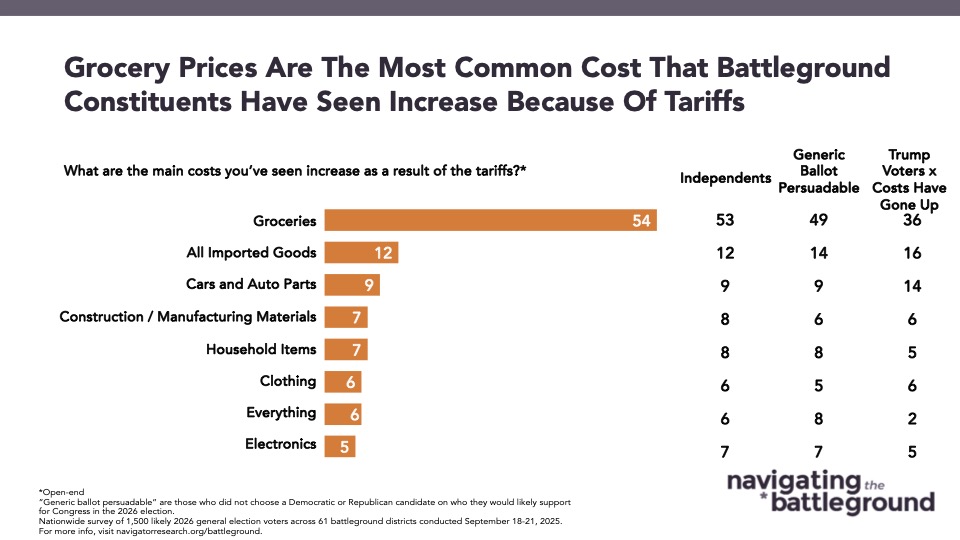
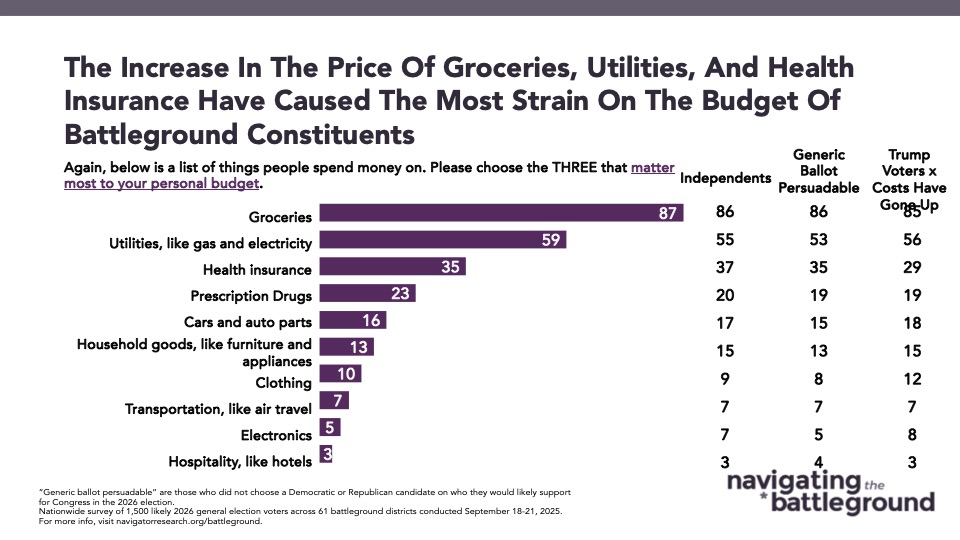
Grocery costs are seen as increasing the most as a result of tariffs – and are seen as mattering the most to battleground Americans’ budgets. Food cost increases have been felt most acutely, with 54 percent of battleground constituents believing the cost of groceries has increased the most as a result of tariffs. Other categories of goods fall well behind, with the next leading cost increase coming from imported goods at 12 percent and cars and auto parts at 9 percent.

Rising food costs are particularly impactful for battleground constituents because 87 percent say groceries matter most to their personal budget. This is followed by utilities and health insurance at 59 percent and 35 percent, respectively.

Bar chart from Navigator Research. Title: Grocery Prices Are The Most Common Cost That Battleground Constituents Have Seen Increase Because Of Tariffs
Bar chart from Navigator Research. Title: The Increase In The Price Of Groceries, Utilities, And Health Insurance Have Caused The Most Strain On The Budget Of Battleground Constituents

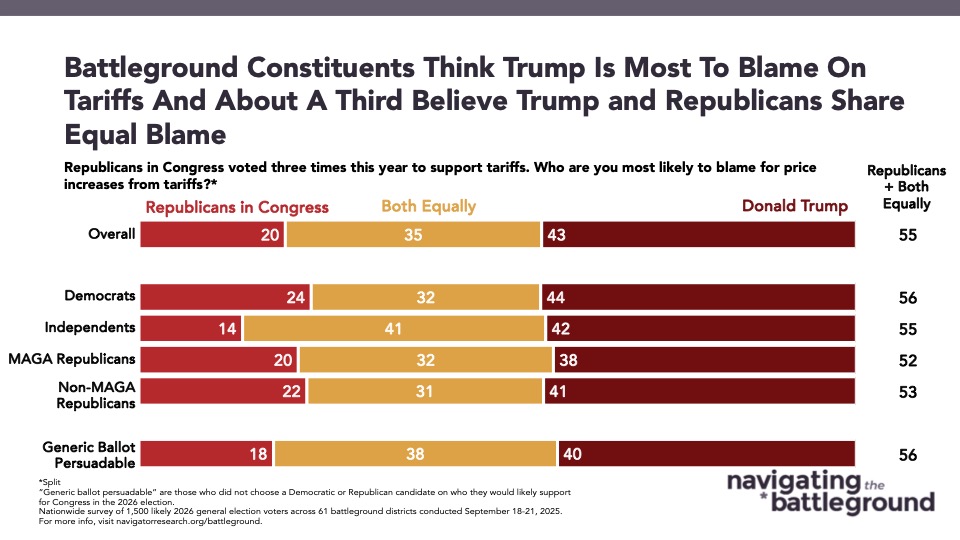
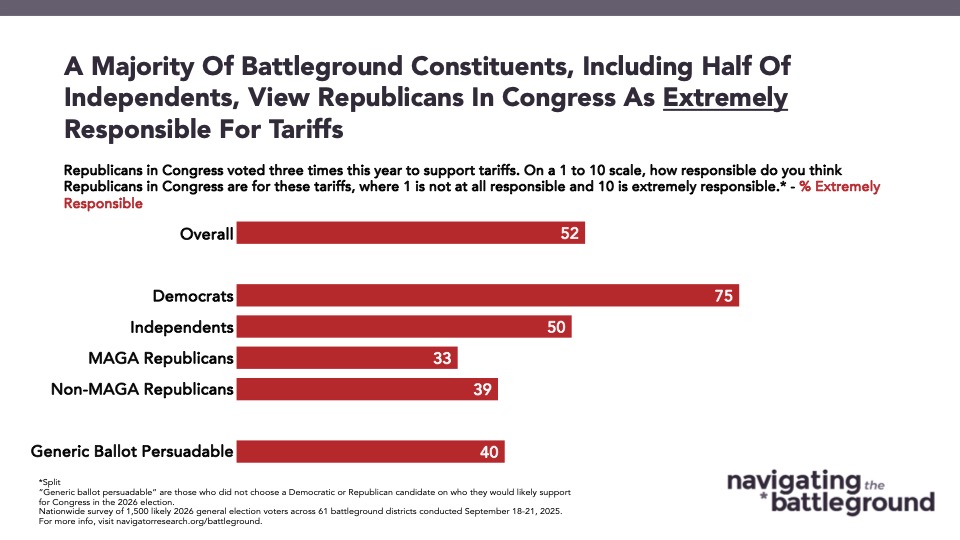
Battleground constituents believe Donald Trump is most to blame for price increases from tariffs. 43 percent believe Donald Trump is to blame for price increases from tariffs while 35 percent blame congressional Republicans and Trump equally. Only 20 percent blame congressional Republicans exclusively for price increases from tariffs. After learning Republicans in Congress have voted three times this year to support tariffs, 52 percent of battleground constituents believe Republicans in Congress are “extremely responsible” for tariffs, including 50 percent of independents.

Bar chart from Navigator Research. Title: Battleground Constituents Think Trump Is Most To Blame On Tariffs And About A Third Believe Trump and Republicans Share Equal Blame
Bar chart from Navigator Research. Title: A Majority Of Battleground Constituents, Including Half Of Independents, View Republicans In Congress As Extremely Responsible For Tariffs

Americans in the Battleground Want Congress to Protect Health Care — Even If It Means Shutting Down the Government

Poll: Government Shutdown

This Navigator Research report covers perceptions of a potential government shutdown, rising costs among House battleground constituents.

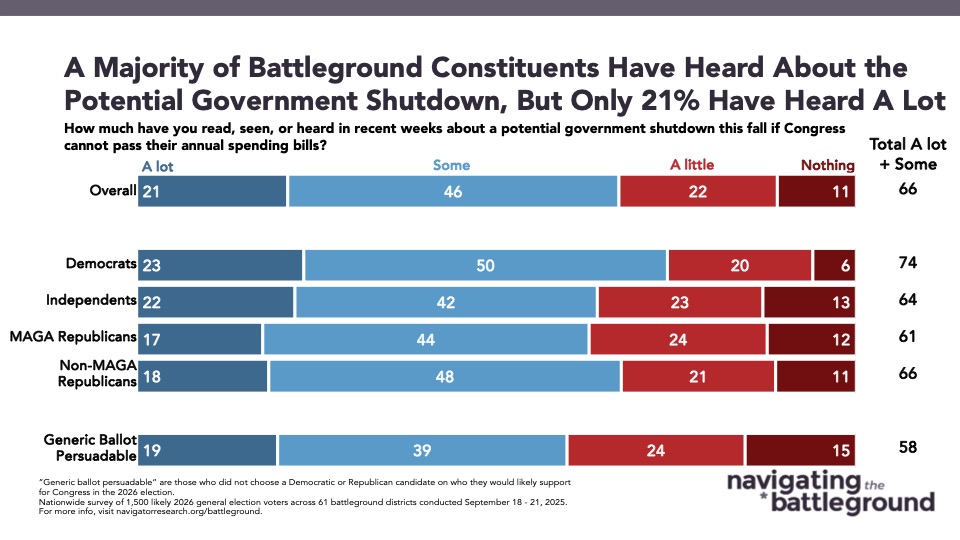
66 percent of Americans have heard “a lot” or “some” about a potential government shutdown, with 21 percent having heard “a lot.” Only 32 of battleground Americans say they’ve heard “nothing” or “a little” about a potential shutdown.

Bar chart from Navigator Research. Title: A Majority of Battleground Constituents Have Heard About the Potential Government Shutdown, But Only 21% Have Heard A Lot

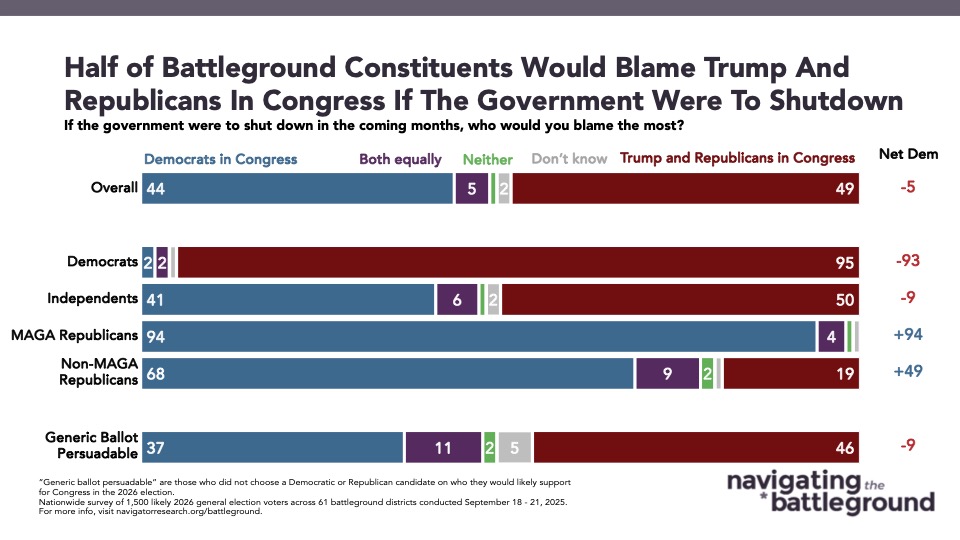
More would blame Republicans than Democrats for a shutdown, but not by much: 44 percent of battleground constituents would blame Democrats in Congress, while 49 percent would blame Trump and Republicans in Congress. This is a departure from our flagship survey, in which a similar share of Americans said they would blame Republicans (45 percent), but there was much more division between blaming Democrats (26 percent) and blaming both sides equally (21 percent).

In the battleground survey, Republicans were far less likely to say “both sides equally,” which likely explains the drop-off. Independents were also much more inclined to blame Republicans rather than both equally: 55 percent would blame Trump and Republicans, 33 percent would blame Democrats, and only 6 percent said they would blame both equally — a significant shift from the 42 percent who blamed both equally in our national survey.

Bar chart from Navigator Research. Title: Half of Battleground Constituents Would Blame Trump And Republicans In Congress If The Government Were To Shutdown

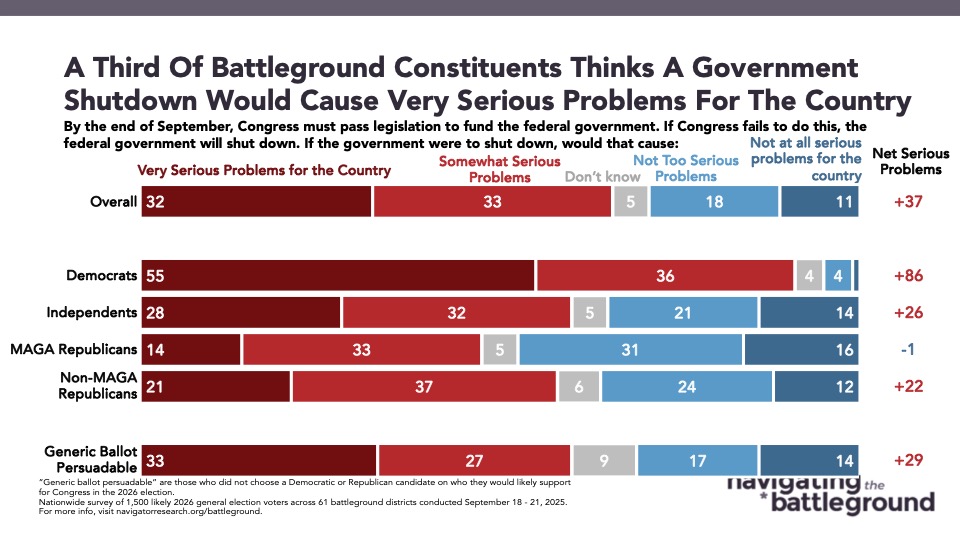
A shutdown would be serious, but many see it as worthwhile to protect people from other bad recent decisions. This included holding the line against funding cuts for health care and ACA tax credits, as well as fighting to remove tariffs. This sentiment persists despite battleground constituents being clear that they believe a shutdown would be “a serious problem for the country” (66 percent) and that it would have a personal impact on them (53 percent).

Bar chart from Navigator Research. Title: A Third Of Battleground Constituents Thinks A Government Shutdown Would Cause Very Serious Problems For The Country

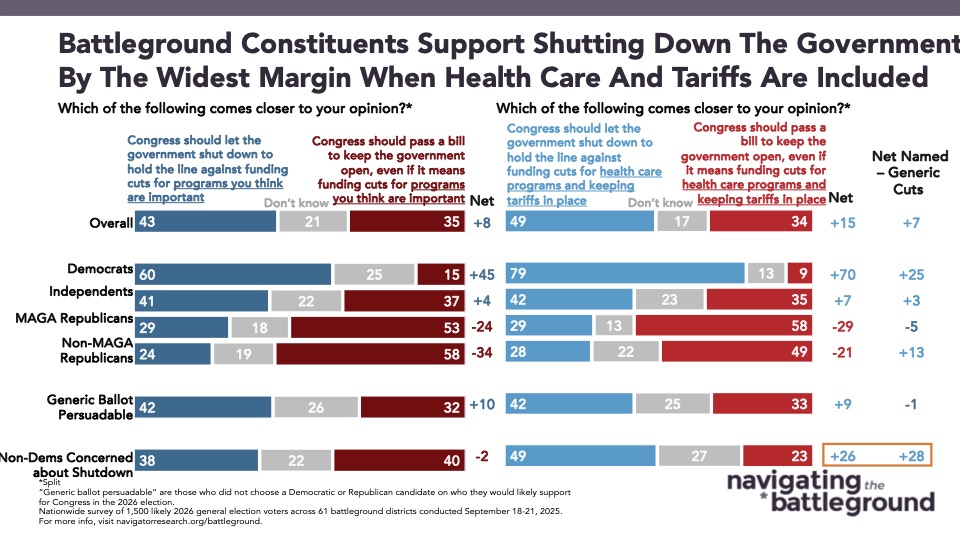
Specifically, protecting health care and opposing tariffs are the top-testing reasons to shut down the government. 49 percent of battleground constituents agreed that “Congress should let the government shut down to hold the line against funding cuts for healthcare programs and keeping tariffs in place,” compared to 34 percent who agreed that “Congress should pass a bill to keep the government open, even if it means funding cuts for healthcare programs and keeping tariffs in place.” Health care and costs evoke the largest pro-shutdown margin, consistent with our other budget priority tests.

Bar chart from Navigator Research. Title: Battleground Constituents Support Shutting Down The Government By The Widest Margin When Health Care And Tariffs Are Included

A partisan shutdown debate narrows our advantage. When testing the Republican position that “Republicans in Congress should make sure the government stays open and keep the current budget in place without making concessions” against two Democratic positions, both Democratic frames earned a slight plurality (44 percent and 45 percent) compared to 40 percent support for the Republican statement in both tests.

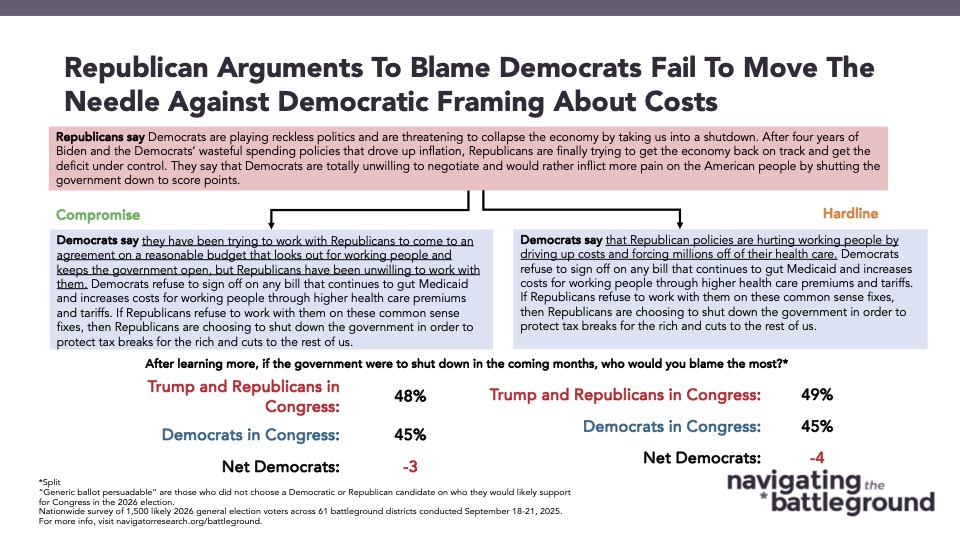
Our post-messaging test underscored how messaging with partisan queues entrenches blame. Respondents heard two Democratic messages: one emphasizing Democrats’ efforts to work with Republicans, and another taking a harder line blaming Republicans for attacks on Medicaid and higher costs for working families. Even after exposure to both messages, results barely moved. Initially, 44 percent of Americans said they would blame Democrats in Congress for a hypothetical shutdown and 49 percent said they would blame Trump and Republicans. After messaging, those numbers remained essentially unchanged: 45 percent blaming Democrats and 49 percent blaming Trump and Republicans.

Messaging slide from Navigator Research. Title: Republican Arguments To Blame Democrats Fail To Move The Needle Against Democratic Framing About Costs

MAHA Message Guidance

MAHA Message Guidance

Messaging guidance on the “Make America Healthy Again” (MAHA) movement.

The “Make America Healthy Again” (MAHA) movement blends common-sense health advice with fringe – and sometimes dangerous – ideas. Its leaders say they want to tackle America’s chronic disease crisis and improve wellness, but their proposals often reveal something else: a distrust of science and a readiness to exploit public frustration with the health care system. As Health and Human Services Secretary Robert F. Kennedy Jr. remakes the nation’s public health establishment, his agenda leans heavily on two emotional threads: fear of illness and anger at a system people feel is broken.

Navigator Research completed a study of public attitudes towards health and wellness, as well as perceptions of the MAHA movement and what progressive messages appeal most to those in the MAHA-curious cohort. (deck here).

Values

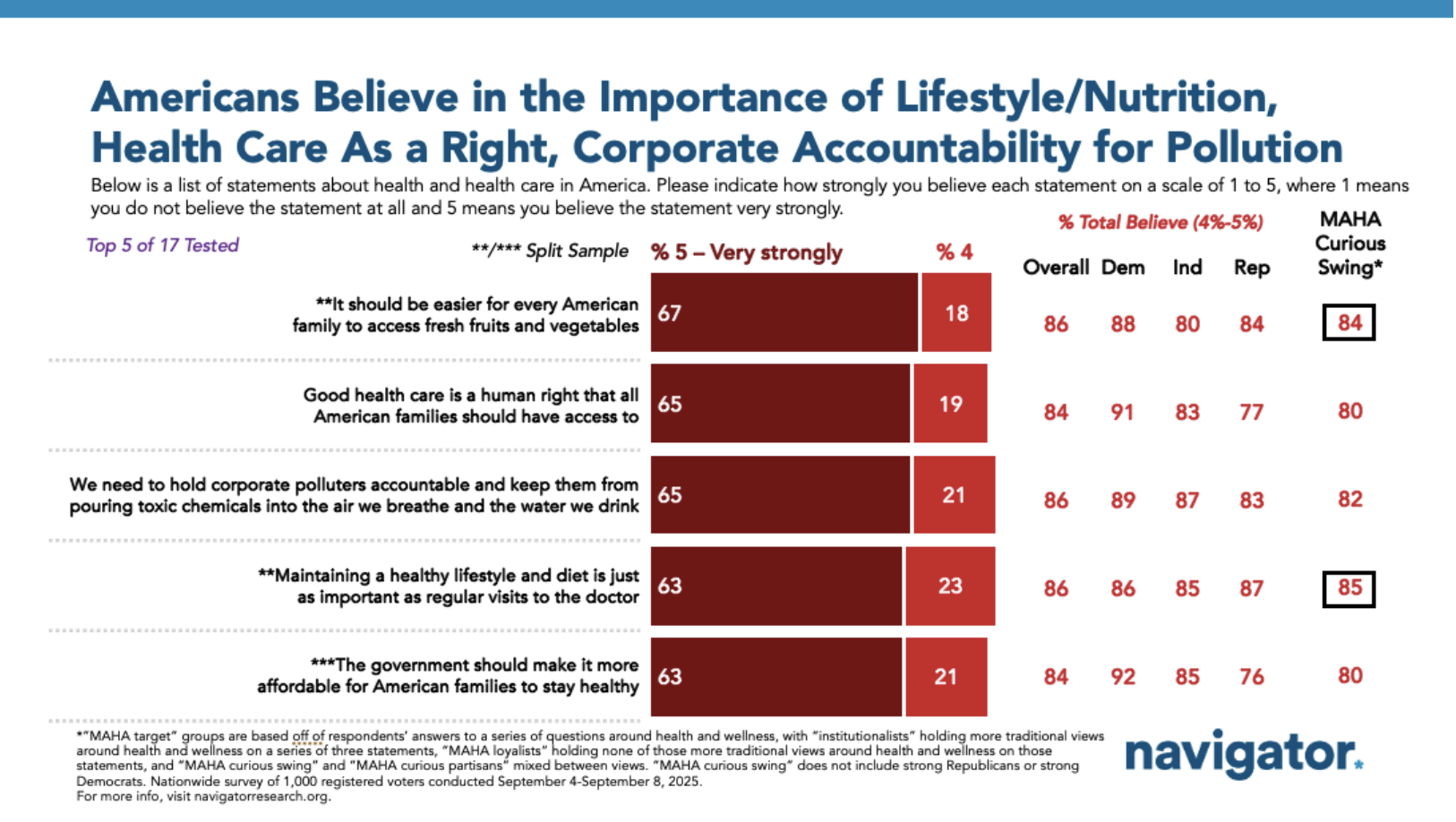
While Robert F. Kennedy may be divisive, an overwhelming majority of Americans across partisanship share common values about health and wellness:

  • The government should make it more affordable for American families to stay healthy.
  • Good health care is a human right that all American families should have access to.
  • It should be easier for every American family to access fresh fruits and vegetables.
  • Maintaining a healthy lifestyle and diet is just as important as regular visits to the doctor.
  • We need to hold corporate polluters accountable and keep them from pouring toxic chemicals into the air we breathe and the water we drink.

Messaging to Meet the Moment

A message that addresses the faults in our health care system and focuses on cracking down on corporate interests persuades Democrats and independents, non-MAGA Republicans, and also “MAHA curious” persuadables.

Our health care system is broken, but the answer is not to cut medical research, take away healthy school meal options from kids, or limit vaccines. Instead we should be cracking down on special interest influence in our government and putting science and facts ahead of politics.

Message Path:

  1. Acknowledge the system is broken: Most Americans are not satisfied with, or confident in, the existing health care system.
  2. Point out that Republicans’ proposed solution is not right: Americans oppose cuts to medical research, taking away healthy school meals from kids, and ending all vaccine mandates.
  3. Provide an alternative: Cracking down on special interest influence in our government is particularly persuasive when talking about health and wellness in the country today.
  4. Lean into common sense consensus solutions: Americans overwhelmingly agree that healthcare should be a right and that government should make it more affordable for people to stay healthy.

Read More

March 18, 2026

Perceptions And Concerns About Trump’s War Against Iran

Maryann Cousens & Melissa Toufanian
February 20, 2026

Message Guidance on Tariff SCOTUS Ruling

Polling report covering the latest perceptions of tariffs, including the share of Americans who support Trump’s tariff plan and how tariffs are seen as impacting costs.

Navigator Research
February 9, 2026

Do’s and Don’ts about Discussing ICE and Immigration

Do’s and Don’ts about Discussing ICE and Immigration

Navigator Research

MAHA: The Policies and Messages

Poll: MAHA

This Navigator Research report covers perceptions of health and wellness policies in the United States and message guidance to meet the moment.

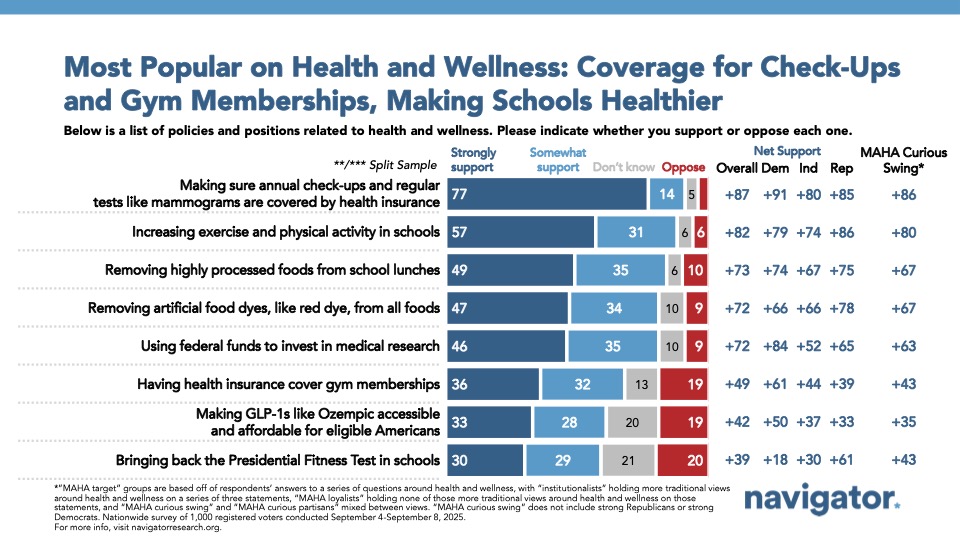
As we explored in the first report on the “Make America Healthy Again” (MAHA) movement, Americans across the political spectrum share a wide range of values on health and wellness. This is borne out in their agreement on certain policies and the role of government in advancing health and wellness.

The Policies

There is overwhelming bi-partisan support for health and wellness policies that seek to make health insurance cover preventative care, increase exercise and physical activity in school, remove highly processed foods from schools and artificial food dyes from all foods, hold corporations who pollute accountable, and use federal funds to invest in medical research.

Bar chart from Navigator Research. Title: Most Popular on Health and Wellness: Coverage for Check-Ups and Gym Memberships, Making Schools Healthier

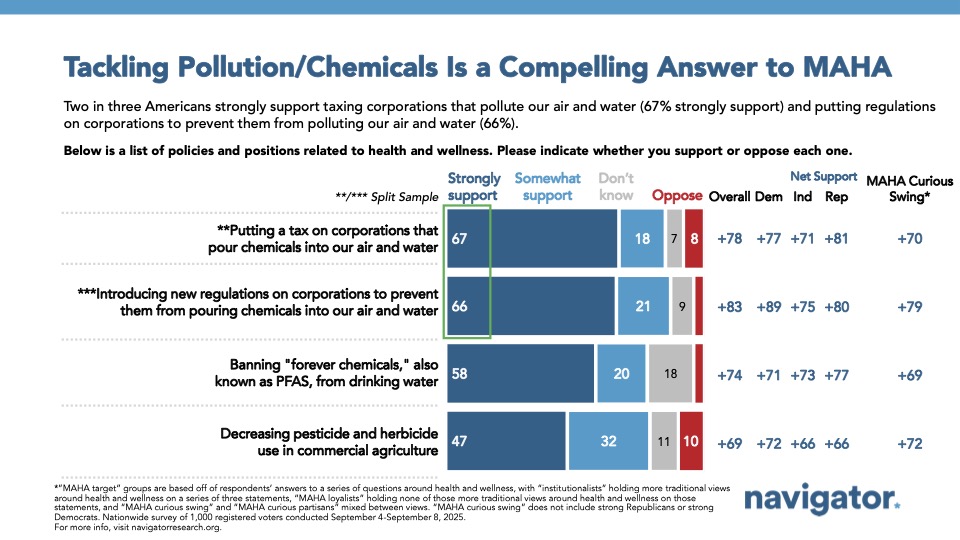
Other popular policies include banning “forever chemicals” from drinking water, decreasing pesticide and herbicide use in commercial agriculture, having health insurance cover gym memberships, making GLP-1s like Ozempic accessible and affordable for eligible Americans, and bringing back the Presidential Fitness Test in schools.

Bar chart from Navigator Research. Title: Tackling Pollution/Chemicals Is a Compelling Answer to MAHA

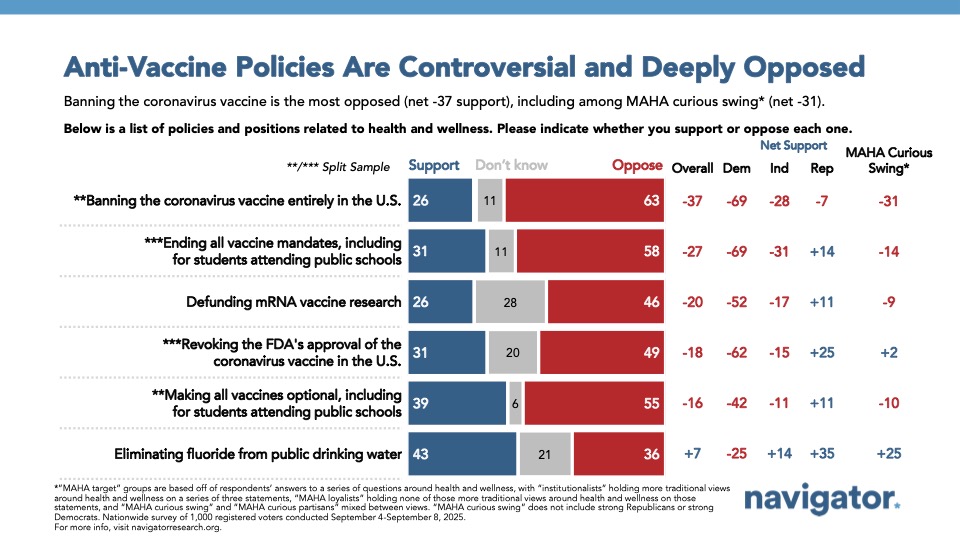
Less popular and more partisan are eliminating fluoride from public drinking water (43 percent support) and defunding mRNA vaccine research (just 26 percent support). These policies receive the most support among the MAHA loyalist cohort.

Bar chart from Navigator Research. Title: Anti-Vaccine Policies Are Controversial and Deeply Opposed

Anti-vaccine policies are the most controversial and opposed: a majority of Americans oppose making all vaccines optional, including for students attending public schools, ending all vaccine mandates, and banning the coronavirus vaccine entirely in the U.S.

The “MAHA curious” cohort are more divided than the overall electorate, but still more oppose ending all vaccine mandates, making all vaccines optional, and banning the coronavirus vaccine.

Vaccines

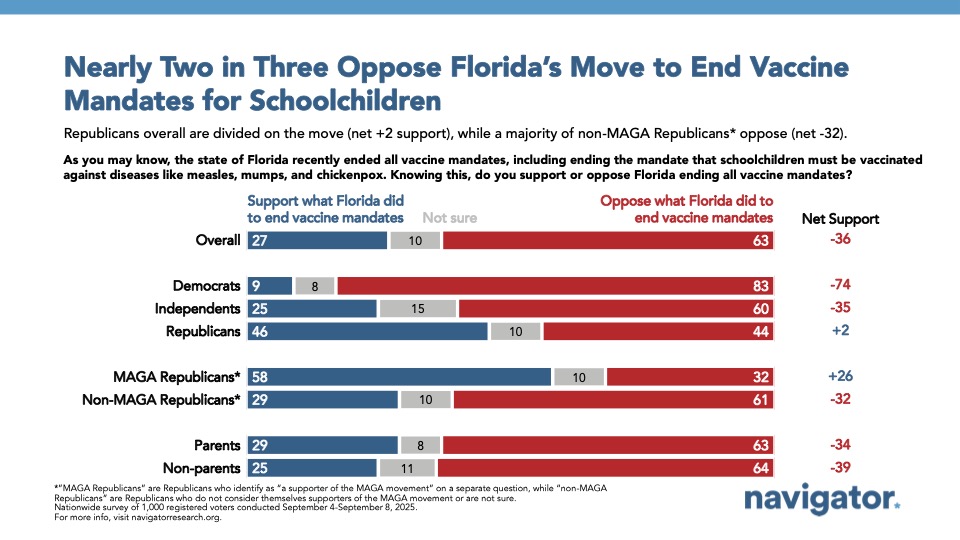
Actions to remove vaccine mandates for children are opposed by most, including those who are MAHA curious. Changes to childhood vaccine mandates in Florida draw fervent opposition (63 percent oppose), including among independents (60 percent) and the MAHA curious (54 percent). These sweeping changes outright divide Republicans (46 percent support – 44 percent oppose).

Bar chart from Navigator Research. Title: Nearly Two in Three Oppose Florida’s Move to End Vaccine Mandates for Schoolchildren

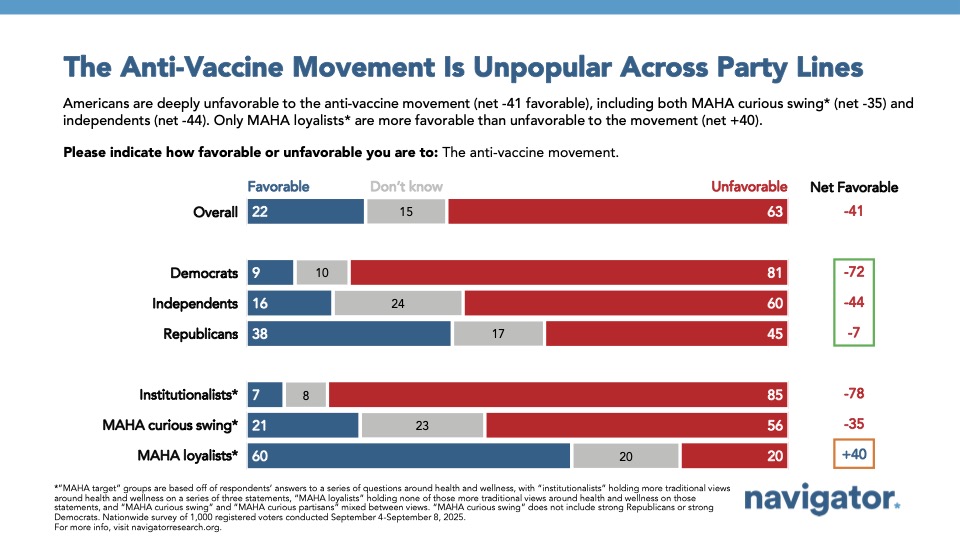
The anti-vaccine movement is viewed overwhelmingly negatively across party lines (-41), including by Republicans (-7), the MAHA curious (-31), independents (-44), and Democrats (-72).

Bar chart from Navigator Research. Title: The Anti-Vaccine Movement Is Unpopular Across Party Lines

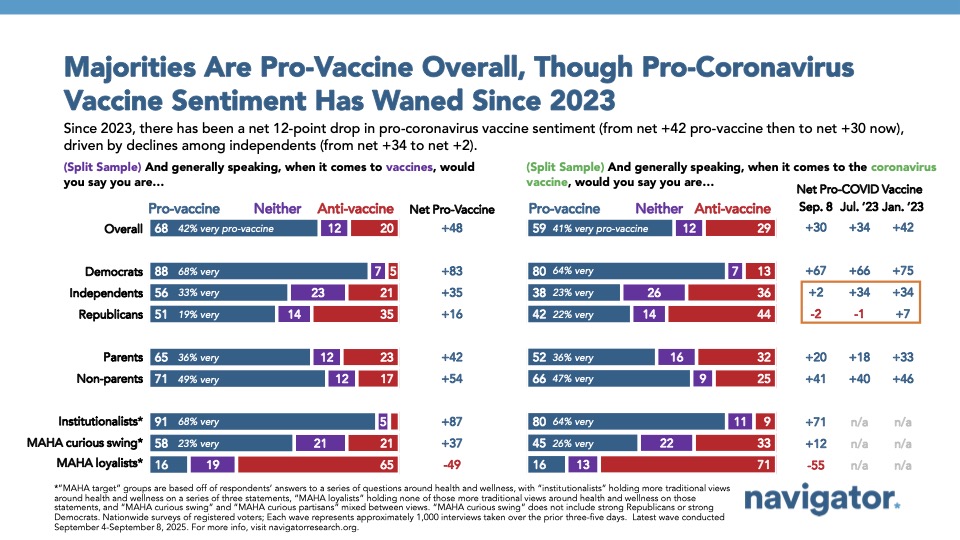
Bipartisan majorities of Americans identify generally as “pro-vaccine” (68 percent) over “anti-vaccine” (20 percent). 12 percent say they are neither pro-vaccine nor anti-vaccine, including 21 percent of the MAHA curious.

Bar chart from Navigator Research. Title: Majorities Are Pro-Vaccine Overall, Though Pro-Coronavirus Vaccine Sentiment Has Waned Since 2023

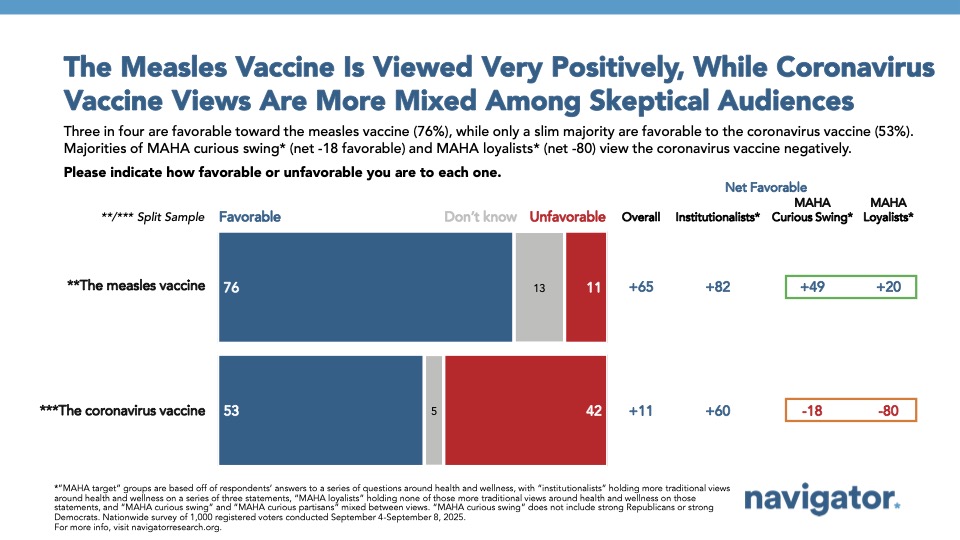
The coronavirus vaccine is where we find the most division. Americans overwhelmingly view the measles vaccine favorably (+66), including the MAHA curious (+49). By comparison, the coronavirus vaccine is viewed favorably by 11 points, and underwater among the MAHA curious (-18).

Bar chart from Navigator Research. Title: The Measles Vaccine Is Viewed Very Positively, While Coronavirus Vaccine Views Are More Mixed Among Skeptical Audiences

And when it comes to the coronavirus vaccine in particular, we see a 10-point drop in those who identify as pro-vaccine (59 percent), increasing anti-vaccine identification among both independents and Republicans and the MAHA curious.

A reminder that the MAHA curious group is deeply unfavorable to the anti-vaccine movement, oppose ending all vaccine mandates and the changes to vaccine mandates in Florida, and identify as “pro-vaccine” generally. All of this begs the question; how much of this is a COVID hangover or something that will have a lasting impact on public health and trust in vaccines?

Messaging to Meet the Moment

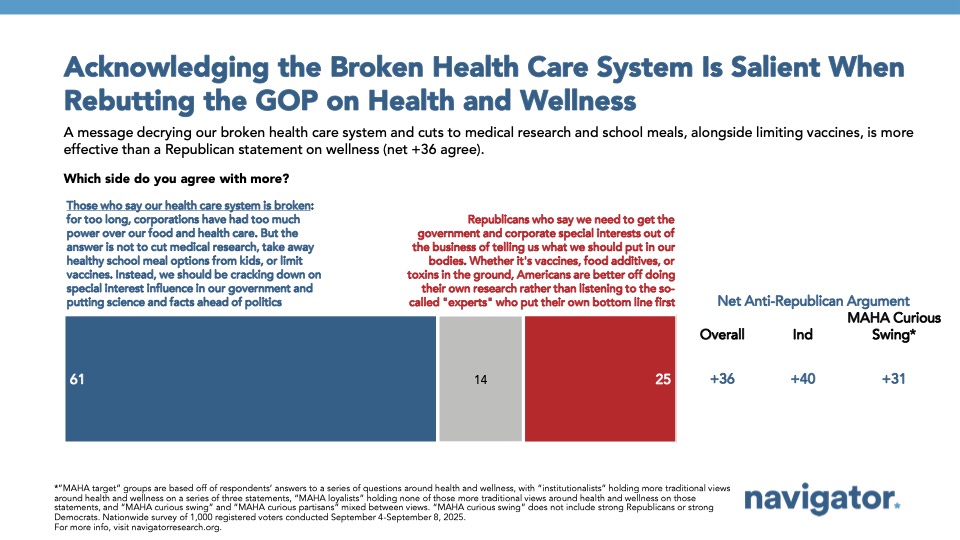
A message that addresses the faults in our health care system and focuses on cracking down on corporate interests is the best lane for progressives, including with MAHA curious Americans. In response to the conservative message that:

We need to get the government and corporate special interests out of the business of telling us what we should put in our bodies. Whether it’s vaccines, food additives, or toxins in the ground, Americans are better off doing their own research rather than listening to the so-called “experts” who put their own bottom line first.

We found the most persuasive response to be a message that acknowledge our health care system is broken, refutes the GOP solution, and provides an alternative, in particular cracking down on special interest influence:

Our health care system is broken, but the answer is not to cut medical research, take away healthy school meal options from kids, or limit vaccines. Instead we should be cracking down on special interest influence in our government and putting science and facts ahead of politics

Six in ten agree more with the latter, including the MAHA curious and independents. A version of the same message that concedes that “for too long, corporations have had too much power over our food and health care” is similarly effective.

Bar chart from Navigator Research. Title: Acknowledging the Broken Health Care System Is Salient When Rebutting the GOP on Health and Wellness

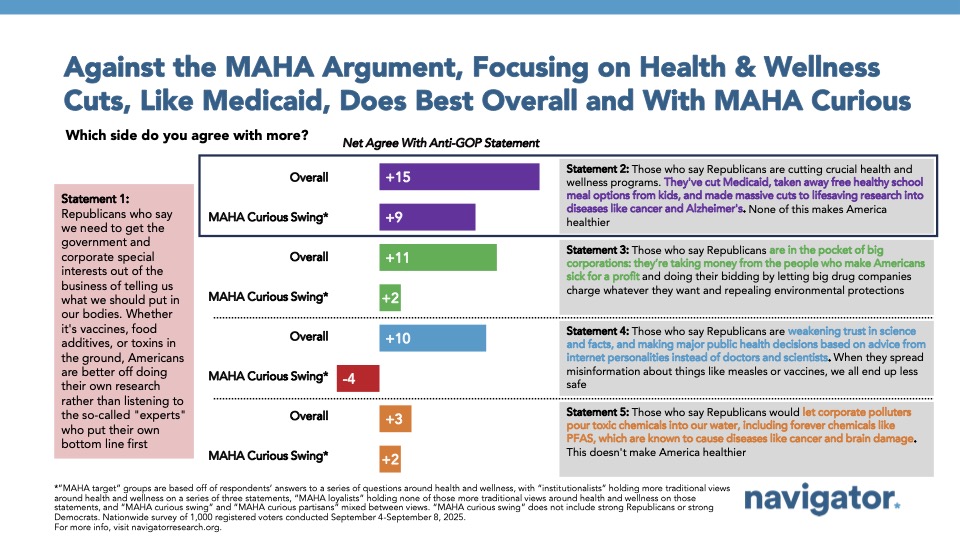
The most persuasive hit on Republican policies emphasizes cuts to Medicaid and school meals, as well as cuts to government-funded disease research.
Republicans are cutting crucial health and wellness programs. They’ve cut Medicaid, taken away free healthy school meal options from kids, and made massive cuts to lifesaving research into diseases like cancer and Alzheimer’s. None of this makes America healthier

Messages that solely take on corporate polluters, focus only on big corporations, and the idea that Republicans are trusting the wrong people for public health advice, are convincing to the institutionalists, but are far less convincing to MAHA curious audiences.

Bar chart from Navigator Research. Title: Against the MAHA Argument, Focusing on Health & Wellness Cuts, Like Medicaid, Does Best Overall and With MAHA Curious

Recommendations:

  1. Acknowledge the system is broken: Most Americans are not satisfied with, or confident in, the existing health care system.
  2. Point out that the proposed solution is not right: Americans oppose cuts to medical research, taking away healthy school meals from kids, and ending all vaccine mandates.
  3. Provide an alternative: Cracking down on special interest influence in our government is particularly persuasive when talking about health and wellness in the country today.

Read More

April 8, 2026

Americans Blame Trump for Rising Gas Prices

This Navigator Research report includes new data on gas prices, including to what extent Americans believe gas prices have increased and perceptions of who’s to blame.

Maryann Cousens