2025 Wrapped: Trump’s Year in Review

Poll: Trump’s Year in Review

This Navigator Research report covers the latest views of Trump and his administration’s actions over the last year.

Presidential Approval and Economic Handling

While President Trump’s approval ratings have improved slightly since the lows of the government shutdown, they remain below his standing prior to the shutdown. Currently, the President sits at 13-points underwater and -38 among independents. Similarly, his economic approval is 14-points underwater, only slightly above the lows seen before the shutdown, Liberation Day, and the rollout of tariffs.
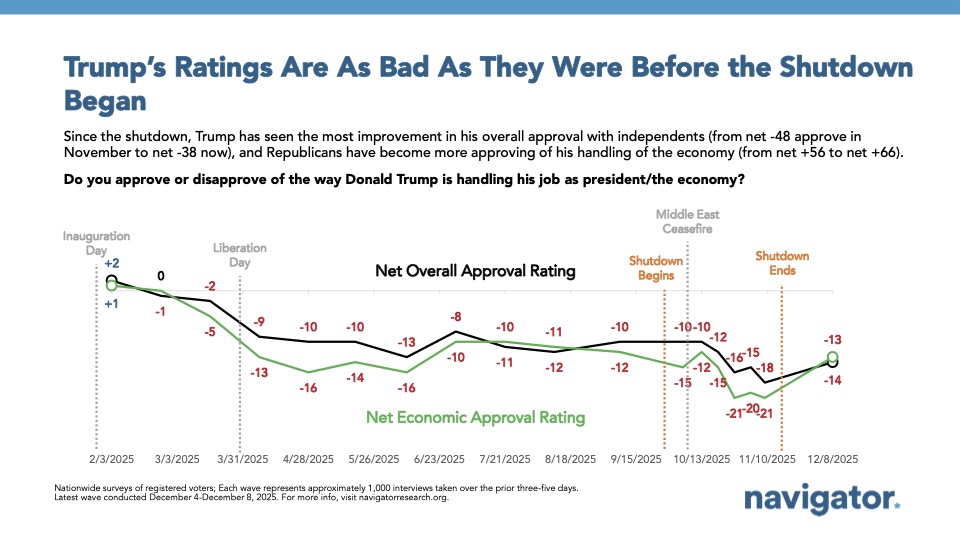
Line graph from Navigator Research, titled: Trump's Ratings Are As Bad As They Were Before the Shutdown

Americans are most negative on the President’s handling of inflation and the cost of living. A majority of Americans disapprove of his performance on these issues (61%), compared to just 35% who approve—a 26-point deficit. This gap widens significantly among independents, where the President faces a 53-point deficit.

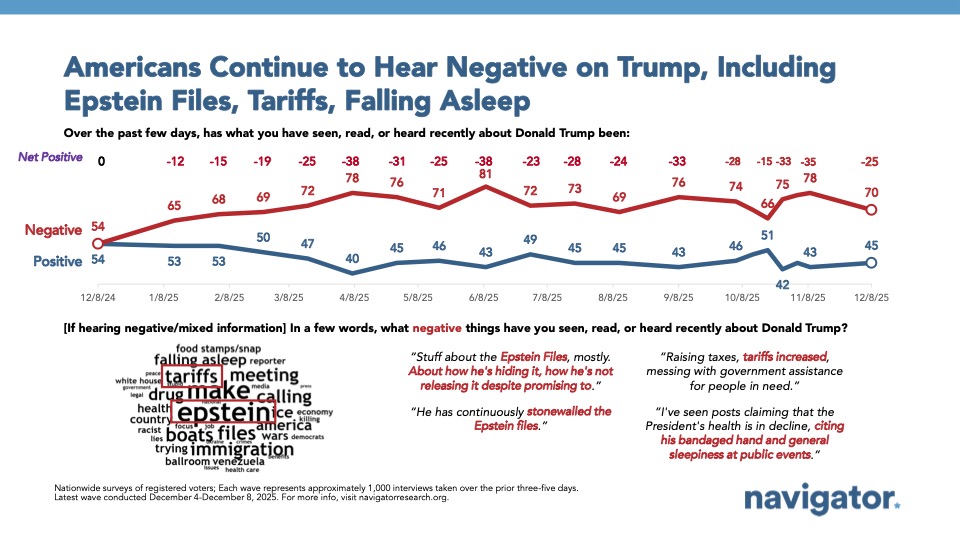
While inflation remains the main drag on his approval, other issues such as health care, tariffs, and government spending are also sources of negativity. Specifically, the President sees his second-lowest approval rating on health care, with 57% of Americans disapproving of his performance. This represents a 21-point net deficit overall and a 37-point net deficit among independents. Furthermore, qualitative data indicates that tariffs and Epstein are dominating the negative news cycle regarding the President.
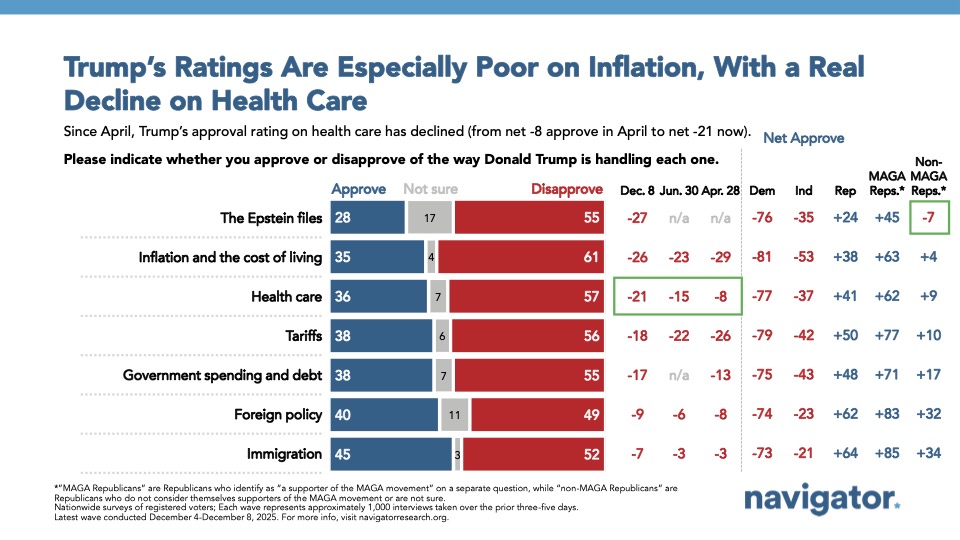
Bar chart from Navigator Research, titled: Trump's Ratings Are Especially Poor on Inflation With a Real Decline on Health Care
Line graph and word clouds from Navigator Research, titled: Americans Continue to Hear Negative on Trump, Including Epstein Files, Tariffs, Falling Asleep

Specific Concerns

As the year progresses, 14% of Trump voters now say they regret their vote. This sentiment is even more pronounced among non-MAGA Republicans, 17% of whom now express regret. When asked to explain this shift, the economy and broken promises are cited as the primary drivers of regret.
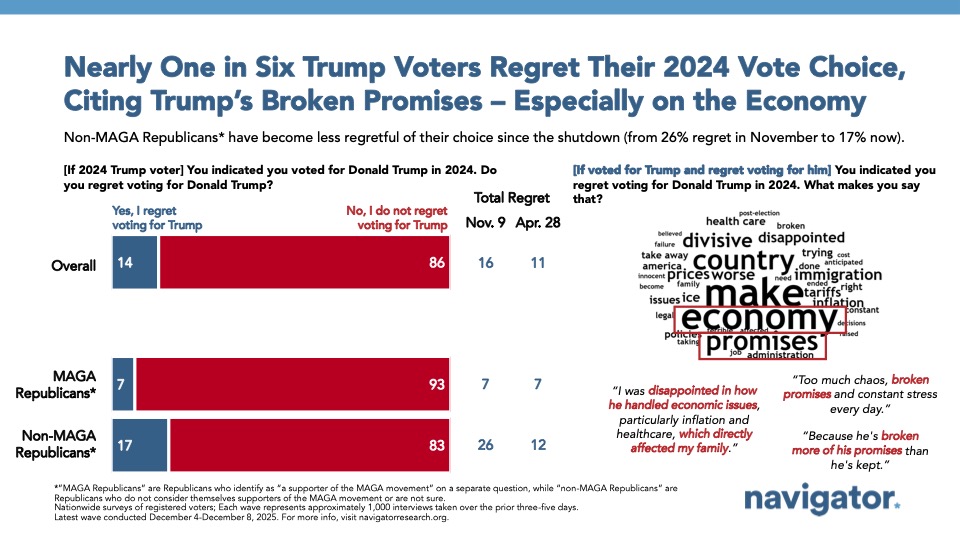
Bar chart and a word cloud from Navigator Research, titled: Nearly One in Six Trump Voters Regret Their 2024 Vote Choice Citing Trump's Broken Promises — Especially on the Economy

Specific policy critiques resonate strongly with concerned Americans. Half of Americans (50%) find it “extremely concerning” that the President promised to look out for forgotten Americans but is cutting SNAP funding and health care while passing tax cuts for the wealthy. Additionally, 47% are extremely concerned that despite promises to put Americans first, billions of dollars are being spent on foreign conflicts, including potential ground strikes in Venezuela. Concerns regarding immigration enforcement also persist, with 44% finding the deportation of legal residents and law-abiding immigrants extremely concerning.

The Prioritization Gap

There is a significant disconnect between what Americans want the government to prioritize and what they perceive as the focus of the President and Republicans in Congress. Inflation and the cost of living remain the top priority for Americans, with 57% ranking it among their top five most important issues. Jobs and the economy follow closely (44%), along with health care, Social Security, and corruption in government.

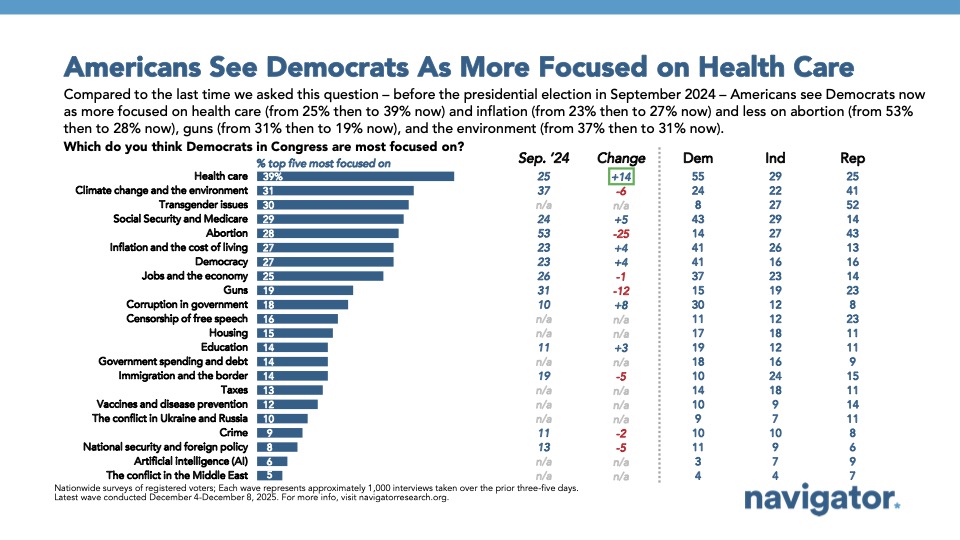
Notably, immigration has fallen out of the top five issues for Americans, now sitting at 27%. However, 69% of Americans believe the President and congressional Republicans are focused on immigration and the border. This creates a massive 42-point gap between the issue’s actual importance to Americans and the perceived prioritization by leadership. Conversely, Americans see 20-point deficits in focus on the issues that matter most to them: inflation, the economy, and health care. Congressional Democrats, meanwhile, are more likely to be seen as prioritizing health care (39%), aligning with one of the public’s top concerns.
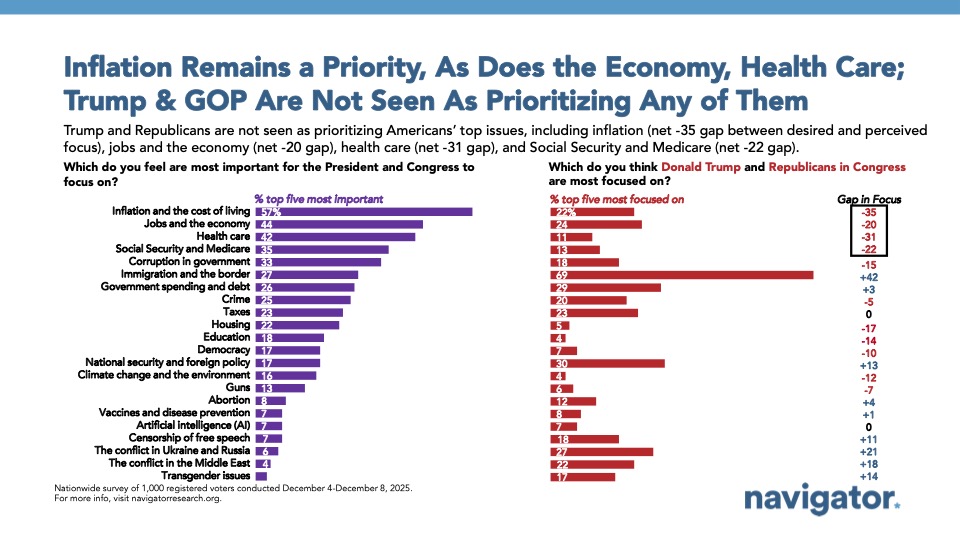
Bar charts from Navigator Research, titled: Inflation Remains a Priority, As Does the Economy, Health Care, Trump & GOP Are Not Seen As Prioritizing Any of Them
Bar chart from Navigator Research, titled: Americans See Democrats As More Focused on Health Care

Read More

June 4, 2026

Americans Are Split on How Safe our Food Is

This Navigator Research report covers perceptions of food safety and the health and wellness concerns that are top of mind for Americans.

Maryann Cousens
June 2, 2026

SPECIAL REPORT: LGBTQ+ Americans on President Trump and the Country

This Navigator Research report covers economic sentiment among LGBTQ+ Americans and how they view President Trump’s job performance across a range of issues.
Maryann Cousens & Tina Tang
May 22, 2026

Americans Want Major Change, But Aren’t Sure if Leaders Can Deliver

This Navigator Research report covers how Americans feel about democracy, institutions, and systems and whether anyone can fix them.
Julie Alderman Boudreau
May 21, 2026

Following Callais: Views on Supreme Court Remain Mixed But Reforms Are Popular

This Navigator Research report covers views of the Supreme Court and what type of reforms Americans support.

Tina Tang

Views of AI and data centers

Poll: AI and Data Centers

This Navigator Research report covers perceptions of AI and data centers in the country today.

Views towards AI

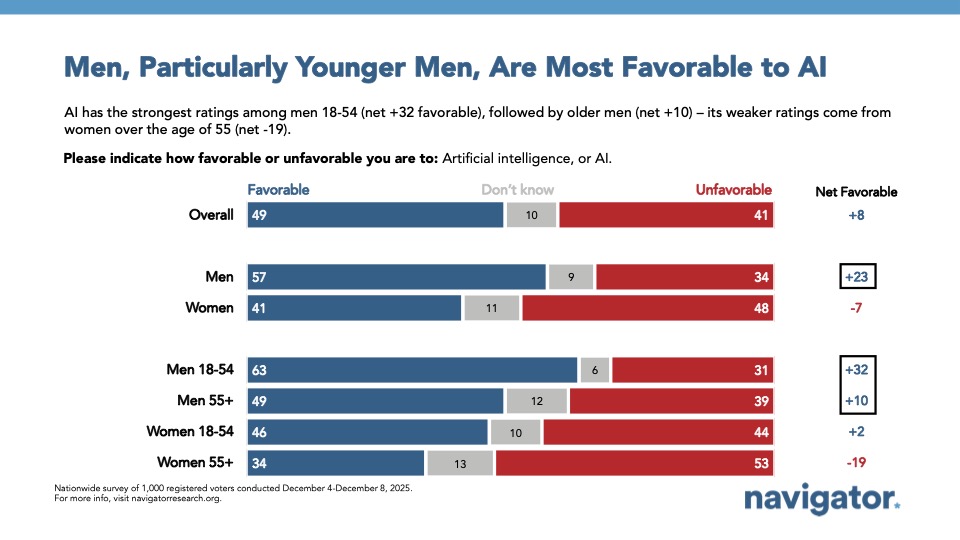
Americans’ perception of artificial intelligence or AI is varied, with young men viewing it the most positively. 49% of Americans have a favorable view of AI, this jumps to 57% for men overall, and 63% for men under the age of 55. Women on the other hand view AI unfavorably by 7 points (41% favorable – 48% unfavorable). Younger women are nearly even on the issue (net -2), while women over the age of 55 view AI unfavorably by 9 points. Younger Americans and voters of color generally have a more positive view of AI.

Despite the fact that AI favorability favors younger and men, Republicans view AI more favorably (net +17) than Democrats (net +2) and independents (net -8), the partisan divide is less disparate around AI than most other issues facing the country.

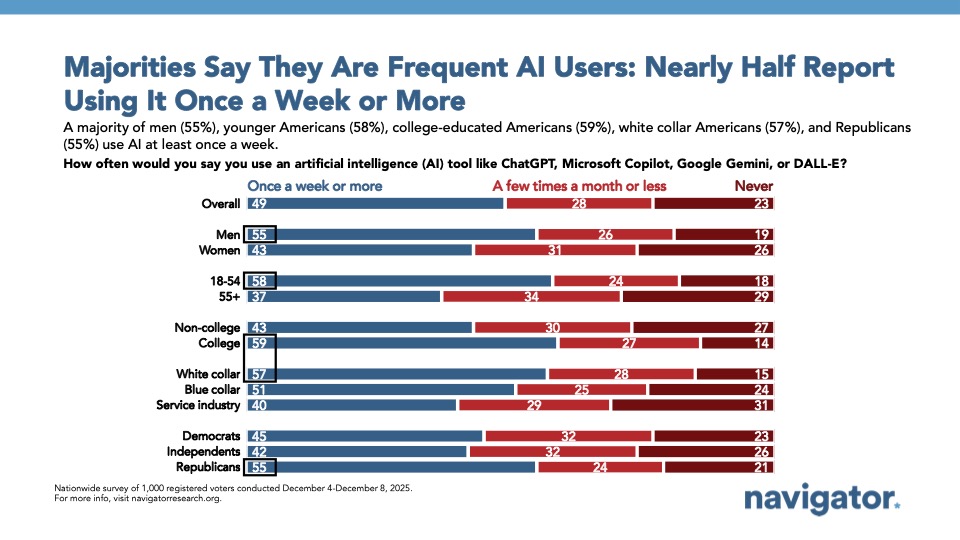
Educational attainment, job type, and income also play a role: Americans with a college degree, those who work white collar jobs, and those living in households that earn more than $100,000 per year all view AI more favorably. Those who use AI frequently, either daily or weekly, are far more favorable towards it than those who don’t.

The groups who report viewing AI most favorably also say they use it the most. While half of Americans say they use AI tools like ChatGPT, Microsoft Copilot, Google Gemini, or DALL-E once a week or more, 15% are using these tools several times a day. 18% of men report using AI tools several times a day, jumping to 23% for men under the age of 55.

When it comes to AI, while most Americans are generally comfortable with it, most also say either use it with caution or have concerns about it. Regardless of usage, Americans are mixed about whether the way AI is being used right now is good or bad for the country and for “people like you.”

AI as a Political Issue

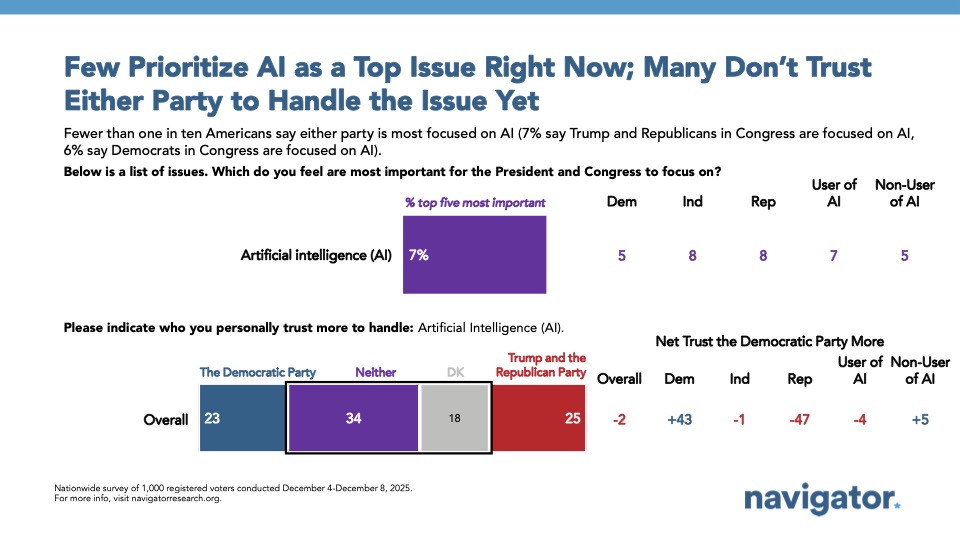
Americans also don’t see either party as having an advantage on the issue. Just 23% say they trust Democrats to handle AI, while 25% say they trust Republicans more—revealing a large opportunity. A majority either trust neither party or say they don’t know who to trust.

There is bipartisan support for more regulation of AI. When it comes to AI, 60% say there should be more regulation to limit its potential negative impact on society, including 63% of Democrats, 59% of Republicans, and 52% of independents. Even among those who view AI favorably, a majority say there should be more regulation.

Data Centers

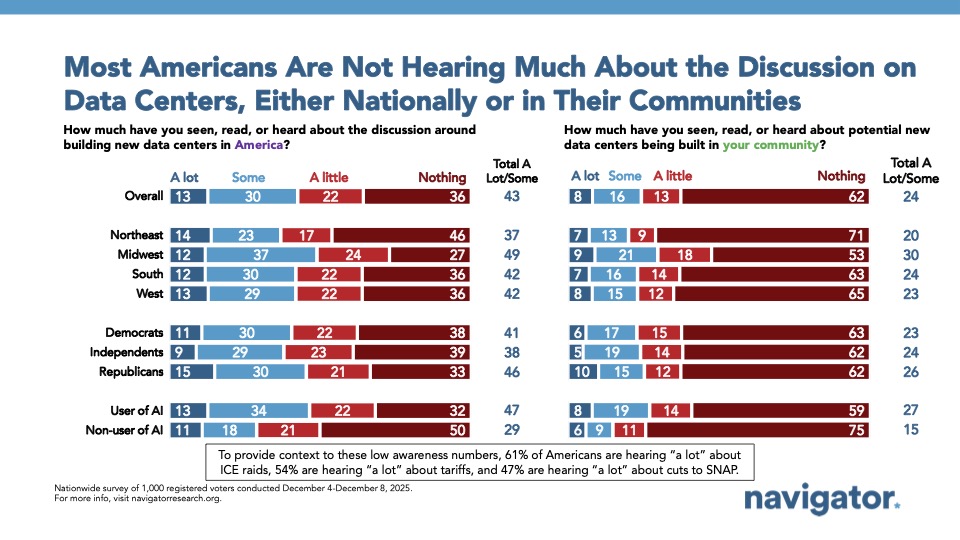
The building of new data centers doesn’t yet evoke strong feelings nationally. A majority say they have heard little or nothing about building new data centers in America, and even fewer have heard about potential data centers being built in their own communities. Americans living in the midwest are hearing more about the building of new data centers both nationally and in their own communities.

Given the lack of awareness about data centers, Americans don’t have a strong sense that they are good or bad for the country or for the communities where they are located. Most Americans say data centers are either an equal mix of good or bad or that they are not sure, indicating an opportunity to engage on the issue.

Ultimately, Americans’ are split and unsure of whether they would support the building of a data center in their local community (36% support – 32% oppose – 32% unsure). While Republicans are more supportive (net +15) than Democrats (net -5) and independents (net -4), most Republicans either say they would oppose it or are unsure. Those who view AI favorably are less likely to believe data centers are far more supportive of building new data centers in their own community (52% support – 21% oppose).

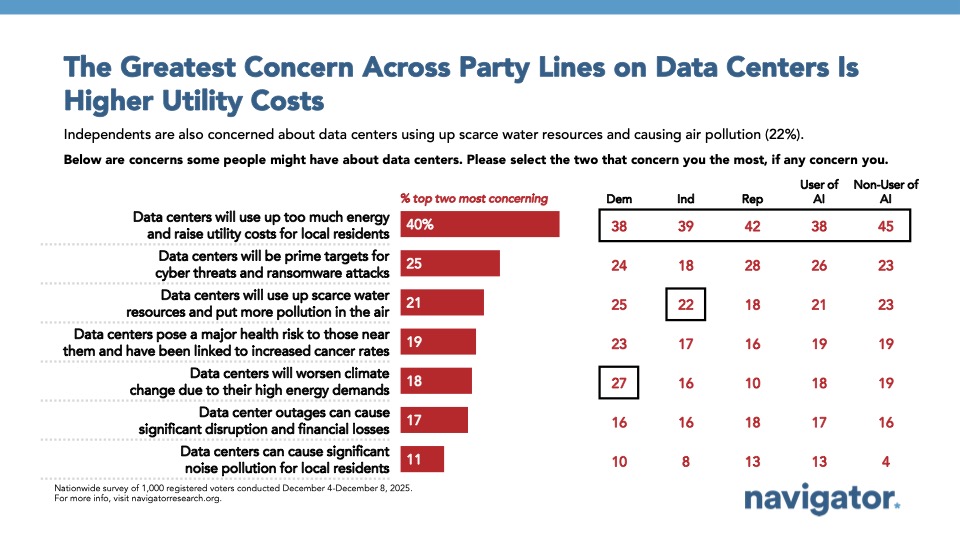
The greatest concern Americans have about data centers focuses on the impact it would have on the community, chiefly that data centers will use up too much energy and raise utility costs for local residents. This is most concerning across partisanship and racial demographics. The most appealing potential benefits are high-paying, union jobs and growth to local economies and tax revenue.

When it comes to building more data centers, an approach that protects consumers from both environmental consequences and higher costs associated with them is more appealing than one that solely aims to slow or stop the construction of data centers.

In response to an argument that “we should encourage more building of data centers so that we can boost our economy, create good-paying local jobs, and stay competitive with countries like China on technology and economic development,” there is a 40 point difference between the rebuttals:

As we build more data centers, we should do it in a way that protects consumers and our environment and makes sure that tech companies pay their fair share instead of passing the costs onto consumers (net +44)

We should try to slow or stop the rampant construction of data centers because they drain local energy, hurt our economy and our health, raise costs for consumers, and make tech billionaires even richer (net +4)

Read More

June 4, 2026

Americans Are Split on How Safe our Food Is

This Navigator Research report covers perceptions of food safety and the health and wellness concerns that are top of mind for Americans.

Maryann Cousens
June 2, 2026

SPECIAL REPORT: LGBTQ+ Americans on President Trump and the Country

This Navigator Research report covers economic sentiment among LGBTQ+ Americans and how they view President Trump’s job performance across a range of issues.

Maryann Cousens & Tina Tang
May 22, 2026

Americans Want Major Change, But Aren’t Sure if Leaders Can Deliver

This Navigator Research report covers how Americans feel about democracy, institutions, and systems and whether anyone can fix them.

Julie Alderman Boudreau
May 21, 2026

Following Callais: Views on Supreme Court Remain Mixed But Reforms Are Popular

This Navigator Research report covers views of the Supreme Court and what type of reforms Americans support.

Tina Tang

In Time for the Holidays, Americans Say Costs Are Going up – on Everything

Poll: Affordability

This Navigator Research report covers the latest views of the affordability crisis, including specific costs Americans say are increasing and how increased costs are impacting financial habits.

Shifting of Economic Perceptions and Priorities

Inflation and the cost of living has remained the top issue for Americans throughout 2025. Our most recent survey shows 57% believe the President and Congress should be focused on the issue, not far from its highest point at 62% in April. Health care has emerged through the year as an issue Americans want the government to focus on, starting at 33% in January and now reaching its highest point at 42%.

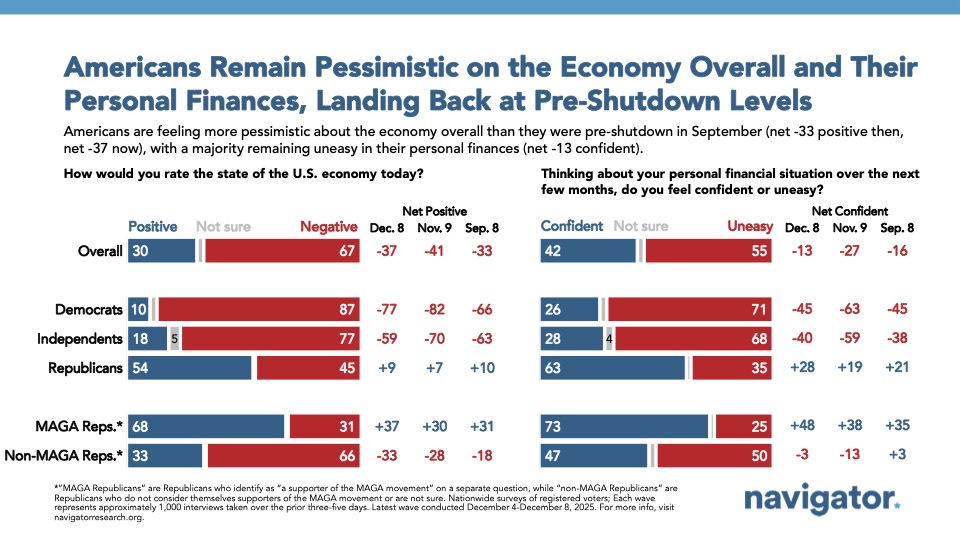
Perceptions of the economy have remained negative throughout the year, reaching their lowest point in April (77% negative), with two in three still rating the economy negatively today (67%). Similarly, Americans have expressed uneasiness regarding their personal financial situations throughout the year, with the greatest amount of stress in early November (63% uneasy – 36% confident) which has improved some over the past few weeks (55% uneasy – 42% confident).

Specific Pain-Points

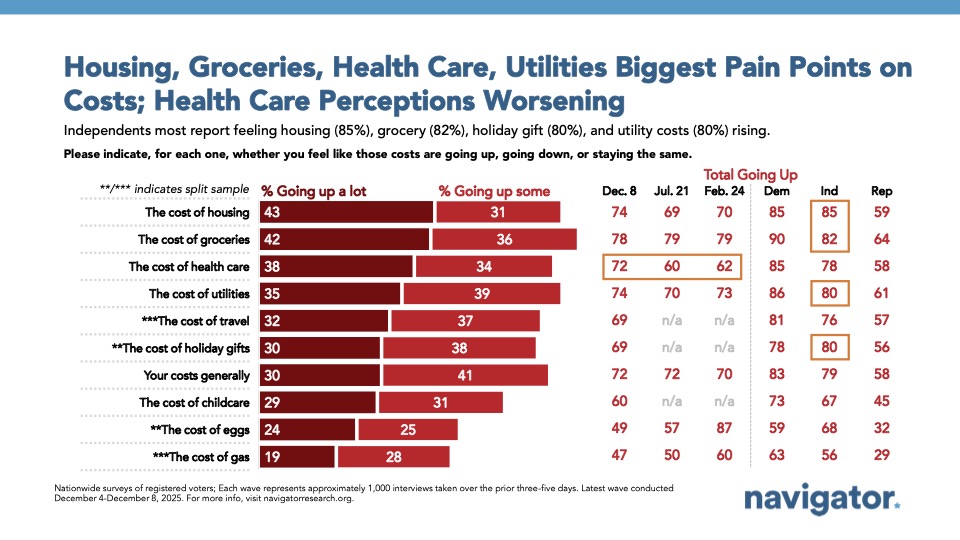
The cost of nearly everything is going up, and going up “a lot.” Over three in four say the cost of groceries is going up (78%), including 42% who say the cost is going up “a lot.” Similarly, 74% say the cost of housing is going up, with 43% saying it is going up “a lot.” The cost of utilities (74% going up, 35% going up a lot) and the cost of health care (72% going up, 38% going up a lot) are the next most significant cost pain points for Americans. While most cost assessments have remained steady throughout the year, Americans are 10-points more likely to say the cost of health care is on the rise than they were in February (62% in February – 72% now).

Renters and home-owners alike are feeling the effects of rising housing costs, though renters are the most likely, as 78% say the cost of housing is on the rise –compared to 70% of homeowners.

While several specific cost metrics vary between urban and rural areas, the cost of utilities is a concern across population density. 76% of urban Americans say the cost of utilities is going up, and 73% of rural Americans say the same.

Health Care Premiums

Half of Americans say their health care premiums are going up (50%), including 20% who say their premiums are going up “a lot.” This cost pressure is felt across party lines. Democrats are only somewhat more likely than Republicans to say their premiums are going up (56% of Democrats, 47% of independents, 44% of Republicans).

Financial Habits and Experiences

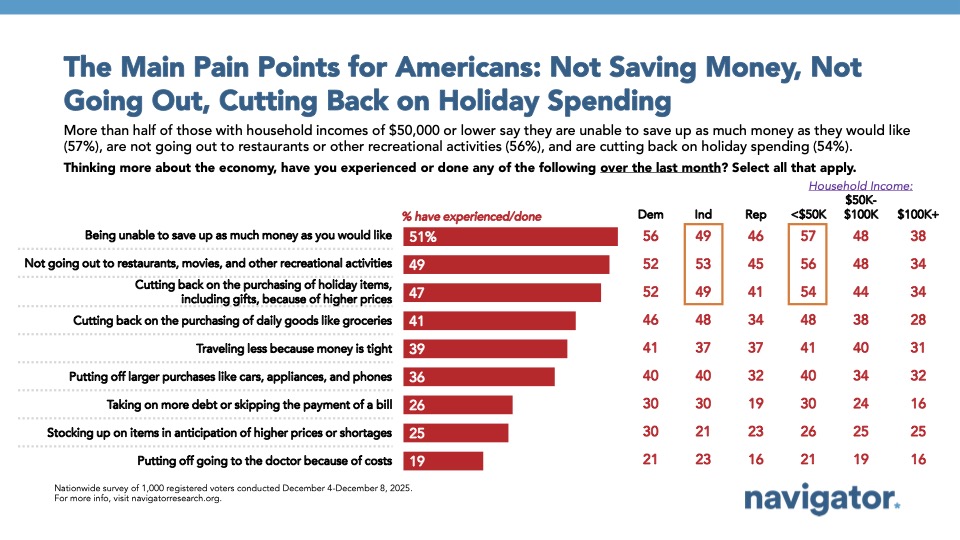
Most Americans report being unable to save up as much money as they would like (51%), and 49% say they have stopped going out to restaurants, movies, and doing other recreational activities. As the holiday season approaches, 47% say they have cut back on gift purchases due to higher prices.

A majority say they have carried a credit card balance in the past year, including 40% who say they have carried a balance in the past month. One in four Americans have used a “buy now, pay later” tool, such as Klarna, in the past year (26%), including 14% who have used one in the past month.

Millennials are significantly more likely than other generations to use a “buy now, pay later” tool such as Klarna or Afterpay. 43% of Millennials report using “buy now, pay later” in the past year, compared to 29% of Gen-Z, 25% of Gen-X, and 12% of Boomers.

Who’s to Blame?

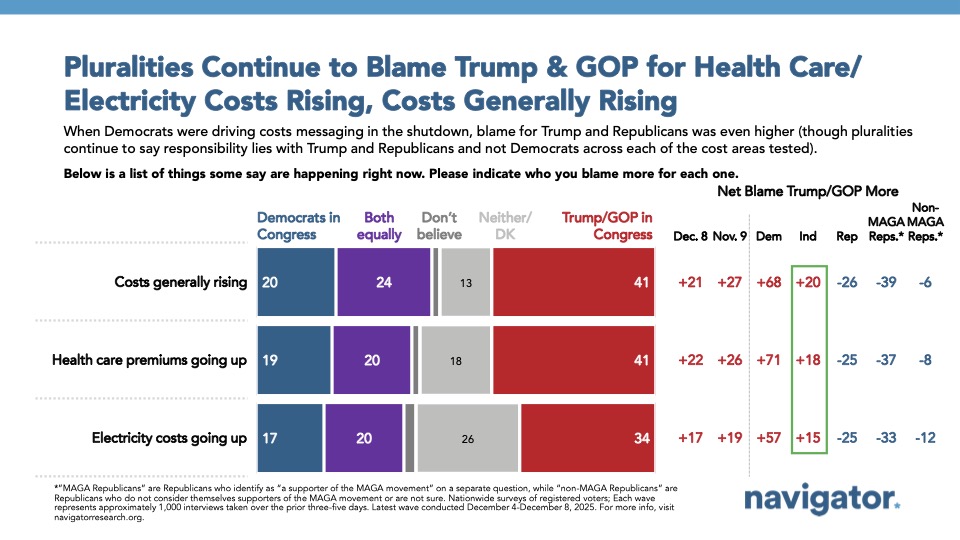
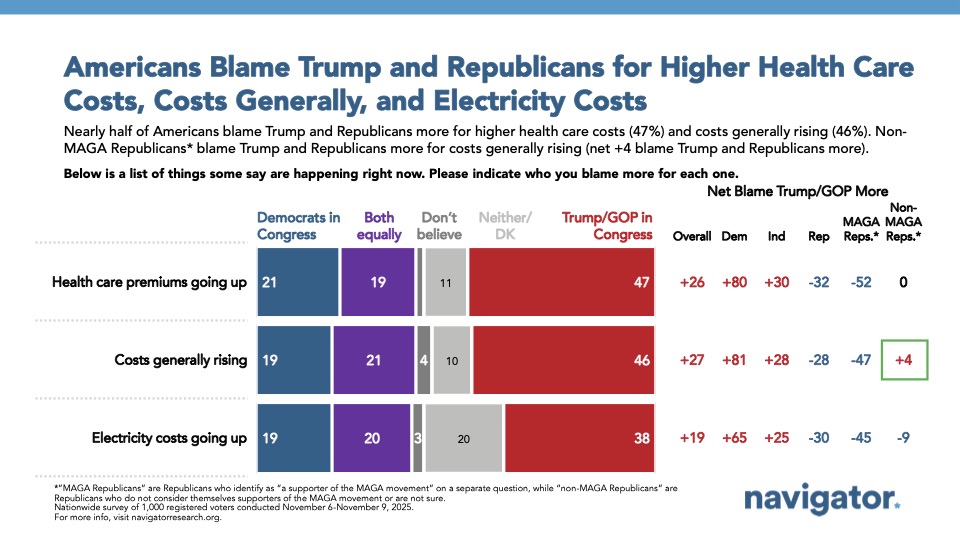
By a 21-point margin, Americans blame Trump and Republicans in Congress more than Democrats in Congress for rising costs. By a similar margin (net +22), Americans blame Trump and Congressional Republicans for health care premiums rising. Independents also blame Trump and Republicans more than Democrats for general costs rising, health care premiums rising, and the cost of electricity rising, but also say both parties are to blame.

Read More

June 4, 2026

Americans Are Split on How Safe our Food Is

This Navigator Research report covers perceptions of food safety and the health and wellness concerns that are top of mind for Americans.

Maryann Cousens
June 2, 2026

SPECIAL REPORT: LGBTQ+ Americans on President Trump and the Country

This Navigator Research report covers economic sentiment among LGBTQ+ Americans and how they view President Trump’s job performance across a range of issues.

Maryann Cousens & Tina Tang
May 22, 2026

Americans Want Major Change, But Aren’t Sure if Leaders Can Deliver

This Navigator Research report covers how Americans feel about democracy, institutions, and systems and whether anyone can fix them.

Julie Alderman Boudreau
May 21, 2026

Following Callais: Views on Supreme Court Remain Mixed But Reforms Are Popular

This Navigator Research report covers views of the Supreme Court and what type of reforms Americans support.

Tina Tang

How Americans’ Views of the Shutdown Changed

Poll: Government Shutdown

This Navigator Research report covers the latest views of the government shutdown and its impacts ahead of the Senate’s move to end the shutdown.

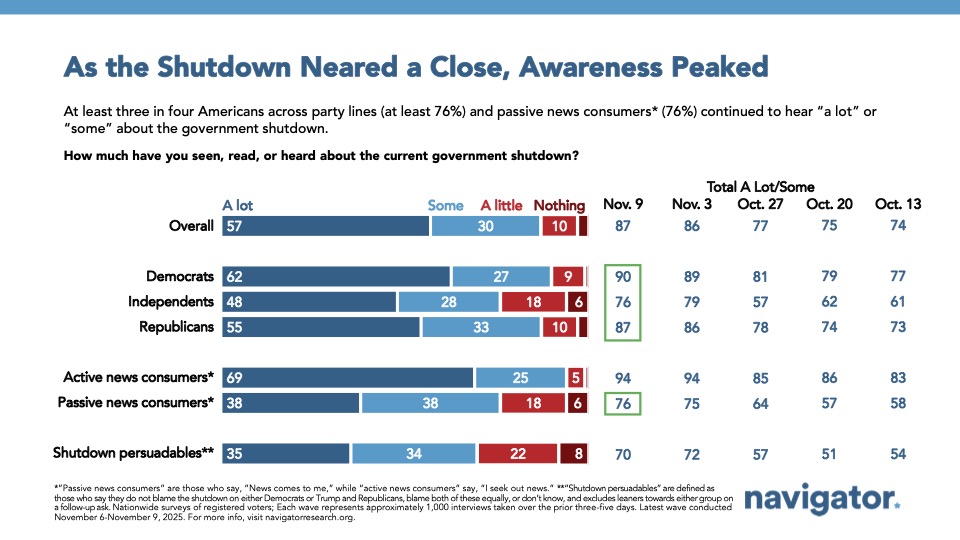
Over the weekend, 87% of Americans said they had now heard about the current government shutdown, including 57% who have heard “a lot.” This is a 47-point increase since September before the shutdown began. 85% were concerned by the government shutdown entering its 6th week with no clear end in sight.

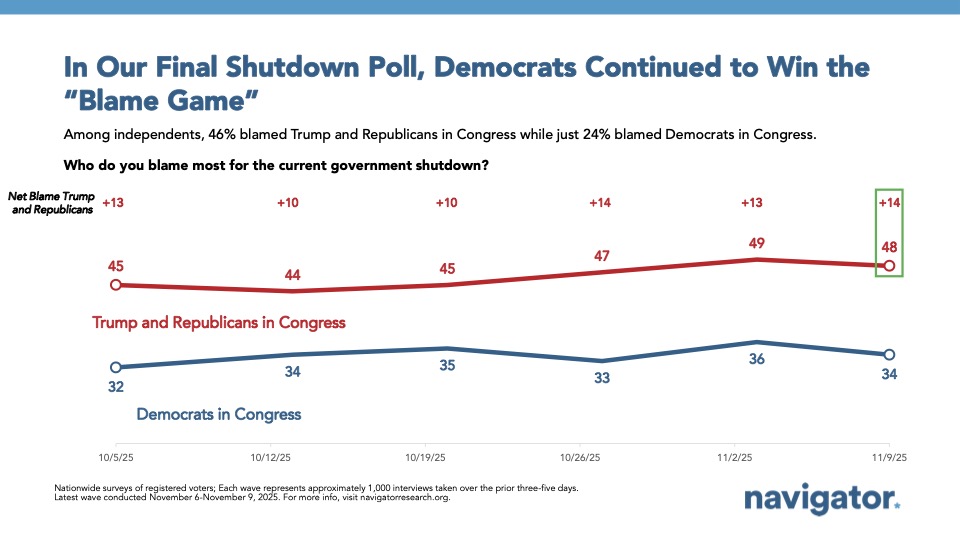
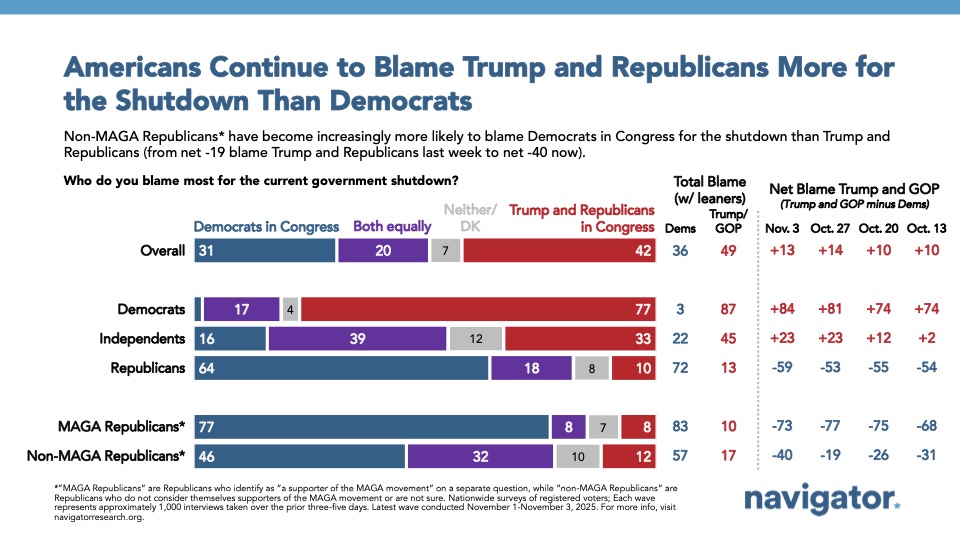
Blame for the shutdown remained overwhelmingly consistent over the last six weeks: Americans continued to place the blame on President Trump and Republicans in Congress (48%) more than Democrats in Congress (34%), including independents by 22 points.

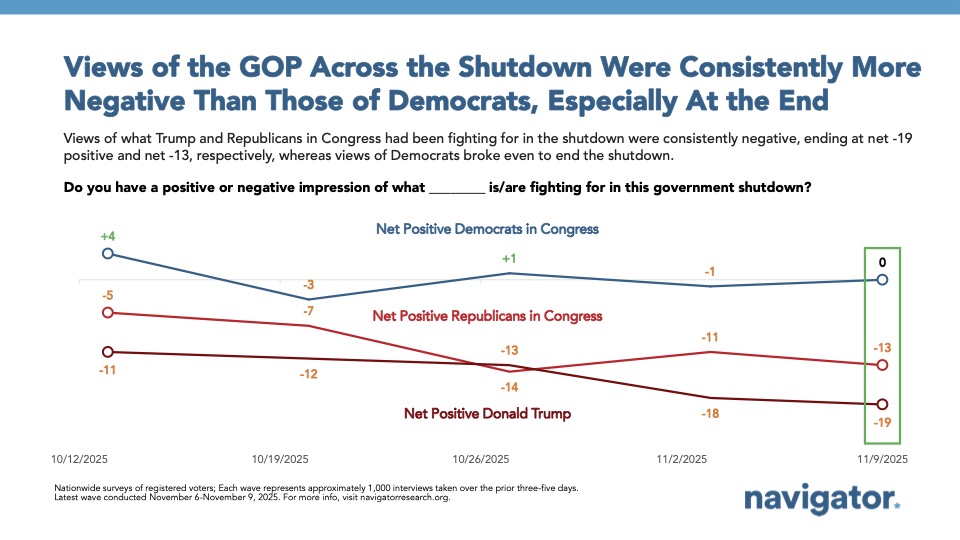
Views of what congressional Republicans and President Trump were fighting for in the shutdown worsened as it wore on, while views of what Democrats were fighting for broke even.

The Toll on Trump

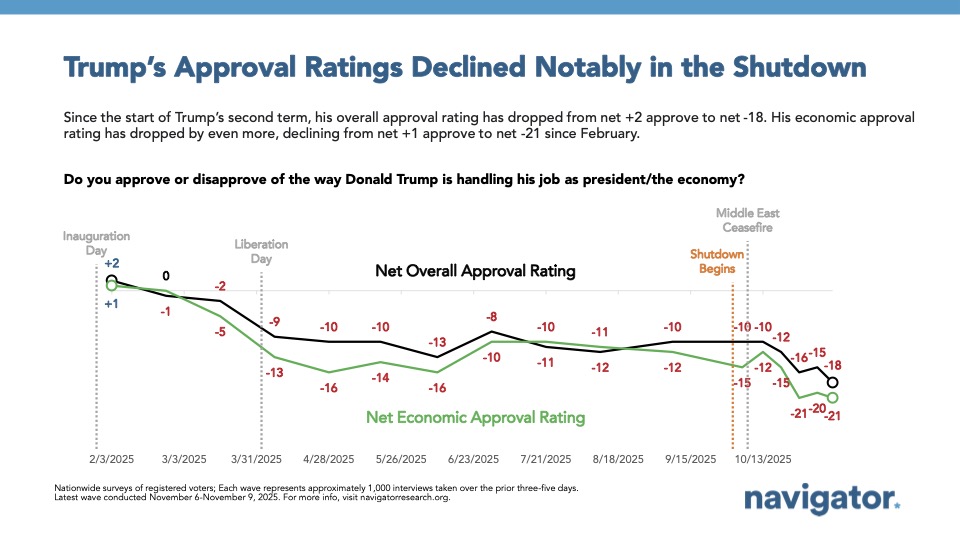
Over the course of the shutdown, a growing majority grew to disapprove of President Trump’s overall job approval (from -10 to -18) and his handling of the economy (from -15 to -21).

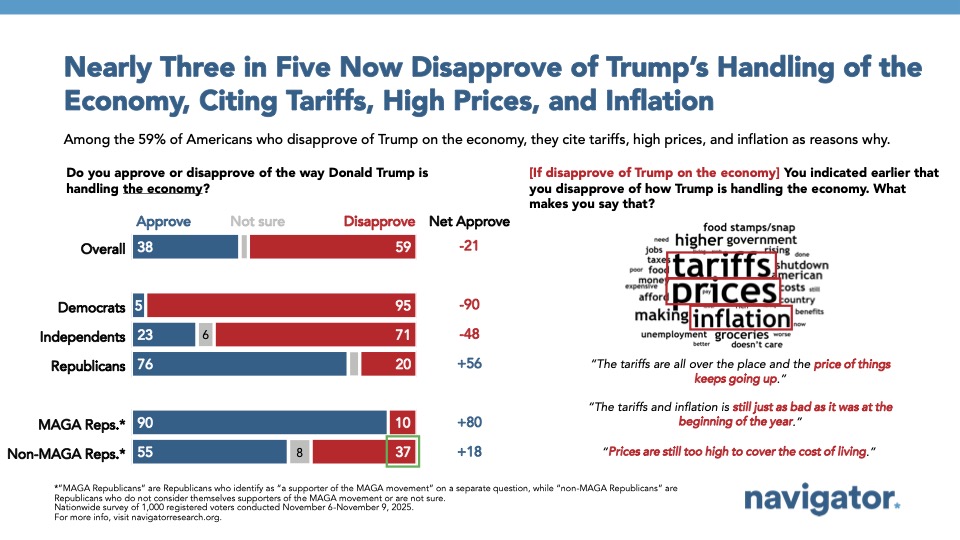
Those who disapprove of his handling of the economy cite “tariffs,” “prices,” and “inflation.”

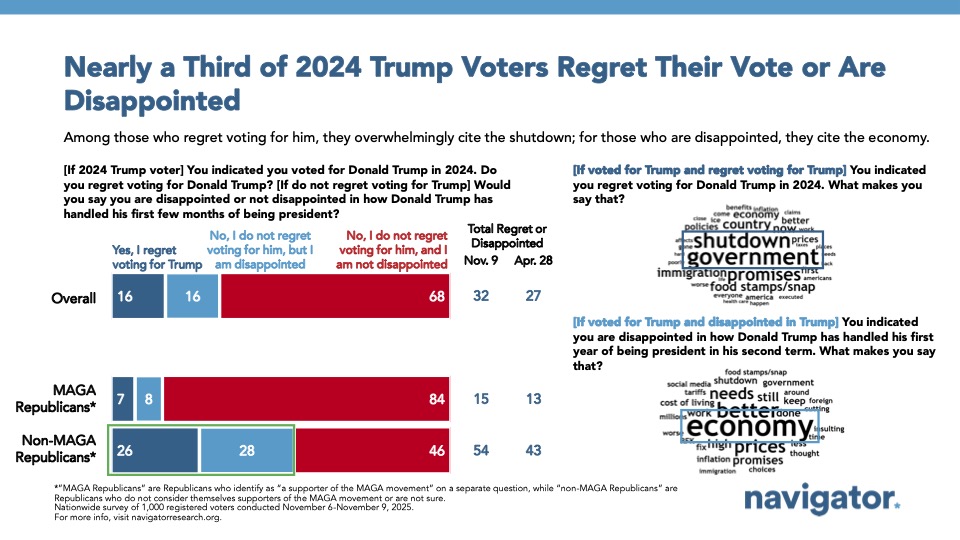
Among those who voted for Trump in the 2024 election, a third say they either regret voting for him (16%) or are disappointed (16%) in how he is handling being president. They point to both the government shutdown and the economy as reasons for their disappointment and regret.

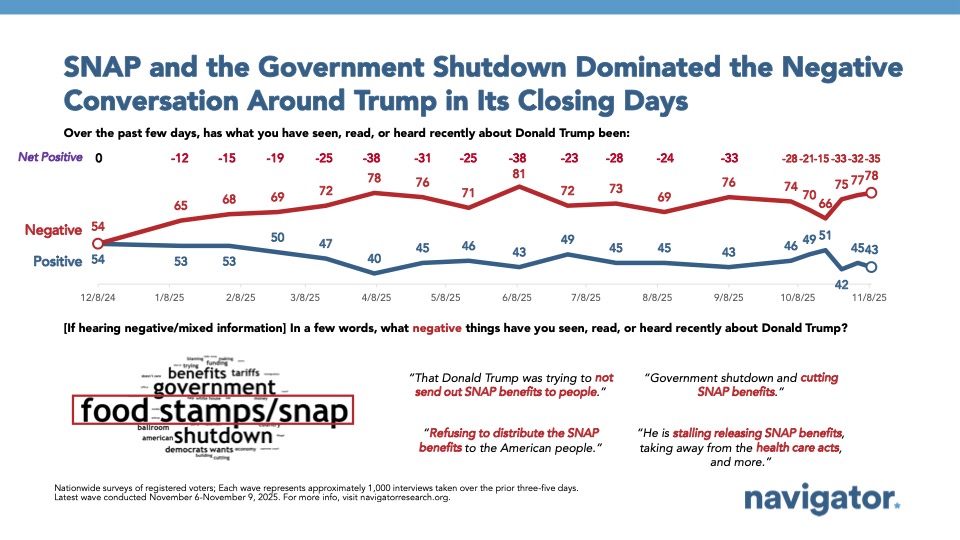
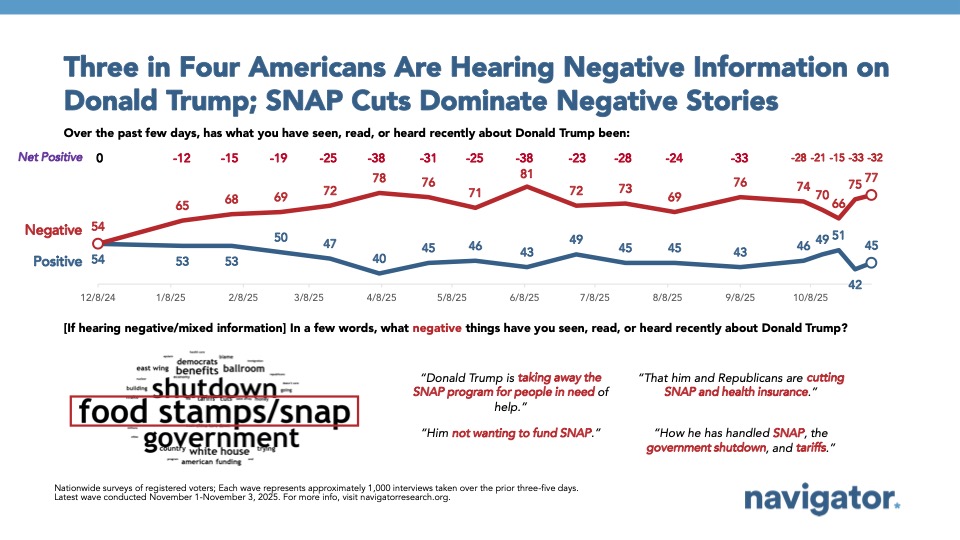
When it comes to the overall news Americans are hearing specifically about Trump, 78% say they are hearing negative news. News sentiment towards Trump has remained consistently negative throughout the course of the shutdown. When citing what negative news they are hearing, “SNAP” and “food stamps” dominate the conversation.

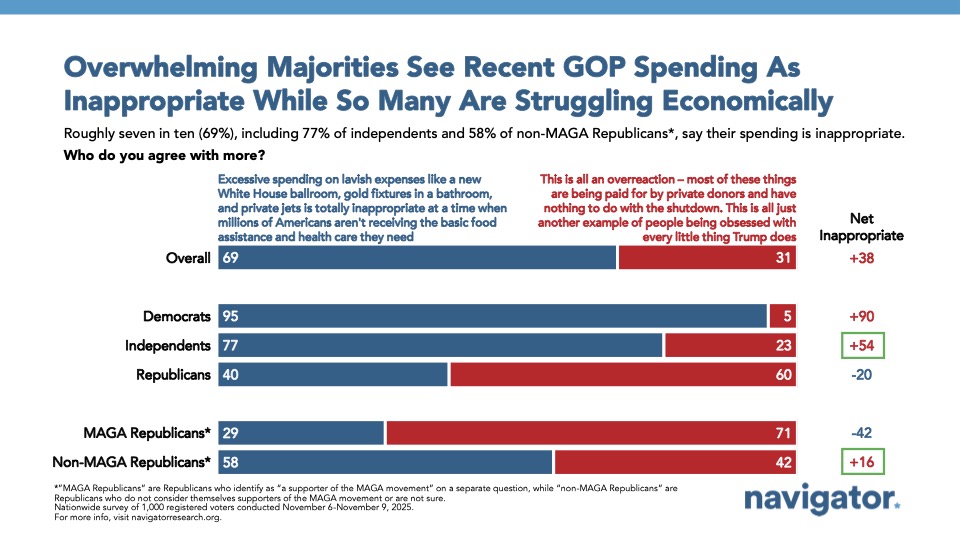
Americans overwhelming agreed (69%) that Trump’s excessive spending on lavish expenses like a new White House ballroom, gold fixtures in a bathroom, and private jets is inappropriate at a time when millions of Americans aren’t receiving the basic food assistance and health care they need – rejecting the narrative that these are unrelated to the shutdown or that they are permissible because they are paid for by private donors.

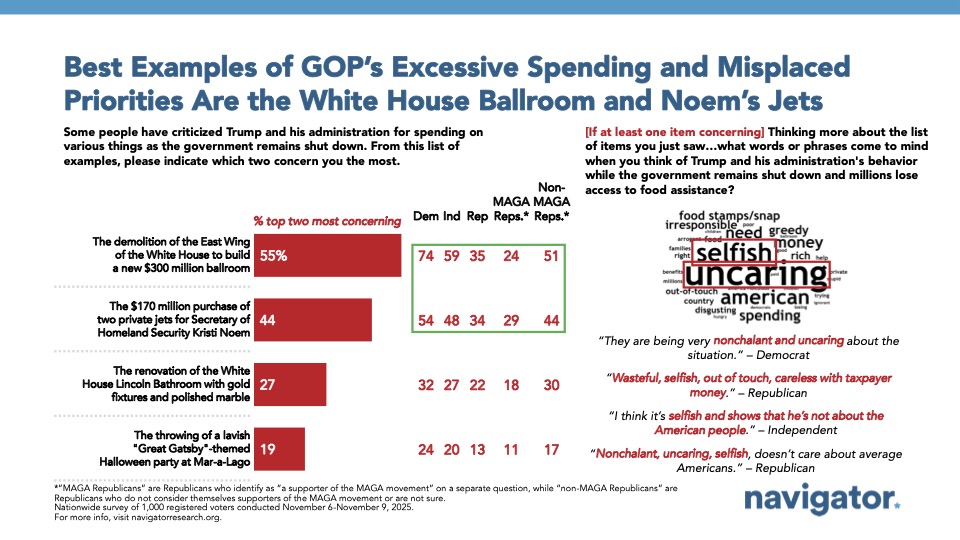
Americans describe the Trump Administration’s behavior as “selfish” and “uncaring” as the government remains shut down and millions lose access to food assistance.

Impact of the Shutdown

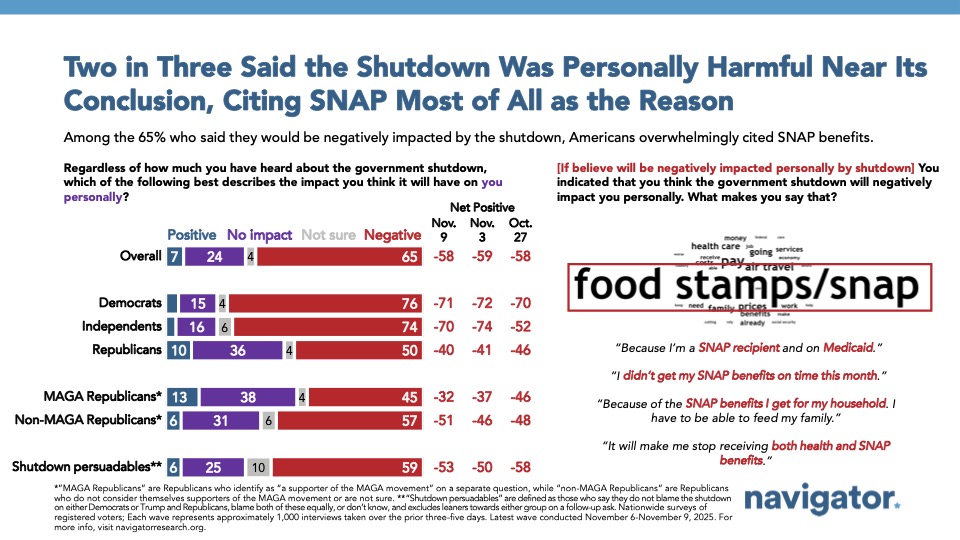
As the shutdown wore on, Americans increasingly believed it would have a negative impact on the country, up by 17 points from early October (68% to 85%). As SNAP’s funding lapse continued, more Americans also saw the government shutdown as negatively impacting them. The share who said the government shutdown would negatively impact them personally increased by 23 points over four weeks (from 42% to 65%). When asked why the shutdown would have a negative impact on them personally, “food stamps” and “SNAP” are overwhelmingly cited.

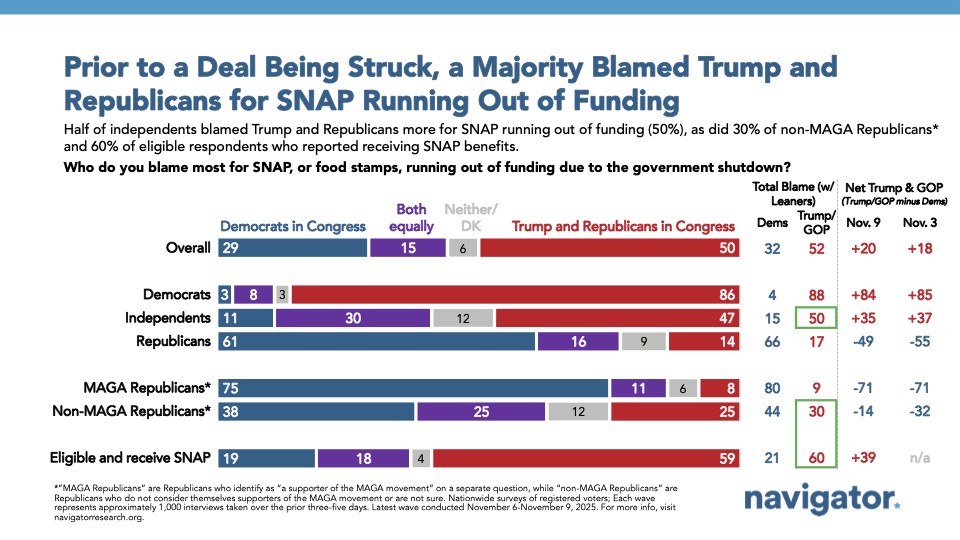
A majority blame Trump and Republicans in Congress for SNAP’s funding lapsing (52% blame Trump and Republicans – 32% blame Democrats in Congress), including 50% of independents. This has remained consistent throughout Navigator’s shutdown tracking.

The Latest on Health Care

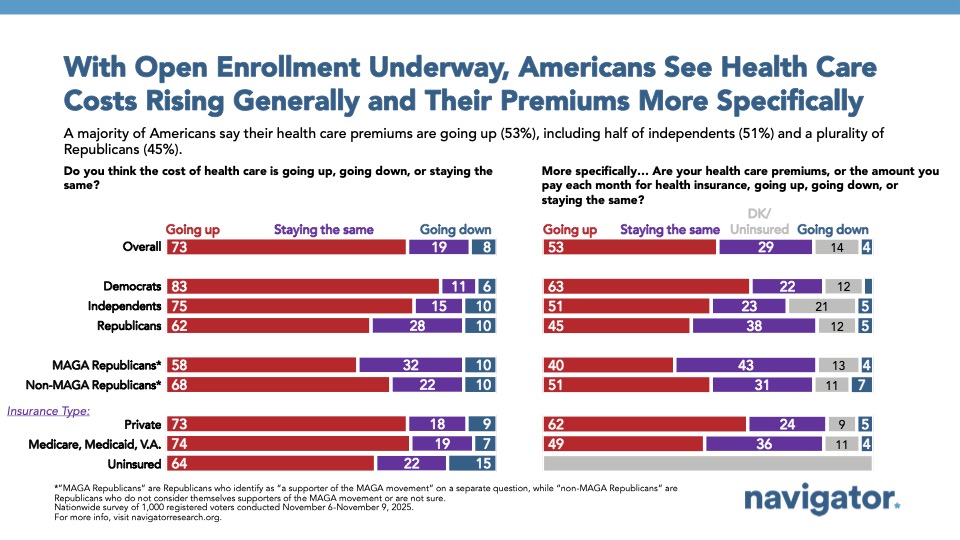
Following the start of open enrollment for millions of Americans, over seven in ten believe the cost of health care is going up (73%), a 13-point increase since July, and by a margin of 49 points Americans say their health care premiums are also going up. When asked about their top concerns about health care as it relates to the government shutdown, 38% cited the cost of health care doubling for 22 million Americans, and 38% cited nearly 5 million Americans losing their health insurance completely.

By a 26-point margin, Americans blame Trump and Republicans in Congress (47%) more than Democrats in Congress (21%) for health care premiums going up.

Read More

June 4, 2026

Americans Are Split on How Safe our Food Is

This Navigator Research report covers perceptions of food safety and the health and wellness concerns that are top of mind for Americans.

Maryann Cousens
June 2, 2026

SPECIAL REPORT: LGBTQ+ Americans on President Trump and the Country

This Navigator Research report covers economic sentiment among LGBTQ+ Americans and how they view President Trump’s job performance across a range of issues.

Maryann Cousens & Tina Tang
May 22, 2026

Americans Want Major Change, But Aren’t Sure if Leaders Can Deliver

This Navigator Research report covers how Americans feel about democracy, institutions, and systems and whether anyone can fix them.

Julie Alderman Boudreau
May 21, 2026

Following Callais: Views on Supreme Court Remain Mixed But Reforms Are Popular

This Navigator Research report covers views of the Supreme Court and what type of reforms Americans support.

Tina Tang

Government Shutdown Week 5: A Guide for Advocates

Poll: Government Shutdown

This Navigator Research report covers awareness of and blame for the government shutdown and message guidance following SNAP’s lapse in funding.

Shutdown Awareness Hits High; Trump and Republican Draw Blame

86% of Americans have now heard about the current government shutdown, including 56% who have heard “a lot.” This is a nine-point overall increase from last week, where 77% had heard about the shutdown, and a 10-point increase in the share who are hearing “a lot” (from 46% to 56%). It’s a 46-point increase since September before the shutdown began.

Passive news consumers in particular say they are hearing significantly more about the shutdown since last week (from 64% to 75%), and the share hearing “a lot” about it has grown 11 points (from 29% to 41%).

By a 13-point margin, Americans blame President Trump and Republicans in Congress more for the government shutdown than Democrats in Congress, remaining consistent through Navigator’s shutdown tracking.

When it comes to the overall news Americans are hearing specifically about Trump, 77% say they are hearing negative news. When citing what negative news they are hearing, “SNAP” and “food stamps” dominate the conversation. When asked in the specific context of what they see parties fighting for in the shutdown, health care is still dominant.

86% also say they have heard about SNAP running out of funding and millions potentially losing access to food assistance, including 66% who have heard “a lot” about it.

SNAP’s Lapse

The shutdown’s impact on food assistance programs is driving public concern — especially around SNAP. Following the funding lapse, more Americans see the government shutdown as negatively impacting them. Nearly two in three believe the government shutdown will negatively impact them personally (65%), an over 23-point increase from three weeks ago when just 42% said the shutdown would negatively impact them. When asked why the shutdown would have a negative impact on them personally, “food stamps” and “SNAP” emerge as the top reasons cited.

Over eight in ten Americans view “SNAP, formerly known as food stamps” favorably (81%), including majorities of Democrats (94%), independents (76%), and Republicans (68%).

A majority blame Trump and Republicans in Congress for SNAP’s funding lapsing (51% blame Trump and Republicans – 33% blame Democrats in Congress), including 53% of independents.

The Latest on Health Care

Amid the start of open enrollment for millions of Americans, over seven in ten believe the cost of health care is going up (72%), a 12-point increase since July. Across insurance types — whether through private insurance or a government program — more than seven in ten say the cost is going up.

By a 28-point margin, Americans blame Trump and Republicans in Congress more than Democrats in Congress for health care premiums going up (48% blame Trump and Republicans – 20% blame Democrats).

Americans see health care as what Democrats in Congress are fighting for in the government shutdown, though Americans with a negative impression of what Democrats are fighting for cite both “health care” and “illegal.”

Shutdown Impacts

Americans are overwhelmingly hearing and concerned about the impacts of the shutdown, specifically health care costs rising and Americans losing health care coverage (78% concerned) and SNAP or food stamps running out of funding (77% concerned).

Specific consequences related to the loss of food assistance and health care costs are overwhelmingly concerning, in particular:

42 million Americans losing food assistance, including 16 million children (81% concerning, 66% extremely concerning);

Some families losing access to food assistance (79% concerning, 66% extremely concerning);

Families on SNAP having to decide between paying for food and paying their rent, their electricity bills, or for their prescriptions (77% concerning, 64% extremely concerning); and,

The cost of health insurance doubling for Americans (79% concerning, 63% extremely concerning).

The Latest Messaging

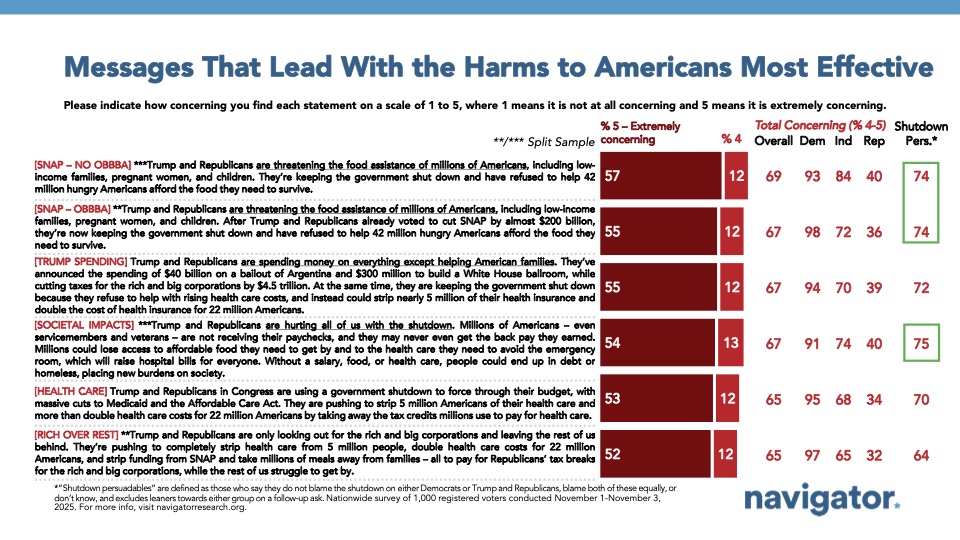
Two in three find Trump and Republicans’ actions in relation to the shutdown concerning, whether it is the loss of food assistance or health care for millions of Americans or their wasteful spending. President Trump and Republicans in Congress are:

  • Threatening the food assistance of millions of Americans, including low-income families, pregnant women, and children.
    • They’re keeping the government shut down and have refused to help 42 million hungry Americans afford the food they need to survive (69% concerning);
  • Spending money on everything except helping American families.
    • They’ve announced the spending of $40 billion on a bailout of Argentina and $300 million to build a White House ballroom, while cutting taxes for the rich and big corporations by $4.5 trillion.
    • At the same time, they are keeping the government shut down because they refuse to help with rising health care costs, and instead could strip nearly 5 million of their health insurance and double the cost of health insurance for 22 million Americans (67% concerning); and,
  • Using a government shutdown to force through their budget, with massive cuts to Medicaid and the Affordable Care Act.
    • They are pushing to strip 5 million Americans of their health care and more than double health care costs for 22 million Americans by taking away the tax credits millions use to pay for health care (65% concerning).

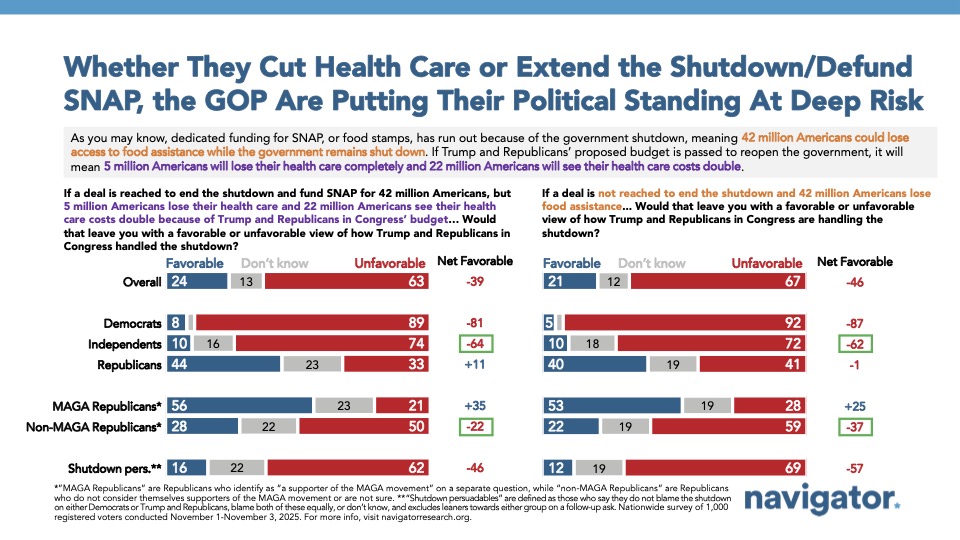
With or without a deal to reopen the government, majorities say they will view Republicans more unfavorably. If the government is reopened without a deal to restore health care, 63% say they will view Trump and Republicans’ handling of the shutdown unfavorably.

A similar 67% say they will have an unfavorable view if the government remains closed and 42 million people lose SNAP. More Republicans say they will view Trump and Republicans unfavorably in this scenario rather than if the government reopens without a deal to protect health care.

Read More

June 4, 2026

Americans Are Split on How Safe our Food Is

This Navigator Research report covers perceptions of food safety and the health and wellness concerns that are top of mind for Americans.

Maryann Cousens
June 2, 2026

SPECIAL REPORT: LGBTQ+ Americans on President Trump and the Country

This Navigator Research report covers economic sentiment among LGBTQ+ Americans and how they view President Trump’s job performance across a range of issues.

Maryann Cousens & Tina Tang
May 22, 2026

Americans Want Major Change, But Aren’t Sure if Leaders Can Deliver

This Navigator Research report covers how Americans feel about democracy, institutions, and systems and whether anyone can fix them.

Julie Alderman Boudreau
May 21, 2026

Following Callais: Views on Supreme Court Remain Mixed But Reforms Are Popular

This Navigator Research report covers views of the Supreme Court and what type of reforms Americans support.

Tina Tang

Focus Group Report: Americans and Political Dysfunction

Focus Groups: Americans and Political Dysfunction

This Navigator Research report covers findings from focus groups conducted on October 23rd among Americans in closely-divided House battleground districts who believe the political system is broken.

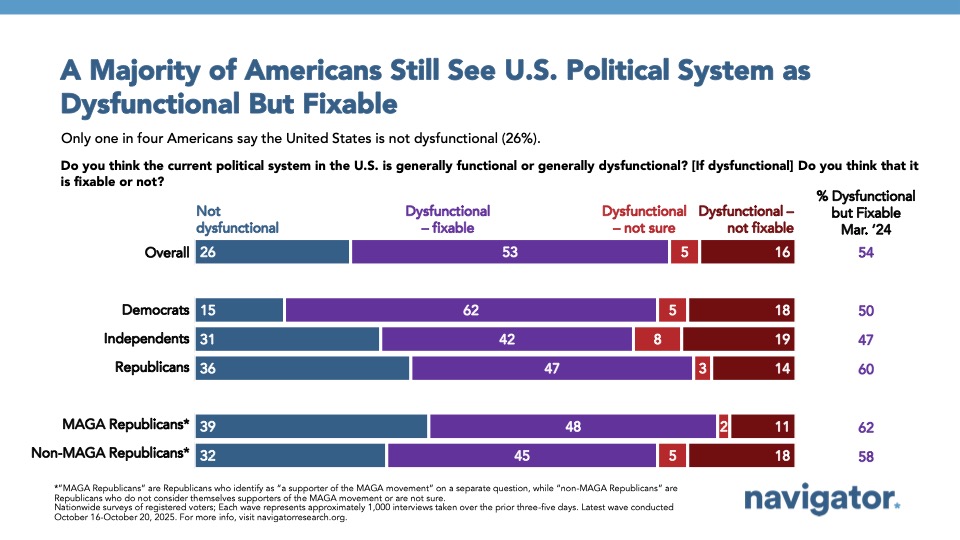
Just over two weeks into the government shutdown, Navigator asked Americans if they believe the U.S. government is generally functional or dysfunctional–and if dysfunctional, if it’s fixable. Overwhelmingly, we found Americans believe the U.S. government is dysfunctional (74 percent) and half say it is fixable (53 percent). An identical share said the government was dysfunctional, but fixable in March of last year, a clear sign that this is not purely shutdown related. We conducted focus groups with Americans who reflect this sentiment to understand what exactly they find dysfunctional and what solutions they believe will fix the brokenness.

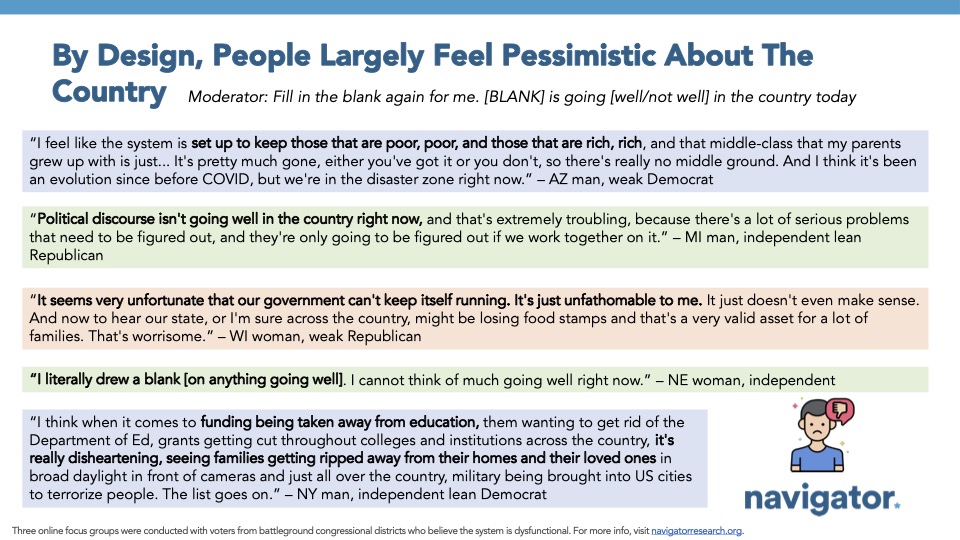
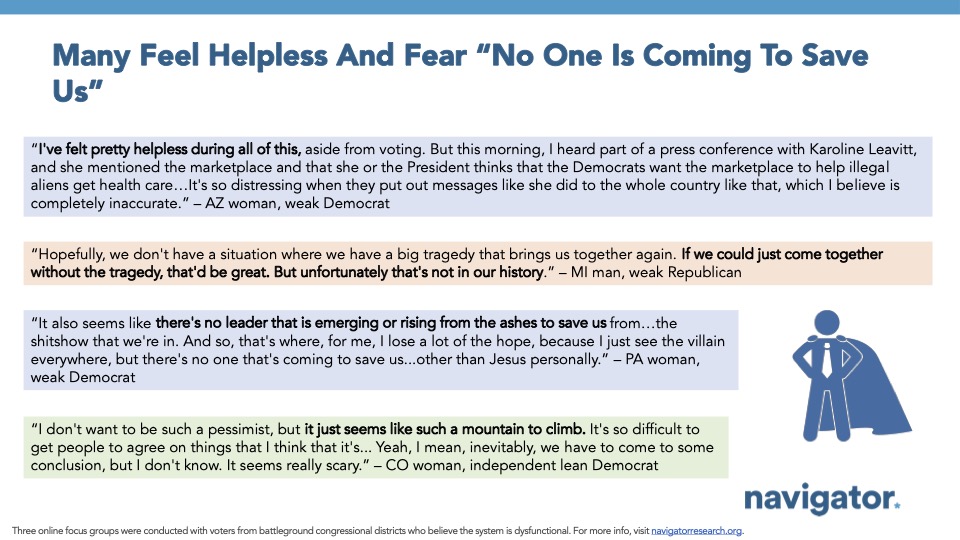
Among participants who believe the political system is dysfunctional, all felt pessimistic about the state of the country today, particularly when it came to issues related to the economy and health care.

“I feel like the system is set up to keep those that are poor, poor, and those that are rich, rich, and that middle-class that my parents grew up with is just… It’s pretty much gone, either you’ve got it or you don’t, so there’s really no middle ground. And I think it’s been an evolution since before COVID, but we’re in the disaster zone right now.”

– AZ man, weak Democrat

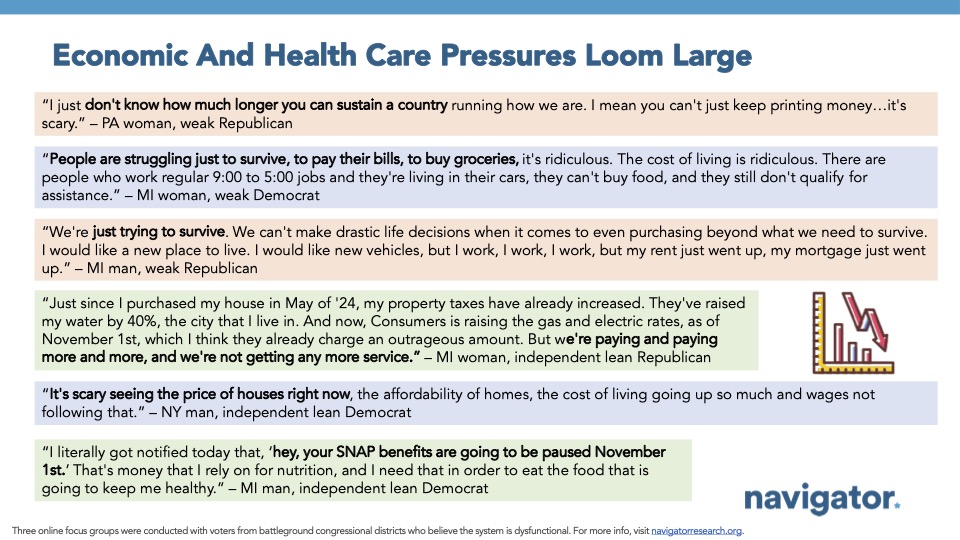
Financial stressors are of top concern.

“People are struggling just to survive, to pay their bills, to buy groceries, it’s ridiculous. The cost of living is ridiculous. There are people who work regular 9:00 to 5:00 jobs and they’re living in their cars, they can’t buy food, and they still don’t qualify for assistance.” – MI women, weak Democrat

“I literally got notified today that, ‘hey, your SNAP benefits are going to be paused November 1st.’ That’s money that I rely on for nutrition, and I need that in order to eat the food that is going to keep me healthy.” – MI man, independent lean Democrat

When prompted, democracy is seen as under threat, with participants citing a range of reasons including President Trump, political division, and government dysfunction.

“Well, first of all, again, we’re in a government shutdown. So how does that look to all the other countries in Europe, Russia, China? United States is weak. They can’t even run their country. They can’t even keep it running. All they’re doing is arguing between both sides. So how does that make us look as a superpower?” – WI woman, weak Republican

“I think we’ve seen a lot of ways that the law system hasn’t been as strong as we might’ve thought it was through Trump’s presidency and the way he’s used executive orders and other things. And I think we found a lot more holes in the system than I thought there were personally. I thought there were more checks and balances than have shown themselves.” – PA man, weak Democrat

“I think unambiguously, democracy is under threat. It’s going to take a while to see the impact of the taxes and the other economic policies. It will definitely get worse, whether it will teeter and fall, can’t say.” – NY man, independent lean Democrat

Democratic-leaning participants blame Trump and Republicans for their pessimism about the country’s future. 

“When you see your elected leader villainizing or arresting or pressing charges against political opponents and cleaning house to surround themselves with all yes-men that would never dare to oppose their decisions, it’s scary to see the damage that that can do to a government that’s supposed to represent the people when both sides of the coin aren’t being represented.” – NY man, independent lean Democrat

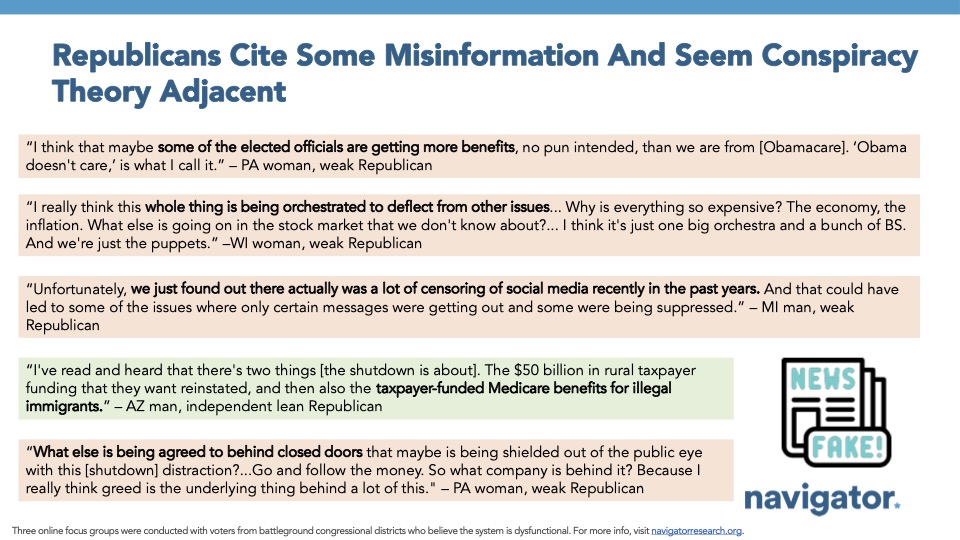
Republican-leaning participants cite some misinformation. Participants across groups express the sentiment that political figures make decisions for personal gain and greed.

I’ve read and heard that there’s two things [the shutdown is about]. The $50 billion in rural taxpayer funding that they want reinstated, and then also the taxpayer-funded Medicare benefits for illegal immigrants.” – AZ man, independent lean Republican

“What else is being agreed to behind closed doors that maybe is being shielded out of the public eye with this [shutdown] distraction?…Go and follow the money. So what company is behind it? Because I really think greed is the underlying thing behind a lot of this.” – PA woman, weak Republican

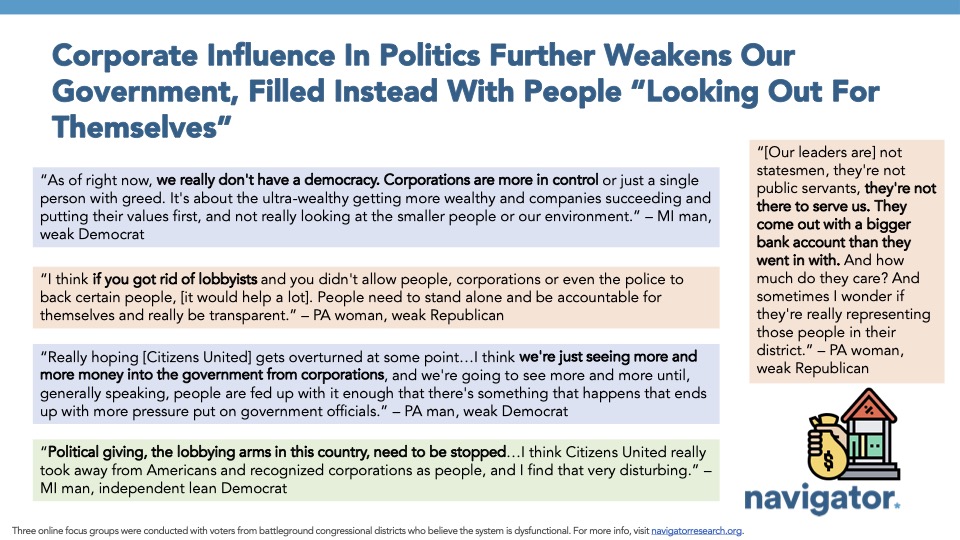
Participants see corporate influence as weakening democracy. Many view corporations and lobbying groups as having more control over the government than everyday Americans–leading many to a feeling of hopelessness.

“As of right now, we really don’t have a democracy. Corporations are more in control or just a single person with greed. It’s about the ultra-wealthy getting more wealthy and companies succeeding and putting their values first, and not really looking at the smaller people or our environment.” – MI man, weak Democrat

“[Our leaders are] not statesmen, they’re not public servants, they’re not there to serve us. They come out with a bigger bank account than they went in with. And how much do they care? And sometimes I wonder if they’re really representing those people in their district.” – PA woman, weak Republican

With many participants feeling helpless about the state of the country and democracy, some hope for a political leader who can unite.

“I don’t want to be such a pessimist, but it just seems like such a mountain to climb. It’s so difficult to get people to agree on things that I think that it’s… Yeah, I mean, inevitably, we have to come to some conclusion, but I don’t know. It seems really scary.” – CO woman, independent lean Democrat

“I’ve felt pretty helpless during all of this, aside from voting. But this morning, I heard part of a press conference with Karoline Leavitt, and she mentioned the marketplace and that she or the President thinks that the Democrats want the marketplace to help illegal aliens get healthcare…It’s so distressing when they put out messages like she did to the whole country like that, which I believe is completely inaccurate.” – AZ women, weak Democrat

“I just think a united joint front, instead of these polarizing radicalizing statements. I think our leaders should be demonstrating to people that, ‘hey, I don’t agree with them, but I can be civil and we can have a conversation.’ And it should be a very united front.” – PA woman, weak Republican

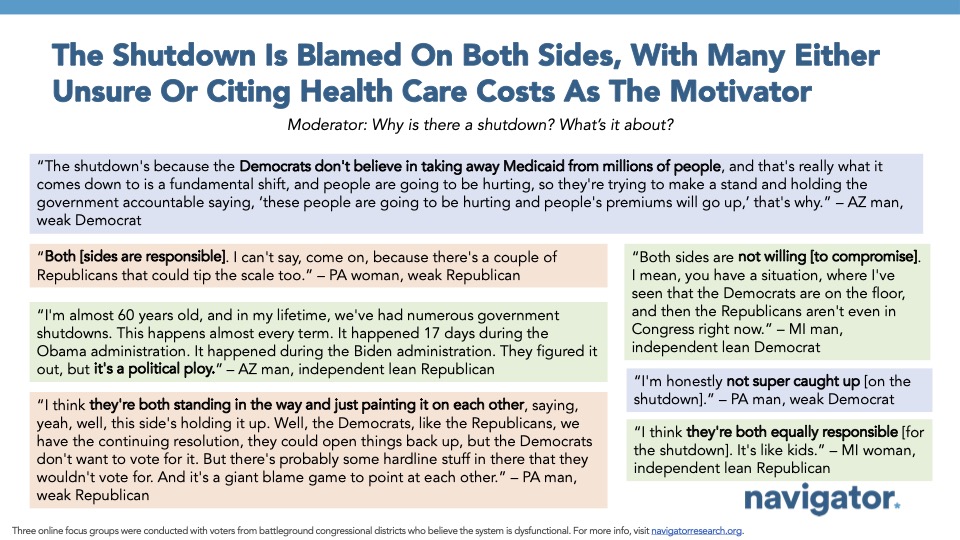
Participants see the government shutdown as another example of political dysfunction and division, though some acknowledge the shutdown fight is about protecting health care.

“The shutdown’s because the Democrats don’t believe in taking away Medicaid from millions of people, and that’s really what it comes down to is a fundamental shift, and people are going to be hurting, so they’re trying to make a stand and holding the government accountable saying, these people are going to be hurting and people’s premiums will go up,’ that’s why.” – AZ man, weak Democrat

“Yeah, I think they’re both standing in the way and just painting it on each other, saying, yeah, well, this side’s holding it up. Well, the Democrats, like the Republicans, we have the continuing resolution, they could open things back up, but the Democrats don’t want to vote for it. But there’s probably some hardline stuff in there that they wouldn’t vote for. And it’s a giant blame game to point at each other.” – PA man, weak Republican

“I think they’re both equally responsible [for the shutdown]. It’s like kids. – MI woman, independent lean Republican

Read More

May 28, 2026

Focus Group Report: Black Americans on Leadership and Voting

This Navigator Research report covers focus groups that explored how Black Americans view the state of the country, elected leaders in Washington, and voting in the wake of the Supreme Court’s Callais decision.

Maryann Cousens
May 10, 2026

What Moms Want: Affordable Healthcare and a Better Economy

This Navigator Research Report covers how mothers across the country are feeling about the economy and healthcare, including their specific pain points and who they trust more on the issues

Maryann Cousens
May 5, 2026

Focus Group Report Pt 2: Healthcare Providers Diagnose the American Healthcare System

This Navigator Research report focuses on how Americans view the healthcare system and their greatest pain points.

Tina Tang
May 4, 2026

Focus Group Report Pt 1: Patients’ Views on the Broken Healthcare System

This Navigator Research report focuses on how Americans view the healthcare system and their greatest pain points.

Maryann Cousens