State of the Shutdown: Families are Paying the Price for GOP Chaos

State of the Shutdown: Families are Paying the Price for GOP Chaos

Understanding The Moment:

It has been a month since congressional Republicans shut down the federal government rather than work with their Democratic colleagues to stop upcoming hikes in health insurance premiums. This weekend, more than 20 million people who buy health insurance on their own will face higher health insurance costs. Because Republicans are demanding an end to health care tax credits, average premiums for ACA enrollees are rising by more than $1,000 a yearmore than double what many people are currently paying. Meanwhile, over 42 million people, including millions of children, will go without food assistance in November due to Republican inaction.

This was never about a “win” for Democrats or Republicans. But, this is a loss for the American people and Republicans now own the rate hikes and price increases that Americans are feeling all over the country

These consequences stem directly from Republicans’ outright opposition to bipartisan problem-solving. Democratic officials have an opportunity to offer a clear contrast — focusing on lowering costs for working families by funding SNAP and making health care more affordable.

Topline Points:

  1. Millions of Americans are struggling with skyrocketing health care costs and rising food prices.
  2. While congressional Democrats have been fighting to lower essential costs for families and ensure no American goes hungry, Trump and Republicans in Congress have shut down the government rather than stop a hike in health insurance costs for millions of Americans.
    • Democrats tried to fund SNAP so parents can put food on the table for their family, but Republicans blocked it.
    • The money exists for SNAP funding, but Republicans are willing to see families go hungry instead of reaching a bipartisan solution.
  3. Congressional Republicans could end the shutdown today by coming to the negotiating table and abandoning their demand to cut health care, but they have opposed every bipartisan solution.
    • They’re willing to let kids and families go hungry rather than working with Democrats to lower health care costs.
  4. As the shutdown drags on, Trump and Republicans are spending money on everything except what helps struggling American families:
    1. $40 billion on a bailout of Argentina;
    2. $170 million on two private jets for Secretary of Homeland Security Kristi Noem;
    3. $300 million to build a White House ballroom

Further Guidance for Democratic Officials:

  • Democrats should clearly and consistently communicate their support of continuing SNAP to help feed struggling families during the shutdown. This week’s research found that more than 70% of Americans have heard at least some about SNAP funding expiring this weekend. It is now a top concern, along with increased health care costs. Democrats must remind Americans about their support for the program and Republicans’ opposition – such as Senate Republicans’ move to block SNAP funding during the government shutdown and the Republican Tax Law’s massive cuts to the program.
  • Democrats should underscore their priorities – lowering essential costs and supporting families in need – with Republican priorities: self-enrichment and wasteful government spending that benefits the wealthy few instead of the many who are struggling. Navigator found Americans feel overwhelmingly negative about many of the GOP’s recent priorities, including Secretary Noem’s private plane purchases, Trump’s $300 million ballroom vanity project, and the administration’s $40 billion Argentine bailout (which is quite unpopular even among Republicans).
  • Democrats should be clear that they will not cave on lowering health care costs. Polling from week two of the shutdown found Americans wanted the shutdown to end, but not if it meant compromising on health care. Similarly, this week’s research found 62% would have a favorable view of how Democrats handled the shutdown if they reach a deal restoring health care. However, if Democrats decide to reopen the government while failing to reach a deal, 59% would view their actions unfavorably.
  • Democrats should continue to go everywhere to reach passive news consumers – those less likely to follow political coverage. Only 66% of passive news consumers have heard about the government shutdown compared to 75% of all Americans. Democrats should continue to think outside the box to reach passive news consumers. Lawmakers are leading by example, including:
    • Rep. Angie Craig (D-MN) posted a video on her Instagram with former Centers for Medicare and Medicaid Services Director Chiquita Brooks-LaSure to discuss Republican health care cuts.
    • Sen. Chris Murphy (D-CT) hosted a Reddit AMA on the shutdown that reached thousands of people on the platform.
    • Rep. Greg Landsman (D-OH) shared a Substack post about his conversations with Ohioans impacted by the shutdown.

Read More

April 22, 2026

Fraud Is Real. Cuts Are Worse. How to Win This Fight.

While Americans are worried about both fraud and budget cuts, when forced to choose they are far more worried about cuts. Denying, dismissing, or minimizing fraud works against us.

Tina Tang
April 14, 2026

Views on Republican Tax Policies

This Navigator Research report covers how Americans feel about taxes, including the Republican tax law.

Julie Alderman Boudreau
April 9, 2026

Americans Oppose an “Expensive,” “Unnecessary,” and “Dangerous” War with Iran

This Navigator Research report covers Americans’ views on the ongoing war with Iran.

Melissa Toufanian & Aidan Harty

Government Shutdown Week 4: Message Guidance

Poll: Government Shutdown

This Navigator Research report covers the latest messaging guidance regarding the government shutdown.

The White House’s Priorities During the Continued Shutdown

Over three quarters of Americans oppose the U.S. spending $170 million on private jets for Secretary of Homeland Security Kristi Noem (76 percent), including 62 percent who “strongly” oppose. Similar spending projects garner strong opposition, including the White House ballroom project (70 percent oppose, 59 percent “strongly” oppose), the U.S. passing new tax cuts for billionaires (72 percent oppose, 59 percent “strongly” oppose), and the U.S. bailing out Argentina’s economy (76 percent oppose, 57 percent “strongly” oppose).

Bar charts from Navigator Research. Title: Bipartisan Majorities Oppose a Range of Recent Trump Spending, From Private Jets to a New Ballroom to Bailing Out Argentina

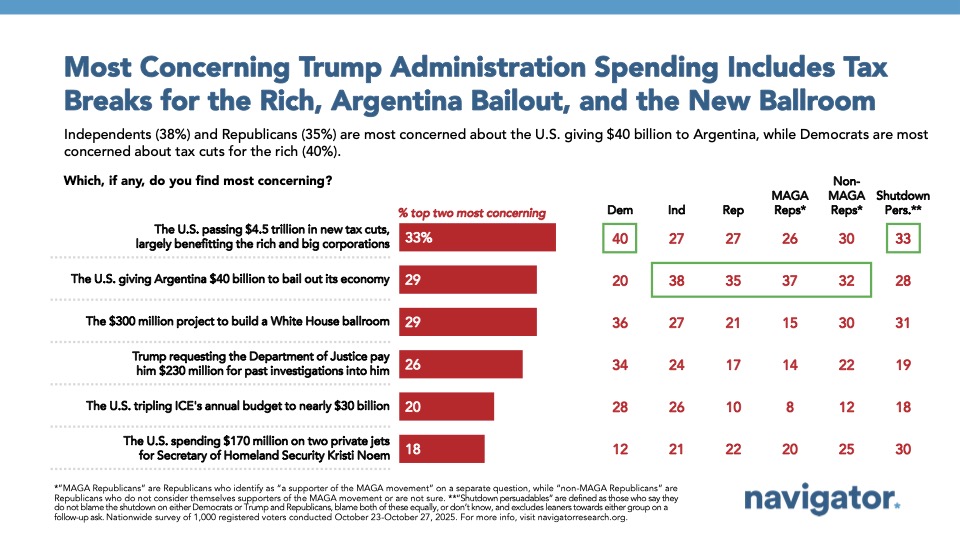
When asked to pick the two most concerning actions, 33 percent are most concerned by the U.S. passing $4.5 trillion in new tax breaks for the wealthy, largely driven by Democrats (40 percent). 29 percent are concerned by both the bail out for Argentina and the White House ballroom project, however the Argentina bail out is most concerning to independents (38 percent) and Republicans (35 percent) indicating this could be a wedge issue among Trump and Republicans. Republicans are most opposed to the U.S. bailing out Argentina’s economy (66 percent oppose) and the spending of millions on private jets for Department of Homeland Security Secretary Kristi Noem (60 percent oppose).

Bar charts from Navigator Research. Title: Most Concerning Trump Administration Spending Includes Tax Breaks for the Rich, Argentina Bailout, and the New Ballroom

The most bothersome aspects of recent government spending include:

  • We’re spending money on those items, while millions of Americans do not receive their paychecks and some will not receive back pay, and thousands will lose their jobs permanently (35 percent)
  • We’re spending money on those items, while millions of Americans will lose their health care completely and millions more will see their health care costs double (33 percent)

Messaging About Waste and the Shutdown

A message highlighting recent wasteful government spending resonates more strongly when tied to the government shutdown:

Trump and Republicans are spending money on everything except what benefits American families. In the last few weeks, they’ve announced the spending of $40 billion on a bailout of Argentina, $170 million on two private jets for Secretary of Homeland Security Kristi Noem, and $300 million to build a White House ballroom. At the same time, they are keeping the government shut down because they refuse to help Americans with rising health care costs, and instead could strip nearly 5 million of their health insurance and double the cost of health insurance for millions more.

Bar charts from Navigator Research. Title: Top Contrasts to Trump’s Spending on the Ballroom, Argentina Are Americans Losing Their Jobs, Paychecks, and Health Care

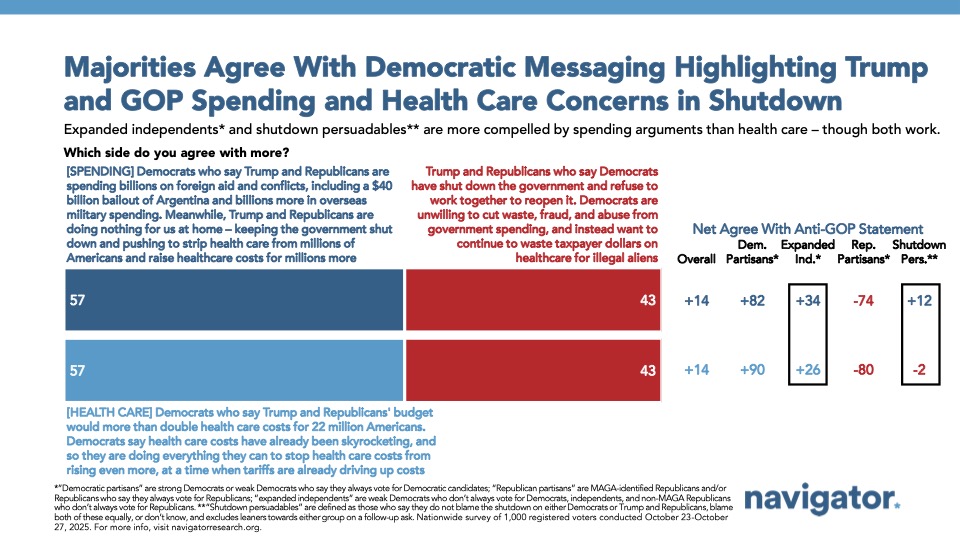
Against the conservative argument that “Democrats have shut down the government and refuse to work together to reopen it. Democrats are unwilling to cut waste, fraud, and abuse from government spending, and instead want to continue to waste taxpayer dollars on health care for illegal aliens,” Americans agree more with progressive messages, whether the focus is health care costs or foreign spending:

  • Trump and Republicans are spending billions on foreign aid and conflicts, including a $40 billion bailout of Argentina and billions more in overseas military spending. Meanwhile, Trump and Republicans are doing nothing for us at home – keeping the government shut down and pushing to strip health care from millions of Americans and raise health care costs for millions more (net +14)
  • Trump and Republicans’ budget would more than double health care costs for 22 million Americans. Democrats say health care costs have already been skyrocketing, and so they are doing everything they can to stop health care costs from rising even more, at a time when tariffs are already driving up costs (net +14)
Bar charts from Navigator Research. Title: Majorities Agree With Democratic Messaging Highlighting Trump and GOP Spending and Health Care Concerns in Shutdown

Focus on the Right or Wrong Things

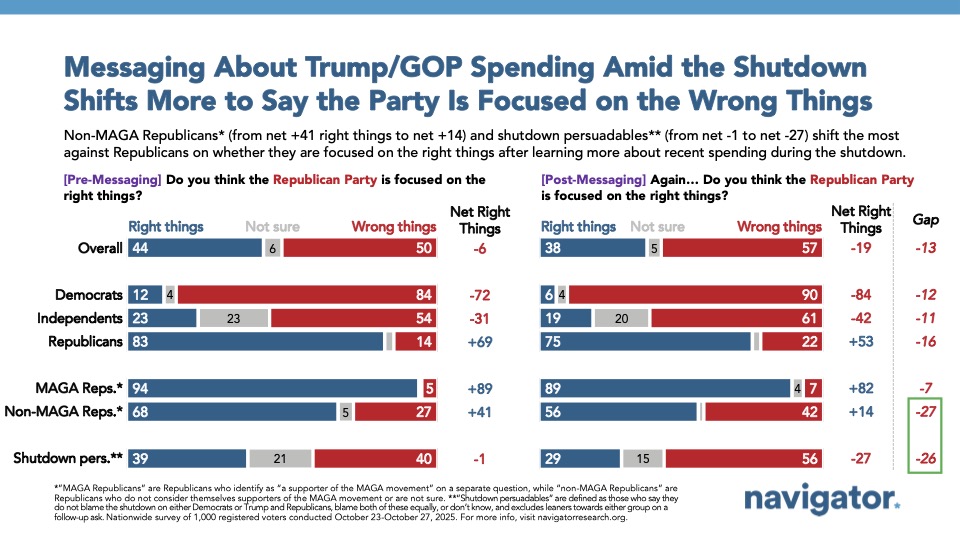
After messaging, Americans move from believing Republicans in Congress are focused on the wrong things by six points (50 percent wrong things – 44 percent right things) to believing they are focused on the wrong things by 19 points (57 percent wrong things – 38 percent right things), with 61 percent of independents believing they are focused on the wrong things.

Bar charts from Navigator Research. Title: Majorities Agree With Democratic Messaging Highlighting Trump and GOP Spending and Health Care Concerns in Shutdown

Read More

June 10, 2026

America at 250: The State of Our Union

This Navigator Research Report explores that gap between the way America is being celebrated and portrayed by this administration, and the America people believe in.

Tina Tang & Melissa Toufanian
June 4, 2026

Americans Are Split on How Safe our Food Is

This Navigator Research report covers perceptions of food safety and the health and wellness concerns that are top of mind for Americans.

Maryann Cousens
June 2, 2026

SPECIAL REPORT: LGBTQ+ Americans on President Trump and the Country

This Navigator Research report covers economic sentiment among LGBTQ+ Americans and how they view President Trump’s job performance across a range of issues.

Maryann Cousens & Tina Tang
May 22, 2026

Americans Want Major Change, But Aren’t Sure if Leaders Can Deliver

This Navigator Research report covers how Americans feel about democracy, institutions, and systems and whether anyone can fix them.

Julie Alderman Boudreau

Government Shutdown Week 4: A Guide for Advocates

Poll: Government Shutdown

This Navigator Research report covers awareness of and blame for the government shutdown.

Shutdown News

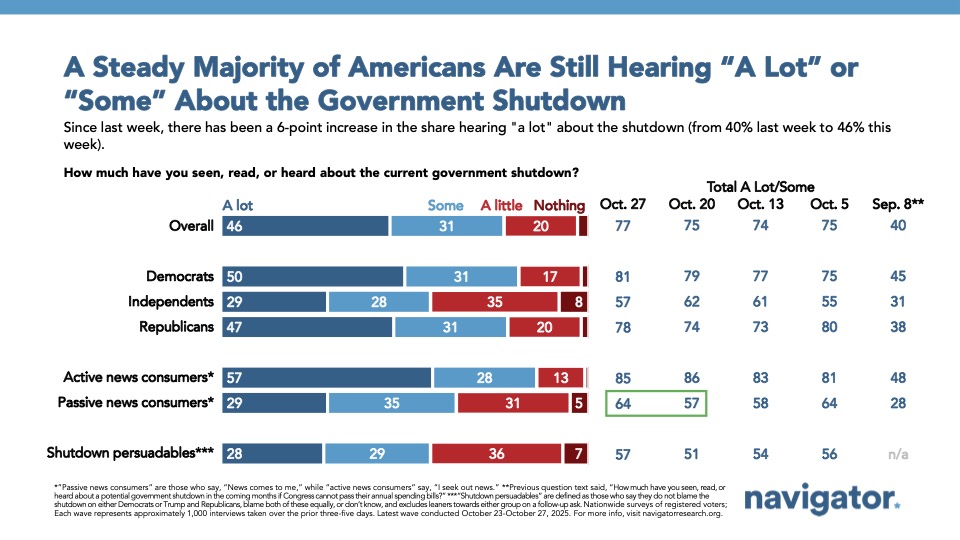
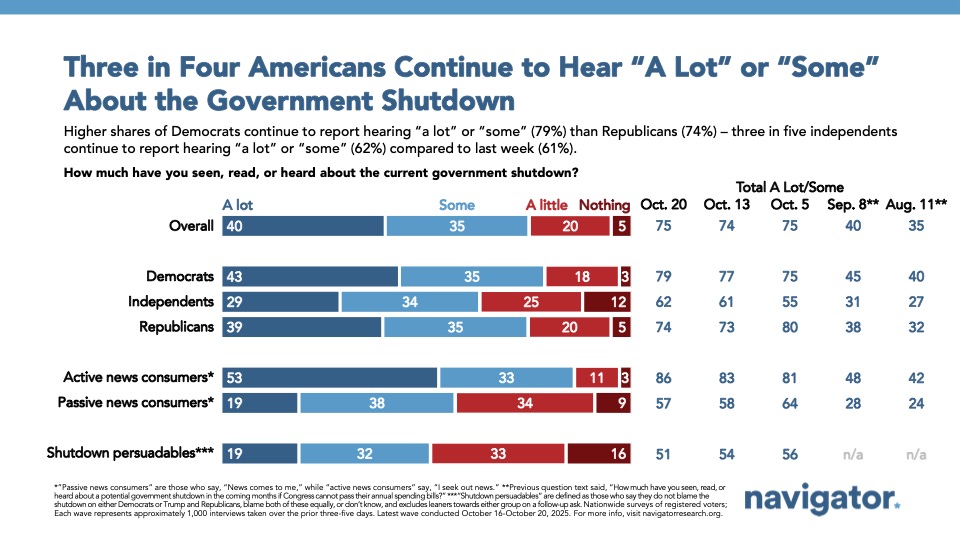
The government shutdown is still top of mind for Americans. Three quarters of respondents are hearing at least some news about the government shutdown, similar to 75 percent from our tracking last week. Awareness is slightly lower among independents at 62 percent. This week’s tracking finds a 9-point uptick in awareness among passive news consumers, 66 percent of whom have now heard a lot or some about shutdown.

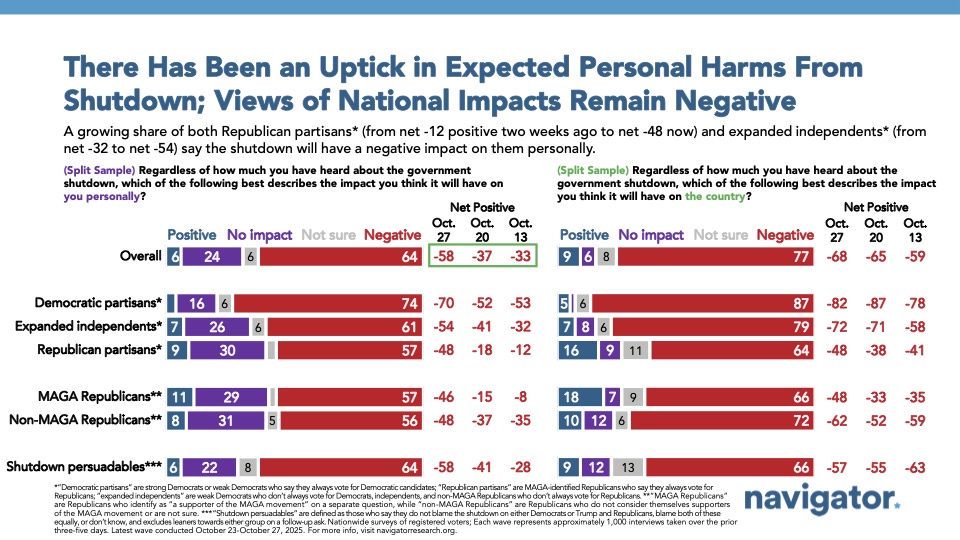
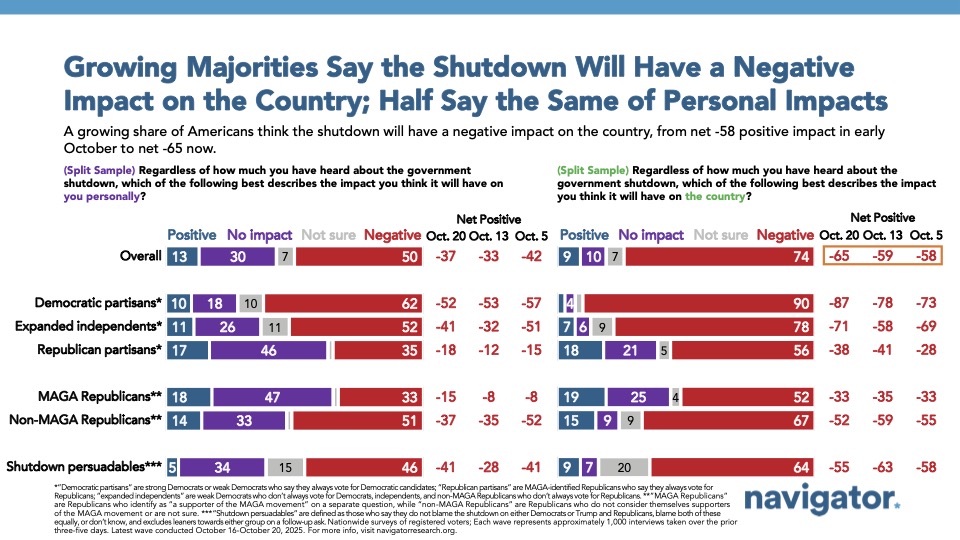
64 percent believe the shutdown will have a negative impact on them personally, up from half who thought the same last week. Even more (77 percent) believe it will have a negative impact on the country. 

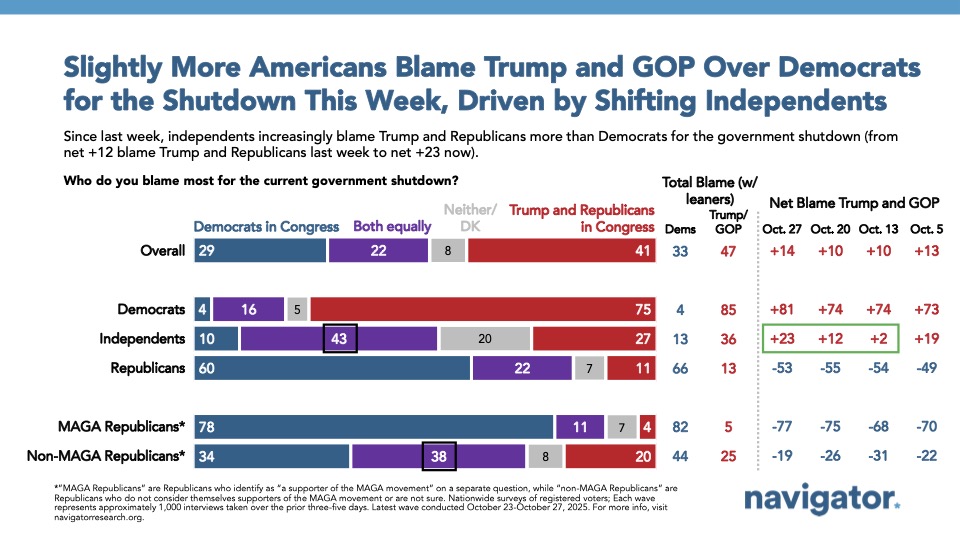
By a 14-point margin (47 percent – 33 percent), Americans blame President Donald Trump and Republicans in Congress for the government shutdown, up 4 points from our tracking last week. Independents blame Trump and Republicans over congressional Democrats by 23 points (13 percent – 36 percent), however a plurality continue to blame both parties (43 percent).

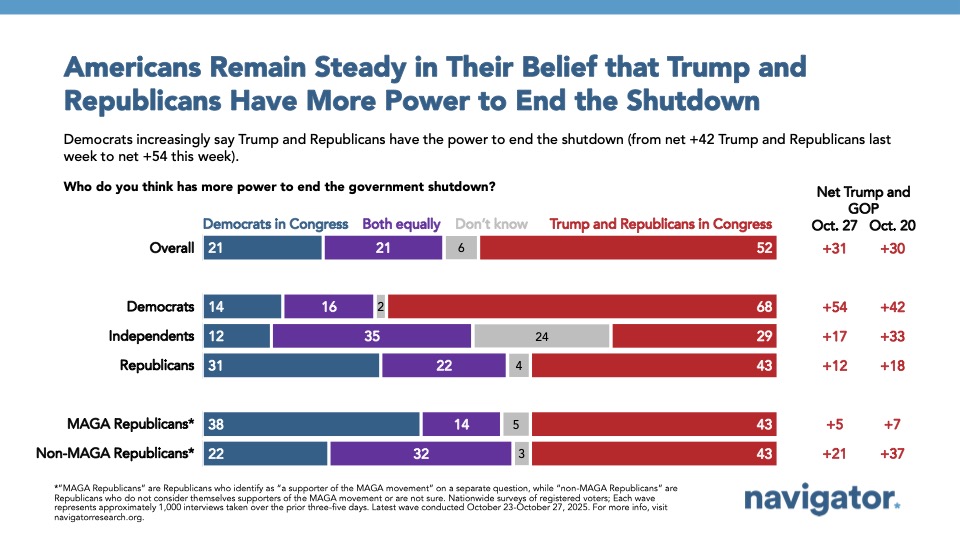
A plurality believe Trump and Republicans in Congress have the power to end the shutdown over Democrats in Congress, though a third say both have equal power to end it. When forced to choose between Trump and Republicans or Democrats, a majority say Trump and Republicans have the power to end it (52 percent – 21 percent) showing no change week over week. 

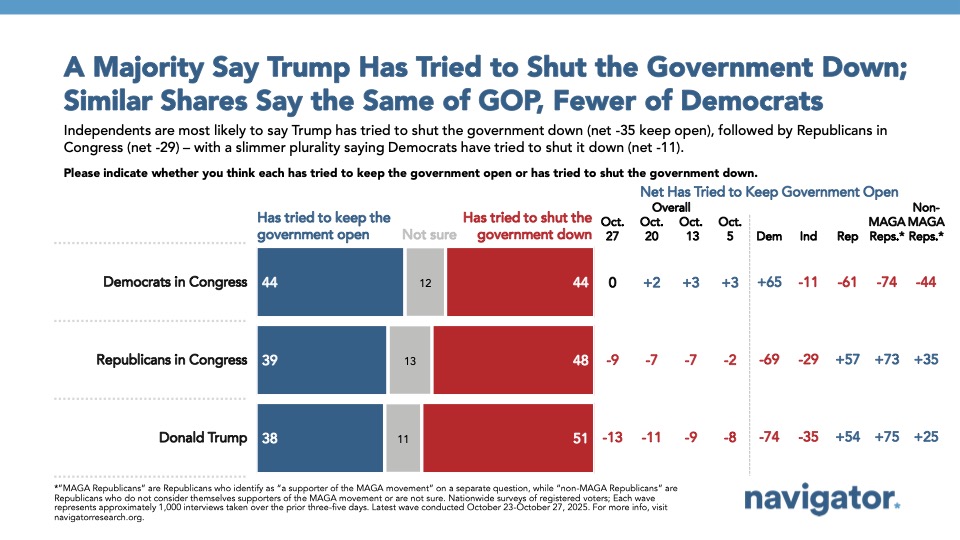
Americans see Trump and Republicans as trying to keep the government shut down. By 9 points, Americans say Republicans in Congress have tried to shut the government down, and they blame Trump by 11 points. Americans are split on whether Democrats are trying to keep the government open (44 percent open – 44 percent shut), but still give them more credit than Trump and Republicans for trying to keep the government open. 

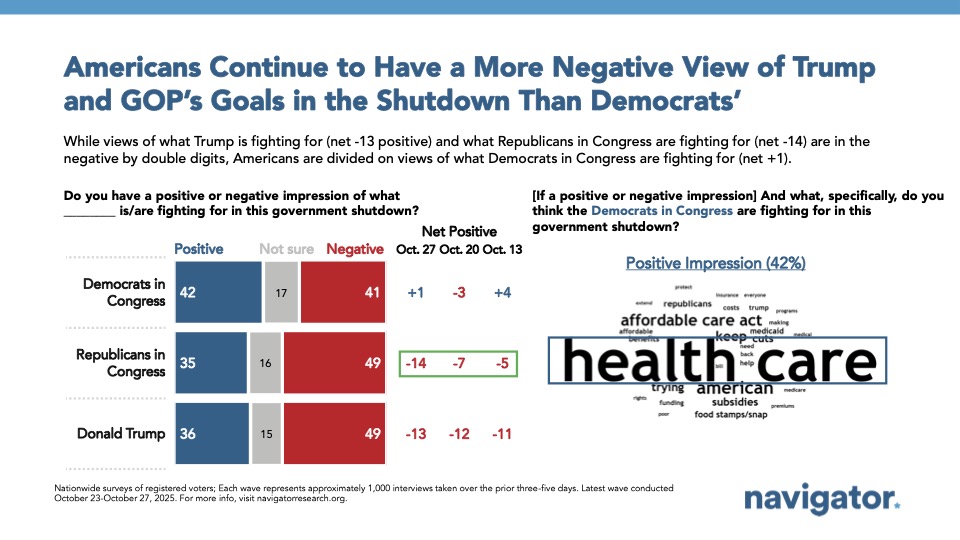
Impressions of what Democrats are fighting for in the shutdown remain mixed, while Trump and Republicans are underwater on the same metric. 42 percent have a positive impression of what Democrats in Congress are fighting for, and among those with a positive impression, health care is cited as the top positive aspect of the Democrats’ fight in the shutdown. 
Republicans in Congress, however, fare much worse on this question (-14 points underwater), doubling their negative margin on what they’re fighting for in this shutdown from last week (-7 points). Similarly to the positive sentiment for Democrats, negative sentiment for Republicans is driven by concerns over health care. Donald Trump, however, has remained stable week over week in the amount of Americans who have a negative impression of what he’s fighting for in the shutdown. 
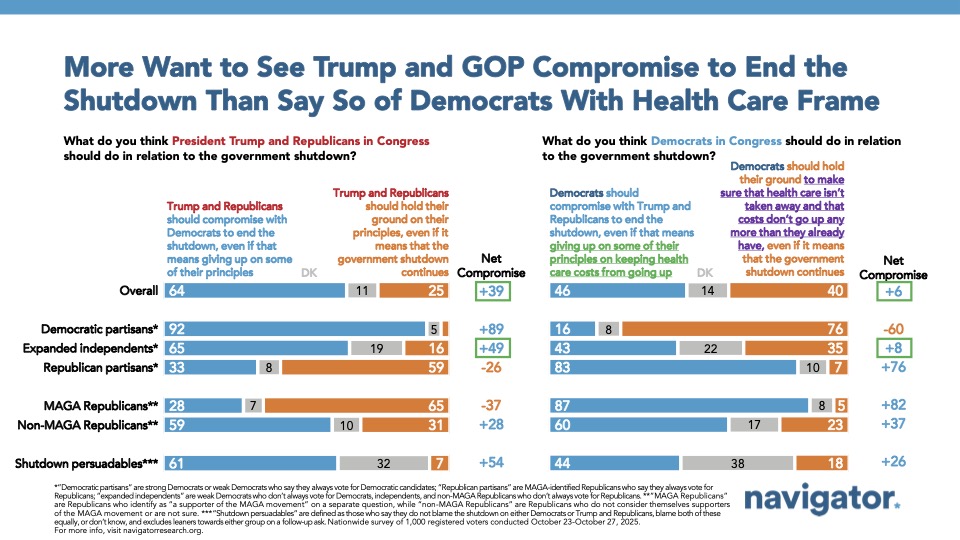
Americans have only grown in their desire for Republicans to compromise with Democrats. By 39 points (64 percent – 25 percent), Americans say Trump and Republicans should compromise with Democrats in Congress, up 9 points from last week. In contrast, Americans say Democrats should compromise with Trump and Republicans by just 6 points. 

More believe Democrats in Congress are focused on the right things by 8 points (50 percent right things – 42 percent wrong things), while Republicans in Congress are underwater on the same measure by 6 points, doubling last week’s margin (44 percent right things – 50 percent wrong things). A plurality of independents continue to think both Democrats and Republicans are focused on the wrong things.


Shutdown Stagnation, Health Care Costs, and Food Assistance Rise to Top Concerns

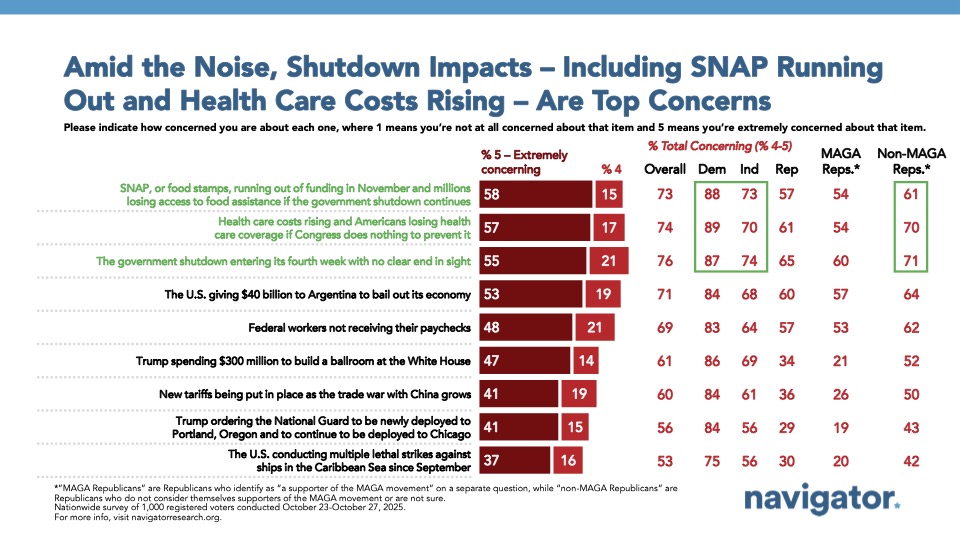
While health care costs remain a top concern for Americans, SNAP funding and the shutdown itself are equally concerning. Most Americans say they have heard “a lot” (42 percent) or “some” (30 percent) about SNAP running out of funds on November 1st if the shutdown continues. Blame for SNAP running out of funds similarly falls on Trump and Republicans in Congress by a 21-point margin. 

When looking just at top concerns on consequences of the shutdown alone, health insurance costs doubling for Americans is tied with an indefinite shutdown for the top concerns, with 80 percent of Americans being extremely or somewhat concerned. The third-highest concern is millions of children and pregnant women losing access to healthy food, at 79 percent. 


Trump hits bottom

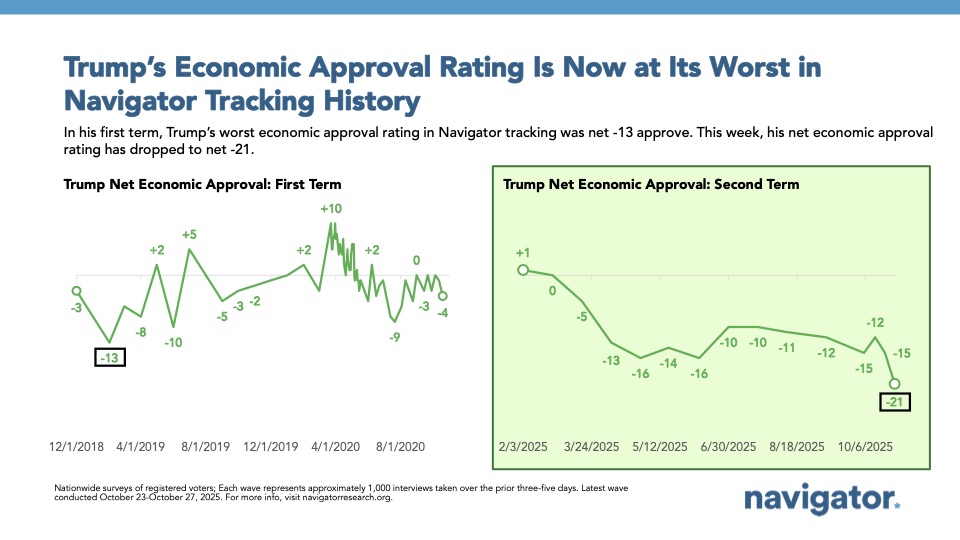
As the shutdown continues, President Trump’s overall approval rating (-16) and economic job approval (-21) remain underwater, the lowest point both of these metrics have been since the beginning of our shutdown tracking. 

While Trump has experienced low job approval ratings in the past, this is the lowest economic rating in Navigator tracking since 2018. These low numbers surpass his previous lowest economic ratings in April, following the administration’s so-called Liberation Day, when his rating was -16. 

Disapproval remained identical among Democrats but has grown among both independents (from -31 to -51) and Republicans (from +61 to +52). 

Read More

June 10, 2026

America at 250: The State of Our Union

This Navigator Research Report explores that gap between the way America is being celebrated and portrayed by this administration, and the America people believe in.

Tina Tang & Melissa Toufanian
June 8, 2026

Americans in the Battleground See Rising Costs, But Are Unsure Who Can Lower Them

This Navigator Research report covers how Americans in the battleground feel about the economy and rising costs as well as who they trust to lower them.

Julie Alderman Boudreau
June 4, 2026

Americans Are Split on How Safe our Food Is

This Navigator Research report covers perceptions of food safety and the health and wellness concerns that are top of mind for Americans.

Maryann Cousens
June 3, 2026

The Overreach Backfires: Battleground Americans Reject Abuse of Government Power

This Navigator Research report covers government weaponization, including which actions concern battleground constituents the most and how to message about them.

Julie Alderman Boudreau

Government Shutdown Week 3: Message Guidance

Government Shutdown Week 3: Message Guidance

This Navigator Research report covers the latest messaging findings around the government shutdown.

Impact Over Process

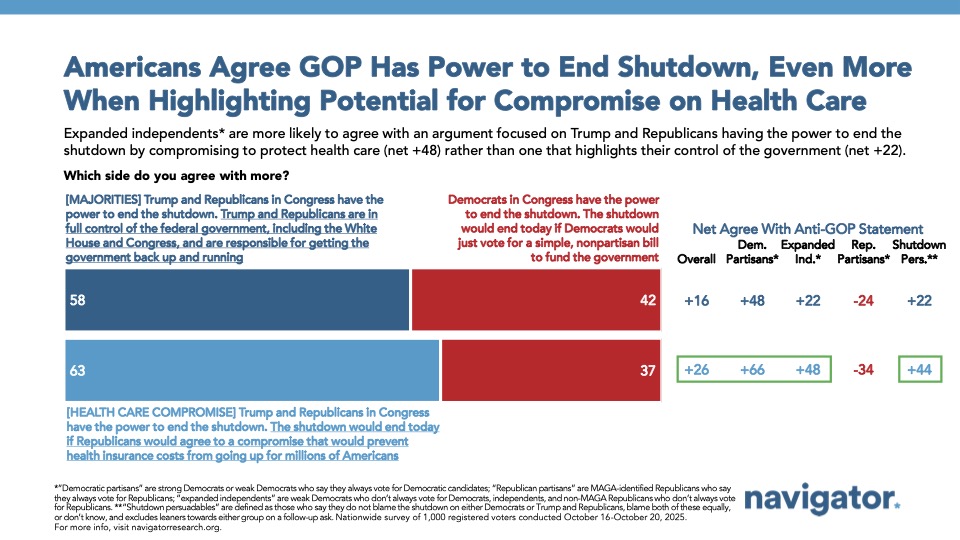
A majority of Americans agree that President Trump and Republicans in Congress have the power to end the government shutdown—but a message around Republicans agreeing to a compromise that would prevent health insurance costs going up in order to end the shutdown is overwhelmingly convincing. 

Asked which side they agree with more, by 16 points Americans agree with the message: 

  • Trump and Republicans in Congress have the power to end the shutdown. Trump and Republicans are in full control of the federal government, including the White House and Congress, and are responsible for getting the government back up and running.
As opposed to the message:

  • Democrats in Congress have the power to end the shutdown. The shutdown would end today if Democrats would just vote for a simple, nonpartisan bill to fund the government.
While this message is popular, it is less effective because it focuses on process rather than impact.

By contrast, focusing on the impact—health care—is much more powerful. When highlighting a potential compromise for health care, Americans agree that Trump and Republicans in Congress have the power to end the shutdown by 26 points, including among soft partisans by 48 points. This represents a 10-point net shift among all Americans and a 26-point shift among independents.

  • Trump and Republicans in Congress have the power to end the shutdown. The shutdown would end today if Republicans would agree to a compromise that would prevent health insurance costs from going up for millions of Americans.
Bar Chart: Americans Agree GOP Has Power to End Shutdown, Even More When Highlighting Potential for Compromise on Health Care

Messaging About Health Care Subsidies

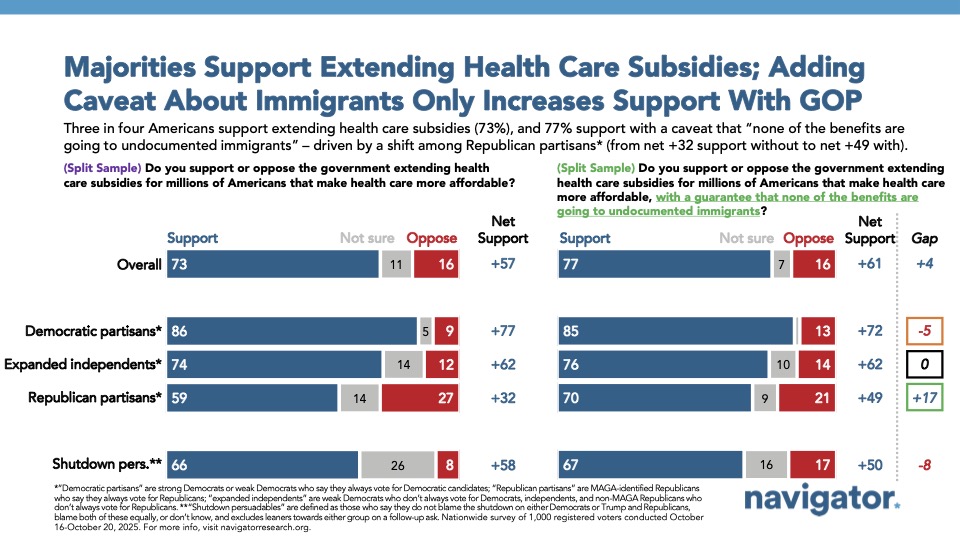
Majorities across partisanship support the government extending health care subsidies for millions of Americans (73 percent support – 16 percent oppose). When framed with the caveat that none of the benefits would go to undocumented immigrants, support remained the same, with a slight increase in Republican support (from +32 to +49), but no shift among independents. 

Bar Chart: Majorities Support Extending Health Care Subsidies, Adding Caveat About Immigrants Only Increases Support With GOP

Reminder

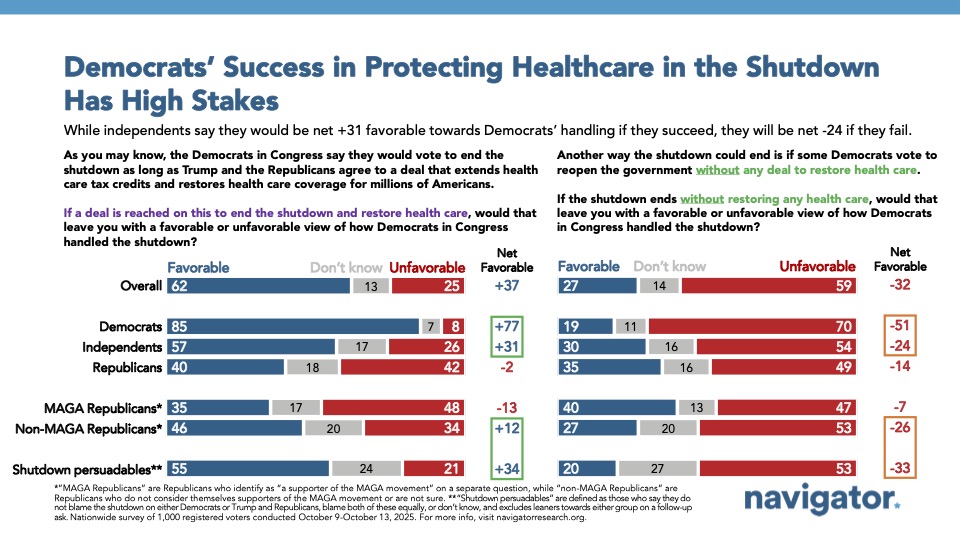
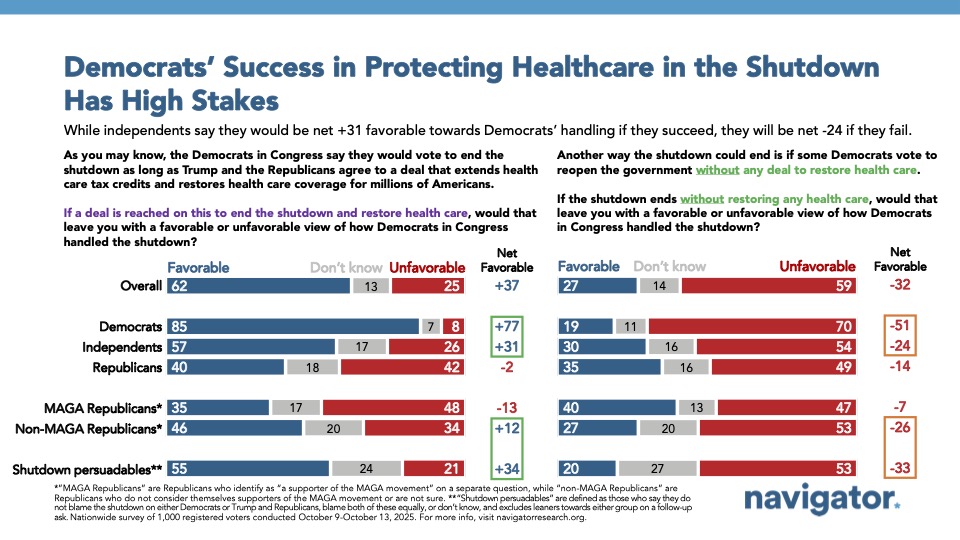
If the shutdown ends without restoring any health care, Americans will have a negative view of how Democrats in Congress handled the shutdown situation by 32 points. Conversely, if a deal is reached to end the shutdown and restore health care, Americans will view how Democrats in Congress handled the shutdown positively by 37 points.

Bar Chart: Democrats' Success in Protecting Healthcare in the Shutdown Has High Stakes

Read More

June 10, 2026

America at 250: The State of Our Union

This Navigator Research Report explores that gap between the way America is being celebrated and portrayed by this administration, and the America people believe in.

Tina Tang & Melissa Toufanian
June 4, 2026

Americans Are Split on How Safe our Food Is

This Navigator Research report covers perceptions of food safety and the health and wellness concerns that are top of mind for Americans.

Maryann Cousens
June 2, 2026

SPECIAL REPORT: LGBTQ+ Americans on President Trump and the Country

This Navigator Research report covers economic sentiment among LGBTQ+ Americans and how they view President Trump’s job performance across a range of issues.

Maryann Cousens & Tina Tang
May 22, 2026

Americans Want Major Change, But Aren’t Sure if Leaders Can Deliver

This Navigator Research report covers how Americans feel about democracy, institutions, and systems and whether anyone can fix them.

Julie Alderman Boudreau

Government Shutdown Week 3: A Guide for Advocates

Poll: Government Shutdown

This Navigator Research report covers awareness of and blame for the government shutdown.
Shutdown News

The government shutdown continues to dominate the negative news Americans are hearing about President Trump, as well as Democrats and Republicans in Congress. Three quarters (75 percent) are hearing at least some news about the government shutdown, slightly lower among independents (62 percent) and passive news consumers (57 percent).

Bar charts from Navigator Research. Title: Three in Four Americans Continue to Hear “A Lot” or “Some” About the Government Shutdown

Half of Americans believe the government shutdown will have a negative impact on them personally, up from 42 percent last week. Even more (74 percent) believe it will have a negative impact on the country.

Bar charts from Navigator Research. Title: Growing Majorities Say the Shutdown Will Have a Negative Impact on the Country; Half Say the Same of Personal Impacts

Shutdown Blame

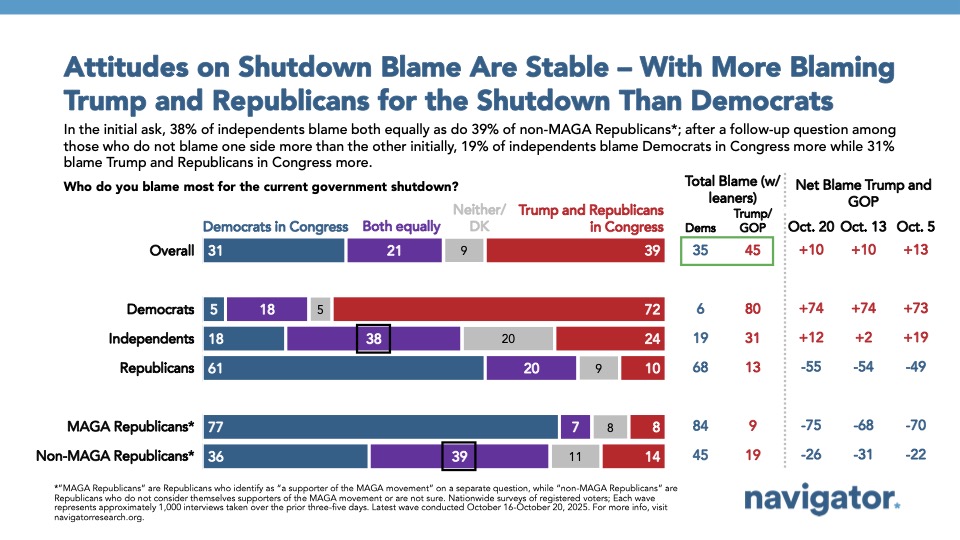
By a 10-point margin, Americans blame Donald Trump and Republicans in Congress (45 percent – 35 percent) for the government shutdown. The margin is unchanged from our tracking last week.
Bar charts from Navigator Research. Title: Attitudes on Shutdown Blame Are Stable – With More Blaming Trump and Republicans for the Shutdown Than Democrats

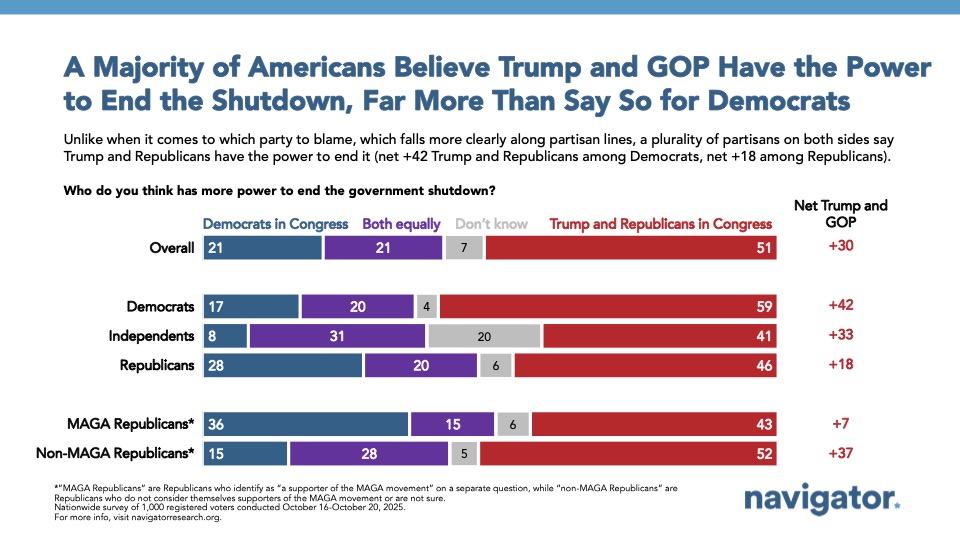
A plurality believe Trump and Republicans in Congress have the power to end the shutdown over Democrats in Congress, though a third say both have equal power to end it. When forced to choose between Trump and Republicans or Democrats, a majority say Trump and Republicans have the power to end it (51 percent – 21 percent).

Bar charts from Navigator Research. Title: A Majority of Americans Believe Trump and GOP Have the Power to End the Shutdown, Far More Than Say So for Democrats

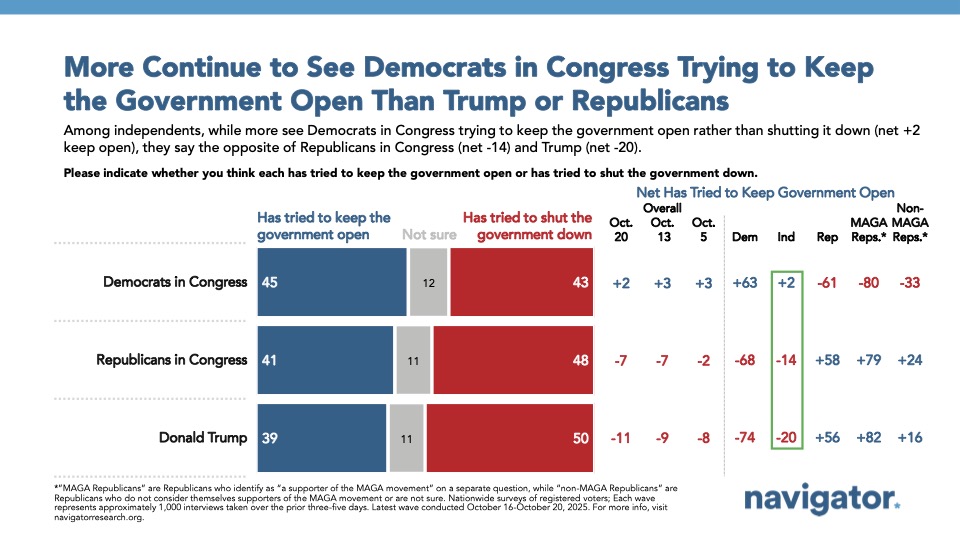
Asked who is trying to keep the government open vs. shut it down, more cast blame on Trump and Republicans in Congress than on Democrats in Congress. Slightly more say Democrats are trying to keep the government open (+2), while more say Republicans in Congress (-7) and Trump are trying to keep it shut (-11). While this is a marginal shift from last week, Americans are more likely now than three weeks ago to say Republicans in Congress and Trump have tried to shut the government down.

Bar charts from Navigator Research. Title: More Continue to See Democrats in Congress Trying to Keep the Government Open Than Trump or Republicans

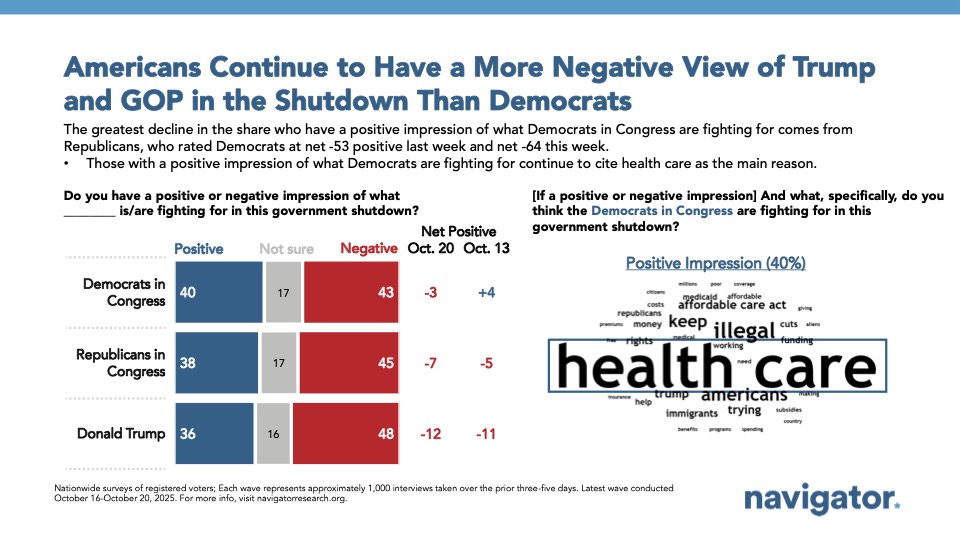
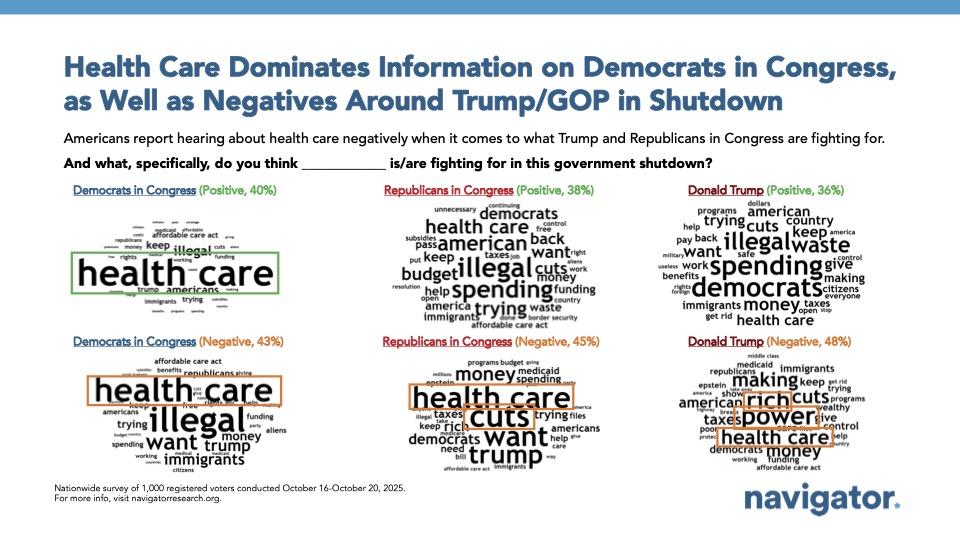
Yet both parties’ motivation for a shut down are viewed negatively. By 3 points, Americans have a negative view of what Democrats in Congress are fighting for in the shutdown. Favorable views are dominated by Democrats’ position on health care.
Bar charts and word cloud from Navigator Research. Title: Americans Continue to Have a More Negative View of Trump and GOP in the Shutdown Than Democrats

By 7 points, Americans have a negative view of what Republicans in Congress are fighting for. Those views are also dominated by health care – specifically cuts.

Donald Trump fares worse than either party in Congress on this question. By a 12-point margin, half (48 percent) have a negative view of what Donald Trump is fighting for in the shutdown. Negative views are dominated by “rich,” “power,” and “ health care cuts.”

Word clouds from Navigator Research. Title: Health Care Dominates Information on Democrats in Congress, as Well as Negatives Around Trump/GOP in Shutdown

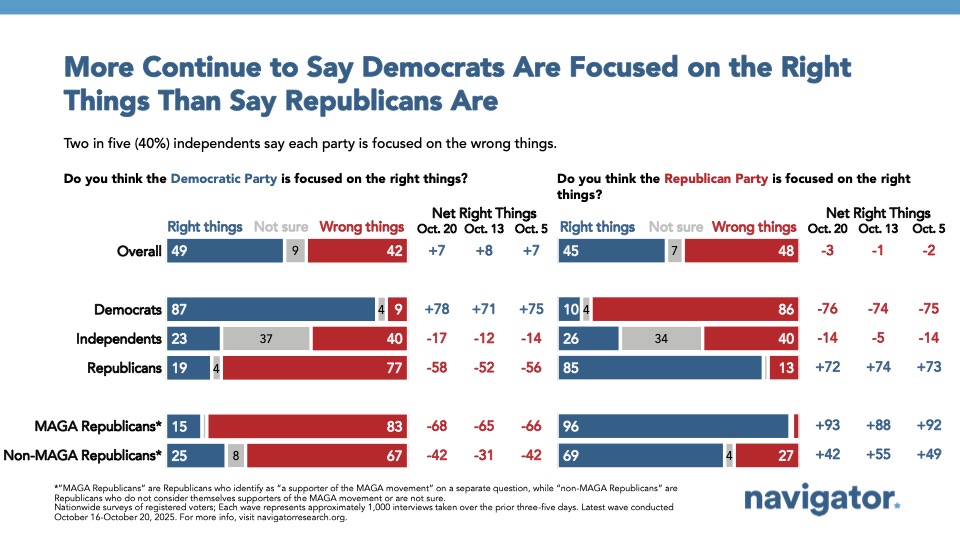
When asked about priorities, more believe Democrats in Congress are focused on the right things by 7 points (49 percent right things – 42 percent wrong things), while Republicans in Congress are underwater on the same measure by 3 points (45 percent right things – 48 percent wrong things). A plurality of independents think both Democrats and Republicans are focused on the wrong things.

Bar charts from Navigator Research. Title: More Continue to Say Democrats Are Focused on the Right Things Than Say Republicans Are

Of Everything Going On Right Now, Health Care Is Top Concern

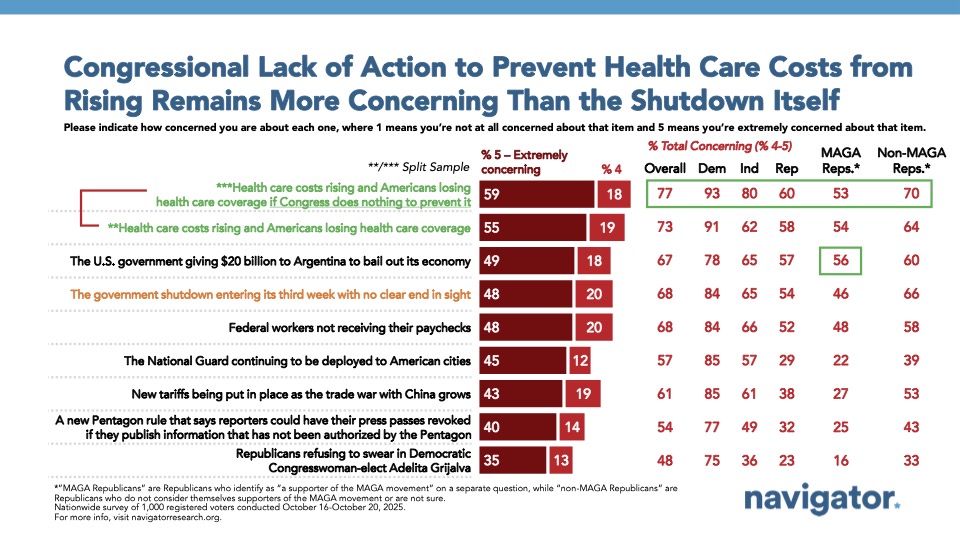
Among a list of things Americans might be concerned about, they are most concerned about health care costs rising and Americans losing health care coverage if Congress does nothing to prevent it. This concern is shared by majorities across party lines, including 60 percent of Republicans.

Bar charts from Navigator Research. Title: Congressional Lack of Action to Prevent Health Care Costs from Rising Remains More Concerning Than the Shutdown Itself

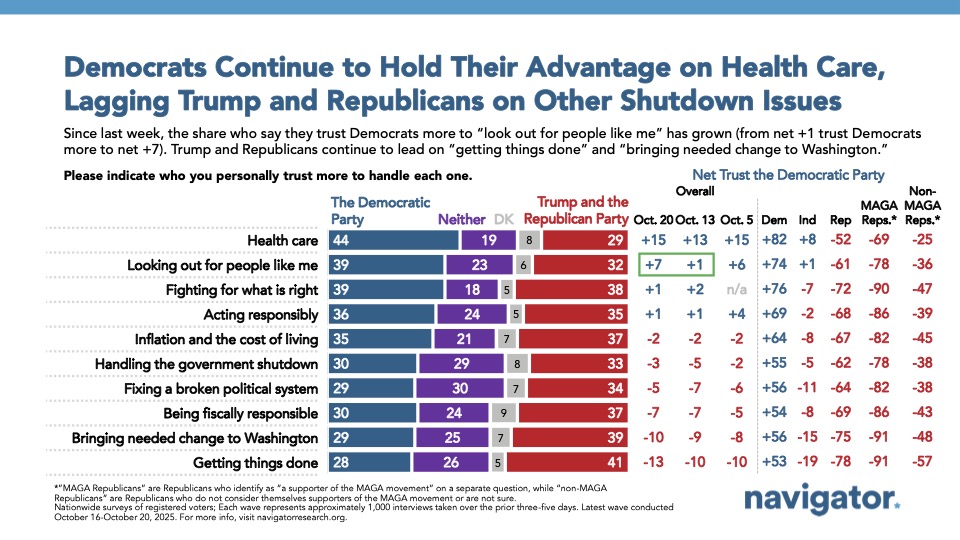
At a time when Democrats are somewhat less trusted than Republicans on a variety of traits, Democrats remain trusted on health care by 15 points.

Bar charts from Navigator Research. Title: Democrats Continue to Hold Their Advantage on Health Care, Lagging Trump and Republicans on Other Shutdown Issues

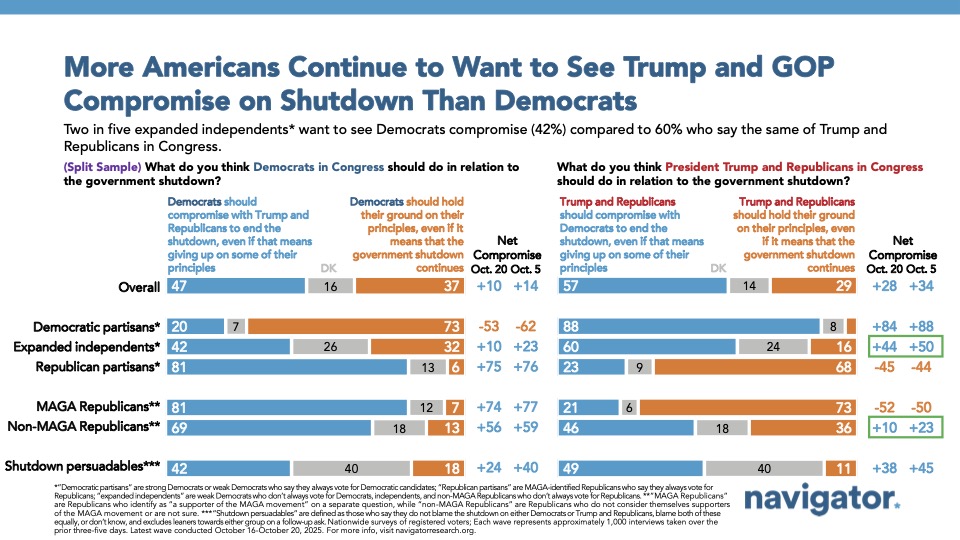
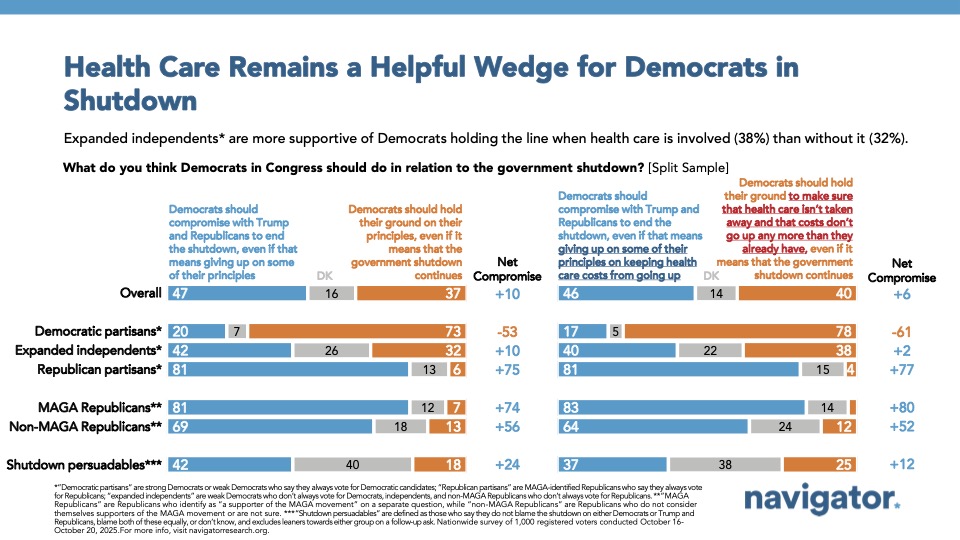
More say Trump and Republicans should compromise with Democrats than the reverse. By 28 points (57 percent – 29 percent) Americans say Trump and Republicans should compromise with Democrats in Congress. But just by 10 points do Americans say Democrats should compromise with Trump and Republicans.

Bar charts from Navigator Research. Title: More Americans Continue to Want to See Trump and GOP Compromise on Shutdown Than Democrats

Asked whether Democrats in Congress should compromise to end the shutdown or hold to their principles, Americans say Democrats should compromise by 10 points.

Democrats should compromise with Trump and Republicans to end the shutdown, even if that means giving up on some of their principles.

Democrats should hold their ground on their principles, even if it means that the government shutdown continues.

Bar charts from Navigator Research. Title: Health Care Remains a Helpful Wedge for Democrats in Shutdown

The Toll on Trump

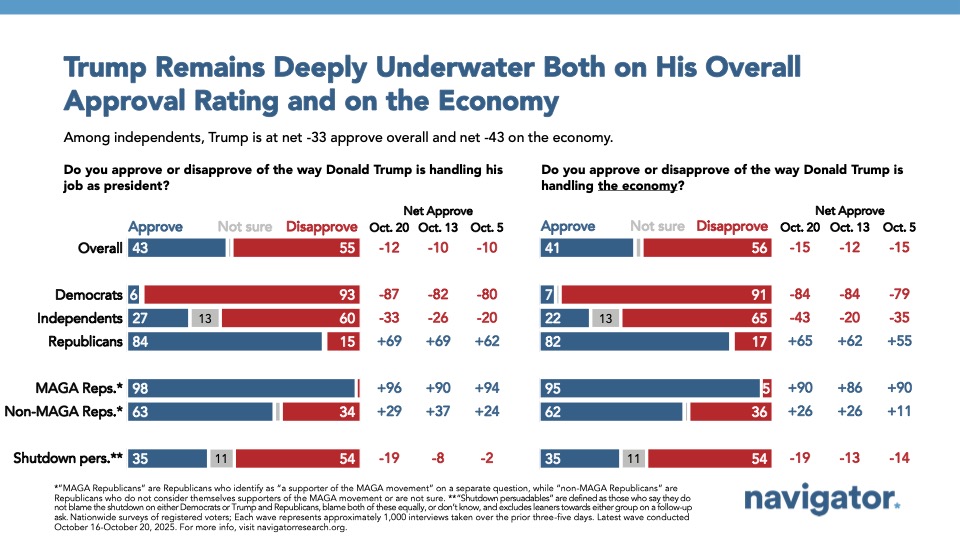
As the shutdown continues, President Trump’s overall approval rating (-12) and economic job approval (-15) remain underwater, nearly identical to where his ratings were two weeks ago.

Economic sentiment also remains consistently negative, with 59 percent feeling uneasy about their personal financial situation and 68 percent rating the economy negatively.

Bar charts from Navigator Research. Title: Trump Remains Deeply Underwater Both on His Overall Approval Rating and on the Economy

Read More

June 10, 2026

America at 250: The State of Our Union

This Navigator Research Report explores that gap between the way America is being celebrated and portrayed by this administration, and the America people believe in.

Tina Tang & Melissa Toufanian
June 8, 2026

Americans in the Battleground See Rising Costs, But Are Unsure Who Can Lower Them

This Navigator Research report covers how Americans in the battleground feel about the economy and rising costs as well as who they trust to lower them.

Julie Alderman Boudreau
June 4, 2026

Americans Are Split on How Safe our Food Is

This Navigator Research report covers perceptions of food safety and the health and wellness concerns that are top of mind for Americans.

Maryann Cousens
June 3, 2026

The Overreach Backfires: Battleground Americans Reject Abuse of Government Power

This Navigator Research report covers government weaponization, including which actions concern battleground constituents the most and how to message about them.

Julie Alderman Boudreau

Government Shutdown Week 2: Fighting for Health Care

Poll: Government Shutdown

This Navigator Research report covers the most concerning consequences of the government shutdown and how to talk about health care costs in relation to the budget.

Blame and Awareness

Reminder: our latest polling found Americans blame Donald Trump and Republicans in Congress over Democrats for the government shutdown by a 10-point margin. News of the shutdown continues to break through, as 74 percent say they have heard “some” or “a lot” about it.

Shutdown Consequences

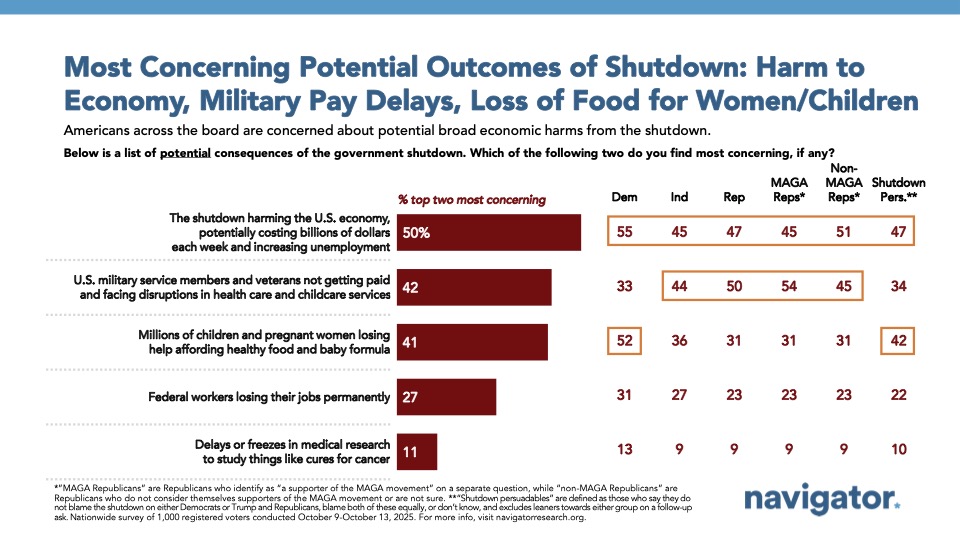
50 percent of Americans are concerned about the potential harm the government shutdown could inflict on the economy, potentially costing billions of dollars each week and increasing unemployment. Of the shutdown impacts that have already happened, 61 percent are concerned millions did not receive their paychecks on time, including 70 percent of Democrats, 55 percent of Republicans, and 51 percent of independents.

Bar charts from Navigator Research. Title: Most Concerning Potential Outcomes of Shutdown: Harm to Economy, Military Pay Delays, Loss of Food for Women/Children

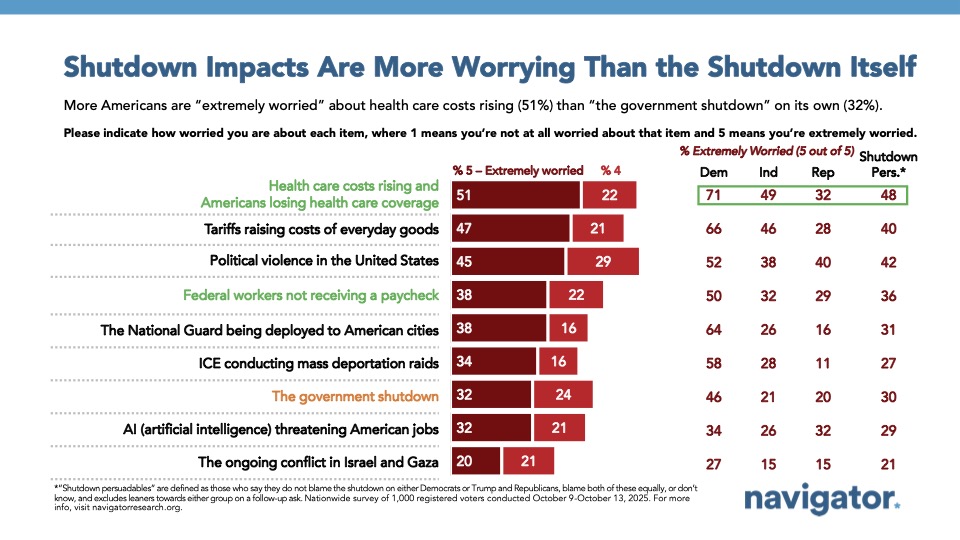
Costs – for health care and for daily goods – are also top-tier shutdown worries. Three quarters are worried about health care costs rising and Americans losing health care coverage (73 percent), including 51 percent who are “extremely” worried. Over two thirds are concerned about tariffs raising costs of everyday goods, including 47 percent who are “extremely” worried.

Bar charts from Navigator Research. Title: Shutdown Impacts Are More Worrying Than the Shutdown Itself

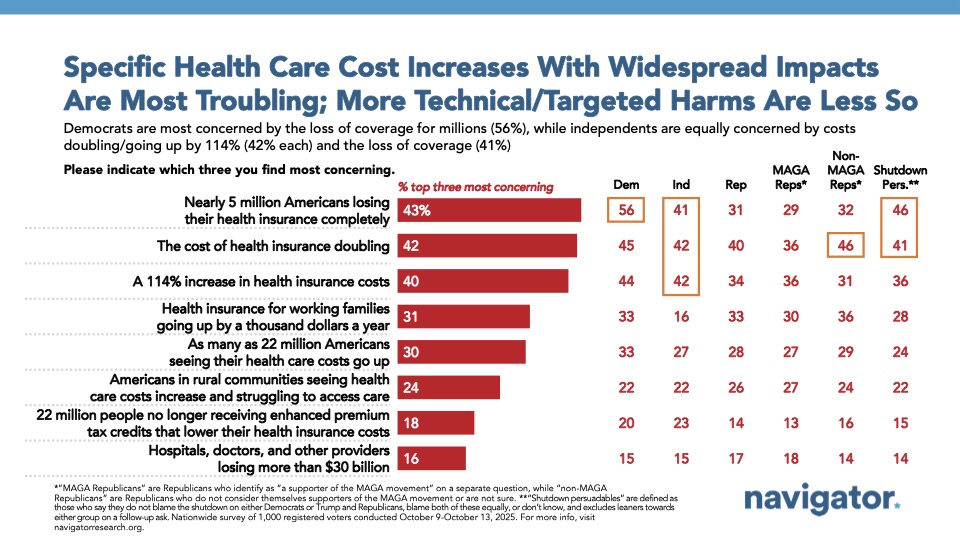
“A 114% increase in health insurance costs” is the most concerning potential outcome of Republicans in Congress’s budget (76 percent concerning, including 60 percent “extremely” concerning), followed closely by “nearly 5 million Americans losing their health insurance completely” (74 percent concerning, including 60 percent “extremely” concerning).

Bar charts from Navigator Research. Title: Specific Health Care Cost Increases With Widespread Impacts Are Most Troubling; More Technical/Targeted Harms Are Less So

Not only are health care costs one of the most worrying shutdown consequences, it’s seen as a top reason to keep fighting. Americans–across party lines–overwhelmingly think the government should extend health care tax credits and subsidies, regardless of how it’s framed. Seven in ten say we should extend health care subsidies (75 percent) and extend tax credits for health care (72 percent). This is true for a majority receiving health insurance through the government, like Medicare and Medicaid and the VA, as well as those who have private insurance or are uninsured.

Americans say the most important priorities in the shutdown are stopping health care cuts and increases in health care costs, specifically cuts to Medicaid and the Affordable Care Act (41 percent).

Bar charts from Navigator Research. Title: Blocking Cuts to Health Care and Increases in Health Care Costs Are Most Important Priorities for Democrats in Congress

It’s essential the shutdown be explained in terms of an outcome – specifically the widely-held view that health care costs should not go up further. A 62 percent majority say they would view Democrats in Congress more favorably if they are able to reach a deal and restore health care, this includes a majority of independents and shutdown persuadables. Democrats in particular say they would view the party very favorably (54 percent) if this were the result.

Bar charts from Navigator Research. Title: Democrats’ Success in Protecting Healthcare in the Shutdown Has High Stakes

The opposite is true if the shutdown ends without restoring health care, as 59 percent of Americans say they would view Democrats in Congress unfavorably if the government were to reopen without any deal.

Read More

June 10, 2026

America at 250: The State of Our Union

This Navigator Research Report explores that gap between the way America is being celebrated and portrayed by this administration, and the America people believe in.

Tina Tang & Melissa Toufanian
June 8, 2026

Americans in the Battleground See Rising Costs, But Are Unsure Who Can Lower Them

This Navigator Research report covers how Americans in the battleground feel about the economy and rising costs as well as who they trust to lower them.

Julie Alderman Boudreau
June 4, 2026

Americans Are Split on How Safe our Food Is

This Navigator Research report covers perceptions of food safety and the health and wellness concerns that are top of mind for Americans.

Maryann Cousens
June 3, 2026

The Overreach Backfires: Battleground Americans Reject Abuse of Government Power

This Navigator Research report covers government weaponization, including which actions concern battleground constituents the most and how to message about them.

Julie Alderman Boudreau